Speech and Audio Understanding in Multimodal Large Language Models: How AI Listens
 Aug, 10 2026
For years, artificial intelligence treated hearing as a separate skill from thinking. You had one tool to transcribe audio and another to understand the text it produced. That separation is gone. Today's Multimodal Large Language Models are learning to listen, analyze soundscapes, and reason about what they hear all at once. This shift isn't just about faster voice assistants; it’s about systems that can interpret tone, background noise, and spoken language with human-like context awareness.
We are standing on the edge of a new era where voice-first interaction becomes the standard interface for complex tasks. From processing hours of meeting recordings in seconds to distinguishing between a command and background chatter, these models are redefining how we interact with technology. Let’s look at how this works under the hood and why it matters for developers and users alike.
How AI Actually "Hears": The Technical Architecture
You might wonder how a model trained primarily on text suddenly understands audio. The secret lies in translation-not of language, but of data format. Sound is continuous and temporal, meaning it flows endlessly over time. A mere 30-second clip sampled at 16,000 Hz contains 480,000 individual data points. Feeding that raw stream directly into a transformer model would be computationally impossible.
To solve this, engineers convert audio into spectrograms. Think of a spectrogram as a visual map of sound. The process slices the long audio signal into tiny overlapping windows, usually around 25 milliseconds each. Then, Fast Fourier Transforms extract frequency information from those windows. These frequencies are mapped onto the mel scale, which mimics human hearing by giving more resolution to lower frequencies where our ears are most sensitive.
Once the audio is a spectrogram, the model treats it like an image. It divides the spectrogram into patches, similar to how vision models process photos. The architecture typically involves three main parts:
- The Audio Encoder: Processes the input audio and creates dense embeddings (numerical representations) of the sound.
- The Modality Adapter: Acts as a bridge, translating those audio embeddings into the same latent space used by the pretrained large language model (LLM).
- The Pretrained LLM: Takes the combined text and audio tokens and generates the final output.
This modular approach allows existing powerful language models to gain hearing capabilities without being rebuilt from scratch. The audio features are injected into the LLM either as soft prompts or through cross-attention mechanisms within the transformer blocks.
Integration Methods: SALM vs. BESTOW
Not all multimodal models connect audio and text in the same way. Two primary architectural approaches have emerged in recent research, each with distinct trade-offs in efficiency and performance.
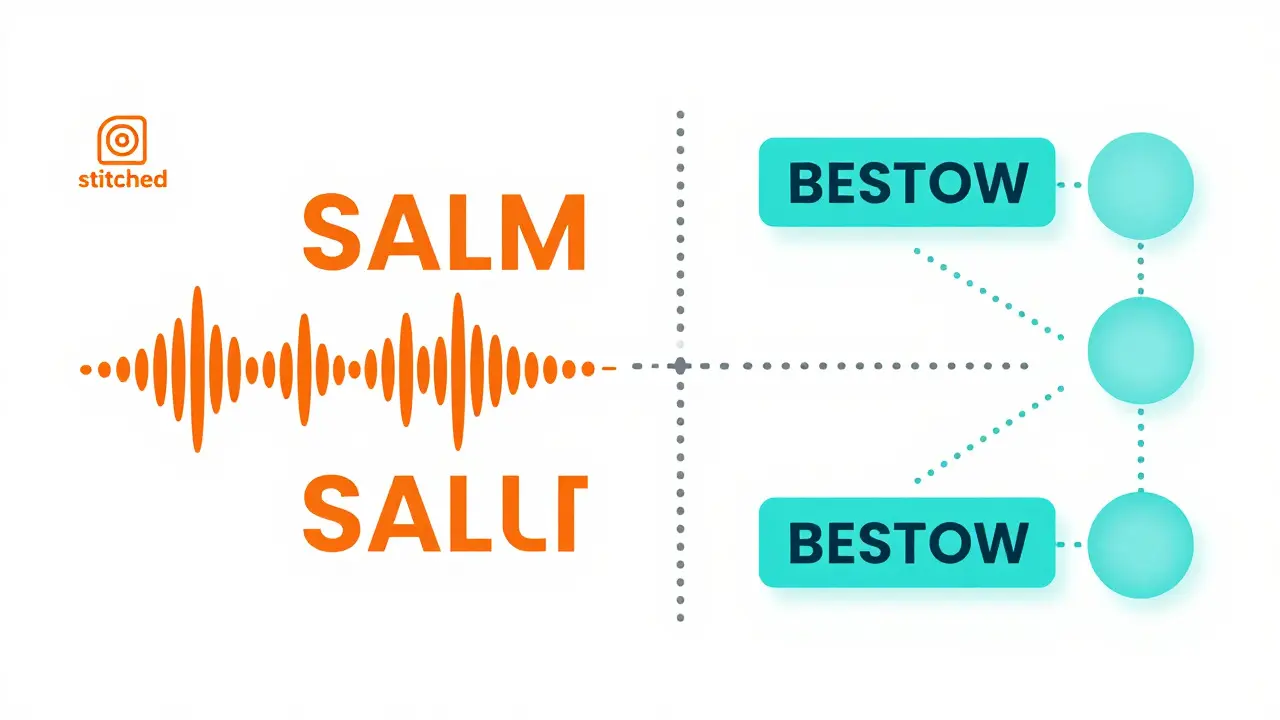
| Feature | SALM (Speech-Augmented) | BESTOW (Cross-Attention) |
|---|---|---|
| Connection Method | Concatenates speech features with text token embeddings before feeding into the LLM. | Uses cross-attention modules where text embeddings attend to speech embeddings. |
| Data Access | Direct access to speech information during generation. | Extracts task-specific information dynamically via attention. |
| Computational Cost | Higher memory usage due to concatenated sequences. | Lower cost; adds modules only before specific LLM layers. |
| Best For | Tasks requiring deep fusion of audio and text context. | Efficient inference and lightweight deployment. |
The SALM approach is straightforward: it stitches speech features directly onto the text prompt. This gives the model immediate access to auditory details when generating responses. On the other hand, the BESTOW model takes a more nuanced route. By using cross-attention, the text side "looks at" the audio side to pull out exactly what it needs for the task. This minimizes computational overhead, making it attractive for real-time applications where latency matters.
Training Paradigms: Learning from Real and Synthetic Data
Building a model that understands audio requires massive amounts of diverse data. Training paradigms for Large Audio-Language Models (LAMs) rely on mixing paired speech-text datasets with vast amounts of text-only data. Datasets like LibriLight and GigaSpeech provide the foundational speech-to-text pairs, while text-only corpora help transfer general language reasoning skills.
A significant innovation in this space is the use of synthetic data. Researchers have leveraged models like GPT-4 to generate realistic conversations based on textual descriptions. This synthetic data distills high-quality reasoning capabilities into multimodal models, filling gaps where real-world labeled audio is scarce. Joint instruction tuning then unifies these inputs, teaching the model to handle open-domain question answering, summarization, and reasoning over both speech and environmental sounds.
For tasks involving speech synthesis or speech-to-speech translation, training objectives include hierarchical codec tokens. These tokens preserve speaker identity and prosody-the rhythm and intonation of speech-ensuring the output doesn't sound robotic. Task tags are often added to pretraining objectives to signal whether the model should focus on Automatic Speech Recognition (ASR), Audio Scene Classification (AST), or Speech-to-Speech Translation (S2ST).
Performance Metrics: Speed and Accuracy
Theoretical architectures are impressive, but do they work in practice? Recent benchmarks show remarkable progress. In Automatic Speech Recognition, Conformer-based LAMs achieve word error rates (WER) of 0.8-1.1% on challenging datasets like LRS3. When tested on Multilingual Librispeech, these models showed an approximate 18% relative WER reduction compared to monolingual baselines, even when the underlying LLM was frozen.
Speed is equally critical for user adoption. We are seeing inference times that match human conversation speeds. For instance, GPT-4o responds to voice input in roughly 232 milliseconds. This near-instant feedback loop eliminates the awkward pauses that plagued earlier voice assistants. Meanwhile, Google's Gemini has demonstrated the ability to process an entire hour of video content in a single prompt, showcasing the scalability of these architectures for long-form media analysis.
In terms of reasoning, curriculum-augmented LAMs have substantially outperformed vanilla models on temporal reasoning tasks. They achieved scores of 0.70 on SPIDER and 0.73 on FENSE (Fact Extraction and VERification) benchmarks. This indicates that these models aren't just transcribing; they are understanding the sequence of events and logical connections within spoken narratives.
Challenges: Hallucinations and Computational Limits
Despite these advances, significant hurdles remain. One major issue is hallucination. Because LLMs are strong predictors of text, they sometimes invent audio content that isn't there, relying on their prior knowledge rather than the actual input. To combat this, researchers developed Audio-Aware Decoding (AAD). This technique uses contrastive reweighting of logits, comparing predictions made with and without audio context. If the prediction changes drastically when audio is removed, the model knows it's grounding its answer in the sound, not just guessing.
Another limitation is the sheer computational weight of processing continuous audio streams. While spectrogram conversion helps, scaling to very long sequences still demands immense memory and processing power. Efficient batch inference and prompt standardization tools, such as AU-Harness released in September 2025, aim to mitigate this by optimizing how models handle large audio batches.
Open Source Tools and Frameworks
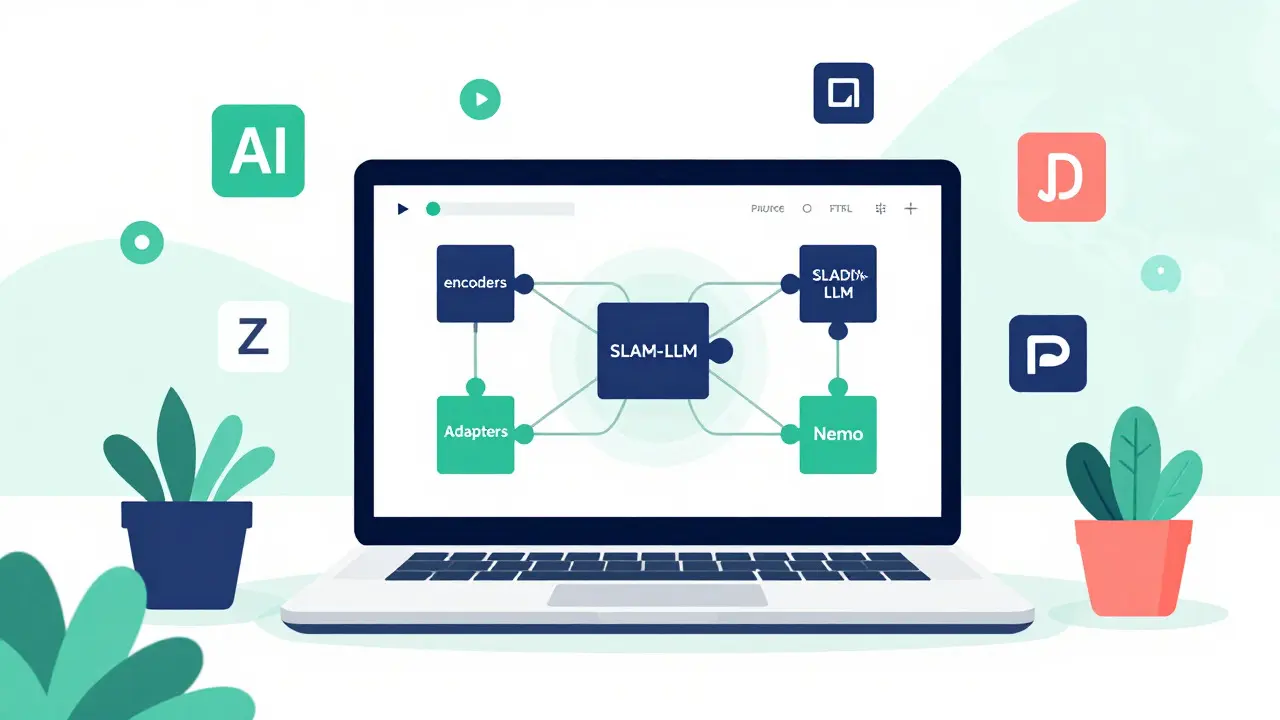
If you want to experiment with these technologies, you don't need to start from zero. The open-source community has built robust frameworks to support development. SLAM-LLM offers a modular configuration for training customized multimodal LLMs focused on speech, language, audio, and music. It allows developers to swap out encoders, projectors, and LLMs easily.
NVIDIA’s NeMo Framework provides implementations for both SALM and BESTOW architectures, complete with pre-trained models. Additionally, resources like the Awesome-Audio-LLM repository on GitHub track the latest models, including specialized ones like Typhoon2-Audio, which focuses on Thai speech and text processing. These tools democratize access to cutting-edge audio understanding, allowing researchers and engineers to build region-specific solutions, such as SeaLLMs-Audio launched in November 2025 for Southeast Asian languages.
Future Directions: Towards AGI and Beyond
The convergence of sensory channels in Multimodal Large Language Models represents a step toward Artificial General Intelligence (AGI). By enabling systems to see, hear, and read simultaneously, we move closer to AI that interacts with the world as humans do. Future priorities include improving efficiency for long-form audio, better handling rare dialects, and enhancing adversarial robustness to prevent spoofing attacks.
As these models become more integrated into daily life, expect voice-first interfaces to dominate complex workflows. Whether it's analyzing legal depositions, monitoring industrial equipment via sound patterns, or simply having natural conversations with your devices, the ability to understand audio deeply is becoming the baseline expectation for modern AI.
What is a Multimodal Large Language Model?
A Multimodal Large Language Model is an AI system that can process and understand multiple types of data inputs, such as text, images, and audio, simultaneously. Unlike traditional models that handle one modality at a time, these models integrate different sensory channels to perform complex reasoning tasks.
How do LLMs process audio data?
LLMs process audio by first converting raw sound waves into spectrograms using techniques like Fast Fourier Transform. These spectrograms are then divided into patches and processed by an audio encoder to create embeddings. A modality adapter translates these embeddings into a format the LLM can understand, allowing it to treat audio similarly to text tokens.
What is the difference between SALM and BESTOW architectures?
SALM (Speech-Augmented Language Model) concatenates speech features directly with text embeddings before feeding them into the LLM, providing direct access to audio data. BESTOW uses cross-attention mechanisms where text embeddings attend to speech embeddings, which is more computationally efficient and allows for dynamic extraction of relevant audio information.
Can multimodal models handle long audio files?
Yes, recent advancements allow models to process long audio sequences efficiently. For example, Google's Gemini can process an hour of video in a single prompt. Techniques like large strides in audio encoding and efficient batch inference help manage the computational load of long-form content.
What are the main challenges in audio understanding for AI?
Key challenges include hallucination, where the model invents audio content, and high computational costs for processing continuous audio streams. Solutions like Audio-Aware Decoding help reduce hallucinations, while optimized frameworks like NVIDIA NeMo address efficiency issues.
Is there open-source software for building audio-language models?
Yes, several open-source frameworks exist. SLAM-LLM provides modular tools for training custom multimodal models. NVIDIA's NeMo Framework offers implementations for various architectures, and repositories like Awesome-Audio-LLM on GitHub curate resources and models for developers.
How fast are current voice-enabled AI models?
Current production-ready models like GPT-4o respond to voice input in approximately 232 milliseconds. This speed matches natural human conversation rates, making real-time interaction seamless and practical for consumer applications.
What role does synthetic data play in training these models?
Synthetic data, generated by models like GPT-4 from textual descriptions, helps fill gaps in labeled audio datasets. It allows for training on high-quality, diverse conversations that may be difficult to record, effectively distilling reasoning capabilities into multimodal systems.