Stochastic Depth and Regularization in Deep Transformer-Based LLMs
 Nov, 15 2026
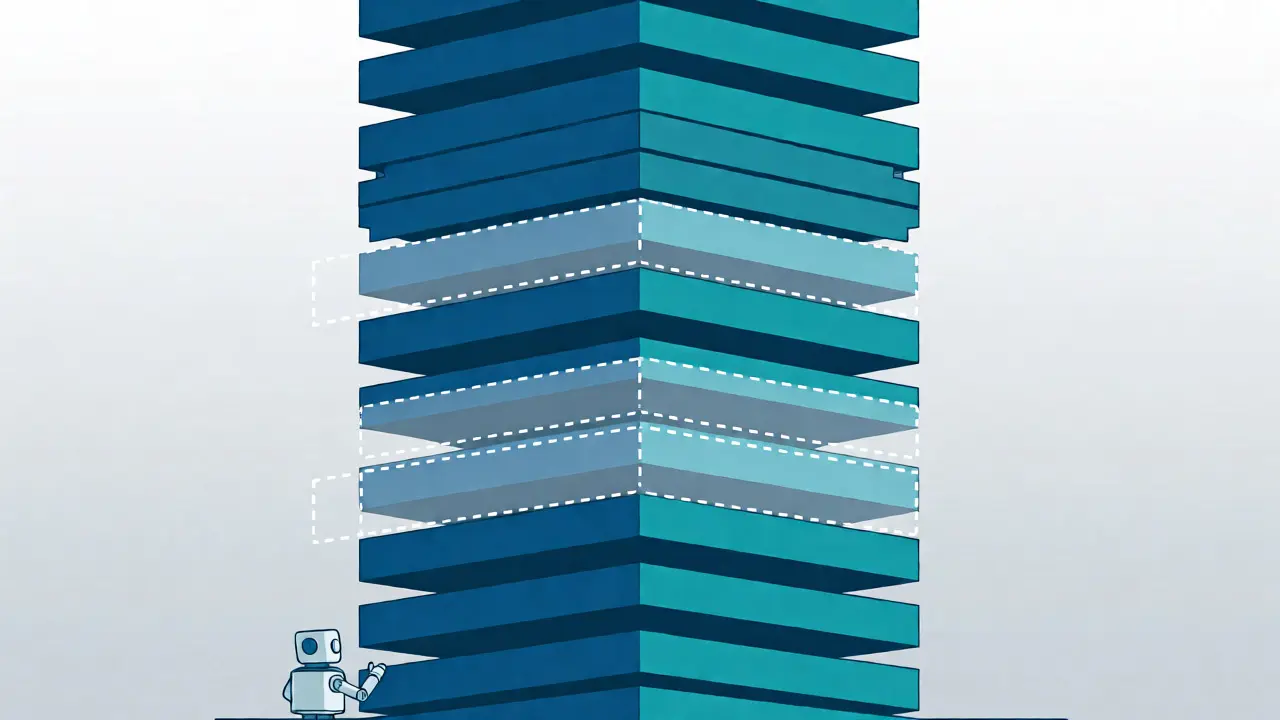
Training a massive Large Language Model (LLM) is like trying to tune an orchestra where every musician plays a different instrument, and half of them are randomly told to stop playing for a few seconds. That’s essentially what Stochastic Depth does. It’s a regularization technique that randomly drops entire layers or blocks during the forward pass of deep neural networks. This isn’t just a hack; it’s a critical strategy for keeping modern deep transformer-based large language models from overfitting and collapsing under their own weight.
If you’ve ever wondered why your model gets worse as you add more layers, or why training becomes unstable at extreme depths, this guide breaks down how stochastic depth and other regularization methods keep transformers healthy. We’ll look at the math, the practical trade-offs, and the latest research on how these techniques shape the future of AI.
What Is Stochastic Depth and Why Does It Matter?
Stochastic Depth is a method that randomly deactivates transformer blocks during training. Instead of dropping individual neurons (like standard dropout), it skips whole residual blocks. This forces the network to learn robust representations that don’t rely on any single layer being present.
Why do we need this? As transformers get deeper-think GPT-4 scale or beyond-they become harder to optimize. Deeper networks suffer from vanishing gradients and increased redundancy. Stochastic depth acts as a safety valve. By randomly skipping layers, it ensures that no single block becomes too dominant. The result? Better generalization and faster training times because skipped layers require no computation during those steps.
The theoretical backbone here is fascinating. Recent studies on neural collapse show that when transformers are trained with constant regularization strength, they naturally converge toward a collapsed state where class representations become maximally separated. Stochastic depth accelerates this process, guiding the model toward stable, optimal solutions without manual intervention.
The Trade-Off: Perplexity vs. Accuracy
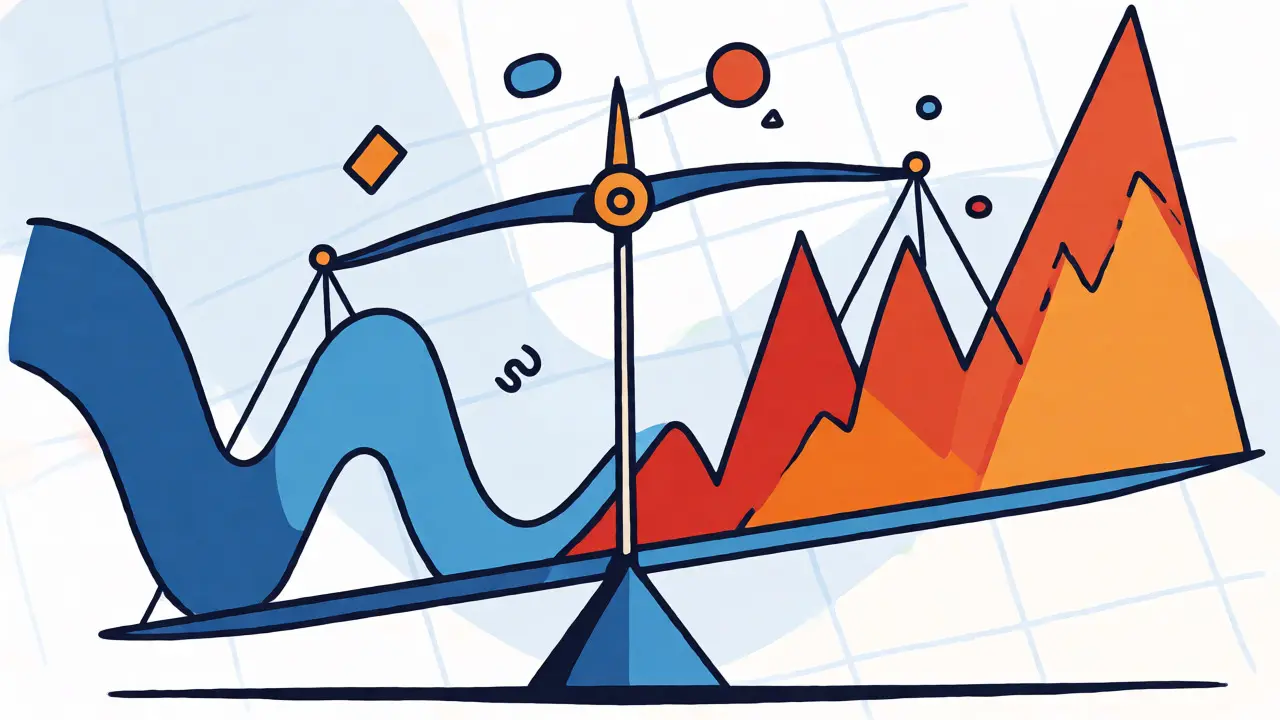
Regularization isn’t free. There’s always a cost. In transformer training, you’re constantly balancing two metrics: perplexity (how well the model predicts the next token) and accuracy on downstream tasks.
Consider ridge regularization. If you set the strength α between 0 and 10³, you might see slight improvements in perplexity, but accuracy stays flat. Crank α up to 10⁴, and accuracy jumps-but perplexity worsens. This is a classic trade-off. You can’t have both simultaneously without careful tuning.
| Regularization Type | Strength Range | Perplexity Impact | Accuracy Impact | Best Use Case |
|---|---|---|---|---|
| Ridge (L₂) | 0 < α < 10³ | Slight Improvement | No Change | General Pre-training |
| Ridge (L₂) | α = 10⁴ | Increase (Worse) | Significant Boost | Fine-tuning for Classification |
| L₁ | α = 10⁻⁴ | Increase (Worse) | Higher Boost than L₂ | Sparsity-focused Tasks |
| Stochastic Depth | Variable Drop Rate | Mixed | Improved Generalization | Deep Architectures |
This table shows why one-size-fits-all doesn’t work. If you’re building a chatbot, you care about perplexity. If you’re building a classifier, you care about accuracy. Stochastic depth sits in the middle, improving generalization by preventing over-reliance on specific paths, which often helps both metrics indirectly by making the model more robust.
Beyond Layer Dropping: Advanced Regularization Techniques
Stochastic depth is powerful, but it’s not alone. Modern LLMs use a cocktail of regularization strategies. One emerging frontier is AttentionDrop. Standard dropout ignores the unique structure of attention mechanisms. AttentionDrop operates directly on attention maps, encouraging diversity and stability. It prevents the model from becoming obsessed with particular attention pathways, which can lead to pathological specialization.
Then there’s ReplaceMe, a training-free depth pruning method. Instead of dropping layers temporarily, ReplaceMe replaces transformer blocks with learned linear operations. This preserves performance while reducing parameter count. It’s particularly effective because empirical analysis shows that appropriate regularizers improve pruned model accuracy, even if perplexity takes a hit. This is a win for deployment scenarios where inference speed matters more than raw predictive power.
A paradigm shift is also happening with Large Language Model Attribution Aligned Training (LAAT). Here, the LLM itself acts as a regularizer. LAAT aligns smaller model training dynamics with global task-specific explanations generated by larger LLMs. It uses black-box API access, so you don’t need full model weights. This approach tackles real-world issues like dataset skewness and bias by injecting high-level knowledge into the training loop.
Practical Implementation: Calibrating Drop Probabilities
So, how do you actually implement stochastic depth? The key is the drop probability schedule. A uniform drop rate across all layers is rarely optimal. Research suggests that drop probabilities should increase with depth. Earlier layers are dropped less frequently; deeper layers are dropped more often. Why? Deeper representations tend to be more redundant. They can afford to be skipped more often without catastrophic loss of information.
- Start Low: Begin with low drop rates (e.g., 0.1) in early layers.
- Scale Up: Gradually increase drop rates in deeper layers (up to 0.3-0.5).
- Validate Empirically: Test on your specific dataset. Suboptimal rates can either underutilize regularization (too low) or damage capacity (too high).
- Ramp-Up Schedules: Some practitioners find that starting with zero drop rate and ramping up during training helps stabilize early learning phases.
Be careful with extreme stochastic depth. If you drop too many layers too aggressively, especially in early training, you might interfere with attention pattern learning. The model needs time to establish basic connectivity before you start tearing down walls.

Hybrid Strategies and Computational Efficiency
Stochastic depth works best in combination with other techniques. When paired with standard methods like dropout, batch normalization, and weight decay, the effects compound rather than interfere. Stochastic depth operates at the architectural block level, while traditional regularization targets finer granularities like neuron activations or weight magnitudes. This multi-scale approach addresses overfitting from multiple angles.
The computational benefits are substantial. During training, dropped layers require no forward or backward pass computation. This means you can train genuinely deep models without proportional increases in compute cost. For inference, insights from stochastic depth training can identify expendable layers, enabling permanent pruning via methods like ReplaceMe. This two-stage process-identify then remove-achieves aggressive compression ratios while maintaining accuracy.
Current research is moving toward adaptive layer selection. Instead of random dropping based on fixed probabilities, new approaches conditionally drop layers based on input difficulty. Harder inputs keep more layers active; easier ones skip more. This dynamic allocation promises to maintain performance while further reducing computational demands.
Limitations and Future Directions
Stochastic depth isn’t a magic bullet. Applying it to specialized layers like attention mechanisms requires careful consideration. Determining optimal drop schedules often involves extensive hyperparameter search, which eats into training budgets. Additionally, convergence can take longer since effective gradients are computed on subsets of the network in any given step.
Understanding how stochastic depth affects scaling laws is still an open question. Early evidence suggests it shifts scaling curves favorably, allowing better generalization at fixed model sizes. But comprehensive characterization across billions to trillions of parameters is ongoing. If you’re working with cutting-edge LLMs, expect to experiment heavily with drop rates and schedules.
Does stochastic depth slow down training?
Paradoxically, it can speed up training per epoch because fewer layers are computed. However, it may require more total epochs to converge due to the noisy gradient signals. The net effect depends on your hardware and implementation efficiency.
Can I use stochastic depth during inference?
No. Stochastic depth is strictly a training-time technique. During inference, all layers are active to ensure maximum capacity and deterministic outputs.
How does stochastic depth differ from dropout?
Dropout randomly zeros out individual neurons within a layer. Stochastic depth randomly bypasses entire residual blocks or layers. Stochastic depth is coarser-grained and specifically designed to handle the optimization challenges of very deep networks.
Is stochastic depth compatible with LoRA fine-tuning?
Yes, but with caution. Since LoRA freezes base weights, stochastic depth’s regularization effect on the base model is limited. It primarily affects the adaptation path. Monitor validation loss closely to ensure the combination doesn’t destabilize the fine-tuning process.
What happens if my drop rate is too high?
If the drop rate is too high, the model loses capacity and fails to learn complex patterns. You’ll see poor training loss reduction and degraded validation performance. Reduce the rate or adjust the schedule to protect earlier layers.
Marilyn wiilliams
November 15, 2026 AT 23:38Oh, great. Another article telling me that my model is overfitting because I didn't randomly delete half its brain during training. It's like trying to fix a broken leg by occasionally kicking it. But fine, I'll try the increasing drop rate schedule. If it doesn't work, I'm blaming the stochastic nature of reality itself.
kevin montesinos valencia
November 17, 2026 AT 01:28This is such a helpful breakdown! I've been struggling with vanishing gradients in my deeper layers, and the idea of using stochastic depth as a safety valve really resonates with me. It feels like we're finally moving past just brute-forcing parameters and into smarter architecture design. I'm definitely going to experiment with the ramp-up schedules mentioned here. Thanks for sharing this!
Adam Fenech
November 18, 2026 AT 20:13I must respectfully disagree with the premise that stochastic depth is a "critical strategy" in the way presented. The assertion that it prevents collapse under "own weight" is anthropomorphic nonsense. Networks do not have feelings; they have loss functions. Furthermore, the trade-off between perplexity and accuracy is not a flaw of regularization but an inherent property of information theory. We are merely trading compression for discrimination. To suggest otherwise is to misunderstand the fundamental limits of predictive modeling. One should always be skeptical of techniques that promise generalization without addressing the underlying data distribution shifts.