Structured Prompting: Constrain LLM Reasoning for Better Factuality
 Aug, 16 2026
Large language models are impressive, but they often wander off-topic or hallucinate facts when left to their own devices. The problem isn't usually the model's intelligence; it's the lack of guardrails in how you ask questions. Structured prompting is the technique that fixes this by forcing the AI to follow a specific logical path before it gives you an answer.
Instead of just asking "What should I do?", you guide the model through interpretation, constraints, and validation. This approach turns chaotic text generation into a controlled reasoning process. If you want reliable, factual outputs from your AI tools, you need to stop treating prompts like casual conversation and start treating them like structured workflows.
The Core Problem with Unstructured Prompts
When you type a simple query into a Large Language Model (LLM) is an artificial intelligence system trained on massive datasets of text to predict the next word in a sequence., the model tries to satisfy your request using all its knowledge at once. This leads to two main issues: cognitive overload and ambiguity. The model might mix up different concepts, forget a constraint you mentioned earlier, or provide an answer that is technically true but practically useless because it's too verbose.
Unstructured prompts rely on the model's implicit understanding of context. But natural language is messy. The same entity can be described in ten different ways, and relationships between ideas are rarely explicit. Without structure, the LLM has to guess what you mean, which increases the risk of hallucination. Structured prompting removes this guesswork by explicitly defining the steps the model must take.
How Structured Prompting Works
Structured Prompting is a methodological approach that organizes inputs and outputs according to systematic frameworks to guide inference processes. It doesn't require retraining the model. Instead, it uses the existing capabilities of the LLM but directs them more efficiently. The core pattern usually follows a linear flow:
- Input: The raw data or user question.
- Interpretation: The model reframes the task clearly to ensure it understands the goal.
- Constraint: Specific limits on scope, format, or length to reduce noise.
- Output: The final, actionable response.
This sequence forces the model to slow down. By separating interpretation from generation, you catch misunderstandings early. For example, if you ask for a budget analysis, the interpretation step ensures the model knows whether you want a monthly breakdown or a yearly summary before it starts calculating.
Key Frameworks for Controlling Reasoning
Several frameworks have emerged to standardize this process. Each addresses specific weaknesses in how LLMs handle complex tasks.
| Framework | Primary Mechanism | Best Use Case | Key Benefit |
|---|---|---|---|
| Chain-of-Thought (CoT) is a prompting technique where the model generates intermediate reasoning steps to improve performance on complex tasks. | Generating step-by-step logic before answering | Math, logic puzzles, multi-step problems | Significantly improves accuracy on GSM8K benchmarks |
| Structure Guided Prompt (SGP) is a three-stage approach that converts unstructured text into a graph for navigation. | Converting text to graphs and navigating via strategies | Zero-shot reasoning, complex entity relationships | Handles linguistic diversity and maintains clear reasoning chains |
| Structured-of-Thought (SoT) is a training-free method for multilingual reasoning using semantic transformation. | Language Thinking and Structured Knowledge Transformation | Cross-lingual queries, multilingual support | Maintains consistent reasoning pathways across languages |
Chain-of-Thought prompting was a breakthrough. Researchers found that giving a 540-billion-parameter model just eight examples of step-by-step reasoning allowed it to outperform fine-tuned models on math word problems. The key insight is that showing the model *how* to think is more effective than just telling it *what* to think.
Structure Guided Prompt takes this further by visualizing the problem. It asks the LLM to map entities and relationships as a graph. This is particularly useful when dealing with complex scenarios where the connections between facts aren't obvious from the text alone. By navigating this internal graph, the model avoids getting lost in irrelevant details.
Implementing Constraints for Factuality Control
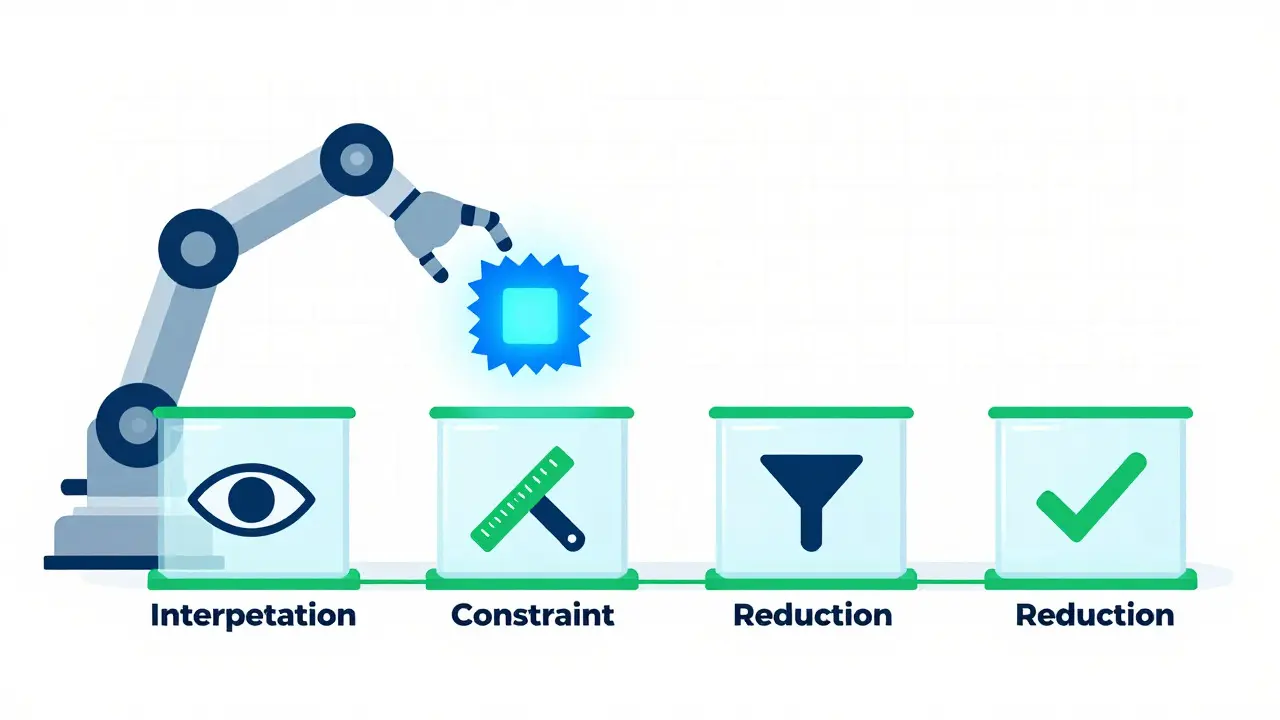
To truly constrain reasoning, you need explicit constraints. This means telling the model exactly what boundaries it cannot cross. For high-stakes tasks like billing or compliance, add a validation step to your workflow:
- Input: Provide the raw data.
- Interpretation: Ask the model to summarize its understanding of the task.
- Constraint: Define limits (e.g., "Use only data from Q3 2025," "Do not exceed 200 words").
- Reduction: Instruct the model to cut fluff and focus on the minimum viable result.
- Output: Generate the final answer.
- Validation: Ask the model to check if it stayed within bounds and interpreted the request correctly.
This validation loop is critical. A technically correct answer is useless if it requires manual cleanup. By forcing the model to self-check, you reduce the chance of subtle errors slipping through. For instance, if the constraint was "list only active users," the validation step asks the model to confirm that no inactive users were included.
Practical Tips for Effective Structured Prompts
You don't need to build a complex framework for every task. Start with these practical adjustments to your existing prompts:
- Use Delimiters: Clearly separate instructions from input data using XML tags or markdown headers. This helps the model distinguish between what it should do and what it should process.
- Be Specific About Output Format: If you need JSON, say "Return valid JSON only." If you need a list, specify the number of items. Vague requests lead to vague answers.
- Leverage Few-Shot Examples: Include one or two examples of the desired output. This is especially helpful when explaining behavior is difficult. Show, don't just tell.
- Define "Done": Explicitly state what a successful output looks like. Is it a single sentence? A table? A code snippet? Clarity here prevents overthinking.
For developers working with agentic applications, XML is often recommended as the default output format unless JSON is strictly required. Models like Claude 4 tend to lean toward Markdown if the prompt is formatted in Markdown, so align your prompt structure with your desired output format.

Common Pitfalls and How to Avoid Them
Even with structured prompting, things can go wrong. Here are the most common issues and how to fix them:
Overthinking: Sometimes the model reasons too deeply, producing long, convoluted explanations for simple questions. To fix this, add a reduction step. Tell the model to prioritize brevity and actionability. If the answer fits on one screen, it's likely better than a five-page essay.
Underthinking: Conversely, the model might skip necessary steps, leading to shallow answers. This happens when constraints are too tight or examples are too simple. Ensure your few-shot examples demonstrate the appropriate depth of reasoning for the task.
Ignoring Context: If the model fails to interpret the input correctly, everything downstream is wrong. Always include an interpretation step for complex tasks. Ask the model to rephrase your request in its own words before generating the final answer. This catches misalignments early.
Future Directions in Structured Reasoning
The field is moving toward collaborative systems. Frameworks like DisCIPL allow larger models to steer smaller ones, improving efficiency while maintaining quality. This suggests that structured prompting will become even more sophisticated, with multiple layers of verification and guidance.
As we move into 2026, expect to see more integration of structured approaches into multi-agent systems. The goal remains the same: make LLM outputs reliable, factual, and ready to use without human intervention. By mastering structured prompting, you gain control over the reasoning process, turning unpredictable AI behavior into a predictable, valuable asset.
Does structured prompting require fine-tuning the model?
No, structured prompting is a training-free methodology. It works with existing large language models by organizing the input and output formats to guide the model's inference process, eliminating the need for retraining or fine-tuning.
What is the difference between Chain-of-Thought and Structure Guided Prompting?
Chain-of-Thought focuses on generating intermediate reasoning steps sequentially. Structure Guided Prompting goes further by converting the problem into a graph structure, allowing the model to navigate relationships between entities explicitly, which is useful for complex, non-linear problems.
How does structured prompting improve factuality?
It reduces hallucination by constraining the model's scope, forcing it to interpret the task clearly, and validating the output against defined boundaries. This prevents the model from wandering off-topic or inventing facts to fill gaps in its reasoning.
Is XML or JSON better for structured outputs?
XML is generally recommended as the default for reasoning models because it handles nested structures well and is less prone to formatting errors. JSON is preferred when strict machine parsing is required, but it can be more brittle if the model deviates slightly from the schema.
Can structured prompting be used for multilingual tasks?
Yes, methods like Structured-of-Thought (SoT) specifically address multilingual reasoning by transforming language-specific semantics into language-agnostic structures. This allows the model to maintain consistent reasoning pathways regardless of the input language.