Structured Prompting: Constrain LLM Reasoning for Factuality Control
 Aug, 16 2026
Large language models are impressive, but they are also prone to drifting off-topic or hallucinating facts when asked to solve complex problems. The core issue is that without clear boundaries, an LLM tends to generate verbose, meandering responses that bury the actual answer in noise. This is where structured prompting comes in. It is a methodological approach that organizes both inputs and outputs according to systematic frameworks to guide the model's inference process. By constraining how the model thinks and speaks, you significantly improve factuality and reduce cognitive overload in the output.
This technique builds upon foundational work in chain-of-thought prompting but expands into more sophisticated constraint-based architectures. Instead of just asking a model to "think step by step," structured prompting defines exactly what those steps look like, limits their scope, and validates the final result. For developers and power users dealing with high-stakes workflows involving mathematics, billing, or compliance, this shift from open-ended generation to constrained reasoning is critical.
The Core Framework: Input, Interpretation, Constraint, Output
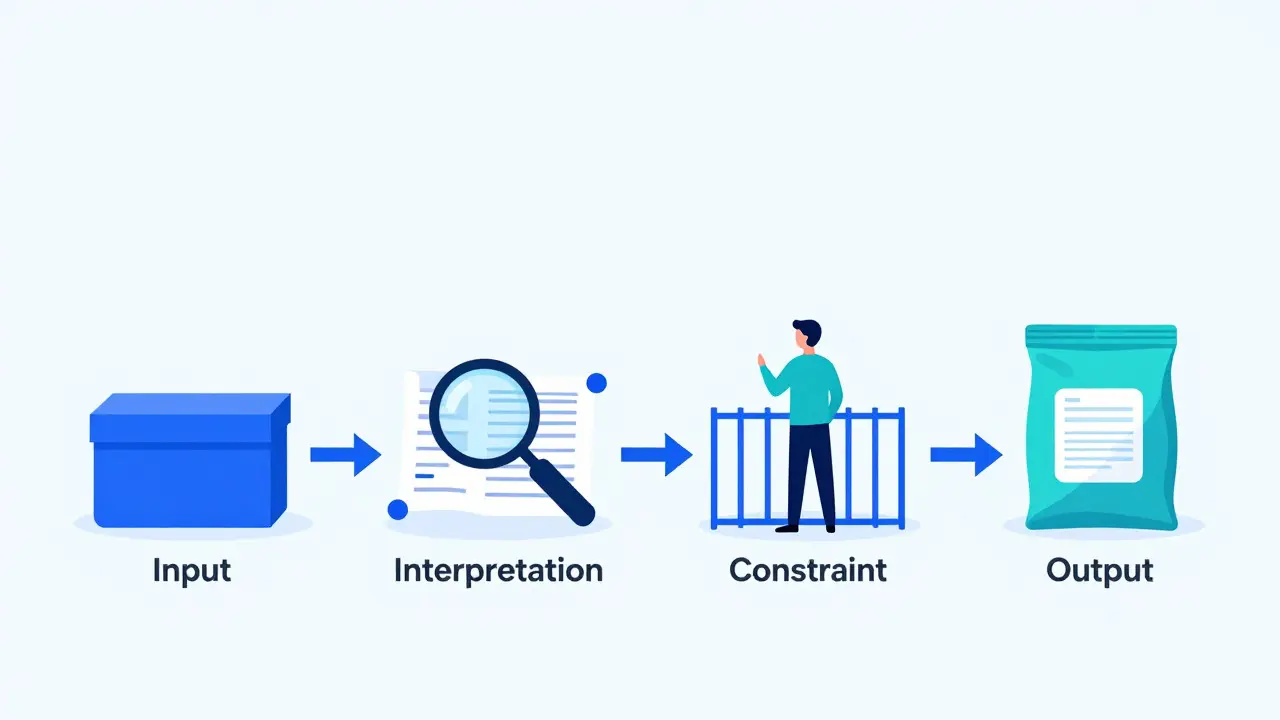
At its heart, effective structured prompting follows a specific interaction pattern. Rather than throwing raw data at a model, you break the interaction down into four distinct stages. This framework ensures that the model understands the task before it starts generating text.
- Input: This represents the raw user context or data provided to the model.
- Interpretation: The model reframes the task clearly. This step forces the LLM to confirm its understanding of the goal before proceeding.
- Constraint: You limit the scope and format. This reduces the search space for the model, preventing it from wandering into irrelevant topics.
- Output: The model provides a structured, actionable response that fits within the defined boundaries.
Practitioners who implement this pattern report increased consistency across different domains. It also makes prompts easier to reuse because you aren't rewriting the entire logic every time; you just swap out the input data while keeping the interpretation and constraint layers intact.
Advancing to Validation and Reduction
While the four-step framework is a solid starting point, higher-stakes applications often require an extended version. This adds two crucial components: reduction and validation.
The Reduction step pushes the model toward minimum viable useful results instead of maximum completeness. In many cases, a shorter, precise answer is better than a long, comprehensive one that requires editing. The Validation component checks whether the model actually interpreted the request correctly, stayed within defined bounds, and returned something usable without additional cleanup.
This extension is particularly important when errors are costly. If you are using an LLM to calculate tax liabilities or draft legal clauses, a technically correct answer that creates ambiguity or false confidence in downstream processes is worthless. Shaping model interaction around explicit constraints and clear boundaries around uncertainty proves significantly more effective in these scenarios.
Graph-Based Reasoning with Structure Guided Prompt
Natural language is inherently messy. Relationships between entities can be expressed in countless ways, making it difficult for LLMs to maintain a clear reasoning chain. The Structure Guided Prompt (SGP) framework addresses this by converting unstructured text into a graph.
SGP is a task-agnostic three-stage prompting approach designed to improve multi-step reasoning capabilities in zero-shot settings. Here is how it works:
- Conversion: The LLM explicitly converts the unstructured input text into a graph structure via internal representation.
- Navigation: The model is instructed to navigate this graph using task-specific strategies.
- Formulation: The response is formulated based on the path taken through the graph.
By organizing information visually and logically, SGP enables LLMs to provide more accurate and context-aware responses. Experimental results show that this framework significantly enhances reasoning capabilities, allowing models to excel in a broader spectrum of natural language scenarios where traditional prompting might fail due to linguistic diversity.
Multilingual Reasoning with Structured-of-Thought
Language barriers can disrupt reasoning pathways. When an LLM switches between languages or handles cross-lingual variations, the underlying logic can become fragmented. Structured-of-Thought (SoT) is a training-free method proposed to fix this. SoT employs multi-step transformation involving Language Thinking Transformation and Structured Knowledge Transformation.
The key attribute of SoT is that it converts language-specific semantic information into language-agnostic structured representations. This allows the model to understand queries in different languages more sophisticatedly. By guiding LLMs toward concentrated reasoning, SoT maintains consistent underlying reasoning pathways regardless of the surface-level language used. Benchmarks have shown that SoT outperforms several strong baselines on multiple multilingual reasoning tasks, proving that structure beats syntax when it comes to pure logic.
Collaborative Constraints: The DisCIPL Framework
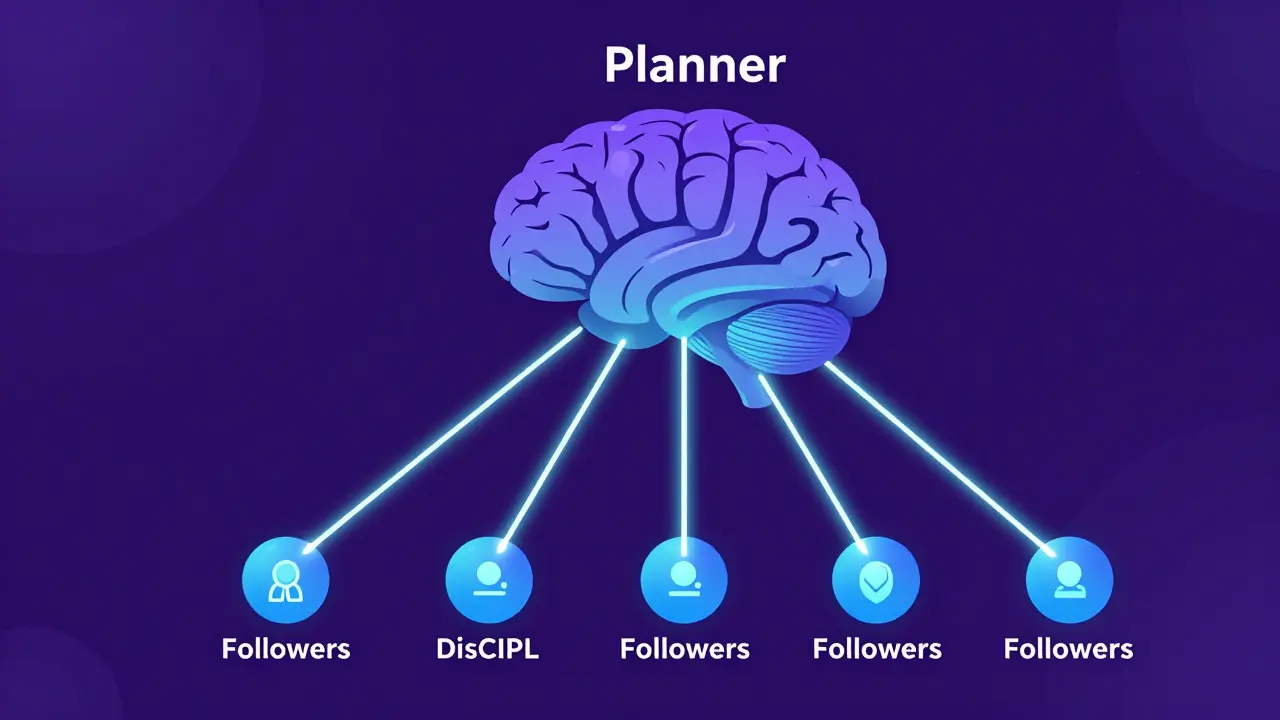
What if you could use a larger, smarter model to steer a smaller, faster model? The DisCIPL (Distributional Constraints by Inference Programming with Language Models) framework, developed at MIT's Computer Science and Artificial Intelligence Laboratory, does exactly this.
DisCIPL uses a large "planner" model to steer smaller "follower" models toward precise responses subject to constraints. For example, GPT-4o might brainstorm a plan for a travel itinerary with a strict budget, while a smaller model like Llama-3.2-1B fills in each word or token of the response. This division of labor improves inference efficiency. Theoretically, dozens of language models can be plugged into this framework regardless of size. Future directions include fully-recursive approaches where the same model serves as both leader and follower, extending the concept to mathematical reasoning tasks where answers are harder to verify.
Best Practices for Implementation
Implementing structured prompting effectively requires attention to detail. Here are some proven best practices to ensure your constraints hold up under pressure.
| Technique | Primary Use Case | Key Benefit |
|---|---|---|
| Input-Interpretation-Constraint-Output | General task execution | Consistency and reusability |
| Structure Guided Prompt (SGP) | Complex entity relationships | Accurate graph navigation |
| Structured-of-Thought (SoT) | Multilingual reasoning | Language-agnostic logic |
| DisCIPL | Efficient constrained generation | Leverages large/small model synergy |
When structuring inputs and outputs, use delimiters. This is standard practice for isolating data from instructions. For complex agentic applications, structured outputs are effective when leveraging reasoning models that excel at following JSON or XML instructions. XML is often recommended as the default mode unless specific requirements mandate JSON. Note that the output format from models is influenced by how prompts are structured; if you use Markdown in your prompt, the model will heavily lean toward Markdown output.
Few-shot prompting remains powerful. Adding demonstrations and exemplars aligned with high-level instructions is particularly useful when it is difficult to explain desired output. However, balance is key. Research suggests that reasoning models tend toward either overthinking or underthinking if not properly prompted. Mitigation strategies include self-reflection, where models critique and revise their own answers, and self-selective reasoning, where models decide when deep reasoning is necessary versus when a direct answer suffices.
Designing for Immediate Usability
The ultimate goal of structured prompting is not just accuracy, but usability. A technically correct answer provides insufficient value if it creates extra cleanup work. Design for immediate usability rather than completeness. Define what "done" means within your constraints. Does the output need to fit on one screen? Is it directly actionable without editing?
Consistent output structure enforcement, separation of input variability from output format, and designing for actionable responses represent the most effective approaches across multi-domain workflows. By combining explicit structure with constraint-specification and validation, you create more reliable and efficient LLM applications. These methods are training-free, meaning you can apply them immediately to existing models without fine-tuning or retraining. As the field evolves, we see these principles integrating into multi-agent systems and constraint-satisfaction problems, always with the emphasis on maintaining reasoning consistency and reducing hallucination.
What is the main difference between chain-of-thought and structured prompting?
Chain-of-thought focuses on generating intermediate reasoning steps to improve performance on complex tasks. Structured prompting goes further by organizing these steps within a systematic framework that includes interpretation, constraints, and validation to ensure the output is actionable and consistent.
Do I need to fine-tune my model to use structured prompting?
No. Structured prompting is a training-free methodology. It improves performance by changing how you interact with the model via prompt design, making it immediately applicable to any existing large language model.
Which output format is best for structured prompting?
XML is generally recommended as the default for complex agentic applications because reasoning models follow XML instructions well. JSON is suitable when specific parsing requirements exist. Always match your output format to your prompt formatting to avoid confusion.
How does the DisCIPL framework improve efficiency?
DisCIPL uses a large planner model to set constraints and a smaller follower model to generate tokens. This division of labor allows for precise, constrained responses without the computational expense of running the largest model for every single token generation.
Why is the 'Reduction' step important in high-stakes workflows?
The Reduction step pushes the model toward minimum viable useful results. In high-stakes areas like billing or compliance, verbose answers can introduce ambiguity or false confidence. Reducing the output ensures it is clean, concise, and ready for immediate use without manual editing.