The Next Wave of Vibe Coding Tools: What's Missing Today
 May, 16 2026
You tell the AI what you want, it writes the code, and suddenly you have a working app. That’s the promise of vibe coding, defined by IBM in November 2025 as a paradigm where natural language intentions transform directly into executable software. It sounds like magic, but if you’ve tried building anything beyond a simple landing page recently, you know the reality is messier. The tools are fast, yes. But they’re also brittle, short-sighted, and often leave you stranded when the logic gets complex.
We are standing at a turning point. The first wave of vibe coding platforms-led by giants like Replit and Vercel-proved that non-technical users could build prototypes quickly. But as we move deeper into 2026, the limitations are glaring. You can generate components, but you can’t yet design systems. You can write code, but you can’t govern it. Here is exactly what is missing from today’s landscape and what the next wave must deliver to make this technology truly viable for serious development.
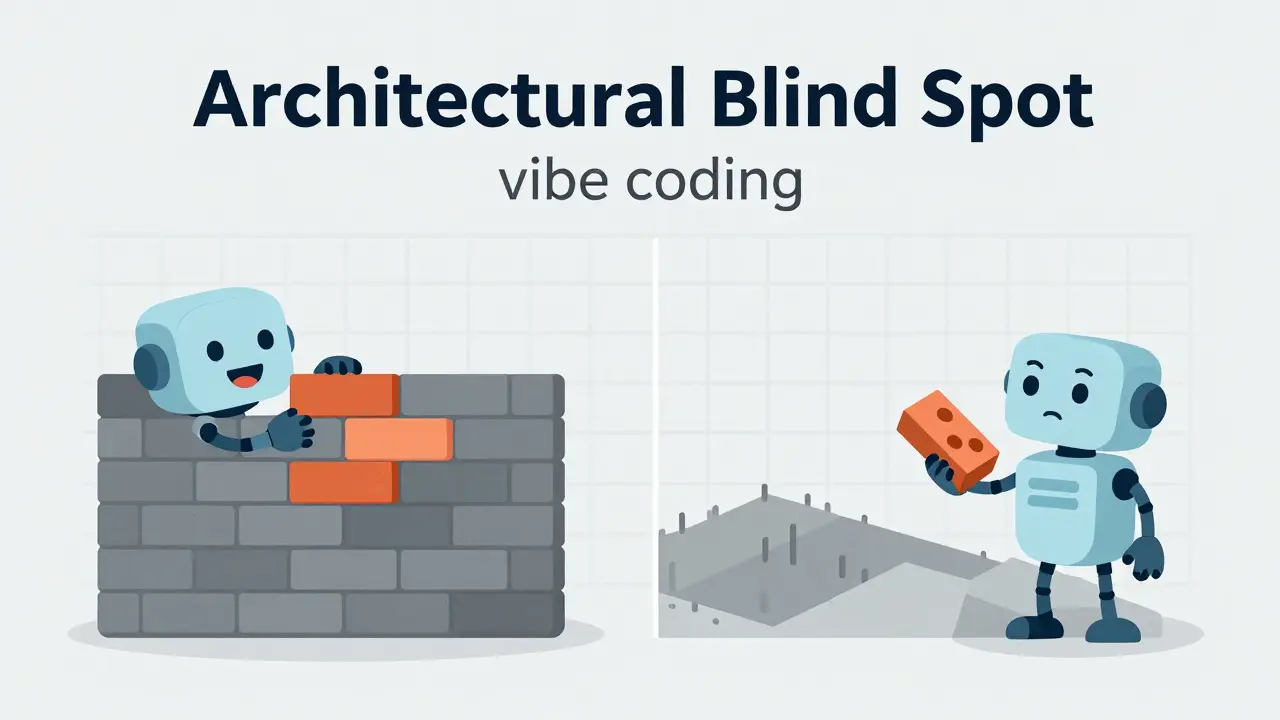
The Architectural Blind Spot
The biggest problem with current vibe coding tools isn’t their ability to write Python or JavaScript; it’s their inability to understand how those pieces fit together. Think of it like hiring a brilliant bricklayer who doesn’t have a blueprint. They can lay a perfect wall, but they don’t know where that wall should go in relation to the foundation or the roof.
In January 2026, Stack Overflow surveyed developers on this exact issue. A staggering 78% reported that while AI handles component-level tasks well, it completely fails at system design. When you ask an AI agent to "build me an e-commerce site," it might generate a beautiful checkout form. But it won’t automatically set up the database schema for inventory management, configure the payment gateway security, or plan the user authentication flow. It sees the trees, not the forest.
This gap forces developers into a frustrating hybrid workflow. You use the tool to speed up the grunt work, but then you have to step back and manually architect the entire application structure. As Justin Weiss from Technically.dev noted in late 2025, the industry needs to spend less time letting models "go off and do what they think is best" and more time planning coherent structures. Until tools can reason about architecture, vibe coding will remain a prototyping aid rather than a production-ready solution.
The Governance and Compliance Gap
If you are building software for a business, especially in regulated industries like finance or healthcare, "just making it work" isn’t enough. You need compliance, security audits, and clear ownership of every line of code. Right now, vibe coding tools offer almost none of this.
Gartner senior analyst David Smith identified this as the "governance gap" in early 2026. He predicts that by 2027, 60% of enterprises will require vibe coding platforms with integrated compliance frameworks. Currently, zero platforms provide this at scale. If an AI generates a function that inadvertently violates GDPR data handling rules, who is responsible? The tool? The prompter? The company?
This lack of guardrails is why enterprise adoption remains cautious. Only 34% of Fortune 500 companies have adopted these tools, and even then, mostly for non-critical internal apps. The EU’s draft AI Act, released in January 2026, explicitly requires human oversight for critical system components. This creates a direct conflict with the fully autonomous workflows that vibe coding promises. The next generation of tools must embed compliance checks directly into the generation process, flagging potential legal or security risks before the code is even written.
Context Window Limitations
Current AI models operate in narrow context windows. They are excellent at answering your immediate question but terrible at remembering the broader project history. Dr. Alan Liu from Stanford’s Human-Computer Interaction Lab described this perfectly: "They see the forest or the trees but not the entire ecosystem."
Imagine you are building a mobile app. In week one, you define a specific color palette and button style. By week three, when you ask the AI to add a new feature, it has likely forgotten those initial design constraints. The result? A disjointed application where the new feature looks and behaves differently from the rest.
This forces constant manual correction. Users report spending nearly as much time refining AI output as they would writing code from scratch. Forrester’s Q4 2025 study found that while vibe coding accelerates prototyping by 63%, it often introduces significant technical debt due to inconsistent context retention. The next wave needs "context-aware development environments" that maintain understanding across the entire project lifecycle, referencing previous decisions and documentation automatically.

Testing and Quality Assurance Deficiencies
Code generation is only half the battle. The other half is ensuring that code actually works under pressure. Here, the numbers are sobering. MIT Technology Review assessed major platforms in January 2026 and found that AI-generated code typically has only 32-41% test coverage. Compare that to industry standards for robust applications, which often aim for 80% or higher.
When you use a tool like Betty Blocks or Retool AI, the AI might write a function that works in the happy path-the ideal scenario where everything goes right. But it rarely accounts for edge cases: what happens if the database is down? What if the user inputs null values? These gaps lead to bugs that are expensive to fix later.
User feedback reflects this pain. On Reddit’s r/programming forum, developers shared stories of getting stuck because the AI couldn’t handle custom logic or error states. One user reported hiring a developer for $1,200 just to fix generated code for a simple e-commerce app. Until AI tools can autonomously generate comprehensive unit tests and integration tests alongside the code, they will remain risky for production environments.
Comparison of Leading Platforms
To understand where the market stands, let’s look at the key players dominating the landscape as of early 2026. Each has strengths, but all share the fundamental gaps mentioned above.
| Platform | Market Share | Best For | Key Limitation | Pricing (Approx.) |
|---|---|---|---|---|
| Replit | 38% | Full-stack prototyping & collaboration | Requires moderate technical literacy | $20/month+ |
| Vercel v0 | 22% | Frontend/UI generation | Less accessible for non-developers | Tiered usage-based |
| Betty Blocks | 15% (Enterprise) | Governance-focused internal tools | Steep learning curve for business users | $95/user/month |
| Retool AI | 12% | Internal dashboards & workflows | Requires JavaScript knowledge for customization | Custom enterprise quotes |
Replit leads the pack with its Autonomous AI Agent 3, offering a cloud-based environment that supports 27 programming languages. However, even Replit admits that full automation is not the goal. CTO Amjad Masad stated in January 2026 that the focus should be on empowering developers through collaboration, not replacing them entirely. This highlights a crucial shift: the future isn’t about AI doing everything alone, but about AI being a smarter partner.
What the Next Wave Must Deliver
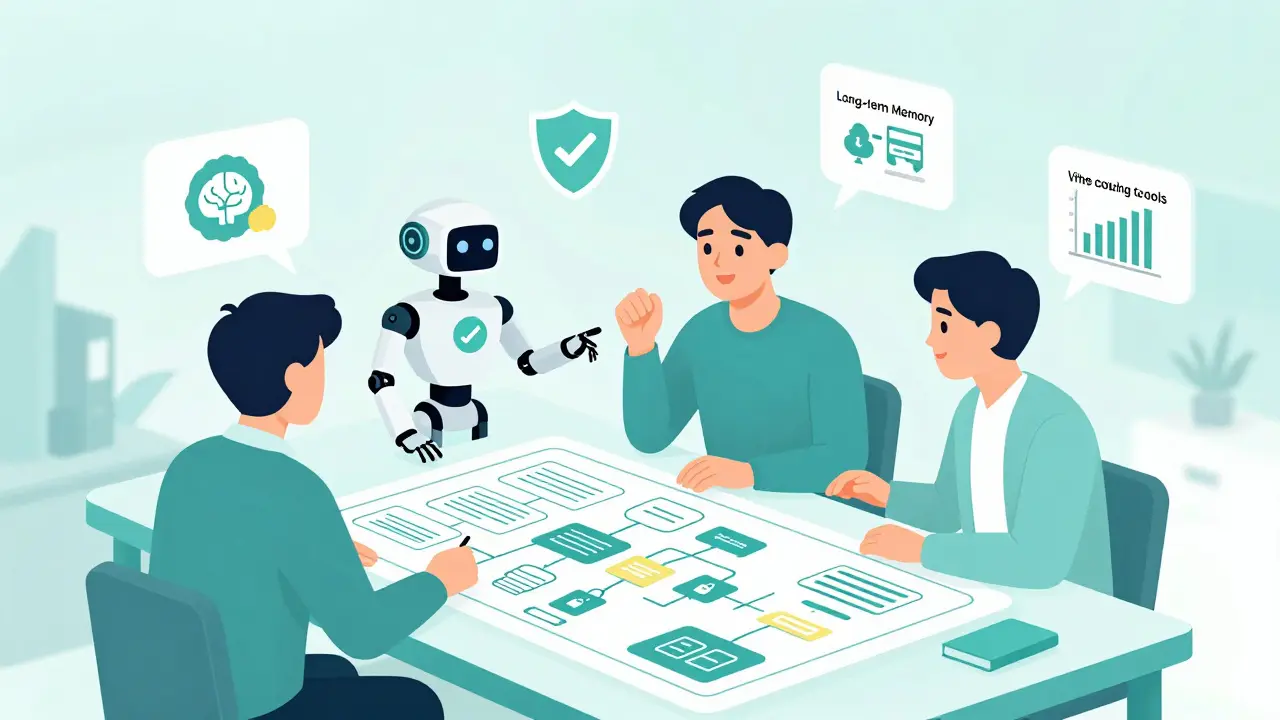
So, what does the next generation of vibe coding look like? Based on current roadmaps and expert analysis, three capabilities are essential:
- AI-Assisted System Design: Tools like Replit’s upcoming "Project Blueprint" (aiming for Q3 2026) will allow users to define high-level requirements, and the AI will propose a complete architectural diagram-including database schemas, API endpoints, and security protocols-before writing any code.
- Integrated Compliance Frameworks: Future platforms will scan generated code against regulatory standards (like GDPR or HIPAA) in real-time, offering suggestions to mitigate risks. This will bridge the governance gap identified by Gartner.
- Long-Term Context Memory: Instead of treating each prompt as an isolated event, next-gen tools will maintain a persistent memory of the project’s goals, design systems, and previous decisions, ensuring consistency across months of development.
Goldman Sachs projects the vibe coding market will reach $5.2 billion by 2027, but IDC warns that tools failing to bridge the planning-execution gap will lose 40% of their market share by 2028. The winners will be those that stop selling "code generators" and start selling "system architects."
Practical Tips for Using Today’s Tools
Until the next wave arrives, here is how you can maximize the value of current vibe coding tools without falling into common traps:
- Plan First, Code Later: Never jump straight into prompting. Spend 20% of your time creating a detailed document outlining your app’s structure, data models, and user flows. Feed this document to the AI as context.
- Use a Hybrid Team Approach: Let business analysts define requirements in natural language, but have senior developers review the AI’s architectural choices. This balances speed with quality.
- Test Rigorously: Assume the AI’s test coverage is insufficient. Manually write critical path tests and integrate them into your CI/CD pipeline immediately.
- Avoid Complex Logic in Prompts: Break down complex features into smaller, manageable components. AI struggles with large blocks of intricate logic; it excels at small, well-defined tasks.
Is vibe coding replacing professional developers?
No. While vibe coding automates routine coding tasks, it currently lacks the architectural reasoning and contextual understanding required for complex system design. Professional developers are shifting their role from writing code to reviewing AI output, designing system architectures, and ensuring compliance and security.
Which vibe coding tool is best for beginners?
For absolute beginners with no coding background, Softr or simplified interfaces within Replit are often the most accessible. However, expect limitations when trying to implement custom logic. For those with some technical knowledge, Vercel v0 offers powerful frontend generation but requires familiarity with React and Next.js concepts.
Can I use vibe coding tools for production enterprise applications?
Currently, it is risky to rely solely on vibe coding for critical production applications due to low test coverage and lack of integrated compliance frameworks. Most enterprises use them for internal tools or prototypes. Always involve human engineers for architectural oversight, security reviews, and extensive testing before deploying customer-facing software.
What is the "governance gap" in AI development?
The governance gap refers to the lack of built-in compliance, security, and audit trails in current AI coding tools. Enterprises need to ensure that generated code meets regulatory standards (like GDPR or HIPAA), but existing platforms do not automatically enforce these rules, leaving organizations vulnerable to legal and security risks.
How much does it cost to use vibe coding platforms?
Pricing varies significantly. Individual developers can start with Replit for around $20 per month. Enterprise solutions like Betty Blocks average $95 per user per month, often requiring minimum commitments. Free tiers exist for basic experimentation, but serious development usually requires paid plans for access to advanced AI models and hosting resources.
Donald Sullivan
May 16, 2026 AT 18:25Stop pretending this is a revolution when it’s just a glorified autocomplete with a marketing budget. I’ve spent three days debugging a 'simple' auth flow generated by Replit because the AI hallucinated a session token structure that doesn’t exist in the standard library. It’s not vibe coding; it’s vibe *guessing*. You’re building on quicksand and calling it innovation.
Tina van Schelt
May 18, 2026 AT 14:13I feel like we’re all just dancing on the edge of a volcano here, one wrong prompt away from total chaos. The architectural blind spot mentioned in the post is so painfully real-it’s like hiring a Picasso who only knows how to paint noses. You get these gorgeous, vibrant UI components that look like they belong in a gallery, but underneath? A tangled mess of spaghetti code that would make a senior engineer weep into their keyboard. We need tools that understand the soul of the system, not just the skin.
Mike Zhong
May 18, 2026 AT 15:48The entire premise of 'vibe coding' is philosophically bankrupt because it assumes that intention translates linearly into execution without the friction of reality. Code is not poetry; it is logic constrained by hardware limits and state management. When you remove the discipline of manual construction, you don’t get freedom-you get entropy. The AI doesn’t care about your business logic; it cares about probability distributions. Expecting it to govern compliance or security is like expecting a monkey typing randomly to produce a valid tax return. It’s not missing features; it’s missing the fundamental understanding of causality.
Jamie Roman
May 19, 2026 AT 15:02I totally see where you are coming from with the governance gap, and honestly, it keeps me up at night thinking about how we might be setting ourselves up for a massive regulatory hangover down the road. I have been trying to wrap my head around whether the hybrid team approach is actually sustainable or if it’s just a temporary band-aid until the context windows get big enough to remember everything we ever told them, which seems like a distant dream right now. Maybe the real issue isn’t the AI’s ability to write code, but our own inability to articulate the constraints clearly enough for the model to respect them, forcing us back into the role of architects rather than builders, which is kind of interesting if you think about it deeply enough.
Salomi Cummingham
May 20, 2026 AT 00:48Oh my stars, can you imagine the sheer dramatic irony of spending thousands on an enterprise license only to find out your AI assistant has no concept of GDPR?! It is absolutely terrifying, truly! I was reading about that Stack Overflow survey and my heart sank because I know exactly what it feels like to hand off a task and get back something that looks perfect on the surface but falls apart the moment you touch it. We need these tools to be more empathetic to the legal frameworks, darling, otherwise we are just playing with fire in a room full of gasoline!
Johnathan Rhyne
May 21, 2026 AT 13:20You say "vibe coding" as if it is a proper noun, yet it is merely a descriptive phrase for natural language programming interfaces. Furthermore, the assertion that Replit leads with 38% market share is questionable without citing the specific methodology of that survey, which is notably absent. If one were to examine the syntax errors generated by these platforms, one would notice a distinct lack of grammatical precision in the code output, mirroring the sloppy prose often found in such articles. Let us not confuse popularity with quality, nor speed with correctness.