Versioning Contracts in Vibe-Coded APIs: Preventing Breaking Changes
 Apr, 4 2026
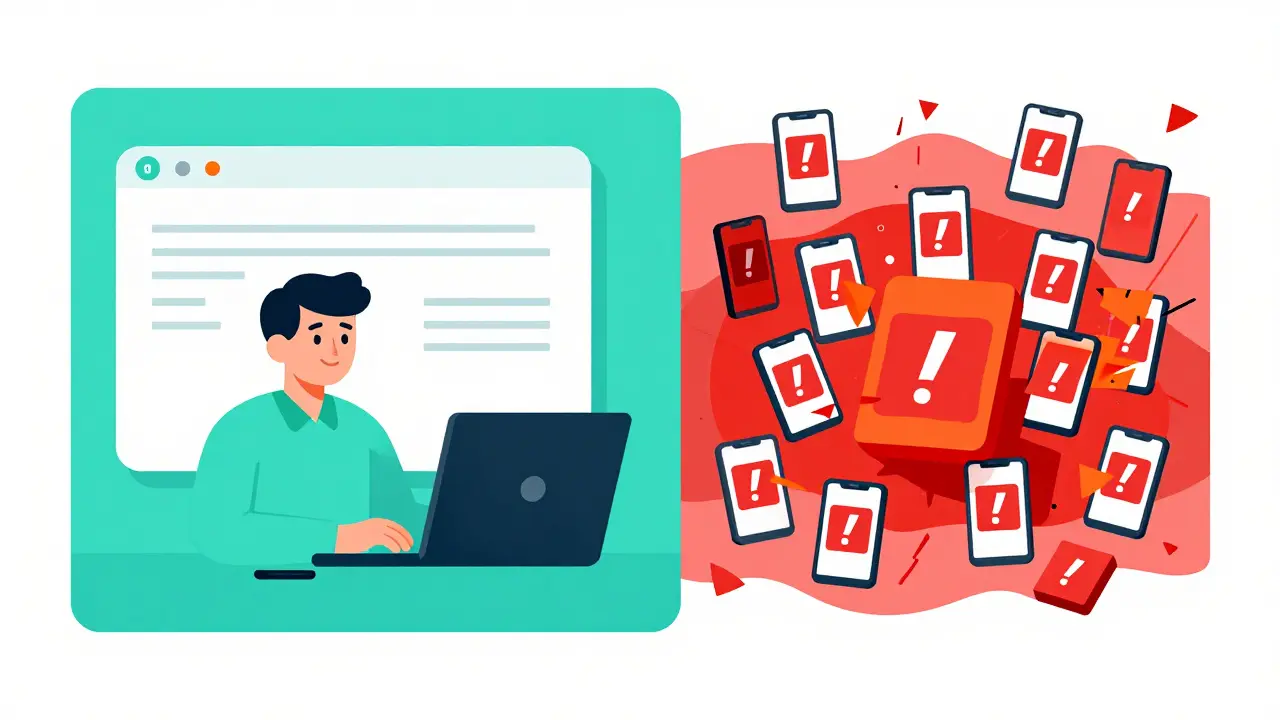
Imagine this: you've just prompted your AI to add a simple new field to a user profile endpoint. The AI regenerates the code in seconds, the build passes, and you push to production. Ten minutes later, your mobile app is crashing for thousands of users because the AI decided to rename an existing field to be "more descriptive." This is the hidden danger of "vibe coding"-where the speed of AI generation can easily outpace your ability to manage stability. When we code by "vibe," we're often trading rigorous architectural oversight for rapid iteration, but without a strict API versioning contract, that speed becomes a liability.
The core problem isn't the AI; it's the lack of a boundary. In traditional development, a human developer hesitates before changing a public-facing field. An AI doesn't hesitate. To stop the bleeding, we need to wrap these AI-generated outputs in a formal contract that dictates how changes are introduced and how old versions are retired.
The Vibe Framework's Approach to Semantic Versioning
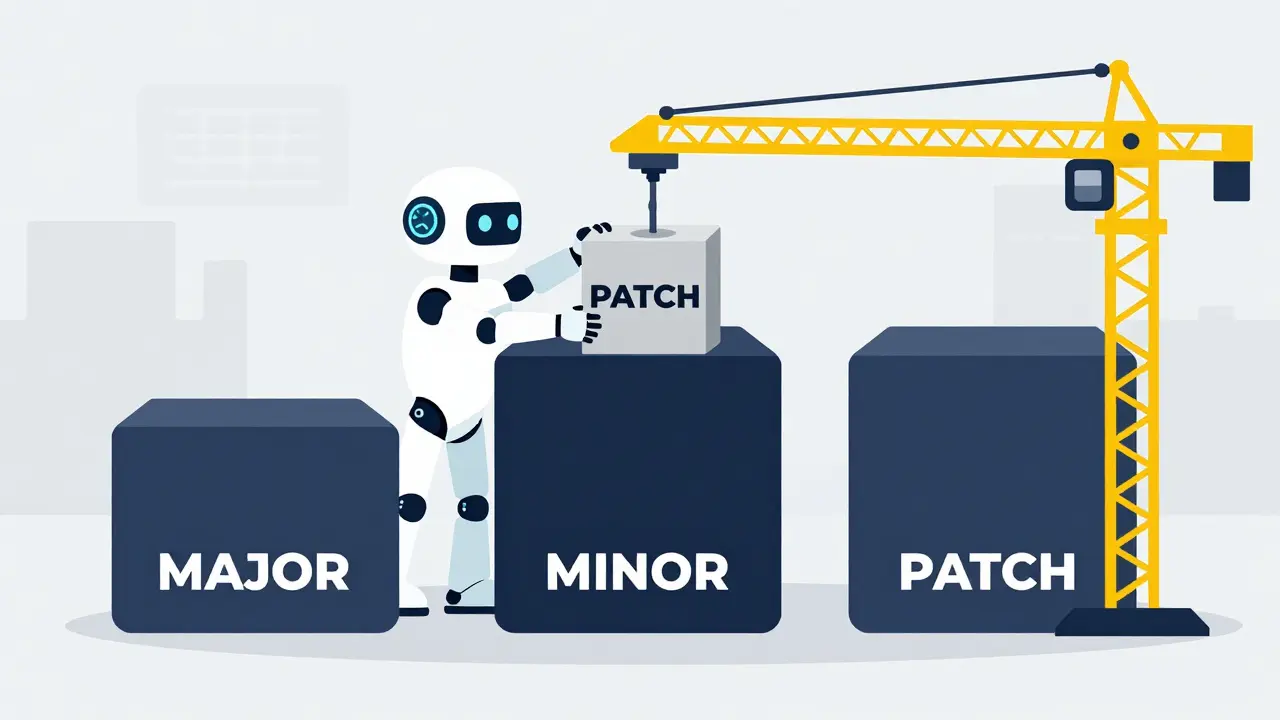
To keep things predictable, the Vibe Programming Framework leans on Semantic Versioning (or SemVer) is a versioning system that uses a three-part number (MAJOR.MINOR.PATCH) to communicate the nature of changes in a software release. This isn't just about numbers; it's a promise to the person using your API.
- MAJOR (X.0.0): These are the "danger zone" updates. If you change a data type or delete an endpoint, you bump the major version. It tells the consumer: "This will probably break your code; you need to migrate."
- MINOR (0.X.0): This is for growth. You've added a new feature or a new optional field, but the existing stuff still works exactly as it did before.
- PATCH (0.0.X): These are the invisible fixes. You've squashed a bug or fixed a typo in the documentation. No one should even notice the change other than that the app is slightly more stable.
In a vibe-coded environment, the AI needs to be explicitly told which version it is targeting. If you're asking for a a new feature, the system should automatically categorize it as a MINOR update. If you're asking it to "clean up" a model, you're potentially triggering a MAJOR version change.
Turning Prompts into Machine-Readable Contracts
One of the biggest risks in AI-driven development is the "hallucination gap"-where the AI thinks it implemented a feature, but the actual output differs from the original intent. The solution is to move away from static docs and toward dynamic, machine-readable specifications. The Vibe framework achieves this by integrating OpenAPI 3.0 is a standard specification for defining RESTful APIs, allowing both humans and computers to discover and understand the capabilities of a service without access to source code.
Instead of manually writing a YAML file, the AI generates the OpenAPI specification directly from your prompt. For example, if you prompt the AI to create a "Product" model with a UUID and a double-format price, the AI doesn't just write the Python or TypeScript code; it simultaneously generates the OpenAPI schema. This creates a single source of truth. If the AI changes the code, it must regenerate the schema. If the schema change is backward-incompatible, the system can flag a version violation before the code even hits a branch.
| Version Type | Compatibility Level | Consumer Action Required | Support Window |
|---|---|---|---|
| PATCH | 100% Backward Compatible | None | Immediate |
| MINOR | Core Compatible | Opt-in for new features | Ongoing |
| MAJOR | Breaking Changes | Mandatory Migration | 2 Minor Cycles |
The Three-Phase Deprecation Strategy
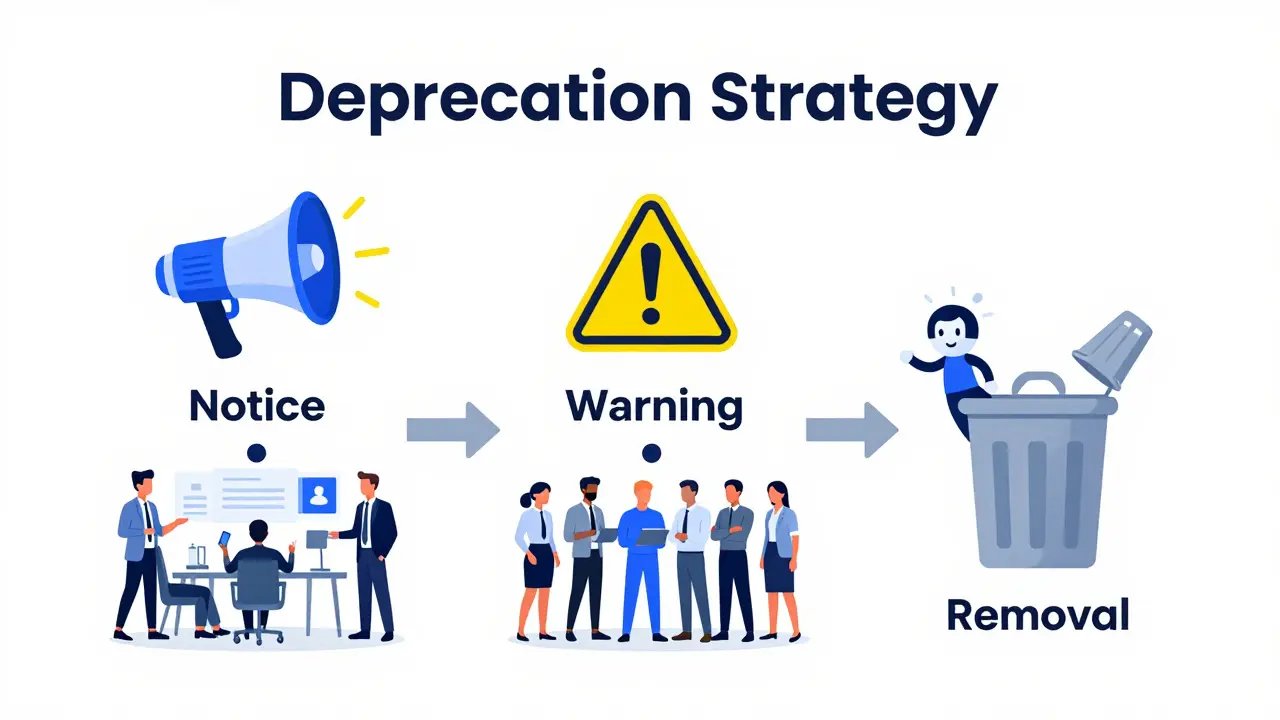
You can't just kill an endpoint because the AI found a "better way" to do it. To prevent breaking production environments, you need a phased exit. The Vibe framework uses a structured process that gives developers time to react.
- The Notice Phase: The feature is marked as deprecated in the documentation. You tell your users, "Hey, we're moving away from this; here is the new way to do it." This must last for at least one full minor version cycle.
- The Warning Phase: Now, it's not just in the docs. The API starts sending explicit warnings in the response headers or logs. It's a loud signal that the clock is ticking. This also lasts for at least one minor version.
- The Removal Phase: Only after the Notice and Warning phases are complete does the feature actually vanish. This always coincides with a MAJOR version release.
By following this cadence, you transform a potential disaster into a managed transition. It stops the "vibe" from becoming chaotic and turns it into a professional software lifecycle.
Guardrails Against AI-Generated Chaos
Treating an AI as a "commit-ready" author is a recipe for disaster. AI can easily hallucinate a library that doesn't exist or use a deprecated version of a package. To prevent breaking builds, you need to implement a rigorous validation checklist before any AI code is merged.
First, you must reproduce and version your prompts. If you can't recreate the exact prompt that generated the API, you can't debug the breaking change. Second, dependency pinning is non-negotiable. If the AI adds a new package, it shouldn't just be "latest"; it must be a specific version. Use Software Composition Analysis (SCA) tools to scan for vulnerabilities in these AI-suggested packages.
Finally, utilize a "Build Agent" approach, similar to what is seen in Google Cloud's Vibe integrations. The agent should be able to open a terminal, install the dependency, and run a linting check in real-time. If the AI's "vibe" creates a version conflict, the agent catches it during the generation phase, not during the deployment phase.
Strategic Version Selection for Different Needs
Not every company needs the same versioning strategy. Depending on what you're building, your tolerance for breaking changes will vary. The Vibe framework provides a way to choose your level of stability through Long-Term Support (LTS) is a software release strategy where a specific version is maintained for an extended period, providing security updates and critical fixes while freezing new feature additions.
If you are an innovation-focused startup, you might chase the latest minor versions every quarter. You want the new features, and you're okay with a bit of churn in exchange for a competitive edge. However, if you're in a regulated environment (like fintech or healthcare), you should stick to LTS versions. You only update for security patches and critical bugs, meaning your API contracts remain rock-solid for 24 months at a time.
Regardless of the strategy, the governance should happen via an RFC (Request for Comments) process. No major version should be bumped just because the AI suggested it; a human must review the architectural reasoning-why a specific authentication pattern was chosen over another, or why a data model needs to change-and sign off on it.
What happens if the AI generates a breaking change in a MINOR release?
This is considered a contract violation. In a Vibe-coded workflow, the generated OpenAPI specification should be compared against the previous version. If a breaking change (like a deleted field) is detected in a MINOR version, the build should automatically fail and require a version bump to MAJOR.
How does Vibe coding handle dependency conflicts?
It uses a combination of dependency pinning and a central allowlist. AI-generated code is scanned for unauthorized packages. If the AI suggests a library not on the allowlist, the developer must manually approve it through a formal exception workflow to ensure security and compatibility.
Can different parts of a Vibe API have different versions?
Yes. Component-level versioning allows the core framework (like the Security Toolkit) to share a primary version, while specialized extension components can evolve independently. They simply must specify the minimum framework version they are compatible with.
Why use OpenAPI 3.0 instead of just documenting the API in a README?
OpenAPI 3.0 is machine-readable. This allows tools like SwaggerCodegen to automatically create client SDKs and server stubs. When an AI regenerates the API, the OpenAPI spec ensures that the transition is validated programmatically rather than relying on a human to update a text file.
How long is a MAJOR version usually supported in the Vibe framework?
Typically, a MAJOR version includes transitional support that lasts for at least two minor release cycles. This gives consumers enough time to follow the documented migration paths and update their integrations without downtime.
Next Steps for Your Workflow
If you're currently vibe-coding without a versioning strategy, start by implementing a pre-commit hook that validates your generated code against an OpenAPI schema. If the schema changes, the commit should prompt you to categorize the change as MAJOR, MINOR, or PATCH. For those in production, identify your stability needs: if you can't afford a single hour of downtime, switch to an LTS-based adoption cycle immediately.
Patrick Tiernan
April 4, 2026 AT 09:17this whole vibe coding thing sounds like a recipe for a total meltdown lol
Liam Hesmondhalgh
April 6, 2026 AT 08:40Typical lazy writing. There's a glaring lack of precision in how this is phrased, and the grammar is absolutely appalling in several spots.
Also, why is this being pushed as some revolution? We've had SemVer for years. Just because you're using an AI to hallucinate your codebase doesn't mean you've discovered a new way to manage versions. It's basic engineering that people are apparently forgetting now that they've stopped thinking and started prompting. Absolute shambles.
Ashley Kuehnel
April 7, 2026 AT 16:33I totally agree that OpenAPI is a lifesaver here! I've seen so many teams struggle with this stuff, and automating the schema generation really helps keep everyone on the same page. Just a small tip for anyone starting out: make sure your prompts are super specific about the data types, or the AI mite still trip up on the double-format prices mentioned in the post! Keep it up everyone!
Patrick Bass
April 9, 2026 AT 00:17The suggestion to use a build agent for real-time linting is a sound approach.
Tyler Springall
April 10, 2026 AT 02:32The sheer arrogance of assuming that a "phased exit" solves the fundamental instability of AI-generated garbage is staggering. You are essentially putting a fancy ribbon on a ticking time bomb. It's an insult to actual software architecture to suggest that an OpenAPI spec generated by a stochastic parrot is a "single source of truth." The industry is spiraling into a void of mediocrity where we value speed over sanity, and this framework is just another layer of delusion to make us feel safe while our production environments burn. It's honestly pathetic that we've reached a point where we need a "vibe framework" to remember how to not break a public API. Give me a break.
Colby Havard
April 10, 2026 AT 09:46One must ponder the ethical implications of delegating architectural sovereignty to an algorithm... Is the pursuit of velocity not a Faustian bargain that erodes the very essence of craftsmanship??? We are trading the intentionality of the human mind for the efficiency of a machine, and in doing so, we risk losing the ability to understand the systems we govern... Truly, the ghost in the machine is now the architect, and we are but the clerks overseeing its whims!!!
Amy P
April 12, 2026 AT 06:55Wait, this is actually terrifying! I can't believe people are just pushing AI code to production without these guardrails! Imagine the chaos of a thousand mobile apps crashing all at once just because an AI wanted to be "more descriptive" with a field name! That is a literal nightmare scenario! I'm obsessed with the idea of the "hallucination gap" and how it just sneaks up on you when you think everything is fine!
adam smith
April 13, 2026 AT 04:26The information provided is very helpful. I appreciate the clear explanation of the versioning types.