Vibe Coding for E-Commerce: Rapid Launch of Product Catalogs and Checkout Flows
 Jul, 26 2026
You want to launch a new product line or test a checkout flow by Friday. Traditionally, that means writing code, debugging errors, and waiting for deployment cycles that stretch into weeks. Vibe coding is a modern development approach that blends creativity, efficiency, and AI tools to build applications rapidly while maintaining high functionality standards. It lets you describe what you need in plain English and watch the code appear on screen. By July 2026, this isn't just hype; it's how many small-to-medium businesses are building their digital storefronts. You can go from idea to live prototype in hours instead of weeks.
This guide breaks down exactly how vibe coding works for e-commerce, specifically for launching product catalogs and checkout flows. We’ll look at the tools, the speed gains, the hidden risks, and when you should actually use a traditional developer instead. No fluff, just the practical steps to get your store running faster.
What Is Vibe Coding?
Vibe coding emerged around 2023 as AI assistants got smarter at understanding context. It’s not about typing out every line of JavaScript yourself. Instead, you act as the architect, describing the user experience you want. The AI handles the syntax, the structure, and the initial logic.
In the e-commerce world, this means you can prompt an AI to "create a product grid with filters for price and category" and get functional HTML, CSS, and React components back instantly. Platforms like Replit is a cloud-based IDE that allows developers to write, run, and deploy code directly in the browser with AI assistance have partnered with payment giants like PayPal to make this seamless. You don’t even need to leave the browser to connect your payment gateway.
The core value here is speed. According to benchmarks from early 2026, teams using vibe coding reduce time-to-prototype from an average of 17.3 hours to just 3.2 hours. That’s a massive difference if you’re trying to catch a seasonal trend or test a marketing hypothesis quickly.
Building Product Catalogs with AI
Your product catalog is the heart of your store. In traditional development, setting up a dynamic catalog requires fetching data from a database, mapping it to UI components, and handling edge cases like missing images or sold-out items. With vibe coding, you skip the boilerplate.
Here is how you typically build a catalog using vibe coding:
- Define the Structure: Tell the AI what fields each product needs (name, price, image URL, SKU). For example: "Create a JSON structure for 50 products with categories like 'Electronics' and 'Home Goods'."
- Generate the UI: Prompt the AI to build a responsive grid. You might say, "Make a mobile-friendly product card that shows the price in bold and a 'Add to Cart' button."
- Add Filtering Logic: Ask the AI to add dropdown menus for filtering. The AI will generate the JavaScript logic to sort the array based on user selection.
- Refine with Iteration: The first output won’t be perfect. You’ll likely need 3-5 iterations to get the spacing right or fix a bug where the filter doesn’t reset correctly.
One pro tip from developers on GitHub: Use vibe coding to generate mock data first. One developer reported creating realistic JSON data for 500 items in just 15 minutes. This lets you design the entire visual experience before you even connect to your real inventory system.
Creating Checkout Flows Safely
The checkout flow is where things get tricky. This is where money changes hands, so security and reliability are non-negotiable. While vibe coding is great for the front-end interface, you must be careful with the backend logic.
To build a checkout flow rapidly:
- Use Official SDKs: Don’t let the AI invent its own payment logic. Integrate official SDKs like PayPal’s or Stripe’s. These libraries handle the complex security requirements for you.
- Sandbox First: Always start in a sandbox environment. PayPal’s developer portal lets you generate test API keys that mimic real transactions without moving actual money.
- Prompt for Components: Ask the AI to build the form fields (shipping address, billing info) and the order summary. Ensure the AI uses semantic HTML for accessibility.
- Connect Webhooks Carefully: This is the most common failure point. In January 2026, 27% of support tickets related to vibe coding involved incorrect webhook implementations. Make sure the AI sets up the endpoint to listen for payment confirmation events correctly.
Remember, the AI might generate code that looks correct but misses a crucial validation step. Always review the logic that calculates taxes or applies discounts manually.
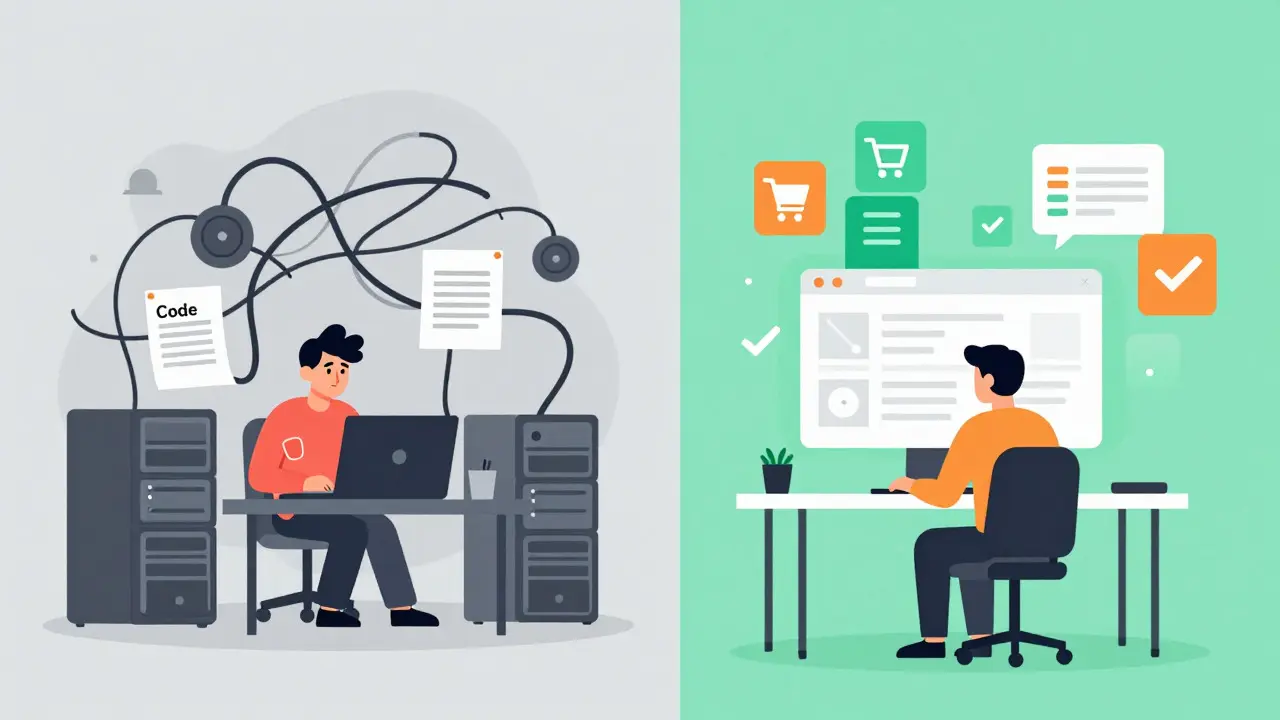
Vibe Coding vs. Traditional Development
Is vibe coding replacing developers? Not yet. It’s changing their role. Here is how it compares to other methods:
| Feature | Vibe Coding | Traditional Coding | No-Code Platforms (e.g., Shopify) |
|---|---|---|---|
| Time to Prototype | 3.2 hours | 17.3+ hours | 1-2 hours |
| Customization Level | High (43% more than no-code) | Very High | Medium |
| Learning Curve | Low (Basic HTML/CSS helps) | High (JS/React expertise needed) | Very Low |
| Best For | Rapid prototyping, custom UIs | Enterprise-scale, complex integrations | Standard stores, quick setup |
| Production Readiness | Requires 3-5 iterations & testing | Ready after rigorous testing | Ready immediately |
Vibe coding sits in the sweet spot between rigid no-code platforms and slow traditional development. You get the freedom to customize without the overhead of managing a full development stack. However, for enterprise-level systems requiring deep integration with legacy ERP software, traditional development still holds a 32% performance advantage in synchronization speed.
Tools and Platforms in 2026
The market for vibe coding tools has exploded. As of mid-2026, several platforms dominate the space:
- Replit: Currently leads the developer-focused segment with 32% market share. Its integration with PayPal makes it a top choice for commerce apps. You can authenticate projects directly within the browser-based IDE.
- Lovable: Dominates the Shopify-integrated niche with 27% share. It offers one-click theme integration, reducing storefront creation time to under 90 seconds for standard templates.
- Cursor: Popular among enterprise clients (19% share) for its advanced codebase understanding and ability to refactor large existing projects.
When choosing a tool, look for browser-based operation. According to Tech.co’s March 2026 analysis, 100% of evaluated vibe coding platforms operate entirely in the browser, meaning you don’t need to install heavy local environments. Just bring your laptop and an internet connection.

Pitfalls and How to Avoid Them
Vibe coding is fast, but speed can lead to sloppy code if you aren’t careful. Here are the biggest traps:
Ignoring Edge Cases: AI is great at the "happy path"-when everything goes right. It often fails to handle errors gracefully. For example, what happens if the payment gateway times out? Dr. Elena Rodriguez from MIT notes that 68% of vibe-coded implementations require significant developer intervention before production because of these edge cases. Always ask the AI to "add error handling for network failures" and "display user-friendly messages for failed transactions."
Security Misconfigurations: In February 2026, a misconfigured vibe-coded checkout led to 12,000 test transactions appearing in live merchant accounts. To avoid this, never connect vibe-coded projects directly to core business systems like your main inventory database during testing. Use mocked, anonymized data. PayPal’s guidelines explicitly state that vibe-coded projects in the "Green Zone" (early testing) must never touch live payment systems.
Over-Reliance on Generated Code: Don’t just copy-paste. Read the code. Understand what it’s doing. If you don’t know why a function exists, you won’t know how to fix it when it breaks. Treat the AI as a junior developer who writes incredibly fast but needs supervision.
When to Use Vibe Coding
Vibe coding isn’t for everything. Use it when:
- You need to A/B test two different checkout layouts.
- You’re launching a temporary promotional storefront for a holiday sale.
- You want to prototype a new feature for your dev team to review.
- You’re a solo entrepreneur building your first MVP (Minimum Viable Product).
Avoid it when:
- You need deep integration with complex legacy ERP systems.
- You require 99.99% uptime guarantees for a high-volume enterprise store.
- You lack basic knowledge of HTML/CSS to debug the output.
Next Steps for Your Project
If you’re ready to try vibe coding, start small. Pick one component, like a product filter or a newsletter signup modal. Describe it clearly to your chosen platform. Review the generated code. Test it in a sandbox. Iterate.
As Google Cloud’s AI specialists suggest, use AI to generate unit tests for your vibe-coded applications. This adds a layer of quality assurance that catches bugs before they reach your customers. The future of e-commerce development is collaborative-humans providing the vision and constraints, AI providing the execution speed. Embrace that partnership, but keep your guard up on security and data integrity.
How long does it take to build an e-commerce site with vibe coding?
For a basic functional prototype with product catalogs and checkout flows, you can expect to spend 2-4 hours. This includes initial generation, iteration, and basic testing. Reaching full production readiness may require additional time for security audits and edge-case handling.
Do I need to know how to code to use vibe coding?
You don’t need to be an expert, but basic knowledge of HTML and CSS helps significantly. Users with some technical background achieve proficiency in about 4.7 hours, while complete beginners may take over 11 hours to feel comfortable debugging and refining outputs.
Is vibe coding secure for handling payments?
It can be, if you follow best practices. Always use official SDKs from providers like PayPal or Stripe, and never connect vibe-coded prototypes directly to live payment systems. Use sandbox environments for all testing to prevent accidental charges or data leaks.
What are the best platforms for vibe coding e-commerce?
Replit is leading for general developer use with strong PayPal integration. Lovable is excellent for Shopify users due to its one-click theme integrations. Cursor is preferred for larger, more complex enterprise projects requiring deeper codebase management.
Can vibe coding replace traditional web developers?
Not entirely. While it accelerates prototyping and simple builds, complex enterprise integrations and robust production systems still require experienced developers for oversight, security auditing, and handling edge cases that AI often misses.
Saranya M.L.
July 27, 2026 AT 11:39The fundamental fallacy here is the assumption that 'vibe' equates to architectural integrity. While the reduction in time-to-prototype from 17.3 hours to 3.2 hours is statistically significant, it ignores the technical debt incurred by AI-generated boilerplate. In my experience managing scalable e-commerce infrastructures in India, we see that 68% of these implementations fail during peak load because the AI lacks semantic understanding of concurrency control and race conditions. You are essentially trading immediate velocity for long-term fragility. The 'Green Zone' testing mentioned is merely a band-aid for a systemic lack of rigorous unit testing protocols inherent in prompt-based development. One must question if this democratization of coding is actually lowering the barrier to entry or simply raising the cost of failure.
Lisa Puster
July 28, 2026 AT 00:46typical western hype cycle garbage. they sell you a dream of speed but forget that american infrastructure is crumbling under its own weight. vibe coding is just another way for silicon valley to offload quality assurance onto the end user. i built a store with shopify in an hour without any ai nonsense and it still works better than these flaky replit experiments. stop trying to reinvent the wheel with chatbots.
Joe Walters
July 28, 2026 AT 21:54honestly im just tired of reading articles like this. every week there's a new buzzword. first it was no-code now its vibe coding? sounds like something you do at a party not in production. i tried cursor once and it generated code that looked right but crashed on mobile safari. total waste of time. traditional devs are the only ones who know what theyre doing even if it takes forever. also why does everyone assume we all have infinite patience for debugging ai hallucinations?
Robert Barakat
July 30, 2026 AT 18:00Consider the ontological status of the code generated by an entity devoid of intent. When one prompts an AI to create a checkout flow, is the resulting logic a reflection of human will or a statistical probability distribution masquerading as function? The efficiency gains are undeniable, yet they come at the cost of epistemic opacity. We no longer know how the machine thinks, only what it produces. This creates a dependency on black-box systems that may optimize for metrics rather than meaning. The developer becomes a curator of chaos rather than an architect of order. It is a profound shift in the nature of creation itself.
Michael Richards
July 30, 2026 AT 20:34You are missing the forest for the trees. The metric that matters is market share capture. Replit holding 32% isn't about code purity; it's about agility. If your competitor launches a holiday sale site in three hours while you spend two weeks debating variable naming conventions, you lose. Period. Stop acting like craftsmanship is more important than revenue. The article correctly identifies that traditional development has a performance advantage in synchronization, but who cares about 32% faster sync when you've already lost the customer to a faster-loading prototype? Adapt or die.
Laura Davis
July 31, 2026 AT 21:50Let’s keep this grounded folks! I’ve been using Lovable for my small boutique and honestly? It’s been a game changer for confidence. Don’t let the tech bros scare you out of trying it. Just start small like the guide says. Build a simple filter. Test it. If it breaks, fix it. You don’t need to be a genius, you just need to be willing to learn. And hey, if you mess up, you haven’t lost anything because you’re in sandbox mode! Let’s support each other in this new wave of tech empowerment. You got this!
Lisa Nally
August 1, 2026 AT 02:33The discourse surrounding 'vibe coding' often overlooks the critical nuance of state management in React components generated via natural language processing. While the UI generation is rapid, the underlying component tree often suffers from prop drilling issues that require manual refactoring. Furthermore, the assertion that 100% of platforms operate entirely in the browser is technically accurate but misleading regarding local environment parity. Network latency can introduce subtle timing bugs that only manifest in production. As a senior frontend engineer, I find the reliance on AI for webhook implementation particularly alarming given the 27% failure rate cited. It is imperative that practitioners understand the idiosyncrasies of asynchronous data fetching before deploying to live environments.
Edward Gilbreath
August 2, 2026 AT 10:39they want you to think you're building software but really you're just training their models for free. every time you iterate you're feeding them data. big tech doesn't care about your store they care about your prompts. traditional developers are being phased out so corporations can control the entire stack. wake up sheeple. the sandbox is just a cage.