Why AI-Generated Code Drifts in Style and Architecture Across Sessions
 Nov, 11 2026
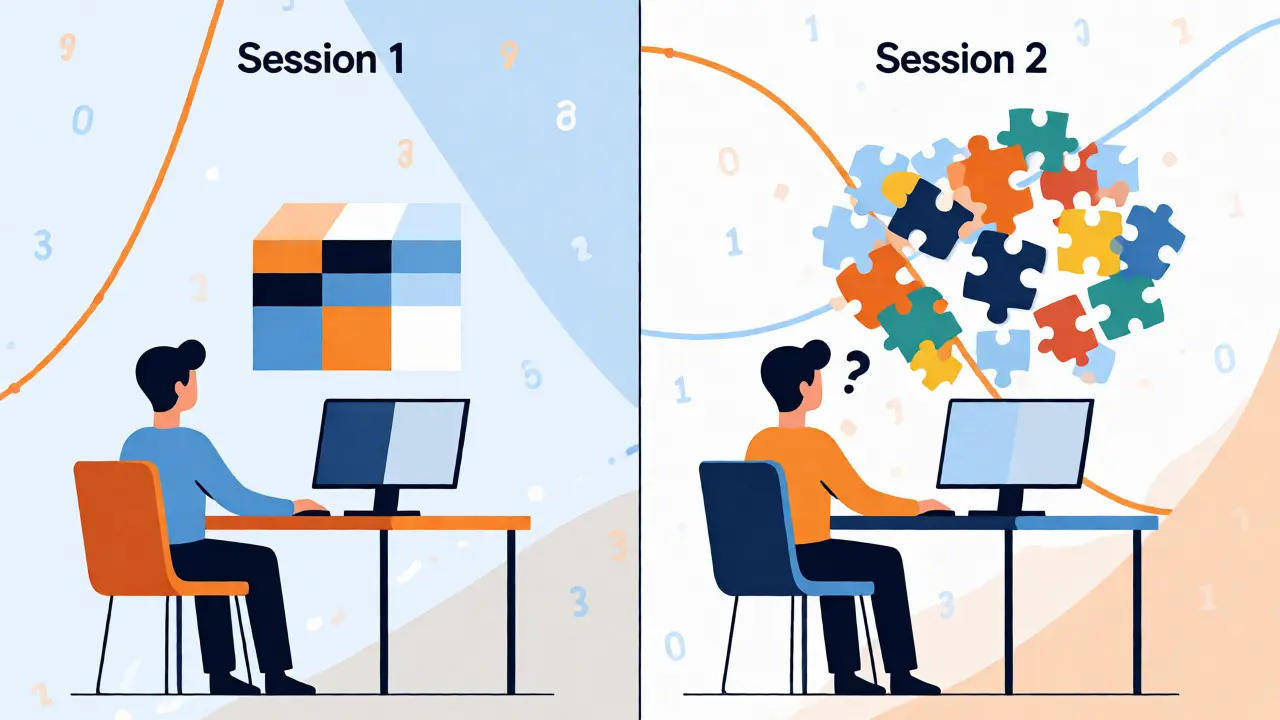
You ask an Large Language Model to write a function. It gives you clean, snake_case Python with clear docstrings. You close the IDE. You come back ten minutes later, ask for a similar feature, and suddenly the model is using camelCase, skipping comments, and structuring logic inside nested if-statements instead of helper functions. Why does this happen? It’s not because the AI "forgot" your project. It’s because AI-generated code drift is an inherent property of how these models work.
This phenomenon-where naming conventions, formatting, and even high-level design patterns shift between sessions-is frustrating for developers who care about long-term maintainability. If every module looks like it was written by a different junior developer on a different day, refactoring becomes a nightmare. Understanding why this drift happens is the first step to controlling it.
The Core Culprit: Stochastic Decoding
At its heart, an LLM doesn't "think" in a deterministic way like traditional software. It predicts the next token (word or symbol) based on a probability distribution. When you generate code, the model samples from this distribution. This process is called stochastic decoding.
Common strategies like temperature scaling and nucleus sampling (top-p) introduce randomness to prevent the model from getting stuck in repetitive loops. A higher temperature (e.g., 0.7 vs. 0.1) flattens the probability curve, making less likely tokens more probable. This means that even with the exact same prompt, two runs can yield completely different continuations. One might choose a functional approach; another might choose an object-oriented one. Both are valid, but they look different.
Even when you set temperature=0 to force determinism, true reproducibility is elusive. Recent studies, including a 2025 analysis of five major LLMs, show that outputs still vary across identical runs. Why? Low-level hardware non-determinism. Differences in GPU kernel execution, thread scheduling, and floating-point arithmetic precision can cause tiny shifts in internal activations. These micro-variances accumulate over hundreds of generated tokens, eventually tipping the balance at critical decision points-like whether to start a class or a function-leading to architectural divergence.
Training Data Diversity Creates Multiple "Right" Answers
LLMs are trained on billions of lines of code from open-source repositories, spanning decades of programming history. This training data is a chaotic mix of styles. You have strict PEP 8-compliant Python alongside legacy scripts with inconsistent spacing. You have rigid enterprise Java patterns mixed with agile, experimental JavaScript frameworks.
Because the model learns from this diverse mixture, its internal representation of "good code" is multimodal. There isn't one single optimal path for solving a problem. Instead, there are many local optima. When you ask for code, the model samples from this broad distribution. In one session, it might latch onto the style of a modern React hook pattern. In another, it might revert to older class-based component structures. The model isn't confused; it's simply reflecting the diversity of its training corpus.
A 2024 study on coding style inconsistencies confirmed this empirically. Researchers found that while LLM-generated code often passes functional tests, it diverges significantly from human-written baselines in metrics like identifier choice and commenting density. The variance wasn't random noise; it was systematic drift driven by which part of the training distribution the model happened to access during that specific generation.
Prompt Sensitivity and Context Windows
Your prompt and surrounding context act as powerful priors. Modern LLMs have large context windows, meaning they consider everything in your file buffer, previous chat history, and even unrelated code snippets near the cursor. Small changes here can swing the output style dramatically.
Imagine you're working on a file where the existing code uses verbose error handling with try-catch blocks everywhere. The model sees this pattern and mimics it. Now, imagine you open a new file with minimal boilerplate. The model, lacking that strong stylistic anchor, might default to a cleaner, more concise error-handling strategy. Developers on Reddit frequently report "swings" in GitHub Copilot's quality and style between sessions, attributing it to exactly this: the invisible influence of partially written code acting as a style guide.
This sensitivity extends to architecture. If your earlier prompts included examples of dependency injection, the model is biased toward that pattern. If those examples were absent, it might propose a simpler, monolithic solution. The model is essentially mirroring the most salient features of its immediate context, leading to drift if that context changes subtly between sessions.
Architectural Drift: More Than Just Formatting
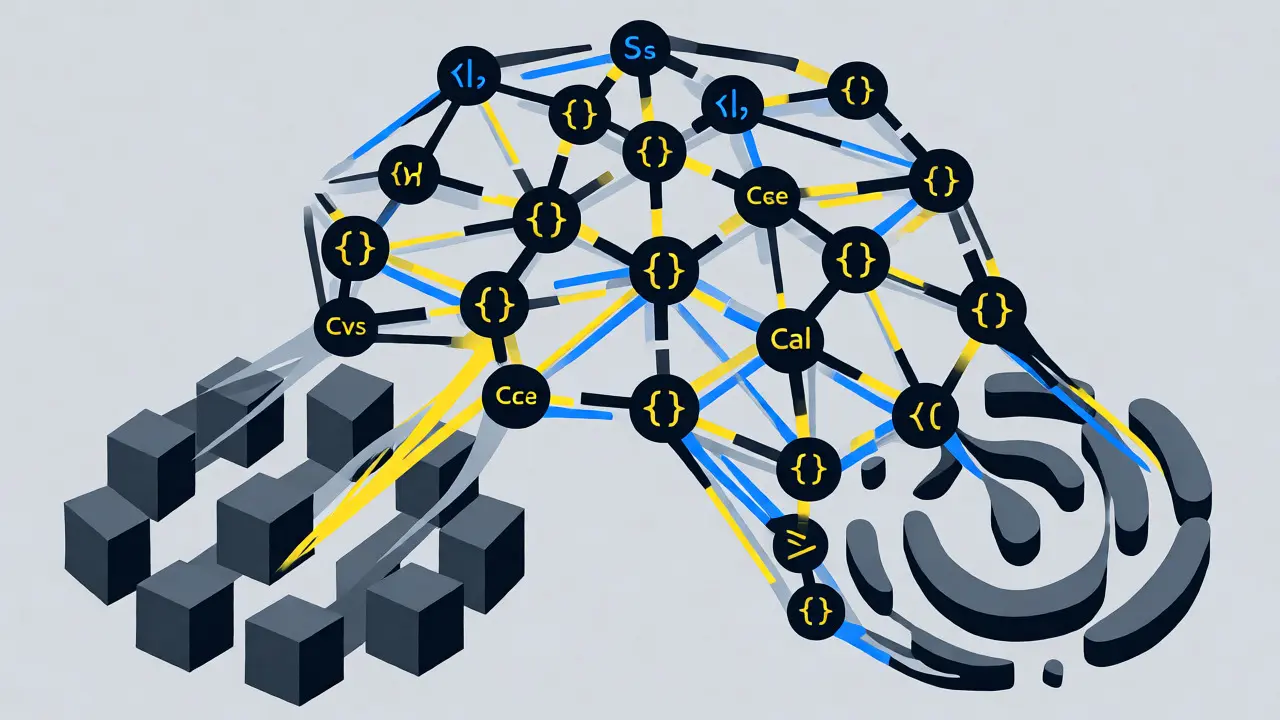
Style drift is annoying, but architectural drift is dangerous. This occurs when the high-level structure of the solution changes-such as switching from a service-layer pattern to a direct database query in a controller. This isn't just about aesthetics; it impacts testability, scalability, and team understanding.
Research into self-consistency and ensemble methods highlights this issue. Techniques like Chain-of-Thought prompting encourage the model to explore multiple reasoning paths. While this improves accuracy, it also increases structural variability. One sample might decompose a task into three small, pure functions. Another might solve it with one complex stateful class. Both pass unit tests, but they fit differently into your existing codebase.
The "ConTested" framework and other recent approaches attempt to mitigate this by generating multiple candidates and selecting the best one based on test performance or consistency scores. However, current mainstream tools often present only one candidate, leaving you exposed to whatever architectural bias emerged from that specific sampling run.
Real-World Impact on Maintainability
Software maintenance accounts for the majority of lifecycle costs. If AI-generated code introduces heterogeneity, maintenance costs rise. Teams report spending significant time normalizing naming schemes, reorganizing modules, and aligning AI suggestions with internal style guides. This shifts effort from creation to cleanup.
Consider a scenario where an organization uses AI for 30-50% of new code lines. Over a year, this could result in a codebase that reflects dozens of subtly different architectural decisions, none of them deliberately chosen. Each module feels like it was written by a different person. Debugging becomes harder because mental models don't transfer easily between modules. Refactoring requires extra cognitive load to reconcile conflicting patterns.
| Drift Driver | Mechanism | Impact on Code | Mitigation Strategy |
|---|---|---|---|
| Stochastic Decoding | Randomness in token sampling (temperature/top-p) | Variation in syntax, variable names, control flow | Lower temperature (0-0.2), fixed seeds, log parameters |
| Training Data Diversity | Multimodal distribution of coding styles | Inconsistent idioms, mixing paradigms (OO vs Functional) | Explicit style instructions in prompts, few-shot examples |
| Context Sensitivity | Influence of surrounding code and chat history | Style mirroring of local files, architectural inconsistency | Clean context buffers, explicit reference files, consistent prompt templates |
| Hardware Non-Determinism | GPU kernel/thread scheduling variations | Unpredictable argmax ties, minor logic shifts | Accept as inherent; rely on automated testing and review |
How to Manage Drift in Your Workflow
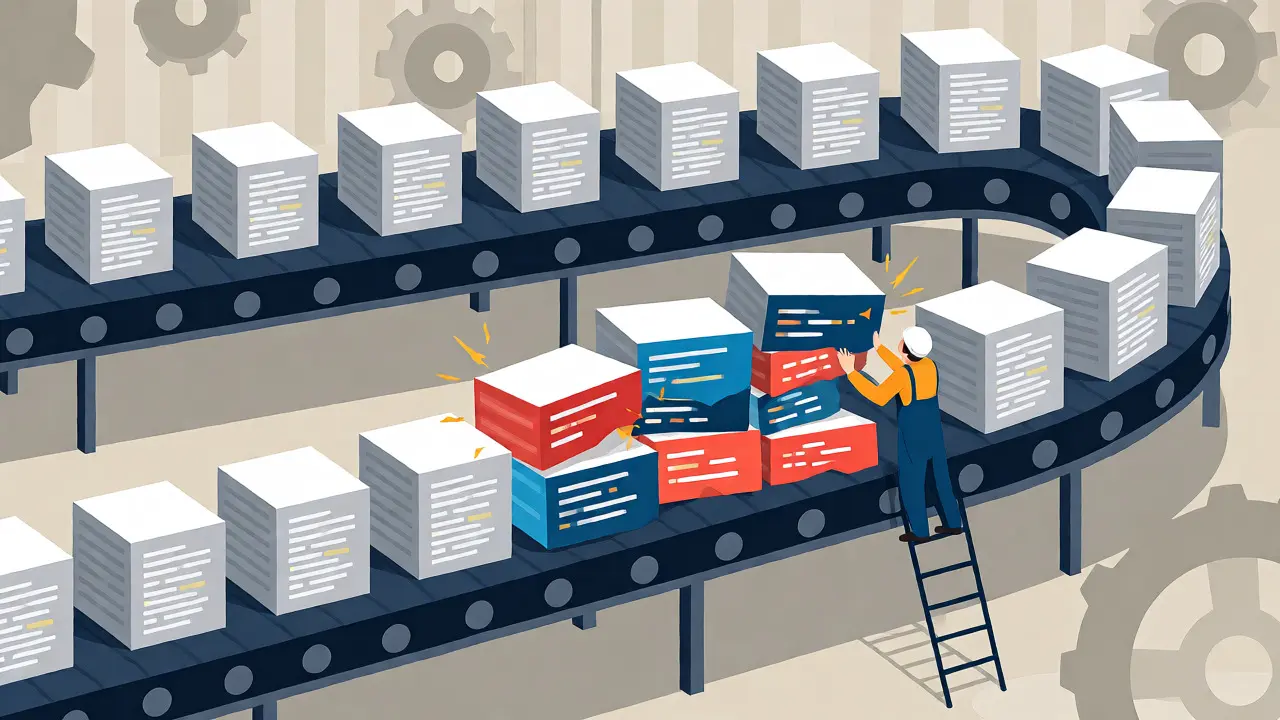
You can't eliminate drift entirely, but you can constrain it. Here’s what works in practice:
- Tighten Decoding Parameters: Set temperature to 0 or near-zero. Reduce top-p to limit the search space. Note that this reduces creativity but increases consistency.
- Anchor with Few-Shot Examples: Include 2-3 snippets of your ideal code style directly in the prompt. This biases the model toward your specific conventions.
- Use Explicit Style Instructions: Don't assume the model knows your preferences. Add comments like "// Use snake_case," "// Prefer functional composition," or "// Follow our internal API guidelines."
- Enforce Post-Processing: Run all AI-generated code through formatters (Black, Prettier) and linters (ESLint, Pylint). This fixes surface-level style but won't fix architecture.
- Limit Scope of Assistance: Use AI for localized tasks (boilerplate, regex, unit tests) rather than system-level design. Keep architectural decisions in human hands.
Some teams are moving toward multi-sample workflows. They generate three variations, then use automated tests or human review to pick the best fit. This embraces the model's variability rather than fighting it, turning a bug into a feature.
Frequently Asked Questions
Does setting temperature=0 guarantee identical code output?
No. While temperature=0 makes the model greedy (always picking the highest probability token), low-level hardware non-determinism (GPU kernels, thread scheduling) can still cause slight variations in internal calculations. These micro-variances can flip the argmax decision at certain steps, leading to different outputs across runs.
Why does my AI assistant change its coding style between projects?
The model relies heavily on context. Different projects have different surrounding code, file structures, and prompt histories. These elements act as style priors. If Project A uses heavy OOP patterns and Project B uses functional pipelines, the model will mirror each respective style, leading to perceived inconsistency.
Can I train a custom model to stop drifting?
Fine-tuning on a narrow, consistent dataset can reduce drift by narrowing the probability distribution. However, it may also reduce the model's ability to generalize to new problems. Most organizations prefer constraining general-purpose models via prompts and tooling rather than maintaining custom fine-tuned versions.
Is architectural drift worse than style drift?
Generally, yes. Style drift (naming, spacing) is easily fixed with linters. Architectural drift (changing design patterns, module boundaries) requires manual refactoring and deep understanding of the codebase. It impacts maintainability, testability, and team collaboration much more severely.
How do professional teams handle AI code inconsistency?
Teams combine strict linting/formatting rules with mandatory code reviews. They often restrict AI usage to specific tasks (e.g., writing tests, generating boilerplate) and require human oversight for architectural decisions. Some use multi-generation selection, where the AI produces several options and the developer picks the best fit.
Taylor Lewis
November 11, 2026 AT 07:25Obvious.
adam pohan
November 12, 2026 AT 09:50I think everyone is missing the point here because they are too busy blaming the machine when the real problem is human laziness and a lack of fundamental understanding of what software engineering actually entails. We have spent decades building robust systems with strict guidelines not because we wanted to be difficult but because consistency is the bedrock of maintainability and if you cannot enforce basic rules on your own team then why are you surprised that a probabilistic model which has no concept of right or wrong fails to do so for you? It is absurd to expect a tool that predicts the next token based on statistical likelihoods to suddenly become a disciplined architect just because you clicked a button and now you want it to read your mind regarding whether you prefer dependency injection or global variables this session. The article suggests mitigations like lowering temperature but that is merely treating the symptom while ignoring the disease which is our collective refusal to define clear boundaries and standards before inviting these tools into our workflow. If developers were more rigorous in their initial specifications and less reliant on the AI to guess their intent then perhaps we would see less drift but instead we get sloppy prompts leading to sloppy code and then we blame the algorithm rather than admitting that we failed to provide the necessary constraints for a deterministic outcome. This isn't about the AI being broken it is about us being impatient and unwilling to put in the upfront work to define exactly what 'good' looks like so that the machine can simply execute rather than improvise every single time we open an editor window.
Melanie visto
November 13, 2026 AT 19:39They are hiding the truth 🤯 They don't want you to know that the randomness is intentional to keep us dependent on their cloud services forever!! 😱📉💸
Arundhati M
November 15, 2026 AT 01:15The analysis provided is quite accurate, though I would emphasize that the stochastic nature of decoding is not merely a bug but a feature that allows for creative exploration in early prototyping phases. From an enterprise perspective, implementing a robust CI/CD pipeline that includes automated style enforcement via tools like Black or Prettier is non-negotiable, as it decouples the generation process from the final artifact quality. Furthermore, leveraging few-shot prompting with curated examples from your specific codebase significantly reduces the entropy of the output distribution, effectively anchoring the model to your organizational idioms. It is also worth noting that context window management plays a critical role; ensuring that the surrounding code snippets provided to the LLM are representative of the target architectural pattern helps mitigate the drift caused by irrelevant contextual noise. Ultimately, treating AI as a junior developer who requires constant supervision and clear specification sheets yields the best long-term results.
Patrick Sarandi
November 16, 2026 AT 10:30this is huge for anyone trying to scale dev teams fast love the tip about using explicit style instructions in prompts its such a game changer for keeping things clean without killing the vibe lets goooo 🚀
Somesh gupta
November 17, 2026 AT 00:30i have been observing this phenomenon closely in my recent projects and it seems that the variability is indeed inherent to the underlying transformer architecture which relies on probabilistic sampling methods to generate text sequences
from a theoretical standpoint one must consider that the training corpus contains a vast heterogeneity of coding styles ranging from highly structured academic implementations to chaotic production hotfixes and the model essentially learns a mixture distribution over these styles
consequently when the prompt does not sufficiently constrain the search space the model may sample from different modes of this distribution resulting in the observed drift in naming conventions and structural patterns
it is fascinating how subtle changes in the context window can shift the attention weights towards different stylistic features thereby altering the generated output significantly even when the semantic intent remains identical
perhaps future advancements in constrained decoding techniques will allow for stricter adherence to predefined grammars and style guides thus reducing this variance without compromising the generative capabilities of the model
Melissa Emrick
November 18, 2026 AT 01:25omg finally someone said it i was literally crying last week bc my ai kept switching between camelCase and snake_case and i thought i was going crazy lol its not just me right?? 🙄✨ also the part about hardware nondeterminism is so deep i had to look it up twice bc im not a super nerd like some people here 💅
Alice Clark
November 18, 2026 AT 16:18the chaos is the point ... they sell you order but deliver entropy disguised as innovation ... the ghost in the machine is just the echo of a million dead coders screaming in binary ... we are dancing with shadows that change shape when we blink ... nothing is stable ... everything flows ... the code drifts because reality itself is unstable ... wake up ... the server farm is dreaming ... and we are just the dream ... 🌌👁️