Why Multimodality Expands Generative AI Capabilities Beyond Text-Only Systems
 May, 12 2026
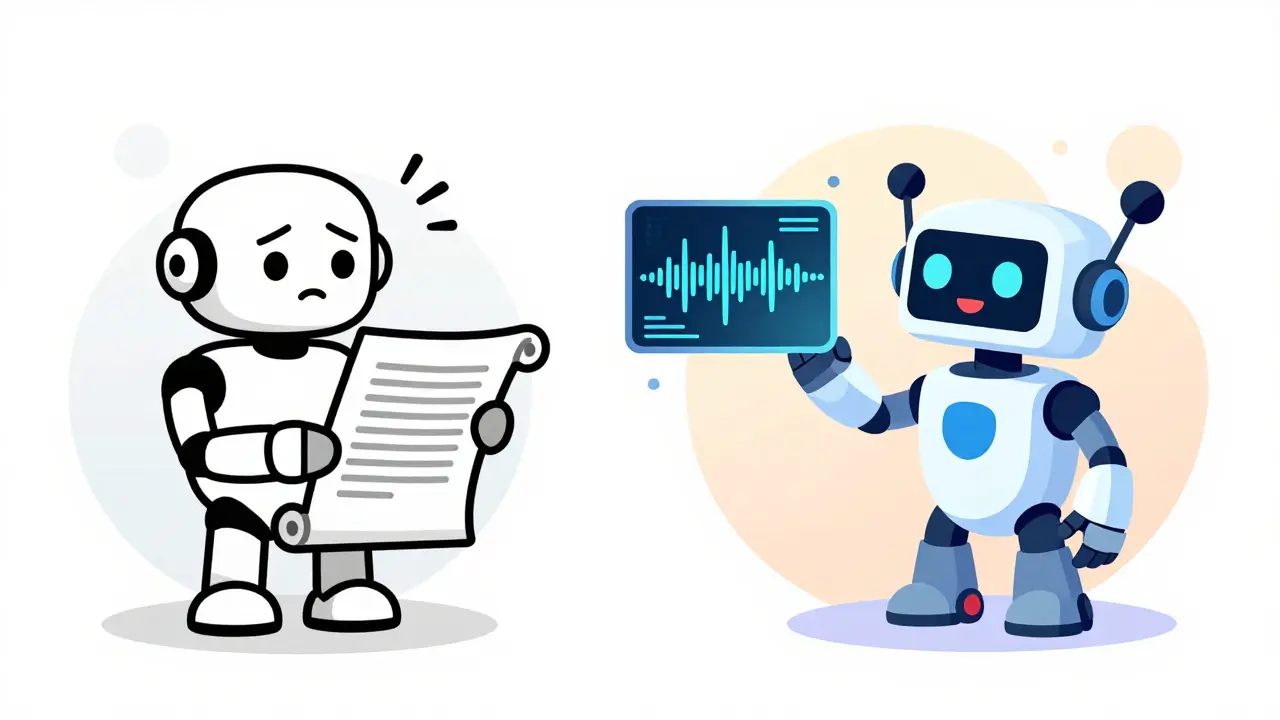
Imagine trying to understand a joke by reading the transcript but never seeing the facial expressions or hearing the tone of voice. You might get the words right, but you’d likely miss the punchline entirely. This is exactly where text-only AI falls short. It processes language in isolation, missing the rich context that comes from images, sounds, and other sensory data. Enter Multimodal AI, a technology that doesn't just read; it sees, hears, and interprets multiple forms of data simultaneously.
The shift from unimodal to multimodal systems isn't just an upgrade-it's a fundamental change in how machines comprehend the world. By integrating text, images, audio, video, and sensor inputs into a single framework, these systems mimic human cognition more closely. They don't analyze data silos separately; they find the connections between them. This capability allows for deeper understanding, fewer errors, and more natural interactions.
How Multimodal Architecture Works
Traditional AI models were built like specialists. One model handled text, another handled images. To combine their insights, you needed complex pipelines that often lost nuance in translation. Modern multimodal architectures, however, are designed as generalists from the ground up. They use unified neural networks that process virtually any input type and generate almost any output type.
Take Google’s Gemini, released in December 2023. Unlike earlier models that required separate encoders for vision and language, Gemini uses a native multimodal approach. It treats tokens-whether they represent words, pixels, or sound waves-as part of the same semantic space. This means the model understands that the word "red" relates directly to the visual pixel data of a red object, rather than just associating the word with other words like "apple" or "stop."
This architectural shift leads to tangible performance gains. Benchmarks show that these unified systems achieve 34% higher accuracy in vision-language tasks compared to stitching together separate text and image models. The system doesn't just describe what it sees; it understands the relationship between what it sees and what it reads. For example, IBM demonstrated this by having a model receive a photo of a landscape and generate a written summary of its characteristics, or vice versa, creating bidirectional comprehension that was previously impossible.
Real-World Performance Improvements
The theoretical benefits of multimodality become clear when looking at specific industry applications. In healthcare, the stakes are high, and precision matters. A study by Stanford University in 2024 revealed that multimodal systems reduced diagnostic errors by 37.2%. How? By combining radiology images with patient history records. A text-only system might miss a subtle anomaly in an X-ray because it lacks the clinical context, while a vision-only model might flag a harmless shadow as critical because it ignores the patient's medical background. Together, they provide a complete picture.
In customer service, the improvement is equally dramatic. Founderz documented a 41% improvement in resolution rates when companies used multimodal AI. These systems can analyze a customer's tone during a call alongside the text of their complaint. If a user types "I'm fine" but their voice indicates frustration, the multimodal model detects the discrepancy and adjusts its response strategy accordingly. Text-only chatbots simply cannot detect sarcasm or emotional distress through text alone, leading to frustrating user experiences.
Speed is another factor. Kanerika’s benchmarking showed that advanced models like GPT-5 (referenced in 2025 analyses) process multimodal queries 2.8x faster than sequential single-modality approaches. Instead of analyzing text first, then images, and then combining results, the model does it all in parallel. This enables natural, context-aware conversations that happen in real-time, such as analyzing a document image and answering questions about it in under 1.2 seconds.
The Cost of Complexity: Limitations and Challenges
Despite the advantages, multimodal AI is not a magic bullet. It comes with significant computational costs. MIT’s 2024 research indicates that effective multimodal training requires substantially more resources, including at least 80GB of VRAM for models handling high-resolution images alongside text. Furthermore, these systems require 3.5x more processing power than their text-only counterparts. For organizations with limited hardware budgets, this can be a barrier to entry.
Latency is another issue. In low-bandwidth environments, multimodal systems exhibit 18-22% higher latency according to IEEE documentation from 2025. Transmitting large video files or high-res images takes time, and processing them adds to the delay. If your application requires instant responses over a slow connection, a text-only system might still be the better choice.
There are also accuracy trade-offs in specific niches. When processing purely textual legal documents, multimodal systems sometimes showed 7.3% lower accuracy because the model wasted computational effort trying to interpret irrelevant visual noise or formatting artifacts. Additionally, cross-modal alignment remains tricky. Tredence’s technical analysis identified a 12-15% accuracy drop when processing non-standard image formats compared to standard RGB inputs. The model needs clean, well-aligned data to perform at its best.

Comparing Leading Multimodal Models
The market for multimodal AI is competitive, with several key players offering distinct advantages. As of mid-2026, the landscape is dominated by a few major providers, each with unique strengths.
| Model | Key Strength | Context Window | Primary Use Case |
|---|---|---|---|
| Google Gemini 1.5 | Massive context window | 1 million tokens | Analyzing full-length videos/documents |
| OpenAI GPT-4o | Low latency & speed | Standard (optimized) | Real-time conversational AI |
| Meta Llama 3.1 | Multilingual support | Variable | Global enterprise applications |
Google’s Gemini 1.5, released in January 2025, stands out for its ability to handle massive amounts of data. Its one-million-token context window allows it to analyze entire movies with synchronized subtitles or thousands of pages of technical manuals in a single pass. This makes it ideal for deep research tasks where comprehensive recall is necessary.
On the other hand, OpenAI’s GPT-4o focuses on speed and responsiveness. With updates in May 2025 reducing cross-modal latency by 42%, it excels in interactive applications like virtual assistants or live customer support agents where every millisecond counts. Meta’s Llama 3.1 improved non-English multimodal understanding by nearly 39% across 200 languages, making it a strong contender for global enterprises needing robust localization.
Expert Perspectives and Ethical Considerations
Leading experts view multimodality as the next evolutionary step in AI. Dr. Fei-Fei Li of Stanford HAI noted that multimodal understanding mirrors human cognition, which naturally integrates multiple sensory inputs. Her team’s research supports this, showing multimodal models achieve 89.7% accuracy in emotion recognition, far surpassing the 63.2% of text-only systems.
However, caution is warranted. Professor Gary Marcus warned in April 2025 that current systems still struggle with causal reasoning across modalities. He cited cases where GPT-4o misinterpreted satirical images as factual content in 23% of test cases. This highlights a critical vulnerability: multimodal models can be tricked by conflicting signals between text and image.
Bias is another concern. The Partnership on AI found a 15.8% higher bias amplification rate in multimodal systems compared to text-only models when processing cultural contexts. If an image contains stereotypes that contradict neutral text, the model may inadvertently reinforce those biases. Developers must carefully curate training data and implement rigorous testing protocols to mitigate these risks.
Implementation Strategies for Enterprises
For businesses looking to adopt multimodal AI, the path forward requires careful planning. Contentful’s 2025 developer survey revealed a 4-6 month learning curve for data scientists transitioning from text-only to multimodal systems. Most reported needing additional expertise in computer vision and signal processing.
The most successful implementations follow a phased approach. IBM recommends starting with a single cross-modal capability, such as image captioning or document analysis, before expanding to full multimodal integration. Coca-Cola achieved ROI in just 7 months using this strategy, whereas companies attempting full deployment immediately took 14 months.
Data alignment is a common hurdle. Sixty-seven percent of enterprises reported issues with synchronizing different data streams. Solutions involve temporal synchronization techniques that improved multimodal coherence by 31.4%. Ensure your data pipeline can handle heterogeneous inputs efficiently, and prioritize documentation quality. Google’s Gemini API received high marks for clarity, while other platforms lagged behind, impacting development speed.
The Future of Embodied AI
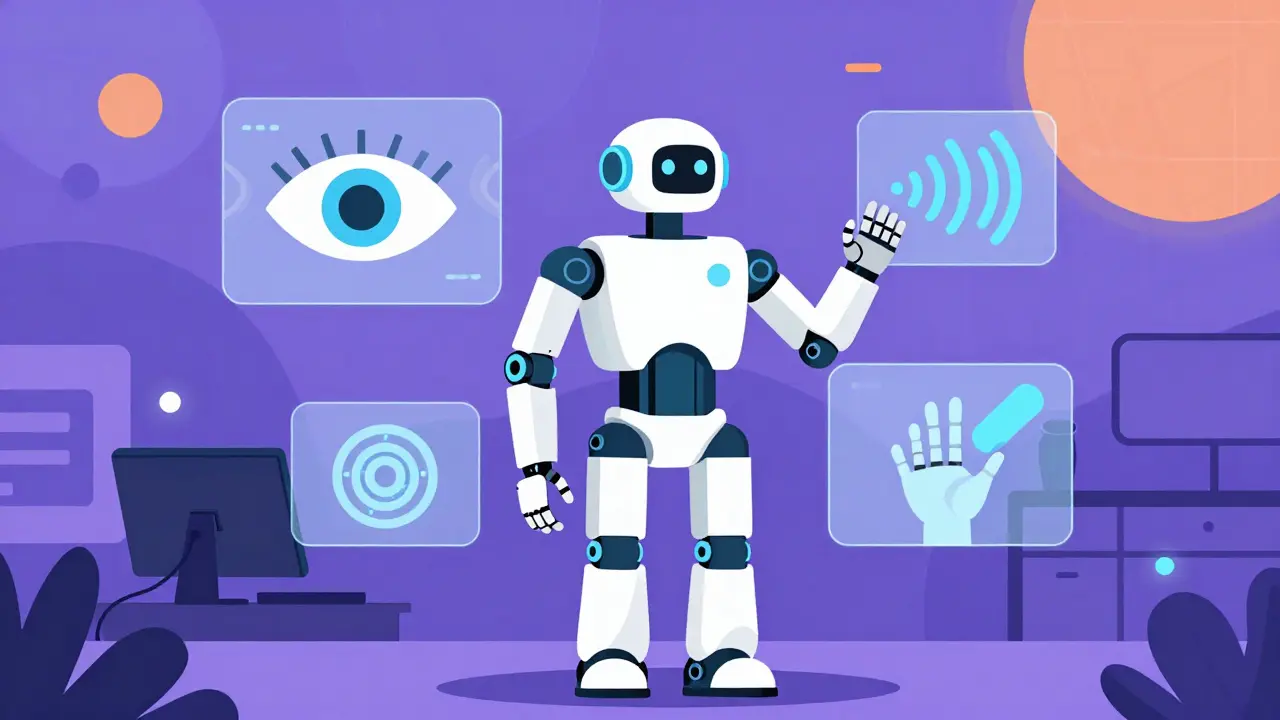
Looking ahead, the frontier of multimodal AI is moving toward embodied intelligence. NVIDIA’s Project GROOT, announced in September 2025, combines vision, audio, and tactile inputs for robotics applications. This represents a shift from passive observation to active interaction with the physical world.
Long-term viability appears strong. Ninety-one percent of AI researchers surveyed in October 2025 predict that multimodal capabilities will become standard in all generative AI systems within three years. While energy efficiency remains a challenge-with multimodal training consuming 2.8x more energy per inference-the World Economic Forum positions this technology as the critical bridge to truly context-aware artificial general intelligence. The future of AI isn't just about what it says, but what it perceives.
What is the main difference between multimodal AI and text-only AI?
Text-only AI processes language in isolation, missing context from images, audio, or other data types. Multimodal AI integrates multiple data sources simultaneously, allowing it to understand relationships between different inputs, such as matching a spoken word to a visual object, resulting in more accurate and nuanced outputs.
Is multimodal AI more expensive to run than text-only models?
Yes, significantly. Multimodal systems require about 3.5x more processing power and at least 80GB of VRAM for high-resolution tasks. They also consume 2.8x more energy per inference. However, the increased accuracy and broader functionality often justify the cost for complex enterprise applications.
Which industries benefit most from multimodal AI?
Healthcare, customer service, and retail are leading adopters. Healthcare sees up to 37% reduction in diagnostic errors by combining images and records. Customer service improves resolution rates by 41% by analyzing tone and text. Retail uses it to identify trends from social media visuals and text.
Can multimodal AI replace human workers completely?
Not currently. While multimodal AI excels at pattern recognition and data synthesis, it still struggles with causal reasoning and can misinterpret satirical or culturally nuanced content. It serves best as an augmentation tool, handling repetitive analysis and providing insights to human decision-makers.
What are the biggest risks associated with multimodal AI?
Key risks include higher bias amplification (15.8% higher than text-only models), potential misinterpretation of conflicting signals (e.g., satire vs. fact), and high computational costs. There are also privacy concerns regarding biometric data processing, which is now regulated under laws like the EU AI Act.