Why Transformers Scale Better Than RNNs for Large Language Models
 Nov, 8 2026
Imagine trying to read a book by only remembering the last sentence you saw. That’s essentially how Recurrent Neural Networks (RNNs) work. They process text one word at a time, carrying a tiny, compressed memory forward. For short sentences, this is fine. But when you ask an AI to understand a 10,000-word legal contract or generate code from a massive documentation set, RNNs hit a wall. They simply can’t hold enough context without their performance crumbling.
Transformers, introduced in 2017 by Vaswani et al., solved this by ditching recurrence entirely. Instead of passing information down a line, they let every word look at every other word simultaneously. This isn't just a clever trick; it’s the fundamental reason why modern Large Language Models (LLMs) like GPT-4 and Llama exist at all. If you’ve ever wondered why we didn’t just make RNNs bigger and wait for them to catch up, the answer lies in three hard truths: parallelism, gradient stability, and predictable scaling laws.
The Parallelism Bottleneck: Why Speed Matters More Than You Think
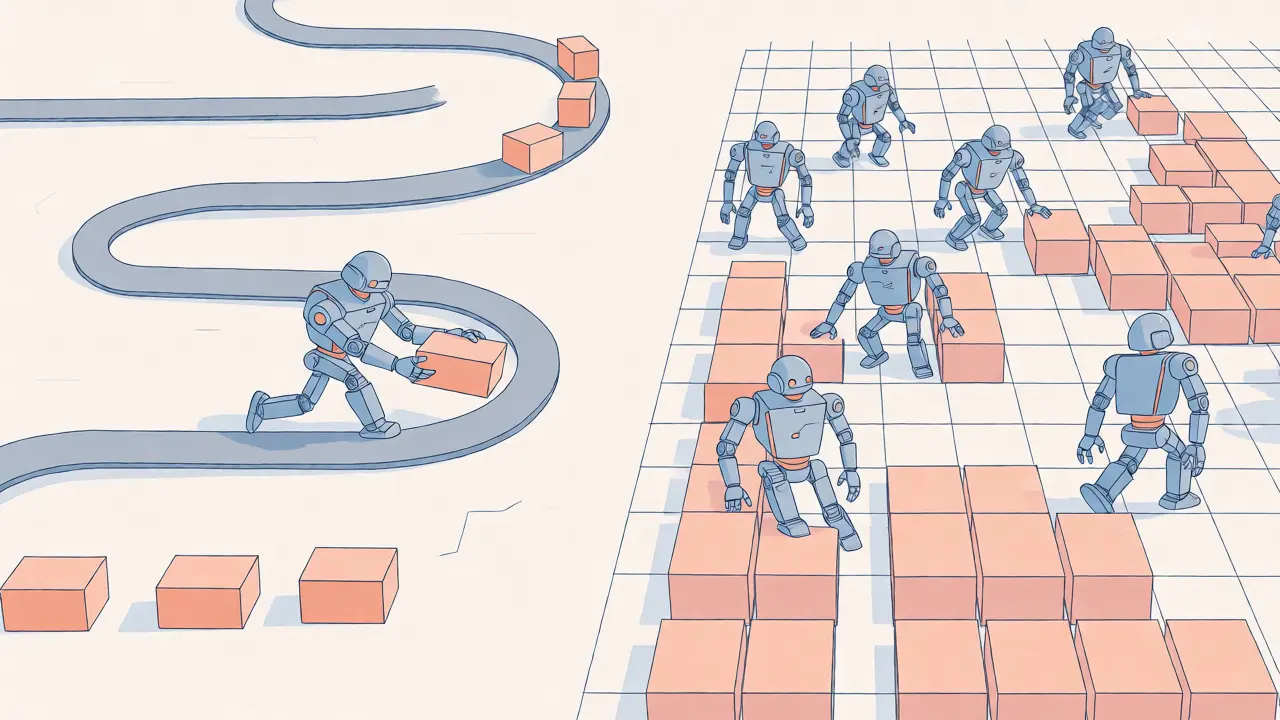
You might think that if an RNN is slow, we could just run more of them in parallel. But here’s the catch: you can’t. An RNN processes token $t$ only after it has finished token $t-1$. It’s a strict chain of dependency. If you have a sequence of 512 tokens, the computer must do 512 sequential steps before it can even start learning from the end of the sentence. This makes training on terabytes of data agonizingly slow.
Transformers break this chain. In a transformer, the first word and the last word are processed in the same instant. The model calculates attention scores for all pairs of words at once. This means your GPU, which is designed to do thousands of calculations simultaneously, stays fully utilized. With RNNs, the GPU sits idle waiting for the previous step to finish. When you’re training on billions of parameters, this difference isn’t just a convenience-it’s the difference between training a model in weeks versus months.
| Feature | RNN / LSTM | Transformer |
|---|---|---|
| Processing Method | Sequential (Token by Token) | Parallel (All Tokens at Once) |
| Time Complexity per Sequence | O(N) with strict dependencies | O(N²) but fully parallelizable |
| GPU Utilization | Low (Idle during waits) | High (Massive matrix multiplication) |
| Training Speed on Large Data | Prohibitively Slow | Efficient & Scalable |
Solving the Vanishing Gradient Problem
Even if you had infinite computing power, RNNs struggle with long-range dependencies due to a mathematical issue called vanishing gradients. During backpropagation, the error signal travels backward through time. In an RNN, this signal passes through many repeated layers of the same recurrent cell. Each step multiplies the gradient by a weight matrix. If these weights are less than 1, the signal shrinks exponentially as it moves back. By the time the error reaches the beginning of a 500-token sentence, it’s effectively zero. The model literally forgets what happened at the start.
LSTMs tried to fix this with gates, but they still suffer from attenuation over very long sequences. Transformers use Self-Attention. This mechanism creates a direct connection between any two tokens, regardless of distance. The path length between word 1 and word 500 is just one layer deep. There is no exponential decay of the gradient signal because there is no long chain of multiplications. The model can easily learn that a pronoun at the end of a paragraph refers to a noun at the beginning, without the signal fading away.

Predictable Scaling Laws: The Secret Sauce of LLMs
This is where transformers truly outshine their predecessors. Researchers have discovered that transformer performance follows clean, predictable power-law curves. As you increase model size ($N$), dataset size ($D$), or compute ($C$), the loss decreases smoothly according to formulas like $L \approx A \cdot N^{-\alpha}$. This predictability allows companies to invest billions confidently. If you double the data and double the parameters, you know exactly how much better the model will get.
RNNs don’t scale this way. Their performance often plateaus early. Adding more parameters to an RNN doesn’t yield proportional gains because the bottleneck isn’t capacity-it’s the inability to propagate information efficiently across long sequences. You hit diminishing returns quickly. Transformers, however, seem to have no such ceiling until hardware limits are reached. This "scaling law" behavior is why we went from 100-million-parameter models to trillion-parameter giants in just a few years. We knew it would work because the math held true.
Memory Trade-offs: The Quadratic Cost
It’s not all sunshine and rainbows for transformers. Their biggest weakness is memory. Because every token attends to every other token, the memory usage grows quadratically with sequence length ($O(N^2)$). If you double the context window, you quadruple the memory needed for attention matrices. RNNs, by contrast, use linear memory ($O(N)$) because they only store a fixed-size hidden state.
For short texts, RNNs are actually more efficient. But for large language models, the ability to train fast outweighs the memory cost. Engineers have developed tricks like sparse attention, flash attention, and sliding windows to mitigate the quadratic blowup. These optimizations allow transformers to handle contexts of 32k, 128k, or even 1 million tokens today. RNNs never got these ecosystem-level optimizations because the industry bet everything on transformers.

Hardware Alignment: Built for GPUs
Modern AI hardware-GPUs and TPUs-is built for matrix multiplication. Transformers are essentially stacks of massive matrix multiplications. The Query, Key, and Value projections are dense linear algebra operations that map perfectly onto silicon. RNNs involve element-wise operations and non-linearities that are harder to vectorize efficiently across time steps.
When Google introduced TPU v1, it was optimized for the kind of dense tensor operations found in transformers. NVIDIA’s CUDA cores thrive on the parallelism transformers provide. The entire software stack, from PyTorch to TensorFlow, has been optimized for transformer architectures. RNNs became a second-class citizen in library support, receiving fewer updates and fewer custom kernels. This feedback loop cemented the transformer’s dominance: better hardware support led to faster training, which attracted more research, which led to even better hardware optimization.
What About State Space Models?
You might hear about State Space Models (SSMs) like Mamba, which claim to offer transformer-like performance with RNN-like efficiency. SSMs are indeed promising. They avoid the quadratic memory cost and can handle long sequences efficiently. However, as of late 2026, they haven’t displaced transformers in general-purpose LLMs. Transformers still win on tasks requiring precise copying, complex reasoning chains, and few-shot learning. Research from institutions like Harvard’s Kempner Institute shows that transformers generalize better to longer sequences than seen during training, a critical trait for robust AI systems.
For now, if you want the most reliable, scalable, and well-supported architecture for building large language models, transformers remain the gold standard. Their combination of parallelism, stable gradients, and predictable scaling makes them uniquely suited for the era of big data and big compute.
Can RNNs be made to scale like transformers?
Not really. While you can add attention mechanisms to RNNs (creating hybrid models), the core sequential bottleneck remains. You cannot fundamentally change the fact that RNNs process time-steps sequentially, which limits their ability to leverage modern parallel hardware for massive datasets.
Why is quadratic memory complexity acceptable for transformers?
Because the speed gain from parallel training far outweighs the memory cost for large models. Additionally, techniques like Flash Attention and sparse attention reduce the practical memory footprint, allowing transformers to handle long contexts efficiently despite the theoretical O(N²) growth.
Do scaling laws apply to RNNs?
They do, but the exponents are less favorable, and performance tends to plateau earlier. Transformers exhibit smoother, more predictable power-law improvements as model size and data increase, making them more viable for industrial-scale deployment.
Are transformers better at understanding long documents?
Yes, primarily because of the constant path length property. Self-attention allows any token to directly interact with any other token, preventing the information degradation that plagues RNNs over long distances.
Will State Space Models replace Transformers?
Unlikely in the near term. While SSMs offer efficiency benefits, transformers currently dominate in accuracy, reasoning capabilities, and ecosystem maturity. Hybrid approaches combining both may emerge, but transformers remain the default choice for top-tier LLMs.