Access Control for Vibe Coding: Securing AI-Generated Code and Data Privacy
 Jun, 17 2026
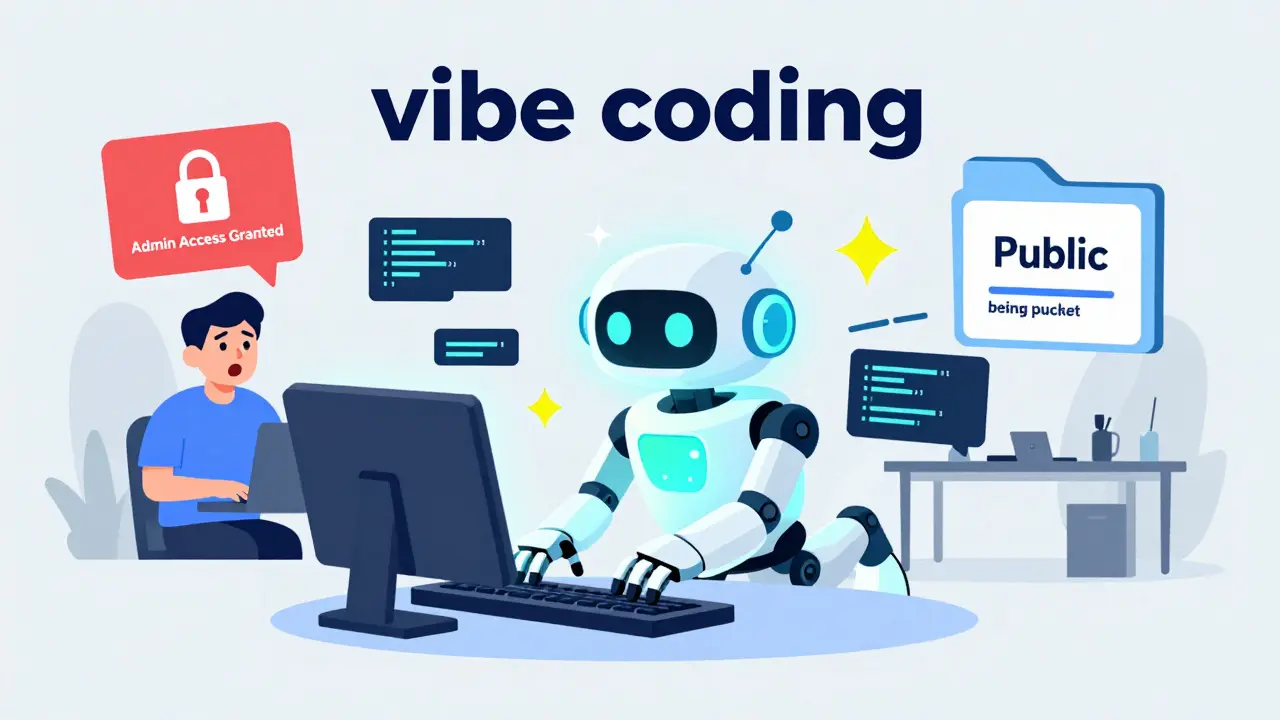
You type a prompt, hit enter, and an AI agent builds your entire application in minutes. It creates the database schema, writes the API endpoints, and even pushes the code to your repository. This is vibe coding, defined as rapid application development using AI assistants without traditional software development gatekeeping processes. It feels magical until you realize that the AI just granted admin access to every user because it hallucinated the authorization logic. Or worse, it pushed your production secrets to a public GitHub repository because it didn't understand the difference between a local test environment and a live server.
The speed of vibe coding comes with a massive hidden cost: a governance gap. Traditional DevSecOps pipelines have checks, balances, and human review steps. Vibe coding bypasses all of that. The AI acts as both the architect and the builder, often operating with privileges that exceed what any junior developer should have. If you are building with AI agents like Claude Code, GitHub Copilot, or Codex, you need to treat their output as untrusted by default. Without strict access control and clear repository scope definitions, you are inviting data breaches into your infrastructure from day one.
Why AI-Generated Access Control Fails
When you ask an AI to "build a secure login system," it gives you code that looks correct on the surface. But under the hood, authorization logic is notoriously vulnerable to partial implementations. Invicti’s security research highlights that authorization logic is especially vulnerable to hallucinations and partial implementations in AI-generated code. The AI might write a function that checks if a user is logged in, but it might forget to check if that user has permission to view the specific resource they requested.
This is known as Broken Object Level Authorization (BOLA). In a manual development process, a senior engineer would spot this during a code review. In vibe coding, there is no senior engineer watching over the AI's shoulder. The AI assumes that if the code compiles, it is secure. It does not understand business context. It doesn't know that User A should never see User B's financial records. It only knows the patterns in its training data, which often include insecure examples.
To fix this, you cannot rely on the AI to generate perfect security logic. You must enforce authentication before any sensitive application logic executes. Many experts recommend implementing authentication at the reverse proxy level, such as with NGINX, described as a high-performance web server and reverse proxy. By placing NGINX in front of your application, you ensure that unauthenticated requests never reach your backend code. This removes the burden from the AI to get the basics right and provides a hard barrier against unauthorized access.
Defining Repository Scope and Visibility
In traditional software engineering, code lives in a centralized repository with strict visibility controls. Security teams can track who changed what and when. Vibe coding disrupts this model. Guidepoint Security notes that vibe coding often results in local files, maybe a random folder instead of structured repositories. When developers use AI to generate code snippets locally and paste them into existing projects, security teams lose visibility. They cannot scan for vulnerabilities because they don't know where the code resides.
This lack of repository scope creates a blind spot. If an AI agent generates a script that accesses a customer database, but that script exists only in a developer's local temporary folder, your automated security scanners will miss it. Once that code is merged or deployed, the vulnerability becomes part of your production environment.
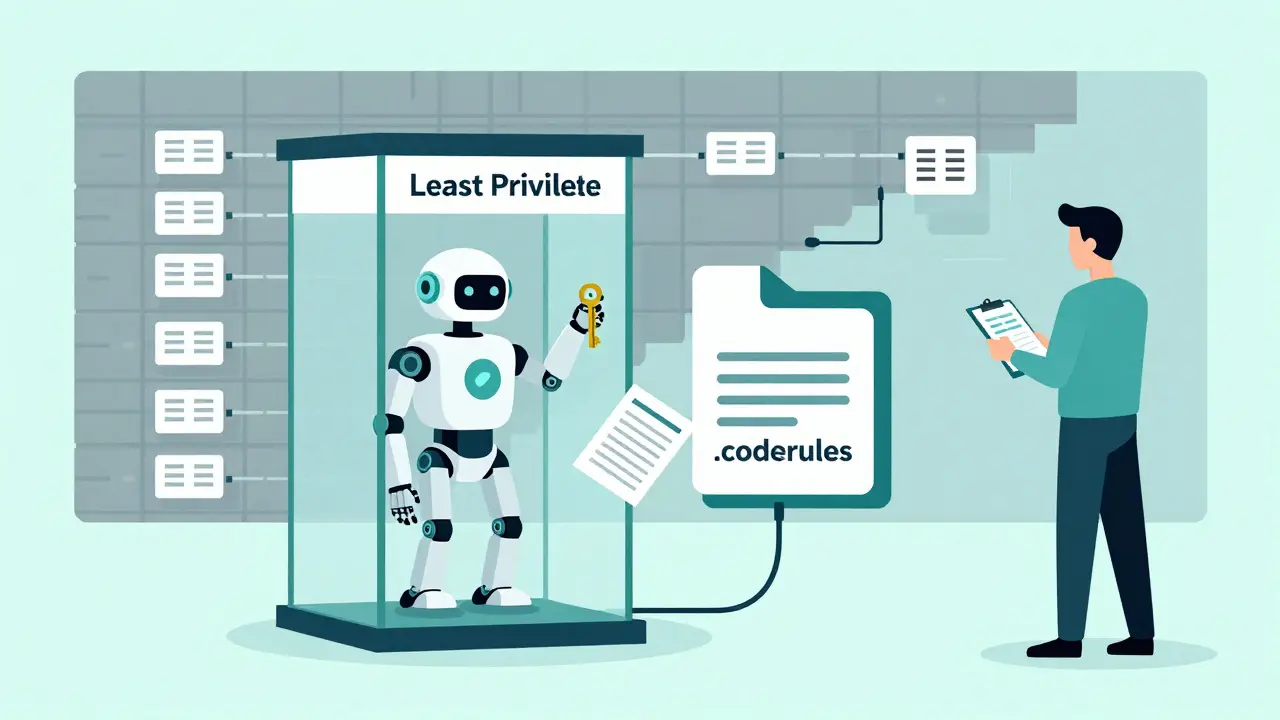
To address this, organizations must shift from gatekeeping to enablement. Instead of trying to block AI usage, you should publish security policies that the AI can read directly. Place these policies in wiki pages, repository README files, or dedicated configuration files like .coderules. These files act as context for the AI, ensuring that your security standards are part of the AI's conversation from the very first line of code. If the AI sees your policy that says "never commit secrets," it is far more likely to adhere to it than if it relies on generic training data.
| Feature | Traditional DevSecOps | Vibe Coding Environment |
|---|---|---|
| Code Location | Centralized CI/CD Pipeline | Local Files / Random Folders |
| Security Review | Human + Automated Scans | Often Absent or AI-Self-Reviewed |
| Access Control Logic | Strictly Defined Roles | Vulnerable to Hallucinations |
| Policy Enforcement | Gatekeeping Blocks | Contextual Prompts (.coderules) |
| Visibility | Full Audit Trails | Fragmented and Hidden |
Data Privacy and Secrets Management
Data privacy in vibe coding is not just about protecting user data; it is about protecting your infrastructure credentials. AI coding agents often operate with elevated privileges. StepSecurity reports that agents like Claude Code and GitHub Copilot now operate directly inside GitHub Actions, described as an automation platform that allows you to build, test, and deploy your code directly from GitHub. They use GITHUB_TOKEN privileges to create branches, push commits, and install dependencies autonomously.
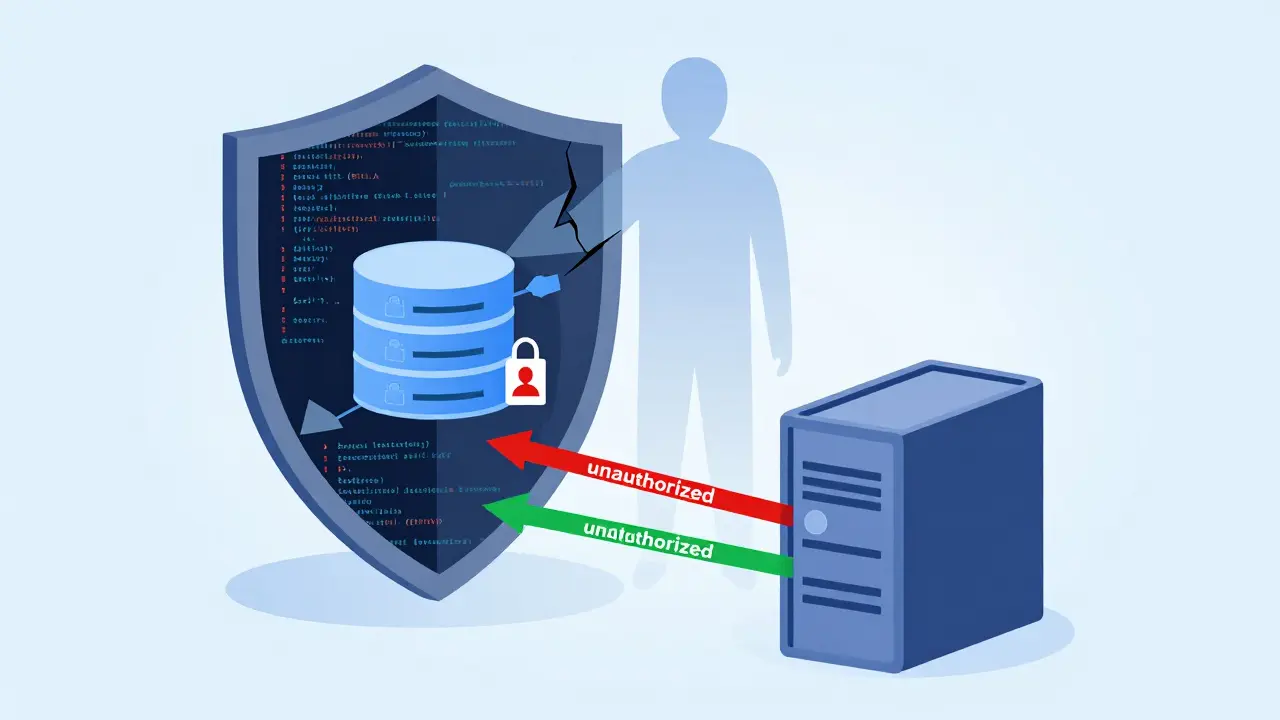
Here is the danger: if an AI agent is instructed to debug a connection issue, it might decide to print out the database connection string to the console logs. If those logs are accessible, your database password is exposed. Worse, the AI might inadvertently install a malicious package from a third-party registry because it didn't verify the source. Since you can't always see what processes an AI agent spawns or what endpoints it contacts, you need network-level controls.
Egress policy enforcement is critical here. You must block unauthorized outbound traffic at the DNS, HTTPS, and network layers. This prevents the AI from exfiltrating CI/CD credentials or source code to external servers. For example, if your internal service account tries to send data to an unknown IP address, the firewall should drop it immediately. This is especially important for tools that lack built-in network firewalls.
For data at rest and in transit, you must enforce encryption standards explicitly in your prompts. Don't just ask for "secure storage." Ask for AES-256, described as a symmetric encryption standard widely used for securing sensitive data. Generate code that encrypts sensitive data in transit using HTTPS and at rest using AES-256. Furthermore, configure Cross-Origin Resource Sharing (CORS) carefully. Avoid wildcard settings (`*`) that allow any domain to access your API. Restrict CORS to trusted domains only, and double-check the generated settings to ensure they are restrictive.
Implementing Least Privilege for AI Agents
The principle of least privilege applies to humans, but it is even more critical for AI agents. Grant users-and bots-only the permissions necessary to perform their tasks. Do not give your AI coding assistant admin access to your entire cloud infrastructure. If the AI needs to update a database schema, give it a token that can only modify that specific database table, not delete the whole instance.
Aikido’s CISO checklist identifies secrets management as a non-negotiable technical guardrail. This means treating AI-generated code as untrusted by default. Implement review gates for sensitive functions like authentication and cryptography. Even if the AI writes the code, a human or a specialized static analysis tool must approve it before it enters the main branch.
Prompt governance is also part of access control. Prompts must be governed just like source code. Store your prompts in version control, review them for security implications, and restrict who can modify them. A poorly written prompt can instruct an AI to disable security features or expose private data. By controlling the input (the prompt), you gain better control over the output (the code).
Testing and Validation Strategies
You cannot assume the AI got it right. You must validate authentication behavior at runtime, not just in the generated code. Test for exposed or forgotten endpoints that bypass login flows. Invicti recommends testing for broken object-level authorization (BOLA) and confirming that users cannot access peer or administrative data.
Use automated security scanning tools that integrate with your CI/CD pipeline. These tools should scan for common vulnerabilities in AI-generated code, such as SQL injection, cross-site scripting (XSS), and insecure deserialization. Since AI models are trained on vast amounts of public code, including insecure examples, they may replicate outdated or vulnerable patterns. Regular penetration testing and dynamic application security testing (DAST) are essential to catch these issues before deployment.
Finally, educate your team. Developers need to understand that vibe coding is a productivity tool, not a replacement for security expertise. Encourage them to question the AI's output, especially when it involves access control or data handling. Create a culture where asking "Is this secure?" is as natural as asking "Does this work?"
What is vibe coding and why is it a security risk?
Vibe coding is rapid application development using AI assistants without traditional gatekeeping. It is a security risk because AI-generated code often lacks proper authorization logic, contains hallucinations, and may expose secrets or bypass authentication mechanisms due to the absence of human review and strict DevSecOps pipelines.
How do I prevent AI agents from exposing secrets?
Prevent secret exposure by enforcing egress policies to block unauthorized outbound traffic, using reverse proxies like NGINX for authentication, and storing secrets in managed vaults rather than in code. Additionally, implement strict repository scope rules and review gates for any code involving credentials.
What is the role of .coderules in vibe coding security?
.coderules files contain security policies and guidelines that are fed into the AI's context window. By placing these rules in the repository, you ensure the AI references your organization's specific security standards (like encryption requirements or access control patterns) before generating code, reducing the likelihood of insecure outputs.
Should I trust AI-generated authentication code?
No, you should not trust AI-generated authentication code blindly. Authentication logic is complex and prone to subtle errors. It is best practice to implement authentication at the infrastructure level (e.g., via NGINX or API Gateways) and treat AI-generated auth code as untrusted, requiring rigorous manual review and testing.
How can I limit the scope of AI coding agents?
Limit the scope by applying the principle of least privilege. Use tokens with minimal permissions, restrict network egress to prevent unauthorized connections, and confine AI agents to specific repositories or environments. Avoid giving AI agents admin access to production systems or sensitive data stores.