AdamW vs Adafactor vs Lion: Choosing the Best Optimizer for LLM Training in 2026
 Jun, 29 2026
You’re staring at a GPU out-of-memory error. Your batch size is stuck at 1, and your training run has been crawling for three days. You know the architecture is sound, but something about the optimization step feels inefficient. This is the exact moment where choosing the right optimizer stops being an academic exercise and becomes a financial decision.
For years, AdamW was the undisputed king of deep learning. It was reliable, well-documented, and just worked. But as Large Language Models (LLMs) have ballooned from millions to billions of parameters, the "just works" approach is costing teams thousands of dollars in wasted compute. In 2026, the landscape has shifted. You now have viable alternatives like Lion and Adafactor that promise significant memory savings and faster convergence, albeit with different trade-offs.
This isn’t about finding a magic bullet. There is no single best optimizer for every scenario. Instead, it’s about matching the optimizer’s mathematical properties to your specific hardware constraints and performance goals. Let’s break down how AdamW, Adafactor, and Lion actually perform in real-world training pipelines, so you can stop guessing and start optimizing.
Why Optimizer Choice Matters More Than Ever
In traditional machine learning, the optimizer’s job is simple: update weights to minimize loss. In LLM training, the stakes are higher because of the sheer scale. An optimizer doesn’t just store the model weights; it stores state variables for each parameter. For AdamW, this means storing two moving averages (first and second moments) per parameter. If your model has 7 billion parameters, AdamW requires roughly 3x the memory of the model itself just to track these states.
This memory overhead directly limits your batch size. A smaller batch size means less stable gradients, which often forces you to use gradient accumulation-a technique that adds computational complexity and slows down training. According to data from the Harvard Kempner Institute (2024), memory-efficient optimizers like Lion and Adafactor require 30-40% less memory than AdamW for equivalent model sizes. That 30% saving isn’t just a number on a spreadsheet; it’s the difference between fitting a batch size of 4 versus a batch size of 8 on the same A100 GPU cluster.
Furthermore, the choice of optimizer impacts convergence speed. Some optimizers reach target perplexity scores significantly faster, reducing the total GPU hours required. In July 2024, studies showed that certain modern optimizers could achieve up to 2.3x faster training in GPU hours compared to standard AdamW configurations. When you’re paying by the hour for cloud instances, that speedup translates directly to cost savings.
AdamW: The Reliable Standard
AdamW is a variant of the Adam optimizer that decouples weight decay regularization from the gradient update, introduced by Ilya Loshchilov and Frank Hutter in 2017. Despite its age, it remains the industry standard for LLM pretraining. As of late 2025, approximately 75-80% of published LLM research still uses AdamW. Why? Because it is robust.
AdamW handles a wide range of hyperparameters without catastrophic failure. You don’t need to spend weeks tuning the learning rate schedule or momentum terms to get reasonable results. It provides a predictable baseline. If you switch to a newer optimizer and performance drops, you can always blame the optimizer rather than your data pipeline.
| Attribute | Value/Description |
|---|---|
| Memory Overhead | ~3x model size (stores first and second moments) |
| Convergence Speed | Moderate; baseline for comparison |
| Downstream Accuracy | High; consistently achieves 2-4% higher accuracy on benchmarks like SuperGLUE and MMLU |
| Implementation Ease | Very High; native support in PyTorch, TensorFlow, JAX |
| Best Use Case | Research settings, final fine-tuning, when memory is not the primary bottleneck |
The main drawback of AdamW is its memory hunger. For very large models (e.g., 70B+ parameters), the optimizer state alone can consume hundreds of gigabytes of VRAM. This forces engineers to use techniques like ZeRO-Offload or DeepSpeed, which add communication overhead. If your goal is maximum downstream task performance and you have ample memory, AdamW is still the safest bet. However, if you are hitting memory walls, it’s time to look elsewhere.
Lion: The Memory-Efficient Challenger
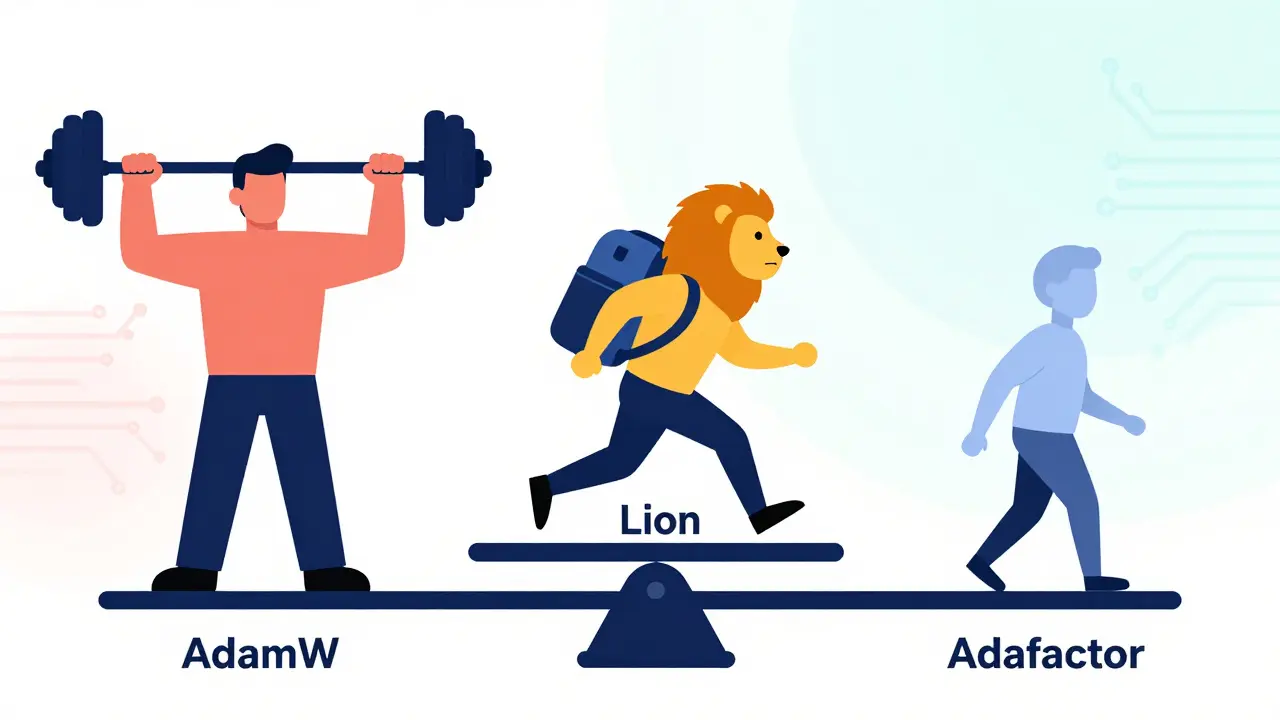
Lion is a sign-based optimizer discovered through evolutionary search that eliminates second-moment calculations, introduced by Chen et al. in 2023. Unlike AdamW, Lion only maintains the first moment estimate. It uses a unique update rule based on the sign of the gradient, which drastically reduces memory overhead to approximately 2x the model size.
This architectural simplicity has profound practical implications. By removing the second-moment buffer, Lion frees up significant VRAM. In production environments, this allows for larger batch sizes without increasing hardware costs. Google, where Lion originated, has deployed it in search ads Click-Through Rate (CTR) models specifically because of these tight memory constraints.
Performance-wise, Lion is impressive. Benchmarks from mid-2024 show that Lion can reach target perplexity scores 18-22% faster than AdamW in language modeling tasks. It matches or slightly outperforms AdamW in perplexity metrics while using less memory. For many practitioners, this combination of speed and efficiency is hard to ignore.
However, Lion is not without quirks. It requires more careful hyperparameter tuning. Users report that default settings often lead to slower convergence or instability, especially for smaller models (under 1B parameters). One senior engineer noted on GitHub that switching to Lion reduced their memory footprint by 35% for a 7B parameter model, allowing them to increase batch size by 2.1x. But another user complained that Lion required extensive tuning for a 1.3B model before it converged properly. If you choose Lion, be prepared to spend time adjusting learning rates and momentum coefficients.
Adafactor: The Legacy Memory Saver
Adafactor is an optimizer designed for memory-constrained training of large transformer models by approximating second-moment statistics, created by Noam Shazeer and Mitchell Stern at Google in 2018. Adafactor was one of the first optimizers to seriously challenge AdamW’s dominance in the NLP space. It achieves memory efficiency by approximating the second-moment matrix as the outer product of two vectors, cutting memory usage to approximately 1.5x the model size.
That 1.5x factor is significantly lower than both AdamW (3x) and Lion (2x). For extremely large models where every megabyte counts, Adafactor is still relevant. It was the go-to choice for training early versions of T5 and other massive transformers.
But recent comparisons paint a mixed picture. Adafactor consistently shows 8-12% slower convergence than AdamW for smaller models like GPT-2-small. More critically, some 2025 studies suggest it performs strictly inferior to AdamW in terms of final loss metrics for certain architectures. Its learning rate schedule is also notoriously sensitive. Users frequently report failed training runs due to unstable gradients if the warmup steps aren’t perfectly calibrated.
Today, Adafactor occupies a niche role. It’s rarely the first choice for new projects unless you are working with legacy codebases or have extreme memory constraints that even Lion cannot satisfy. For most modern LLM training pipelines, Lion offers a better balance of memory efficiency and ease of use.
Head-to-Head Comparison: Performance vs. Cost
To make an informed decision, you need to compare these optimizers across key dimensions: memory usage, convergence speed, downstream accuracy, and implementation complexity.
| Feature | AdamW | Lion | Adafactor |
|---|---|---|---|
| Memory Overhead | High (~3x model size) | Medium (~2x model size) | Low (~1.5x model size) |
| Training Speed | Moderate | Fast (up to 2.3x faster GPU hours) | Slow (8-12% slower than AdamW) |
| Downstream Accuracy | Highest (SuperGLUE/MMLU) | Comparable to AdamW | Lower than AdamW |
| Hyperparameter Sensitivity | Low (Robust) | Medium (Requires tuning) | High (Sensitive LR schedules) |
| Community Support | Extensive | Growing | Moderate |
Notice the trade-off: AdamW gives you the highest downstream accuracy but at the cost of memory and speed. Lion gives you speed and memory efficiency but requires more tuning. Adafactor saves the most memory but sacrifices speed and ease of use.
There’s also the emerging player, Sophia, a second-order optimizer that achieved superior validation losses in some 2024 studies. However, Sophia requires 15-20% more computational resources, making it less attractive for budget-conscious teams. Similarly, AdamS, introduced in 2025, improves throughput over AdamW by 35.8%, but it’s still relatively new and lacks the broad community validation of AdamW.
How to Choose the Right Optimizer for Your Project
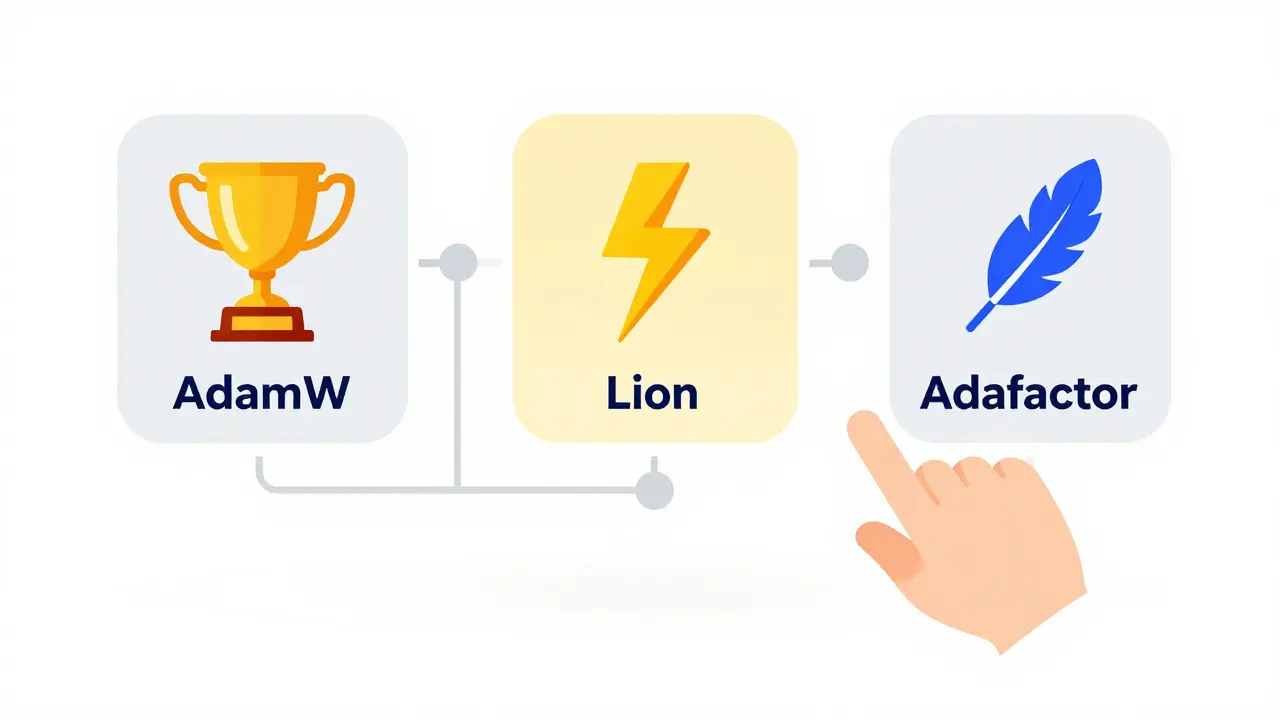
Your choice should depend on your primary constraint. Are you limited by memory, time, or accuracy?
- Choose AdamW if: You are doing research, fine-tuning for maximum downstream accuracy, or have abundant memory. It’s the safe, robust choice. If you’re unsure, start here.
- Choose Lion if: You are training large models (7B+) in a production environment where memory costs are high. You need to maximize batch size or reduce training time. Be prepared to tune hyperparameters carefully.
- Choose Adafactor if: You are working with extremely large models where even Lion’s 2x memory overhead is too much, and you have legacy infrastructure optimized for it. Otherwise, Lion is usually a better modern alternative.
Consider also the architecture of your model. Some studies suggest that GPT architectures interact differently with optimizers than LLaMA counterparts. For instance, Lion performed slightly better on average with LLaMA architectures in certain benchmarks. Always run a small-scale ablation study (e.g., train for 1,000 steps) with your top two choices before committing to a full training run.
Implementation Tips and Pitfalls
Switching optimizers isn’t just a drop-in replacement. You need to adjust your learning rate schedule and warmup steps. Here are some practical tips based on community feedback:
- Start with Default Learning Rates: Don’t copy-paste your AdamW learning rate into Lion. Lion typically benefits from a slightly higher base learning rate. Start with the values recommended in the original paper and then sweep ±20%.
- Monitor Gradient Norms: Lion’s sign-based updates can sometimes lead to noisy gradients. Monitor the gradient norm during training. If it spikes unexpectedly, consider adding gradient clipping.
- Use Mixed Precision Carefully: All three optimizers support mixed precision (FP16/BF16), but Lion’s memory savings are most pronounced when combined with BF16. Ensure your framework supports BF16 natively to avoid conversion overhead.
- Check LayerNorm Adaptivity: Zhao et al. (2024) highlighted that adaptivity on LayerNorm parameters is critical for stability. Ensure your implementation applies adaptive updates to LayerNorm layers, regardless of the optimizer you choose.
Finally, keep an eye on the ecosystem. Tools like DeepSpeed and FSDP (Fully Sharded Data Parallel) integrate seamlessly with AdamW. While support for Lion and Adafactor is growing, you may encounter bugs or lack documentation in distributed training setups. Check the compatibility of your specific training library before starting.
The Future of LLM Optimization
The optimizer landscape is fragmenting. We’re moving away from a one-size-fits-all approach toward specialized tools. By 2027, analysts predict that memory-optimized optimizers like Lion will capture 35-40% of the LLM training market. Meanwhile, automated machine learning pipelines will begin dynamically selecting optimizers based on training phase and resource constraints.
For now, the battle is between AdamW’s reliability and Lion’s efficiency. Adafactor is fading into the background, reserved for niche use cases. As model sizes continue to grow, the pressure to optimize memory and compute will only increase. The optimizer you choose today will define the cost and quality of your model tomorrow. Choose wisely.
Is Lion better than AdamW for all LLM tasks?
No. While Lion is faster and more memory-efficient, AdamW consistently achieves higher downstream accuracy on benchmarks like SuperGLUE and MMLU. Lion is better suited for production environments where memory and training time are critical, whereas AdamW remains the gold standard for research and final model quality.
How much memory does Adafactor save compared to AdamW?
Adafactor reduces memory overhead to approximately 1.5x the model size, compared to AdamW's ~3x. This means Adafactor uses roughly half the optimizer state memory of AdamW, making it ideal for extremely large models where VRAM is severely constrained.
Can I switch from AdamW to Lion without changing my learning rate?
It is not recommended. Lion uses a sign-based update rule, which behaves differently from AdamW's magnitude-based updates. You should re-tune your learning rate and warmup schedule when switching to Lion to ensure stable convergence. Starting with the default values from the Lion paper is a good baseline.
What is the current adoption rate of Lion in industry?
As of 2025, Lion captures approximately 12-15% of the LLM training market, primarily in production environments. In enterprise production systems, adoption is higher (around 47%) due to strict memory constraints, while it remains low (9%) in academic research settings.
Is Adafactor still relevant in 2026?
Adafactor is less common today due to its slower convergence and sensitivity to hyperparameters. However, it remains relevant for specific use cases involving extremely large models where its 1.5x memory overhead is advantageous. For most new projects, Lion is preferred as a more modern, balanced alternative.
Lisa Puster
June 30, 2026 AT 09:38another day another guru telling you what to do with your compute. honestly this is just corporate slop designed to make you feel smart while spending more money on cloud instances. nobody cares about the nuance of second moment estimators when the whole stack is built on sand. stop pretending there's a magic bullet and admit we're all just burning cash for vanity metrics.
Joe Walters
July 1, 2026 AT 04:06wait wait wait hold up. did i just read that lion is faster? i tried it last week and my model exploded into oblivion. maybe its because im dumb but the defaults were trash. also adafactor feels like using a abacus in 2026. why are we still talking about it??
Robert Barakat
July 2, 2026 AT 13:55The optimization landscape is merely a reflection of our collective inability to grasp the fundamental nature of gradient descent as a philosophical exercise rather than a computational one. We chase efficiency while ignoring the epistemological void left by stochastic updates.
Michael Richards
July 2, 2026 AT 17:03You guys are missing the point entirely. If you can't tune Lion properly, you don't deserve to train LLMs. It's not about the tool, it's about the operator. AdamW is for people who are afraid to touch hyperparameters. Stop complaining and learn the math or get out of the lab.
Laura Davis
July 2, 2026 AT 21:02Hey hey lets keep it civil here! I know tuning optimizers is super frustrating especially when you are just trying to get results for your thesis or project. But remember everyone starts somewhere. Maybe try starting with a smaller batch size and gradually increasing it? You got this!
Lisa Nally
July 3, 2026 AT 04:55Actually, from a strictly algorithmic perspective, the sign-based update rule in Lion introduces non-differentiable points which theoretically complicates the convergence landscape compared to the smooth manifold navigation of AdamW. However, empirical evidence suggests that in high-dimensional sparse regimes, the memory savings outweigh the theoretical purity concerns. It is crucial to understand that jargon like 'momentum decay' is often misapplied in these discussions.