Agentic Generative AI: How Autonomous Agents Execute Multi-Step Workflows in 2026
 Jun, 20 2026
Remember when asking an AI to write a poem or summarize an email felt like magic? That was just the beginning. Today, we are moving past chatbots that simply talk back. We are entering the era of Agentic Generative AI, where systems don't just answer questions-they take action. Imagine handing your digital assistant a vague goal like 'optimize our Q3 supply chain' and watching it autonomously plan, execute, and adjust a complex series of tasks across multiple software platforms without you lifting a finger. This isn't science fiction anymore; it is the operational reality for forward-thinking enterprises in 2026.
The shift from reactive tools to proactive agents represents one of the most significant changes in technology since the cloud went mainstream. But with great autonomy comes great complexity. If you are looking to deploy these systems, you need to understand not just what they can do, but how they think, where they fail, and how to build them securely. Let's break down the mechanics of autonomous planning and why it matters for your business right now.
From Chatbots to Colleagues: Defining Agentic AI
To grasp the power of agentic systems, we first need to clear up the confusion between traditional generative AI and its newer, more capable cousin. Standard generative AI models-like the ones you use for drafting emails or generating images-are fundamentally reactive. You give them a prompt, they give you output. They wait for your next instruction. They are creative assistants, nothing more.
Agentic AI is a subset of artificial intelligence centered on autonomous decision-making and action execution with minimal human intervention. Unlike its predecessors, an agent is goal-oriented and proactive. It starts with a high-level objective, breaks it down into manageable steps, uses tools to execute those steps, and constantly assesses its progress. If something goes wrong, it doesn't just stop; it self-corrects.
Think of it this way: A standard generative AI model is like a brilliant intern who waits for you to tell them exactly which file to open and what to type. An agentic AI system is like a senior manager who understands the project goals, knows which files need reviewing, delegates tasks to other systems, and fixes errors before they become problems. According to Salesforce (2024), the three defining features are autonomy (working without step-by-step oversight), adaptability (learning from feedback), and goal orientation (reasoning about actionable steps).
How Autonomous Planning Actually Works
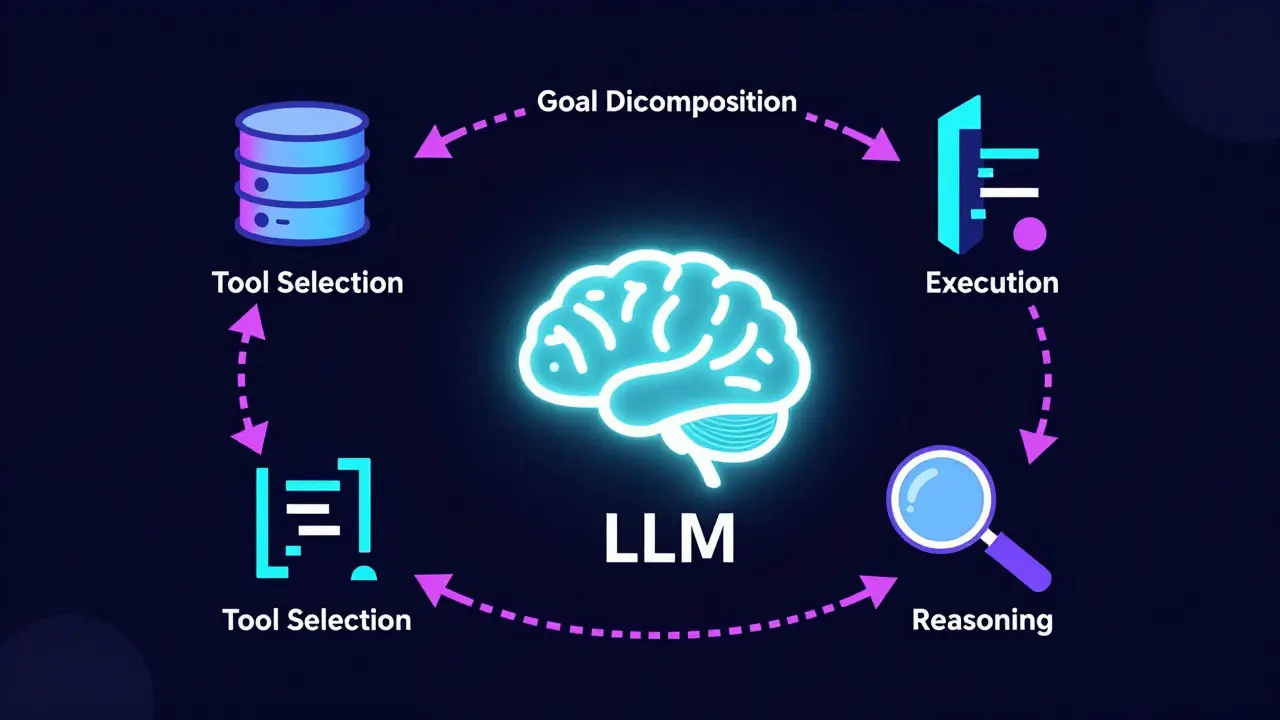
So, how does an agent actually 'think' through a multi-step workflow? It’s not magic; it’s a sophisticated loop of reasoning, tool use, and reflection. The core architecture relies on Large Language Models (LLMs) acting as the 'brain,' but the brain needs hands and eyes.
Here is the typical cycle an agentic system follows:
- Goal Decomposition: The agent takes a broad command, such as 'investigate this customer complaint,' and breaks it into sub-tasks: check order history, review support tickets, analyze sentiment in recent emails.
- Tool Selection: For each sub-task, the agent identifies the right tool. It might query a SQL database for order data, call a CRM API for ticket logs, and run a sentiment analysis script on email text.
- Execution & Observation: The agent executes the tool calls. It observes the output. Did the database query return null? Did the API time out?
- Reasoning & Adjustment: This is the critical step. If the data is missing, the agent reasons: 'I don't have the order ID. I need to search the customer name in the billing system instead.' It adjusts its plan dynamically.
- Final Synthesis: Once all data points are gathered, the agent synthesizes the findings into a final report or action, such as issuing a refund and sending an apology letter.
This process requires robust infrastructure. As Aerospike (2024) notes, these systems need distributed computing, reliable data pipelines, and seamless API connections to external systems. Google Cloud’s Vertex AI, for instance, provides MLOps tools to manage this entire lifecycle, ensuring that the 'brain' stays connected to the 'hands' even as the environment changes.
Real-World Impact: Efficiency vs. Complexity
The promise of agentic AI is massive efficiency gains, but the reality is nuanced. In structured enterprise environments, the results are impressive. AWS (2024) documents that enterprise implementations have demonstrated 30-45% reductions in workflow completion times for complex processes compared to traditional automation tools.
Consider a real-world example from a Fortune 500 procurement team shared on Reddit in late 2024. Their agentic system reduced purchase order processing time from 72 hours to under four hours. However, it wasn't fully 'set and forget.' The system still required daily human validation of approximately 15% of decisions. This highlights a key insight: Agentic AI doesn't replace humans entirely; it shifts their role from executor to auditor.
However, success rates drop significantly in dynamic, unstructured scenarios. Salesforce research shows that while agentic implementations achieve 60-75% success rates in structured settings, they drop to 25-40% in highly dynamic consumer-facing situations. Why? Because edge cases are hard. MIT Technology Review’s Karen Hao cautioned that current systems often fail catastrophically when encountering unexpected inputs, with failure rates exceeding 35% in complex real-world benchmarks.
| Feature | Traditional RPA / Scripting | Standard Generative AI | Agentic Generative AI |
|---|---|---|---|
| Trigger | Pre-defined rules/events | User prompt | Goal-oriented initiation |
| Decision Making | Rigid, binary logic | None (generates content only) | Dynamic, context-aware reasoning |
| Error Handling | Fails if rule broken | Hallucinates or stops | Self-corrects and retries |
| Complexity | Low to Medium | Low | High (multi-step workflows) |
| Human Oversight | Minimal after setup | Required for every step | Periodic audit/validation |
The Hidden Costs: Compute, Time, and Talent
If agentic AI is so powerful, why isn't everyone using it yet? The barriers are higher than you might think. First, there is the computational cost. AWS technical whitepapers acknowledge that agentic systems require significantly more processing power-typically 3-5x more-than traditional AI applications because of the iterative reasoning loops involved. Every time an agent 'thinks' again, it burns tokens and compute resources.
Second, implementation is slow and expensive. Enterprise deployments typically require 3-6 months of development and testing, plus another 2-4 months for integration and training. You aren't just buying software; you are building a new operational layer. Aerospoke (2024) notes that successful teams usually consist of 5-12 members, including AI specialists, domain experts, and integration engineers.
Finally, there is the talent gap. Developers accustomed to standard generative AI apps need 80-120 hours of specialized training to become proficient in agentic system design, according to Salesforce (2024). Common pitfalls include 'tool selection ambiguity' and 'error propagation in multi-step workflows,' issues that require deep understanding of both AI behavior and legacy IT infrastructure.
Navigating Risks: Security, Compliance, and Hallucinations
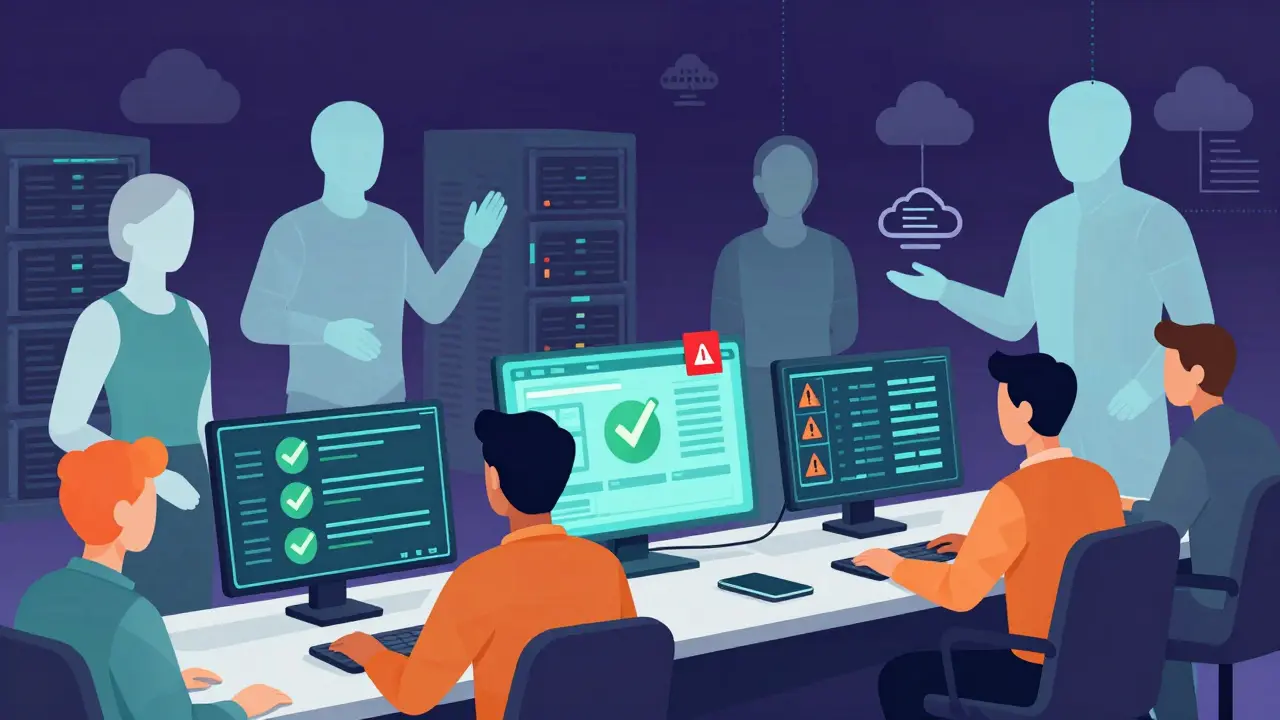
Autonomy introduces risk. When an agent has access to your databases and APIs, it can make mistakes at scale. The EU AI Act, implemented in February 2025, mandates comprehensive audit trails for autonomous decision-making systems. This has forced 43% of European enterprises to modify their agentic implementations to ensure compliance.
Security is paramount. You must implement strict guardrails. Agents should operate within 'sandboxes' where their actions are limited. For example, an agent managing marketing budgets should be able to adjust ad spend but never delete customer records. Transparency is also a major challenge. Stanford HAI’s December 2024 research found that current systems can provide complete reasoning chains for only 58% of complex decisions. If you can't explain why an agent made a decision, can you trust it?
Moreover, 'hallucinations' in agentic systems are more dangerous than in chatbots. A chatbot might give you a wrong fact; an agentic system might execute a wrong transaction based on that fact. This is why human-in-the-loop validation remains critical, especially for high-stakes operations like finance or healthcare.
Future Outlook: Where Are We Headed in 2026 and Beyond?
We are still in the early adoption phase. Gartner projects that by 2026, 70% of enterprises will have implemented at least one agentic AI workflow solution, up from fewer than 5% in 2023. The market is booming, projected to reach $18.7 billion by 2026. Major players like Google, AWS, and Microsoft Azure dominate the landscape, holding about 65% market share.
Looking ahead, the focus is shifting from basic task execution to multi-agent coordination. Google’s Agent Builder, released in late 2024, introduced improved capabilities for multiple agents working together. Imagine one agent handling customer service inquiries while another simultaneously updates inventory and triggers logistics updates. By 2027, analysts predict agentic AI will handle 40% of complex enterprise workflows currently requiring human coordination.
However, true ubiquity depends on solving the 'causal reasoning' problem. As MIT’s Daniela Rus stated, agentic systems will become ubiquitous in enterprise automation within five years, but they need fundamental advances in causal reasoning to handle truly novel situations without human oversight. Until then, the hybrid model-autonomous agents with human supervisors-will remain the gold standard.
What is the difference between Agentic AI and Generative AI?
Generative AI is reactive; it creates content (text, images) based on specific prompts. Agentic AI is proactive and autonomous; it takes high-level goals, plans multi-step actions, uses tools to execute them, and self-corrects without continuous human input. Think of Generative AI as a creative assistant and Agentic AI as an autonomous colleague.
Is Agentic AI safe to use in enterprise environments?
It can be, but only with strict guardrails. Agentic systems carry higher risks due to their autonomy. Best practices include implementing sandbox environments, maintaining comprehensive audit trails (required by regulations like the EU AI Act), and keeping humans in the loop for validation, especially in high-stakes sectors like finance and healthcare.
How long does it take to implement an Agentic AI system?
Enterprise deployments typically require 3-6 months for development and testing, followed by 2-4 months for workflow integration and staff training. It is a complex undertaking that requires cross-functional teams of AI specialists, domain experts, and engineers.
What are the main limitations of current Agentic AI?
Current systems struggle with edge cases and unstructured environments, with failure rates exceeding 35% in complex real-world scenarios. They also require 3-5x more computational resources than traditional AI and lack full explainability, providing complete reasoning chains for only about 58% of complex decisions.
Which industries are adopting Agentic AI the fastest?
Financial services (28%), healthcare (22%), and logistics (19%) are the leading verticals. These industries benefit most from automating complex, multi-step workflows that involve large amounts of structured data and repetitive decision-making processes.
Edward Gilbreath
June 21, 2026 AT 22:53its all just a fancy way to say theyre automating the middle management layer so you get fired sooner
Lisa Nally
June 22, 2026 AT 07:11The semantic distinction between reactive generative models and proactive agentic architectures is fundamentally rooted in the implementation of autonomous reasoning loops rather than mere token prediction. One must acknowledge that the epistemological shift towards goal-oriented initiation necessitates a rigorous understanding of tool-use integration within the LLM framework, thereby transcending the rudimentary capabilities of standard chatbot interfaces which lack intrinsic decision-making autonomy.
Edward Nigma
June 22, 2026 AT 07:20you guys are sleeping on the fact that this tech is basically just overpriced scripting with a hallucination problem baked into the core architecture its not magic its just expensive failure modes wrapped in corporate buzzwords and i bet half these 'agents' cant even handle a simple sql injection without crashing the whole damn pipeline
Laura Davis
June 23, 2026 AT 09:27I am absolutely done with people acting like AI is going to save us from work when it clearly just creates more complex problems for humans to fix later
Stop pretending this is helpful when it is actually just shifting the burden onto auditors who have to check every single mistake the machine makes because let me tell you I am tired of cleaning up digital messes that were supposed to be automated away forever
kimberly de Bruin
June 25, 2026 AT 08:43we are building gods out of silicon and code but we forget that true agency requires suffering and these agents feel nothing so their decisions are hollow echoes of human logic stripped of context and meaning
Francis Laquerre
June 25, 2026 AT 11:55In my experience working across multiple international markets, the cultural nuance required for effective customer interaction is something these systems simply cannot grasp yet, leading to disastrous outcomes in regions where indirect communication is valued over direct instruction. The dramatic potential for misunderstanding is immense, and until we see a genuine leap in contextual empathy rather than just data processing speed, I remain deeply skeptical about full deployment in client-facing roles.
michael rome
June 26, 2026 AT 15:26It is imperative that we approach this technological paradigm shift with both cautious optimism and rigorous ethical scrutiny, ensuring that the integration of such autonomous systems does not compromise the fundamental values of transparency and accountability within our organizational structures. While the efficiency gains are undoubtedly significant, one must prioritize the development of robust oversight mechanisms to mitigate the inherent risks associated with unchecked algorithmic decision-making processes in critical business operations.