AI Code Is Guilty Until Proven Secure: A Policy Framework for Teams
 Sep, 1 2026
You just shipped a feature in record time. The AI coding assistant generated the boilerplate, handled the edge cases you forgot about, and saved you three hours of grunt work. It felt like magic. But here is the uncomfortable truth: that code is guilty until proven secure. Treating AI-generated snippets with the same blind trust as your own hand-written logic is a gamble most teams are losing. Recent research from the Center for Security and Emerging Technology (CSET) found that nearly half of code snippets produced by major large language models contained bugs, many of which were potentially exploitable. If you aren't verifying every line, you aren't building software; you're accumulating technical debt at machine speed.
This isn't about hating on AI tools. It’s about adapting our security posture to a new reality where code volume explodes but human oversight capacity stays flat. We need a framework. Not a vague suggestion to "be careful," but a concrete policy structure that treats AI output as untrusted input by default. This article breaks down how to build that framework, moving from risk assessment to practical enforcement, so you can reap the productivity benefits without waking up to a breach caused by a hallucinated authentication check.
Why AI Code Requires Zero-Trust Verification
Traditional security assumes developers understand the context of what they write. When you write a function, you know why you’re handling user input that way. An Large Language Model (LLM) doesn’t have intent. It predicts tokens based on probability. It doesn’t know if your specific database schema requires parameterized queries or if your company’s compliance rules forbid storing PII in logs. It just knows what looks syntactically correct based on its training data.
The risks fall into three distinct buckets, according to analyses by Checkmarx and Contrast Security:
- Insecure Generation: The model produces code that works but fails security best practices-missing input validation, weak cryptographic implementations, or hardcoded credentials.
- Model-Level Vulnerabilities: The AI itself can be manipulated through prompt injection or poisoned training data, leading it to suggest malicious patterns.
- Systemic Supply Chain Risks: Insecure AI-generated code gets copied into open-source libraries, propagating vulnerabilities across thousands of downstream projects.
If you treat AI code as trusted, you expand your attack surface. You generate more code faster, meaning more opportunities for a vulnerability to slip through before review. The solution isn't to slow down development; it's to shift left with automated rigor. Adopting a "guilty until proven secure" stance means every AI-generated block must pass explicit verification gates before merging, regardless of how confident the developer feels.
Building Your Policy Framework: The Governance Layer
Policies fail when they are too abstract. "Use AI responsibly" means nothing to a junior dev rushing to meet a sprint deadline. You need granular rules that define scope, responsibility, and exceptions. Start by mapping where AI usage is permitted versus prohibited.
| Component Type | AI Usage Level | Required Controls |
|---|---|---|
| Cryptography & Auth | Prohibited / Limited | Human-only implementation; strict peer review if AI-assisted. |
| Business Logic | Permitted | Mandatory unit tests + SAST scan; contextual review. |
| UI Components | High Trust | Standard CI/CD checks; visual regression testing. |
| Data Access Layers | Caution | SCA for dependencies; query validation against schema. |
Notice the asymmetry. You don't ban AI everywhere. You ban it where mistakes are catastrophic (like auth) and allow it where errors are cheap to fix (like UI). This tiered approach prevents "governance paralysis," where teams ignore all policies because they feel restrictive. Define clear ownership, too. Who reviews AI code? Is it the author? A senior engineer? An AppSec specialist? For critical paths, mandate a second pair of eyes. For low-risk areas, automate the checks and let the pipeline decide.
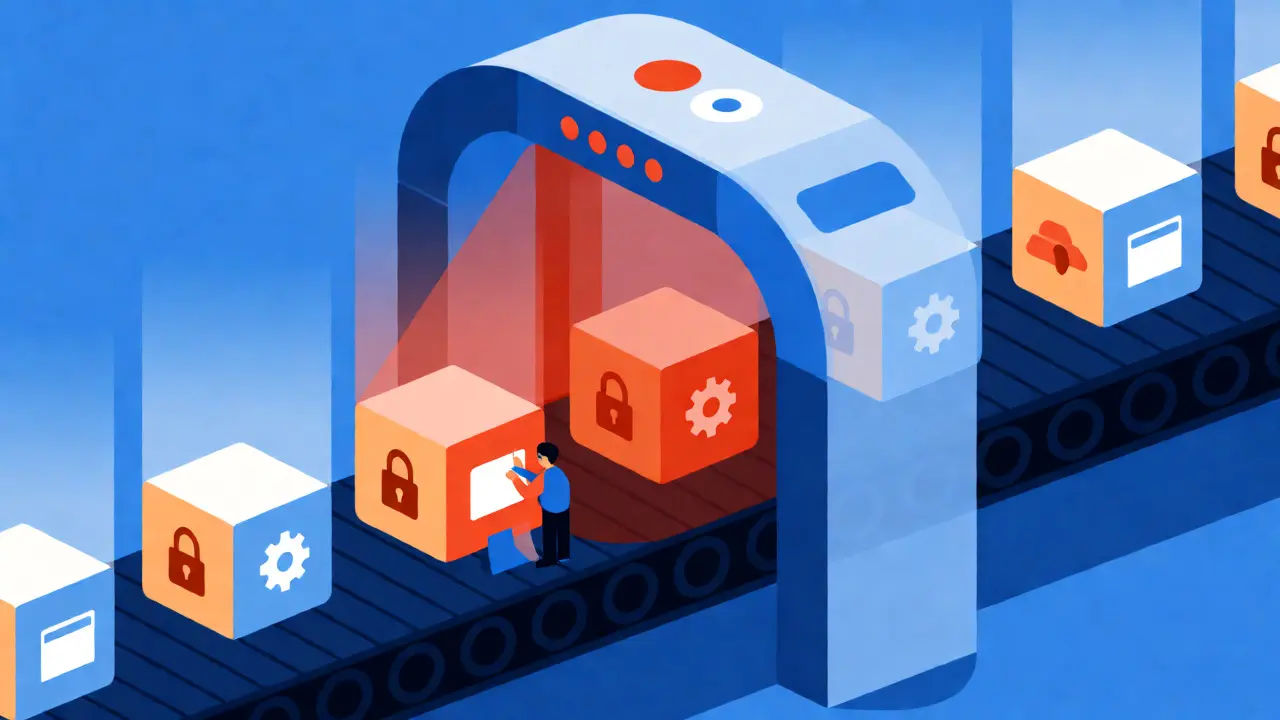
Technical Controls: Automating the Vetting Process
Manual review alone cannot keep pace with AI-driven velocity. You need a layered technical stack that acts as an immune system for your codebase. This starts inside the IDE and extends to production runtime.
First, integrate Static Application Security Testing (SAST) directly into the workflow. Modern SAST tools can now flag insecure patterns typical of AI generation, such as SQL injection vectors or improper error handling. But standard SAST often generates noise. To combat this, look for tools that offer AI-augmented analysis, which uses context to reduce false positives. Some emerging platforms, like Cisco’s Project CodeGuard, use rule-based validators that enforce secure-by-default patterns within the AI agent itself, catching issues before the code even hits the repository.
Next, enforce dependency hygiene with Software Composition Analysis (SCA). AI models love to pull in obscure libraries to solve simple problems. Without SCA, you might introduce a package with known CVEs or one that hasn't been maintained in five years. Set a policy: any new dependency introduced by AI code must be whitelisted or justified. Finally, don't forget runtime protection. Even with rigorous pre-deployment checks, some business logic flaws only manifest under load or specific conditions. Implementing Runtime Application Self-Protection (RASP) or Application Detection and Response (ADR) provides a safety net, alerting you if AI-generated code behaves unexpectedly in production.
Training Developers to Critique, Not Just Accept
The biggest failure point in AI adoption isn't the tool; it's human complacency. Developers often suffer from "automation bias," trusting the machine's output because it appears authoritative. Training needs to move beyond generic secure coding principles to specific AI literacy.
Teach your team to ask different questions when reviewing AI code. Instead of "Does this compile?", they should ask "Did the model invent this API method?" or "Is this random number generator cryptographically secure?" Run workshops where you show real examples of insecure AI code-like hardcoded API keys or missing CSRF tokens-and have devs spot the flaws. Create a culture where questioning AI output is encouraged, not seen as slowing down progress. Encourage developers to refactor AI suggestions rather than copy-pasting them. Rewriting the code forces engagement and understanding, turning the AI into a drafting partner rather than an oracle.

Implementing the Framework: A Phased Rollout
Don't try to boil the ocean. Attempting to implement perfect governance across all repositories overnight will lead to resistance and abandonment. Follow a maturity model inspired by the NIST AI Risk Management Framework:
- Discovery: Use automated tools to identify where AI code is already living in your repos. You’ll likely find more than you think.
- Pilot: Pick one non-critical service. Apply your new policy matrix and technical controls there. Measure the impact on delivery speed and bug rates.
- Refine: Adjust your rules based on pilot feedback. Did the SAST tool block too many valid commits? Tune the thresholds.
- Scale: Expand to other teams, prioritizing those with high AI usage. Provide support and champions who can help onboard others.
Track metrics that matter. Don't just count lines of code. Look at "time-to-remediation" for AI-related findings and the ratio of AI-generated code to human-reviewed code. These numbers tell you if your controls are working or just adding friction.
Future-Proofing Against Evolving Threats
The landscape changes fast. Today’s secure pattern might be tomorrow’s vulnerability as attackers learn to exploit common AI idioms. Stay agile by keeping your policy engine modular. Tools that allow natural-language policy definitions, like ZeroPath, let you update rules without redeploying infrastructure. As regulatory pressure mounts-think EU AI Act or future US standards-having documented governance processes will be your best defense during audits. Remember, the goal isn't to stop AI; it's to make it safe enough to rely on.
Is AI-generated code inherently less secure than human-written code?
Not necessarily. Studies suggest AI code has similar vulnerability densities to human code. However, AI increases the volume of code produced, which expands the attack surface. The risk lies in the lack of contextual understanding and the potential for systemic propagation of insecure patterns, not in inherent inferiority.
Should we ban AI coding assistants entirely?
No. Banning them ignores the significant productivity gains. Instead, restrict their use in high-risk areas like cryptography and authentication, while allowing broader use in lower-risk components like UI and boilerplate, provided appropriate security controls are in place.
What tools are needed to enforce a 'guilty until proven secure' policy?
You need a combination of SAST for static analysis, SCA for dependency management, and ideally runtime monitoring (RASP/ADR). Integrating these into the CI/CD pipeline ensures automatic verification. Newer AI-native security tools also offer context-aware scanning specifically tuned for AI-generated patterns.
How do we handle false positives from security scanners?
False positives can cause developer fatigue. Mitigate this by using risk-based prioritization, tuning scanner rules to your specific architecture, and employing AI-augmented triage tools that can distinguish between actual threats and benign anomalies. Regularly review and adjust your policy thresholds.
Who is responsible for the security of AI-generated code?
Responsibility should be shared. Developers are accountable for the code they merge, including AI contributions. AppSec teams provide the tools and guidelines. Engineering leadership owns the policy framework. Clear roles prevent the "someone else will catch it" mentality.