Audio Generation in Generative AI: Speech, Music, and Sound Effects Guide
 Oct, 21 2026
You type a prompt, hit enter, and seconds later you hear a voice that sounds like your favorite narrator, a jazz track that never existed, or the specific crunch of gravel under tires. This isn't magic; it's audio generation powered by generative AI models trained on massive datasets of human-made audio. The technology has moved from robotic, stilted voices to hyper-realistic synthesis that can fool even attentive listeners. But how does it actually work? And more importantly, which tools should you use for speech, music, or sound design?
This guide breaks down the three pillars of AI audio: speech synthesis, music generation, and sound effects. We’ll look at the tech behind them, compare leading platforms, and help you decide what fits your workflow.
The Tech Behind the Sound
At its core, audio generation is about predicting waveforms. Early systems used rule-based methods or concatenated snippets of recorded speech. Today’s systems use deep neural networks-specifically transformers, diffusion models, and variational autoencoders (VAEs)-to learn the statistical patterns of sound.
For speech synthesis, also known as Text-to-Speech (TTS), the process usually involves three stages:
- Text Analysis: The model converts text into phonemes and linguistic features.
- Acoustic Modeling: It predicts spectrograms (visual representations of sound frequencies) based on prosody, tone, and speed.
- Vocoder: A final layer, such as HiFi-GAN or WaveNet, turns those spectrograms into raw audio waveforms.
Music and sound effect generation often rely on different architectures. Models like MusicLM or Stable Audio use latent diffusion. They start with random noise and iteratively refine it into coherent audio structures guided by text prompts. Others, like Meta’s AudioCraft suite, use discrete audio tokens compressed by neural codecs like EnCodec, allowing transformers to predict sequences of sound much like they predict words.
Speech Synthesis: From Robotic to Real
If you need a voice, you’re likely looking at one of two categories: standard TTS or voice cloning. Standard TTS offers dozens of pre-built voices in multiple languages. Voice cloning takes a few minutes of sample audio and creates a custom voice model.
Leading this space is ElevenLabs. Founded in 2022, it quickly became the go-to for creators needing ultra-realistic narration. Its platform supports over 70 languages and allows for emotional control-you can instruct the AI to speak "whispering" or "excitedly." Another strong contender is LOVO, which focuses heavily on audiobooks and marketing content, offering granular control over pacing and emphasis.
| Platform | Best For | Key Feature | Language Support |
|---|---|---|---|
| ElevenLabs | Narration & Dubbing | Instant Voice Cloning | 70+ |
| LOVO | Audiobooks & Ads | Emotion Control | 100+ |
| Resemble AI | Enterprise & Security | Deepfake Detection | 50+ |
| Amazon Polly | Integration | AWS Ecosystem | 30+ |
One critical aspect of modern speech synthesis is latency. Cloud services now offer real-time responses, making them viable for live chatbots and interactive gaming. However, high-fidelity cloning often requires longer processing times. If you need a voice instantly for a prototype, instant cloning works. For a permanent brand voice, professional-grade cloning might take days but yields higher accuracy.
Music Generation: Composition Without Instruments
Generating music is harder than generating speech because music relies on long-term structure. A sentence needs coherence for ten seconds; a song needs it for three minutes. Early models struggled with this, producing disjointed loops. Newer models handle global structure better.
Suno and Udio have democratized this field. You type "upbeat 90s hip-hop with piano samples," and within moments, you get a full song with lyrics and vocals. These tools are ideal for content creators who need background tracks without hiring composers. For more control, Soundful targets musicians and producers, allowing users to generate stems (drums, bass, melody) separately for mixing.
Open-source options exist too. MusicGen, part of Meta’s AudioCraft, is popular among developers. It runs locally if you have a decent GPU (8GB+ VRAM). While it lacks the polish of commercial closed-source models, it offers transparency and customization. You can fine-tune it on specific genres, something proprietary APIs rarely allow.
Sound Effects: Filling the Silence
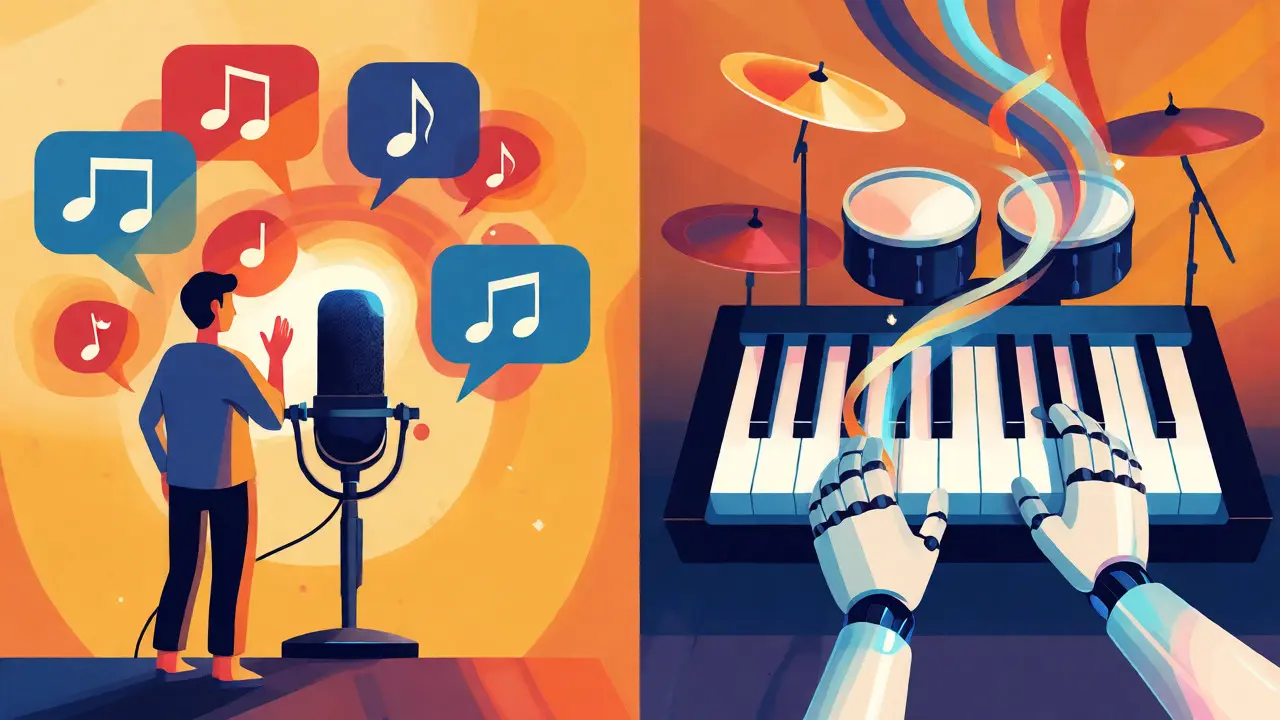
Often overlooked, sound effects (Foley) are crucial for immersion. Traditional Foley involves recording footsteps, door slams, and ambient noises manually. AI can now generate these from text descriptions.
AudioGen excels here. Trained on diverse environmental audio, it can produce complex scenes like "rain falling on a tin roof with distant thunder." Stable Audio by Stability AI also handles SFX well, offering precise duration controls. This is invaluable for game developers who need thousands of unique variations of a single sound, such as different types of explosions or crowd murmurs.
However, quality varies. High-frequency transients-sharp sounds like clicks or snaps-are hard for AI to model accurately. They often sound "mushy" or artificial. For critical applications, you might still need to layer AI-generated ambience with recorded elements.
Ethical Concerns and Copyright
With great power comes legal ambiguity. Voice cloning raises issues of consent. Can someone clone your voice without permission? Recent cases involve unauthorized impersonations of celebrities like Drake and The Weeknd. Record labels have pushed back, arguing that training data infringes on copyrights.
Watermarking is emerging as a solution. Some platforms embed inaudible signals in generated audio to identify it as AI-created. Resemble AI, for instance, integrates detection tools to flag synthetic voices. As regulations evolve, expect stricter requirements for disclosing AI-generated content, especially in advertising and news.
Choosing the Right Tool
So, what should you pick? Here’s a quick decision framework:
- Need a realistic voice for videos? Try ElevenLabs. It’s fast, accurate, and easy to use.
- Creating background music for YouTube? Use Suno or Soundful. They offer royalty-free options and quick results.
- Developing a game with dynamic audio? Look at AudioGen or Stable Audio for procedural sound effects.
- Building an app with local privacy needs? Deploy open-source models like MusicGen or Tacotron 2 on your own servers.
Pricing generally follows a subscription model. Free tiers let you test capabilities, but limits apply to character counts or generation minutes. Enterprise plans unlock higher volumes and API access. Always check current pricing, as this market shifts rapidly.
Frequently Asked Questions
Can AI replace human voice actors?
Not entirely. AI excels at consistent, scalable narration and prototyping. However, human actors bring nuanced emotional depth and improvisation that AI still struggles to replicate perfectly. Many professionals use AI for drafts or secondary characters while keeping humans for lead roles.
Is AI-generated music copyright-free?
It depends on the platform’s terms of service. Most commercial tools grant you ownership of the output if you pay for a subscription. However, laws regarding AI-generated content are still evolving. Always read the license agreement before using tracks commercially.
How much data is needed for voice cloning?
Modern tools can create a basic clone with just 1-5 minutes of clean audio. For high-fidelity, professional-grade clones that capture subtle inflections, providers often recommend 30 minutes to several hours of varied recordings.
What hardware do I need for local audio generation?
If you run open-source models like MusicGen or AudioGen locally, you typically need a dedicated NVIDIA GPU with at least 8-16 GB of VRAM. CPU-only inference is possible but significantly slower.
Are there risks of deepfakes with audio?
Yes. Audio deepfakes can mimic specific individuals convincingly, posing risks for fraud and misinformation. Detection tools and watermarking technologies are being developed to mitigate these threats, but vigilance remains necessary.