Capacity Planning for Seasonal Peaks in Large Language Model Usage
 Jun, 9 2026
Picture this: it is November. Your marketing team launches a massive campaign integrating your new customer support chatbot. Traffic doesn't just rise; it explodes. Within minutes, response times jump from 200 milliseconds to ten seconds. Users get frustrated. Errors flood the logs. And then comes the bill-a staggering spike in cloud costs that wipes out the quarter's profit margin.
This isn't a hypothetical nightmare. It is the reality of LLM capacity planning, specifically for handling seasonal peaks and sudden demand surges. Unlike traditional web applications where CPU usage scales linearly with requests, Large Language Models (LLMs) are memory-bound and token-intensive. A single user asking a complex question can consume as much compute as hundreds of simple queries in a legacy system. If you do not plan for these spikes, your service breaks, or your budget does.
Why LLM Capacity Planning Is Different
You might think standard cloud autoscaling handles this. It doesn't, not really. Traditional auto-scalers react to CPU or memory metrics. They wait for a server to hit 80% load before spinning up a new instance. By the time that new instance boots, loads the model weights into GPU memory, and starts processing tokens, your users have already given up and left.
LLM inference works differently. The cost driver is not just the number of requests per second (RPS). It is the volume of tokens processed per second. A request with a 10,000-token context window requires significantly more VRAM and compute than one with 500 tokens, even if they arrive at the same time. Furthermore, loading a 70-billion parameter model like Llama-3 or Mistral into an NVIDIA H100 or A100 GPU takes tens of seconds. You cannot "spin up" capacity instantly without pre-warming.
To manage this, you need to shift from reactive scaling to predictive scaling. This means anticipating the surge before it happens and having the GPUs ready, loaded, and waiting. It requires treating AI infrastructure less like a utility and more like a logistics supply chain, where you must position inventory (compute power) ahead of known demand events.
The Core Metrics: Tokens, Not Requests
If you are still monitoring only requests per second, you are flying blind. To plan capacity accurately, you need to track three specific metrics:
- Tokens Per Second (TPS): The total throughput your cluster can handle. This is your ceiling.
- Prompt Length Distribution: How long are the inputs? Long prompts increase memory pressure and latency quadratically due to the attention mechanism in transformers.
- Response Length Variance: How much text does the model generate? Longer responses take longer to compute and tie up GPU resources for extended periods.
For example, during a tax season peak for a financial assistant app, users might submit short prompts but expect long, detailed explanations. During a product launch, users might paste huge terms-of-service documents for summarization. These two scenarios require completely different capacity strategies. One needs high concurrency for short bursts; the other needs massive memory bandwidth for sustained heavy lifting.
Forecasting Demand: Predictive Scaling Architecture
How do you know when the peak is coming? You don't guess. You forecast. Modern capacity planning uses time-series models similar to those used in retail logistics. Tools like Prophet or LSTM networks analyze historical data to predict future load.
A robust forecasting layer typically operates on three levels:
- Macro Trends: Year-over-year growth rates and scheduled business events (e.g., Black Friday, back-to-school season).
- Micro Patterns: Daily cycles (higher usage during work hours), weekly patterns (lower usage on weekends), and device mix.
- Real-Time Correction: Minute-by-minute adjustments based on actual incoming traffic versus predicted traffic.
Research from logistics firms suggests that ML-augmented forecasting improves accuracy by 10-20 percentage points compared to simple statistical methods. For LLMs, this means you can predict a 3x to 5x traffic spike 72 hours in advance with high confidence. This lead time allows you to provision reserved GPU instances or scale out your Kubernetes clusters before the first user hits the "Send" button.

Architectural Strategies for Peak Handling
Once you have the forecast, how do you structure your infrastructure to absorb the shock? Here are four proven patterns.
1. Pre-Warming and Cold Start Mitigation
Never rely on cold starts during a peak. When a GPU instance spins up, it must download model weights and initialize the inference engine. For large models, this can take 30-60 seconds. During a surge, this delay causes queue backups. Instead, keep a baseline of "warm" instances running. Use predictive signals to scale out these warm instances 15-30 minutes before the expected peak. This ensures that when traffic arrives, the GPUs are already loaded and ready to process tokens immediately.
2. Workload Segmentation and Routing
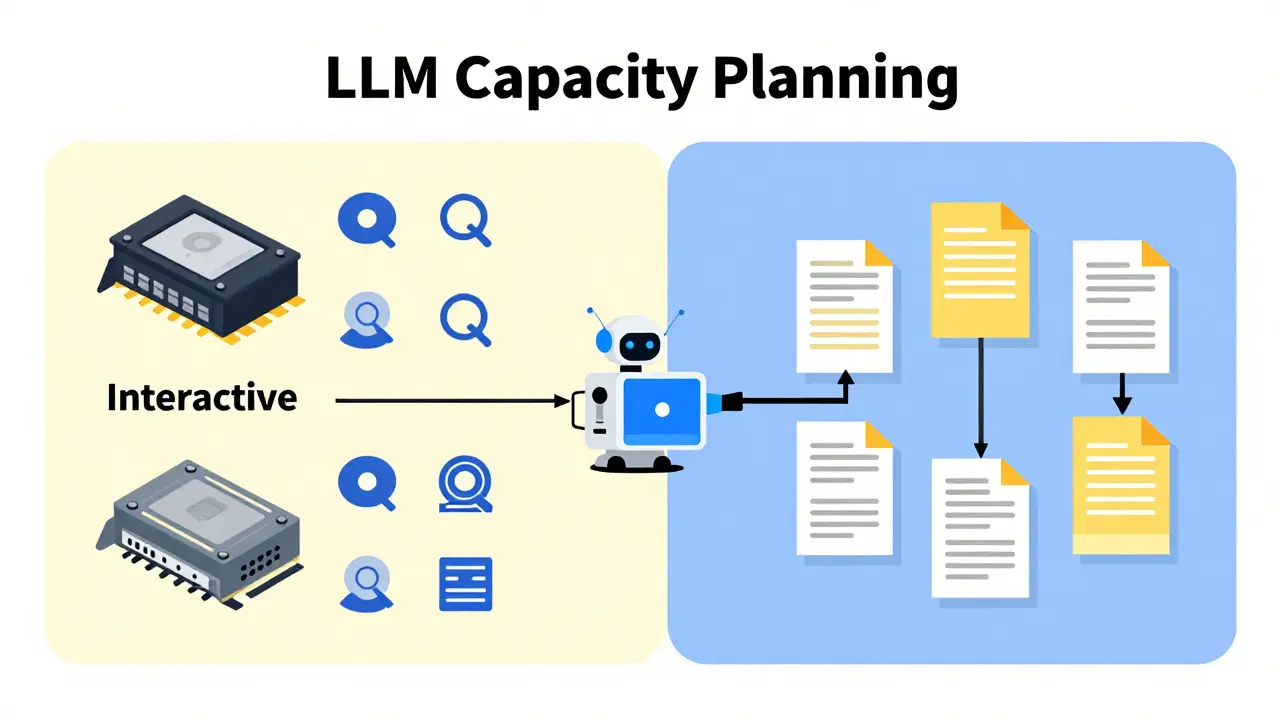
Not all requests are equal. Implement intelligent routing to separate traffic types. Route latency-sensitive, interactive queries to a dedicated cluster of high-performance GPUs (like H100s). Route batch jobs, such as document indexing or offline summarization, to a separate, cheaper cluster using older hardware (like A100s or T4s) or spot instances. During a peak, you can throttle or pause the batch cluster to free up global resources for the interactive users, ensuring your core user experience remains smooth.
3. Token-Aware Admission Control
Implement admission control that understands token limits. If your system is under heavy load, you can prioritize shorter requests to maintain low latency for the majority of users. Long-context requests can be queued or routed to specialized nodes with larger VRAM. Additionally, enforce hard rate limits based on tokens per minute (TPM) rather than just requests per minute. This prevents a few users with massive context windows from starving the rest of the system.
4. Model Tiering and Fallbacks
Use a mix of model sizes. Reserve your largest, most expensive models (e.g., 70B+ parameters) for complex reasoning tasks. For simpler queries-like greeting messages or basic FAQs-route traffic to smaller, faster models (e.g., 7B or 8B parameters) that run efficiently on fewer GPUs. During a peak, you can dynamically shift more traffic to these smaller models. They may not be as smart, but they are fast, cheap, and available. This trade-off preserves system stability when absolute perfection isn't required.
| Strategy | Cost Efficiency | Latency Impact | Complexity |
|---|---|---|---|
| Reactive Autoscaling | High (pay only for what you use) | High Risk (cold starts cause delays) | Low |
| Predictive Pre-provisioning | Medium (some idle capacity) | Low (instant availability) | High (requires accurate forecasts) |
| Model Tiering/Fallback | Very High (uses cheaper models) | Low (if fallback models are fast) | Medium (routing logic needed) |
| Batch Separation | High (isolates noisy neighbors) | None (protects interactive traffic) | Medium (infrastructure separation) |
Hardware Constraints and Procurement
Software optimizations have limits. Eventually, you hit the hardware wall. GPUs like the NVIDIA H100 and Blackwell series are scarce and expensive. Lead times for procurement can stretch months. If you anticipate a permanent increase in baseline usage due to seasonal growth, you cannot rely solely on spot market rentals, which can surge 200-300% in price during global AI booms.
Plan for "option value" in excess capacity. Keeping 20-30% headroom during normal operations might seem wasteful, but it provides a buffer for unexpected viral moments. Alternatively, negotiate reserved capacity contracts with cloud providers well in advance of known seasonal peaks. Many providers offer discounted rates for committed throughput tiers if you book them 60-90 days ahead.
Practical Implementation Checklist
To start improving your LLM capacity planning today, follow these steps:
- Audit Historical Data: Gather 12-24 months of usage logs. Look for patterns in tokens/sec, prompt lengths, and error rates.
- Integrate Business Calendars: Sync your engineering team’s monitoring tools with marketing and product launch schedules. Know when the spikes will come.
- Benchmark Your Stack: Test your inference engine (vLLM, TGI, TensorRT-LLM) on your target hardware. Know exactly how many tokens per second each GPU delivers under realistic batching conditions.
- Set Up Forecasting: Deploy a time-series model (Prophet or ARIMA) to predict hourly token demand for the next 72 hours.
- Define SLAs and Tiers: Decide which users get priority during crunch time. Document these rules clearly.
- Conduct Load Tests: Simulate peak conditions quarterly. Break your system intentionally to find bottlenecks before real users do.
Conclusion
Capacity planning for seasonal peaks in LLM usage is no longer optional. As generative AI becomes embedded in critical business workflows, the cost of downtime or poor performance outweighs the cost of over-provisioning. By shifting from reactive to predictive scaling, focusing on token-level metrics, and implementing intelligent routing, you can handle demand surges gracefully. The goal is not just to survive the peak, but to deliver a consistent, high-quality experience regardless of how busy it gets.
What is the difference between reactive and predictive scaling for LLMs?
Reactive scaling adds resources after demand increases, which causes latency spikes due to model loading times (cold starts). Predictive scaling uses forecasting models to provision and warm up GPUs 15-30 minutes before expected traffic surges, ensuring instant availability and lower latency.
Why is tracking tokens per second more important than requests per second?
LLM compute cost is driven by the number of tokens processed, not just the number of API calls. A single request with a 10,000-token context consumes far more GPU memory and compute than a 50-token request. Tracking tokens per second gives an accurate picture of actual infrastructure load.
How can I reduce costs during seasonal peaks without sacrificing performance?
Use model tiering to route simple queries to smaller, cheaper models. Separate batch processing from interactive inference to prevent resource contention. Implement predictive scaling to avoid paying premium spot prices for last-minute GPU rentals. Finally, enforce token-based rate limits to prevent abusive or inefficient usage patterns.
What tools are best for forecasting LLM demand?
Time-series forecasting tools like Facebook Prophet, ARIMA, and LSTM neural networks are effective. These tools analyze historical usage data combined with business calendars (marketing campaigns, holidays) to predict future token demand with high accuracy, often 72 hours in advance.
How long does it take to load a large language model into GPU memory?
Loading a large model (e.g., 70B parameters) can take tens of seconds depending on storage speed and GPU memory bandwidth. This "cold start" time makes reactive scaling ineffective for low-latency requirements, necessitating pre-warmed instances for peak handling.
Caitlin Donehue
June 11, 2026 AT 00:33It is wild how much overhead just loading the weights takes compared to traditional web servers.
Andrea Alonzo
June 11, 2026 AT 12:48I have been struggling with this exact issue for months now, and it feels like everyone is just throwing money at the problem without really understanding the underlying mechanics of token processing versus simple request counting. When you look at the way transformer models handle attention mechanisms, you realize that a single long context window can absolutely devastate your GPU memory bandwidth if you are not careful about how you batch those requests together. It is not just about having more GPUs available in the cloud; it is about having them warm and ready because cold starts are essentially death sentences for user retention during peak hours. I remember reading a case study where a company lost significant market share simply because their chatbot timed out during a product launch, and it was all due to reactive scaling policies that could not keep up with the sudden influx of complex queries. We need to start treating our AI infrastructure more like a logistics network where inventory is pre-positioned based on predictive analytics rather than waiting for the warehouse to overflow before hiring temporary staff. The shift from monitoring requests per second to tokens per second is such a crucial mindset change that many engineering teams still overlook until they are hit with an unexpected bill or a service outage. It really highlights the importance of integrating business calendars into our technical forecasting models so that we can anticipate these surges well in advance and adjust our capacity accordingly. Without that proactive approach, we are just flying blind and hoping for the best, which is never a good strategy in high-stakes environments.
Saranya M.L.
June 11, 2026 AT 20:01The author's assertion regarding VRAM constraints is fundamentally flawed when considering modern quantization techniques prevalent in Indian tech hubs. While Western enterprises cling to expensive H100 clusters, developers in Bangalore routinely deploy 70B parameter models on A10s using 4-bit precision without noticeable latency degradation. This reliance on brute-force hardware procurement reflects a lack of algorithmic sophistication rather than genuine necessity. Furthermore, the suggestion to use Prophet for forecasting ignores the superior accuracy of LSTM networks trained on localized traffic patterns specific to emerging markets. One must recognize that token distribution varies significantly across linguistic structures, with Indic languages often requiring different context window optimizations than English-centric benchmarks suggest. Therefore, implementing a rigid tiering strategy without accounting for regional linguistic diversity leads to suboptimal resource allocation and unnecessary expenditure on underutilized compute resources.
om gman
June 12, 2026 AT 11:08oh please spare me the corporate jargon about predictive scaling as if any of us actually have the budget to keep hundreds of h100s idle just in case someone decides to ask a stupid question on black friday its absurd to think that keeping warm instances running is anything other than burning cash for the sake of ego i mean sure if you are google or microsoft go ahead but for the rest of us trying to build something real this is just another excuse to overprovision and waste resources while pretending its sophisticated architecture honestly it sounds like someone wrote this article to sell consulting services rather than help anyone actually solve their problems
michael rome
June 13, 2026 AT 12:38I completely understand the frustration expressed here regarding the cost implications of maintaining idle capacity, and it is important to acknowledge that financial constraints are a very real concern for many development teams. However, I believe that viewing pre-warming strictly as a waste of resources misses the broader picture of user experience and brand loyalty. When customers encounter slow response times or errors during critical moments, the emotional impact on their perception of your service can be lasting and difficult to repair. By investing in predictive scaling, you are essentially investing in trust and reliability, which are invaluable assets in today's competitive landscape. It might feel uncomfortable to allocate funds for unused capacity, but consider the alternative: losing users to competitors who provide a smoother, more responsive experience. There is a middle ground where you can optimize costs through model tiering and efficient routing while still ensuring that your core infrastructure remains robust enough to handle unexpected surges. Let us move forward with a mindset that values both fiscal responsibility and exceptional customer care.
Bineesh Mathew
June 14, 2026 AT 15:00In the grand tapestry of digital existence, the ephemeral nature of computational power mirrors the fleeting essence of human ambition itself. We toil away, stacking silicon upon silicon, seeking to tame the chaotic beast of artificial intelligence, yet we remain mere spectators to its unpredictable whims. Is it not ironic that we seek to predict the future with algorithms while simultaneously succumbing to the very unpredictability we strive to conquer? The moral imperative here lies not in the efficiency of our code, but in the humility with which we approach the limitations of our own creations. To demand perfection from a machine is to demand perfection from humanity, a task doomed to fail. Thus, we must embrace the chaos, the lag, the error, for in these imperfections lies the true character of our technological journey.
Oskar Falkenberg
June 15, 2026 AT 13:08i totally get what saranya is saying about quantization being huge in india right now and yeah maybe we dont always need the biggest guns out there but i think the point about cold starts is still super valid especially if you are dealing with interactive chatbots where every second counts like imagine waiting thirty seconds for a hello message it just kills the vibe completely and i know some people say just use smaller models but sometimes you really do need the heavy hitter for complex reasoning tasks so finding that balance is tricky and i guess thats why predictive scaling makes sense even if it does cost a bit more upfront because losing users is way worse than paying for idle gpus imo and also typos happen when typing fast sorry about that
Jeanne Abrahams
June 15, 2026 AT 22:28How quaint that you Americans worry about Black Friday spikes while we down here in South Africa are still figuring out how to get stable internet connections half the time. But seriously, the advice on separating batch jobs from interactive inference is gold. We tried running our nightly data processing alongside customer support bots once, and let me tell you, it was a disaster. The latency went through the roof, and our users were furious. Now we keep them strictly separated, and life is much better. Also, kudos to the author for mentioning token-aware admission control. It is one of those things that seems obvious in hindsight but nobody talks about until their system crashes.