Checkpointing and Fault Tolerance in Distributed LLM Training: A Practical Guide
 Jun, 3 2026
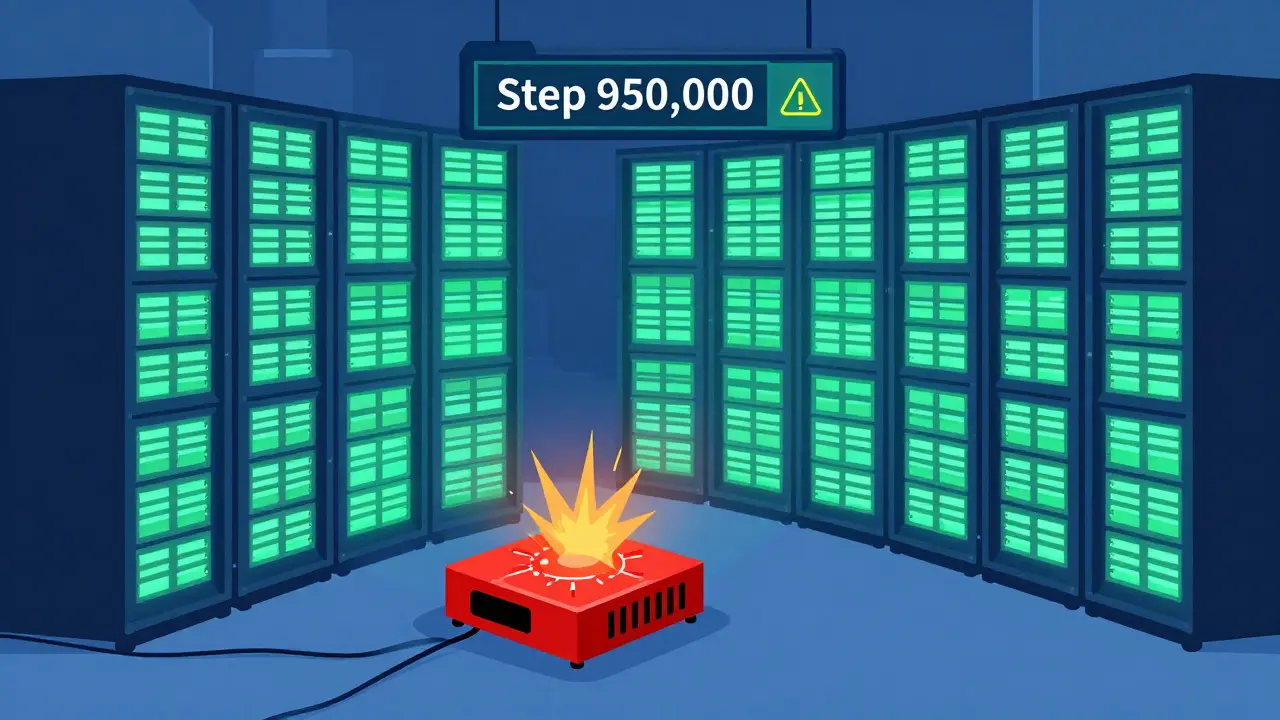
Imagine spending three weeks training a massive language model on thousands of GPUs. You are at step 950,000. The loss is dropping nicely. Then, a single GPU driver crashes. Or maybe a spot instance gets preempted by the cloud provider. In a synchronous distributed setup, that one failure stops the entire job. If you don't have a robust recovery plan, you lose days of compute time and tens of thousands of dollars.
This is why checkpointing and fault tolerance are not optional features for modern AI engineering-they are survival mechanisms. As models grow from billions to trillions of parameters, the cost of failure scales with them. Google’s recent runs on 50,944 TPU chips show us the scale we are dealing with: at this level, losing even an hour of progress is unacceptable.
The Anatomy of a Modern Checkpoint
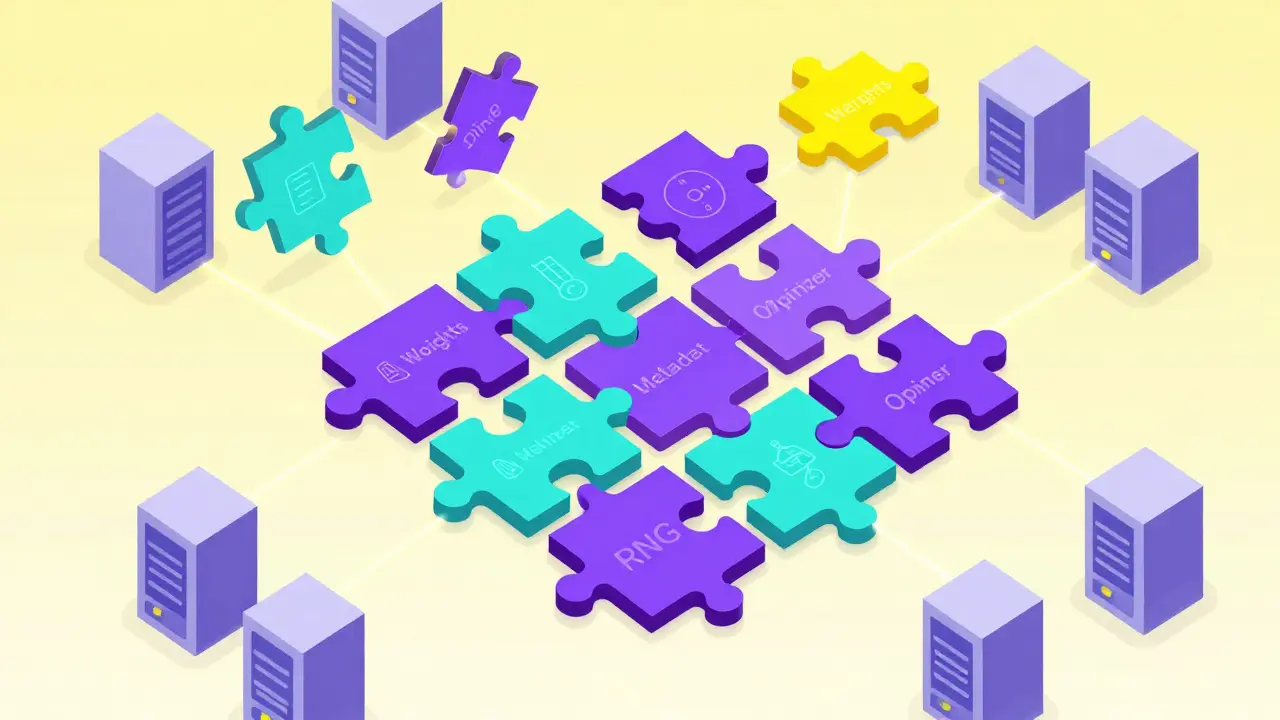
To understand how to save your work, you first need to know what "your work" actually looks like in memory. A naive approach might suggest just saving the model weights. That is not enough. To resume training exactly where you left off-with bit-wise reproducibility-you need the complete training state.
A full checkpoint typically includes:
- Model Parameters: The actual weights and biases of the neural network.
- Optimizer State: For optimizers like Adam, this includes momentum buffers (first and second moments). Without these, the optimizer loses its "memory" of past gradients, causing a spike in loss upon restart.
- Training Metadata: The current global step, epoch number, and learning rate scheduler state.
- Data Loader State: The offset in your dataset so you don't repeat data or skip samples.
- RNG Seeds: Random number generator states for dropout, data augmentation, and other stochastic processes.
In distributed training, this state is partitioned across hundreds or thousands of ranks. This means a checkpoint is rarely a single file. Instead, it is a collection of shards, where each GPU rank writes its own piece of the puzzle. Managing these shards efficiently is the core challenge of modern checkpointing.
Why Traditional Checkpoints Fail at Scale
In smaller setups, writing a checkpoint to a shared Network File System (NFS) or a simple object store works fine. But as you scale to tens of thousands of accelerators, this approach hits a wall. The I/O bottleneck becomes severe. Every rank tries to write simultaneously, saturating the network bandwidth and storage metadata operations.
Furthermore, traditional frameworks often lack Fine-grained Fault Tolerance. If one node fails, many older systems require restarting the entire cluster from the last global checkpoint. This is inefficient. A 2024 ACM paper highlighted that while existing toolkits can handle full restarts, they struggle with partial failures-like a single node crash-leading to unnecessary downtime.
The trade-off is clear: if you checkpoint too frequently to minimize lost work, you choke your I/O and reduce training throughput (goodput). If you checkpoint too infrequently, a failure wipes out hours of progress. Finding the sweet spot requires smarter architectures.
Modern Architectures: In-Cluster and Tiered Storage
Industry leaders are moving away from monolithic remote storage for frequent checkpoints. Two emerging patterns dominate the landscape in 2026:
| Strategy | Storage Location | Speed/Latency | Best Use Case |
|---|---|---|---|
| Global Single-Tier | Remote NFS/Object Store | Slow (High Latency) | Small clusters, final model saves |
| In-Cluster Checkpointing | Node-local SSDs | Fast (Low Latency) | Frequent saves, rapid recovery |
| Tiered Checkpointing | Local + Rack + Remote | Optimized | Balancing speed and durability |
In-Cluster Checkpointing, developed jointly by Google Cloud and Meta using PyTorch's Distributed Checkpointing (DCP) APIs, stores checkpoints on local NVMe SSDs within the training nodes. This drastically reduces write latency. When a node fails, the system replicates the local checkpoint to a replacement node. According to production data, this approach improved training goodput by up to 5% and reduced wasted compute (badput) by over 50%.
TierCheck, introduced in 2026, takes this further with a tiered architecture. It places different parts of the training state or different checkpoint versions across multiple storage tiers-local SSDs for immediate recovery, rack-local storage for redundancy, and remote object stores for long-term durability. This leverages the fact that per-rank shards can be written in parallel without clogging a single remote endpoint.
Checkpointless Fault Tolerance: The torchft Approach
What if you could avoid disk I/O entirely during recovery? Enter torchft (fault-tolerant Distributed Data Parallel). This framework challenges the assumption that you always need persistent checkpoints to survive failures.
In a demonstration on Crusoe L40S GPUs, engineers simulated 2,000 synthetic failures every 15 seconds. They disabled checkpointing completely. How did it work? torchft organizes workers into replica groups. Gradients are synchronized within each group. When a group fails, it is restarted asynchronously. The new workers recover their weights and optimizer state via peer-to-peer (P2P) transfer from a healthy replica group, rather than loading from disk.
This approach is incredibly fast because P2P network transfers are often faster than reading terabytes from storage. However, it has a catch: it requires redundancy. You need enough healthy groups to act as donors. If all groups fail simultaneously, you are stuck. Therefore, torchft complements rather than replaces traditional checkpointing. Use P2P recovery for high-frequency, minor glitches, and keep periodic disk checkpoints for catastrophic failures.

Integrating with Orchestration and Pipelines
Checkpointing does not exist in a vacuum. It must integrate seamlessly with your infrastructure. Whether you use Kubernetes, Slurm, or Ray, the orchestration layer handles failure detection and job restart. Your training script must be idempotent and smart enough to find the latest valid checkpoint on startup.
Key integration points include:
- Automated Restart Logic: Configure your orchestrator to restart pods/jobs automatically. The entry point script should scan the checkpoint directory, identify the highest step number, and load that state before resuming the training loop.
- Storage Compatibility: Ensure your checkpoint format works with your storage backend. Amazon S3, Google Cloud Storage, Lustre, and Ceph have different performance characteristics. Using libraries like PyTorch DataLoader with asynchronous prefetching can help overlap data loading with checkpoint I/O.
- Monitoring: Track metrics like checkpoint latency, failure counts, and restart attempts. If checkpointing starts taking longer than the interval between saves, you have a problem.
Companies like Together AI now hire specialized "Checkpoint Optimization Engineers" with salaries ranging from $160,000 to $230,000 USD. This reflects the critical nature of this role. These experts focus on incremental checkpointing (saving only changed weights), compression, and serialization optimizations to squeeze out every last percent of efficiency.
Practical Checklist for Robust Training
If you are setting up a distributed LLM training job today, follow these steps to ensure resilience:
- Define Your Failure Modes: Will you face node crashes? Network partitions? Spot instance preemptions? Design your strategy around the most likely scenario.
- Use Sharded Checkpoints: Never try to gather all weights to one node. Save per-rank shards to parallelize I/O.
- Leverage Local Storage: Use node-local SSDs for frequent intermediate checkpoints. Only replicate to remote durable storage periodically.
- Validate Integrity: After loading a checkpoint, verify the loss value or a hash of the weights to ensure the file wasn't corrupted during the write process.
- Combine Strategies: Use in-cluster checkpointing for speed and P2P recovery (if available) for minor faults. Keep a remote backup for disaster recovery.
- Monitor Goodput: Measure the percentage of compute time spent actually training versus waiting for I/O or recovering. Aim to maximize goodput.
How often should I save checkpoints during LLM training?
The frequency depends on your storage speed and the cost of compute. A common rule of thumb is to balance the I/O overhead against the acceptable loss of progress. If a failure costs you 10 hours of work, but checkpointing takes 1 minute, you might checkpoint every 30-60 minutes. With fast local SSDs, you can checkpoint every few hundred steps with minimal impact on throughput.
What is the difference between model weights and optimizer state in a checkpoint?
Model weights are the learned parameters of the network. Optimizer state (like Adam's momentum buffers) contains historical gradient information used to update those weights. Saving only weights allows you to continue training, but the optimizer will start fresh, which can cause instability or slower convergence. For exact resumption, you must save both.
Can I use checkpointless fault tolerance for my entire training run?
Not recommended. Checkpointless methods like torchft rely on having healthy replica groups to donate state. If a catastrophic failure affects all replicas, you have no backup. Use checkpointless recovery for high-frequency, minor errors, but maintain periodic persistent checkpoints for disaster recovery.
Why is In-Cluster Checkpointing faster than remote storage?
In-Cluster Checkpointing writes directly to local NVMe SSDs attached to the GPU nodes, avoiding network latency and congestion associated with remote file systems or object stores. Local I/O is significantly faster and more predictable, allowing for higher frequency saves without blocking training computation.
How do I handle data loader state when resuming from a checkpoint?
You must save the current index or offset of the data loader in your checkpoint. Upon restart, initialize the data loader with this saved offset. This ensures you pick up exactly where you left off, preventing duplicate data processing or skipped samples, which could bias your model.
Saranya M.L.
June 3, 2026 AT 14:31The distinction between model weights and optimizer state is not merely a technicality but a fundamental epistemological divide in how we conceptualize learning. You see, saving only the weights is akin to preserving the skeleton of an organism while discarding its nervous system's memory of movement. The Adam optimizer's momentum buffers are the very essence of historical gradient information, the accumulated wisdom of past errors that guide future updates. Without these first and second moments, the optimizer suffers from amnesia, starting fresh with every restart, which inevitably leads to instability and slower convergence rates that would make any discerning engineer cringe. It is absolutely imperative that one saves both to ensure bit-wise reproducibility, for anything less is a disservice to the scientific method and a waste of precious compute resources. We must demand precision in our serialization protocols, utilizing libraries like PyTorch DataLoader with asynchronous prefetching to overlap data loading with checkpoint I/O, thereby ensuring that no sample is skipped or duplicated, which could otherwise bias our models in subtle yet catastrophic ways.
om gman
June 5, 2026 AT 01:53oh look another article pretending to know everything about distributed systems while ignoring the fact that most people just use huggingface transformers and pray to the gpu gods. torchft sounds cool i guess if you have thousands of gpus lying around collecting dust but for the rest of us struggling with oom errors on a single a100 it is all theoretical nonsense. who cares about goodput when your code crashes because you forgot to set seed properly anyway
Bineesh Mathew
June 6, 2026 AT 15:29We stand at the precipice of a digital abyss where the fragility of our silicon idols mirrors the impermanence of human existence itself. To lose three weeks of training due to a driver crash is not merely an inconvenience; it is a profound commentary on the hubris of believing we can control chaos through code. The GPU driver crashes, the spot instance vanishes into the ether, and we are left staring at the void, questioning the nature of progress when it can be so easily erased by a single faulty transistor. This is the tragedy of modern AI engineering: we build cathedrals of parameters on foundations of sand, hoping that our checkpointing strategies will serve as the ark that saves us from the flood of entropy. It is a dramatic reminder that despite our trillions of parameters, we remain subject to the whims of cloud providers and hardware failures, forced to dance with disaster rather than command it.
Francis Laquerre
June 7, 2026 AT 13:39I was absolutely blown away by the section on TierCheck! It really highlights how collaborative innovation between industry giants like Google and Meta is pushing the boundaries of what we thought possible in storage architecture. The idea of leveraging local SSDs for immediate recovery while maintaining remote object stores for long-term durability is simply brilliant. It reminds me of how different cultures approach problem-solving-by combining the speed of local action with the resilience of global support, we create a system that is truly robust. I hope more teams adopt this tiered approach because it feels like the natural evolution of our infrastructure needs. Let's keep sharing these insights so we can all benefit from these advancements!
Andrea Alonzo
June 7, 2026 AT 18:58It is incredibly important to remember that when we are dealing with distributed training across hundreds or even thousands of ranks, the management of these shards becomes a complex puzzle that requires careful attention to detail, and I always find myself thinking about how much easier this process would be if we had better tooling out of the box for handling the metadata operations that often bottleneck our systems. The point about RNG seeds is particularly crucial because many beginners overlook the stochastic processes involved in dropout and data augmentation, not realizing that without saving those states, their resumed training runs will diverge significantly from the original trajectory, leading to results that are not bitwise reproducible and thus undermining the scientific rigor of their experiments. I have seen so many teams struggle with this exact issue, where they save the weights and optimizer state but forget the data loader offset, resulting in duplicate samples being processed during the next epoch, which can subtly bias the model in ways that are difficult to detect until it is too late. It is a gentle reminder that robustness is built in the details, and taking the time to validate the integrity of your checkpoints after loading them can save you countless hours of debugging later on.
Oskar Falkenberg
June 8, 2026 AT 03:39i think the part about checkpointless fault tolerance is super interesting but also kinda scary tbh. relying on p2p transfers means you need enough healthy groups to act as donors which feels like a risky bet if you have a massive cluster failure. i mean sure its faster than reading terabytes from disk but what happens when everything goes wrong at once? i guess thats why they say you still need periodic disk checkpoints for disaster recovery. its a nice balance though using p2p for minor glitches and disk for big ones. just wish there was a simpler way to handle all this without needing specialized engineers making 200k a year lol. maybe im just dreaming but i hope things get easier soon
Jeanne Abrahams
June 8, 2026 AT 14:30Oh, wonderful. Another guide telling us how to spend millions on GPUs while worrying about 'goodput' instead of whether the energy consumption is melting the planet. But sure, let's talk about NVMe SSD latency while the grid collapses. Typical tech bro solutionism. At least the salary range for 'Checkpoint Optimization Engineers' is accurate; someone has to get paid to manage this digital mess.
michael rome
June 9, 2026 AT 00:29This is an exceptionally well-structured overview of the current landscape. The emphasis on defining failure modes before designing the strategy is something I cannot stress enough. Too many teams jump straight into implementation without considering whether they are facing node crashes, network partitions, or spot preemptions, and this lack of foresight leads to fragile systems that fail under pressure. I appreciate the practical checklist provided here, especially the recommendation to use sharded checkpoints to parallelize I/O. It is a simple concept that makes a world of difference at scale. Keep up the great work in documenting these best practices.