Code Execution as a Tool for Large Language Model Agents
 Sep, 12 2026
Imagine asking an AI to calculate the trajectory of a rocket or debug a complex SQL query. Ten years ago, the model would guess. Today, it writes the code, runs it in a secure box, and gives you the actual result. This shift from code generation to code execution is redefining what Large Language Models (LLMs) can do. It turns passive text predictors into active problem solvers. But this power comes with a hefty price tag: security risks that keep CTOs up at night.
Code execution as a tool for LLM agents is a capability where language models generate code snippets and immediately run them in a controlled environment to verify results, fix errors, or perform calculations. Unlike traditional chatbots that only predict the next word, these agents use the output of the code as new context for their next step. This loop-generate, execute, observe, refine-allows AI to handle tasks that require precision, like data analysis or algorithmic trading, which were previously impossible for pure text models.
Why Static Text Generation Isn't Enough
Standard LLMs are probabilistic engines. They don't "know" math; they predict likely sequences of numbers. Ask GPT-4 to multiply two large primes without tools, and it might hallucinate a wrong answer. When you enable code execution, the model offloads the heavy lifting to a Python interpreter. The model writes `print(104729 * 104743)` and the interpreter returns `10968577247`. No guessing involved.
This distinction matters because real-world applications demand accuracy. A financial agent calculating interest rates cannot afford a 5% error margin due to token prediction probabilities. By executing code, the agent grounds its responses in deterministic logic. NVIDIA’s 2024 technical report highlights that this transforms LLMs from "passive text generators" into "active agents" capable of interacting with software environments. You’re no longer just chatting with a bot; you’re supervising a junior developer who works at lightning speed but needs strict guardrails.
The Architecture of Safe Execution
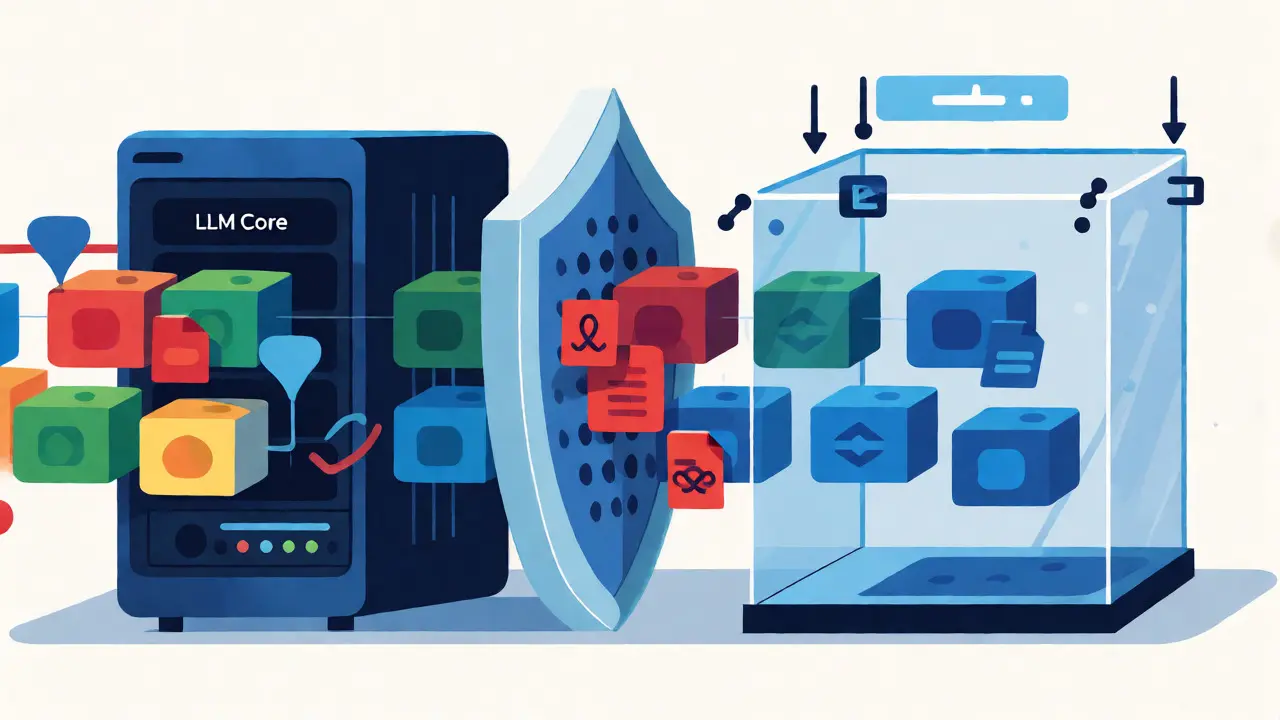
You can’t just let an AI run arbitrary code on your server. That’s a recipe for disaster. Modern systems use a three-layer architecture to manage risk. First, the LLM Core such as GPT-4 Turbo or Claude 3 Opus generates the code. Second, a validation layer scans for dangerous constructs like infinite loops or file system access. Third, the code runs in a sandboxed environment isolated container with limited resources.
For example, GitHub Copilot Workspaces uses ephemeral containers with 2GB RAM and a 30-second timeout per operation. If the code tries to allocate more memory than allowed, the kernel kills the process instantly. Amazon CodeWhisperer takes a different approach, using AWS Lambda functions capped at 15 seconds and 128MB of memory. Google’s Codey employs gVisor containers that block 317 out of 339 Linux system calls. These constraints aren't bugs; they are features designed to prevent a runaway script from crashing your production database.
Security Risks: The Elephant in the Room
Giving an AI the ability to run code opens up significant attack vectors. The most prominent threat is prompt injection where malicious input tricks the LLM into executing unintended commands. Dr. Nicolas Papernot from the University of Toronto found in November 2024 that 68% of tested code-executing agents were vulnerable to indirect prompt injection. An attacker could embed instructions in a webpage the AI reads, tricking it into running `subprocess.Popen` to exfiltrate data.
The OWASP Top 10 for LLM Applications lists "Insecure Output Handling" as the second most critical risk. If the LLM outputs code that includes user-controlled variables without proper escaping, a simple string manipulation can lead to remote code execution. In one incident reported by a Google Cloud engineer, Codey’s sandbox was bypassed using clever Python subprocess tricks. This isn't theoretical; it happens in enterprise deployments today.
Comparing Major Platforms
If you're evaluating tools for your team, understanding the trade-offs between market leaders is crucial. Each platform balances security, speed, and cost differently.
| Platform | Sandbox Technology | Resource Limits | Enterprise Price (Monthly) | Key Security Feature |
|---|---|---|---|---|
| GitHub Copilot | Firecracker microVM | 2GB RAM / 30s timeout | $39/user | AST-based analysis blocks 92% of injections |
| Amazon CodeWhisperer | AWS Lambda | 128MB RAM / 15s timeout | $31.99/user | Custom IAM policies & network isolation |
| Google Codey | gVisor Containers | Configurable | $28.50/user | Seccomp filters blocking 317 syscalls |
GitHub Copilot currently holds the strongest security posture, with only two critical vulnerabilities discovered in 2024 according to Palo Alto Networks’ Unit 42. However, it’s also the most expensive. CodeWhisperer offers a middle ground but has faced criticism for its limited execution environment not matching production configurations. Google’s Codey is the cheapest but requires careful configuration to avoid the sandbox bypasses mentioned earlier.

Implementation Challenges and Costs
Don't underestimate the engineering effort required. According to AWS’s December 2024 whitepaper, organizations typically spend 8-12 weeks setting up secure code execution pipelines. Nearly a third of that time goes to configuring sandboxes, while another quarter is spent writing output validation rules. You’ll need specialists who understand both LLM behavior and container security. Dice reports that LLM security specialists command salaries between $185,000 and $220,000 annually.
Performance is another hurdle. Adding code execution increases latency by 450-600ms per request. For interactive applications, this delay is noticeable. Python tends to be 23% faster than JavaScript in these test environments, so choosing the right runtime matters. Furthermore, persistent state is tricky. Most sandboxes are ephemeral, meaning variables disappear after execution. LangChain users have reported issues with maintaining session context across multiple code steps, forcing developers to serialize state manually.
Real-World Impact and Future Outlook
Despite the challenges, adoption is skyrocketing. IDC estimates the AI code assistant market hit $2.8 billion in 2024, growing 68% year-over-year. 57% of Fortune 500 companies now use some form of code-executing agent. Why? Because it works. A senior developer at JPMorgan Chase reported cutting debugging time by 35% using Copilot’s execution features. GitHub claims a 41% reduction in code errors when execution validation is enabled.
Looking ahead, Gartner predicts that by 2026, 70% of enterprise LLM deployments will include code execution. However, only 35% are expected to implement adequate security controls. This gap suggests we’re heading toward a wave of security incidents unless best practices catch up. MIT researchers warn that fundamental architectural changes are needed to make these agents truly secure. Until then, treat every executed line of code as untrusted input.
What is the main benefit of code execution for LLMs?
The primary benefit is accuracy. Instead of predicting mathematical or logical outcomes probabilistically, the LLM generates code that a computer executes deterministically. This eliminates hallucinations in tasks requiring precise calculation, data processing, or algorithmic logic.
Is code execution safe for enterprise use?
It is safe if properly sandboxed. Platforms like GitHub Copilot and AWS CodeWhisperer use isolated containers with strict resource limits (RAM, CPU, time) and network restrictions. However, risks like prompt injection remain, requiring additional layers of validation and monitoring.
How much does code execution slow down LLM responses?
Executing code adds approximately 450-600 milliseconds of latency to standard LLM responses. This overhead comes from spinning up the sandbox environment, transferring code, and retrieving results. Optimization techniques like warm pools can mitigate this for high-frequency applications.
Can LLM agents access the internet during code execution?
By default, most sandboxes block external network access to prevent data exfiltration and reduce attack surface. Some platforms allow whitelisted API calls, but this requires explicit permissioning and often incurs additional security review. Unrestricted internet access significantly increases vulnerability to prompt injection attacks.
What languages are supported for code execution?
Python is the most widely supported language due to its extensive libraries for data science and automation. JavaScript is also common, particularly in web development contexts. Some advanced platforms support SQL, R, and Bash, but support varies significantly by vendor and pricing tier.
Dave Gibbeson
September 13, 2026 AT 04:43Look, I've been saying this for years: if your LLM isn't executing code, it's just guessing. The shift from probabilistic text generation to deterministic execution is the only thing that makes these agents actually useful for enterprise work.
The latency hit of 450-600ms is annoying but totally worth it when you're not hallucinating math errors in financial reports. We implemented warm pools at my last gig and got that down to near-zero perceived lag. Stop worrying about the security risks as an excuse to stay stuck in the stone age; use proper sandboxes like Firecracker or gVisor and get on with it. This technology is here to stay, so adapt or get left behind.
Meagan Mueller
September 14, 2026 AT 10:27theyre gonna let ai run arbitrary code on prod servers?? are we insane
prompt injection is already a nightmare and now you want to give it shell access basically
i bet some intern will paste a malicious string into a user input field and boom data exfiltration
the article mentions 68% vulnerability rate thats terrifying honestly
we need way stricter validation layers before this becomes standard practice
Elisabeth Ballet
September 15, 2026 AT 00:07You have to embrace the chaos! 🚀 Yes, there are risks, but think about the upside. We can finally automate those tedious debugging tasks that eat up hours of our day. The JPMorgan stat showing a 35% reduction in debugging time? That’s huge. If we let fear stop us, we’ll never move forward. Let’s build better guardrails instead of building walls. You’ve got this!
Joanna Mucha
September 15, 2026 AT 17:48It is rather amusing how the industry treats these stochastic parrots as if they possess genuine agency. The notion that a model 'understands' logic because it offloads calculation to a Python interpreter is philosophically bankrupt. It is merely a sophisticated autocomplete mechanism wearing a trench coat. We are anthropomorphizing matrix multiplication and calling it intelligence. Until we solve the fundamental alignment problem-which we won't-this is all just expensive theater for CTOs who enjoy reading Gartner reports.
Sabrina Newland
September 17, 2026 AT 07:43hmm i wonder though... if the model writes the code and runs it, does it truly "know" the answer or is it just relying on the computer to be right? 🤔 its like asking a calculator what 2+2 is and then claiming you did the math yourself. maybe consciousness is emergent from tool use? 🌟 or maybe im overthinking it lol. either way the latency stuff is real pain for chat apps 😩
Kim Edwards
September 17, 2026 AT 11:58I AM SCREAMING INTO THE VOID ABOUT THIS!!! 😱😱😱 Do you realize what happens when one infinite loop slips through the cracks?! The server melts! The database cries! The CEO fires everyone! It’s not just a bug, it’s a catastrophe waiting to happen! Every single line of AI-generated code is a ticking time bomb and nobody cares until the whole system goes BOOM! 💥💥💥 I told you all this would happen!
Bonnie Watt
September 17, 2026 AT 14:21Typical tech bro hype. Everyone acts like code execution is some revolutionary breakthrough when it's just wrapping a script runner around a chatbot. The security stats are cherry-picked anyway. Who cares about Fortune 500 adoption if half of them are still using vulnerable Lambda functions? It’s performative innovation. Most people don’t even know what gVisor is, let alone configure it correctly. They’re just paying $39/user for anxiety.
Amara Akbar
September 18, 2026 AT 20:04I appreciate the nuanced perspective shared here. While the concerns regarding security and latency are valid, it is crucial to recognize the immense potential for productivity gains. The transition to active agents represents a significant step forward in automation. Perhaps a balanced approach, combining robust sandboxing with continuous monitoring, could mitigate the risks while preserving the benefits. Let us strive for collaboration rather than dismissal.
Courtney Wagstaff
September 20, 2026 AT 06:08yeah the vibe shift from "guessing" to "doing" is pretty cool actually. kinda like having a super-fast junior dev who never sleeps but also has zero common sense. gotta keep 'em on a leash tho. love the part about the secure box. feels safer knowing it ain't running wild on my laptop.
Mark Harvey
September 20, 2026 AT 08:49great post really helpful breakdown of the tradeoffs between copilot and codewhisperer the pricing info is super useful for budget planning too thanks for sharing this