Compression-Aware Prompting: Getting the Best from Small LLMs
 Jun, 10 2026
Have you ever stared at a massive document and tried to ask an AI for a summary, only to hit a wall? The context window is full. The cost per token is climbing. And if you are running a smaller, local model, it might just crash or hallucinate because it cannot process that much noise. This is the bottleneck facing developers today. We have powerful models, but we also have expensive, limited hardware and strict budget constraints.
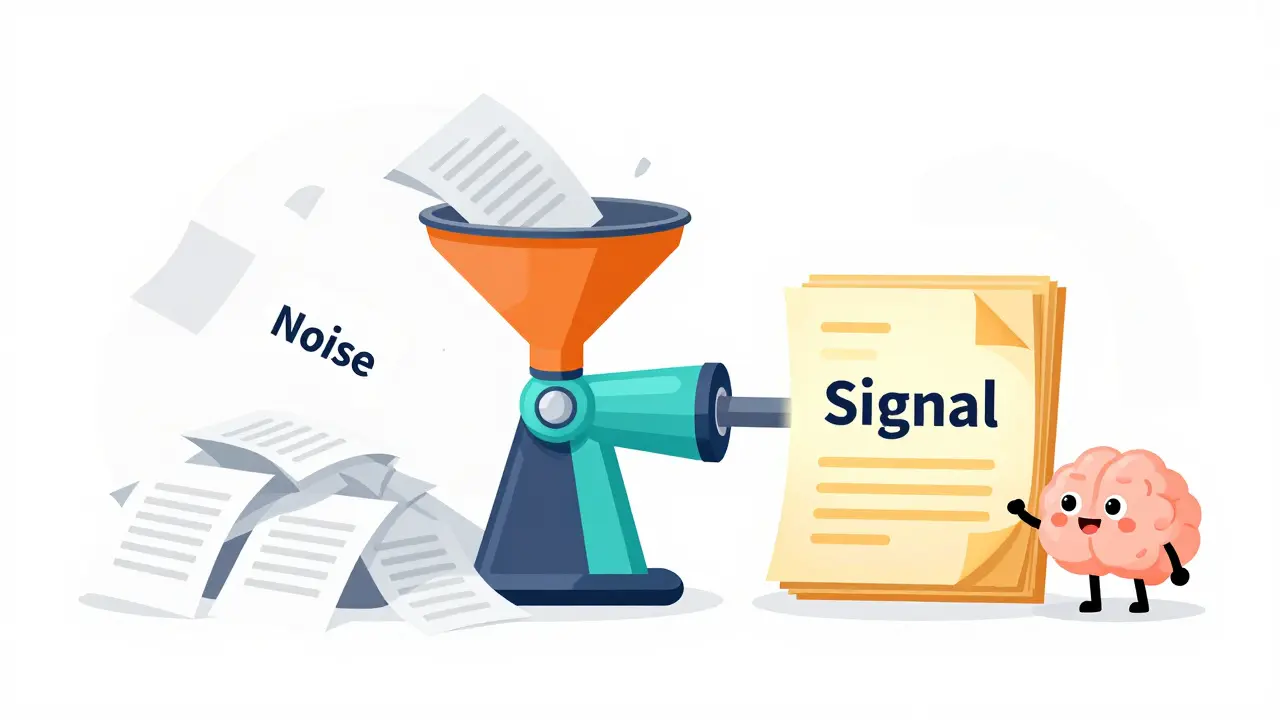
The solution isn't always buying a bigger GPU or upgrading to the most expensive API tier. Sometimes, the answer lies in what you feed the model. Enter compression-aware prompting. This technique strips away the fluff from your input data before the Large Language Model (LLM) ever sees it. It keeps the signal and discards the noise. For small LLMs with limited context windows and memory, this is not just a nice-to-have feature; it is a survival strategy.
Why Small LLMs Need Compressed Prompts
Let's be real about how small language models work. Models like Llama-3-8B, Mistral-7B, or even smaller quantized versions are fantastic tools. They run locally on consumer hardware. They respect privacy. But they have limits. When you throw a 10,000-token research paper at a model with a 4,096-token context window, you have two choices: truncate the text (losing critical info) or pay a premium for a larger model.
Even if the model has a large enough window, there is another problem: "lost in the middle." Research shows that LLMs often struggle to retrieve information from the middle of long contexts. They remember the beginning and the end best. If your key fact is buried on page 5 of a 20-page PDF, a small model might miss it entirely. Compression-aware prompting fixes this by distilling those 20 pages into a tight, high-signal paragraph that fits perfectly within the model's sweet spot.
Prompt Compression is a technique that reduces the length of input prompts while preserving semantic meaning and task-relevant information. It acts as a pre-processing step, ensuring that the final input sent to the LLM contains only the tokens necessary for accurate inference.
How Compression-Aware Prompting Works
You might think compressing a prompt means using a standard summarization tool. That’s close, but not quite right. Standard summarization tries to give you a human-readable overview. Compression-aware prompting tries to give the *model* exactly what it needs to answer a specific question. It is optimized for machine consumption, not human reading.
There are three main ways this happens:
- Filtering: This is the simplest approach. An algorithm scores every sentence or token in your document. Low-scoring sentences-like generic introductions, repetitive transitions, or irrelevant background-are deleted. High-scoring sentences stay. Think of it like editing a draft, but done by code.
- Knowledge Distillation: Here, a smaller, cheaper model (like BERT or a tiny encoder) reads the long text first. It extracts the core concepts and rewrites them in a dense format. The big LLM then receives this dense summary instead of the raw text.
- Embedding-Based Ranking: Tools use vector embeddings to measure how similar each part of the text is to your actual question. If a paragraph doesn’t relate to the query, it gets cut. This is highly effective for Retrieval-Augmented Generation (RAG) systems.
The goal is simple: reduce the token count without reducing the accuracy of the answer. If you can cut the prompt size by 50% and keep the same answer quality, you have just doubled your throughput and halved your costs.
Key Tools and Frameworks You Should Know
The landscape of prompt compression tools is moving fast. As of mid-2026, several frameworks stand out for their ability to handle complex tasks without breaking a sweat.
| Tool/Framework | Primary Method | Best Use Case | Compression Ratio |
|---|---|---|---|
| LJMLingua | External LM Filtering | Closed-source LLMs & General QA | Up to 20x |
| TPC (Task-agnostic Prompt Compression) | Reinforcement Learning + Embeddings | Multi-domain tasks without templates | Variable (High Fidelity) |
| PromptOptMe | Token Optimization | Evaluating LLM metrics efficiently | 2.37x reduction |
| TCRA-LLM | Sentence Encoder Summarization | Semantic compression for RAG | High relevance retention |
LJMLingua is particularly interesting for teams working with closed-source models like GPT-4 or Claude. Since you cannot tweak the internal weights of these proprietary models, LJMLingua uses a separate, smaller open-source model to filter the input before sending it to the API. It achieves compression ratios up to 20x. That means a 20,000-token document becomes a 1,000-token prompt. The savings in API costs are immediate.
TPC (Task-agnostic Prompt Compression) takes a different route. It doesn't need you to provide a specific question upfront. Instead, it uses a lightweight causal language model trained via reinforcement learning to generate a "task descriptor." This descriptor captures the main concept of the prompt. Then, it calculates embedding similarity between this descriptor and every sentence in the input. This makes TPC incredibly robust for general-purpose applications where the query type might change dynamically.
Implementing Compression in RAG Systems
If you are building a Retrieval-Augmented Generation (RAG) system, you are already pulling documents from a vector database. The problem? Vector search retrieves chunks based on similarity, but it often pulls too much irrelevant context along with the relevant bits. A single retrieval might return 5,000 tokens of text, but only 500 tokens actually answer the user's question.
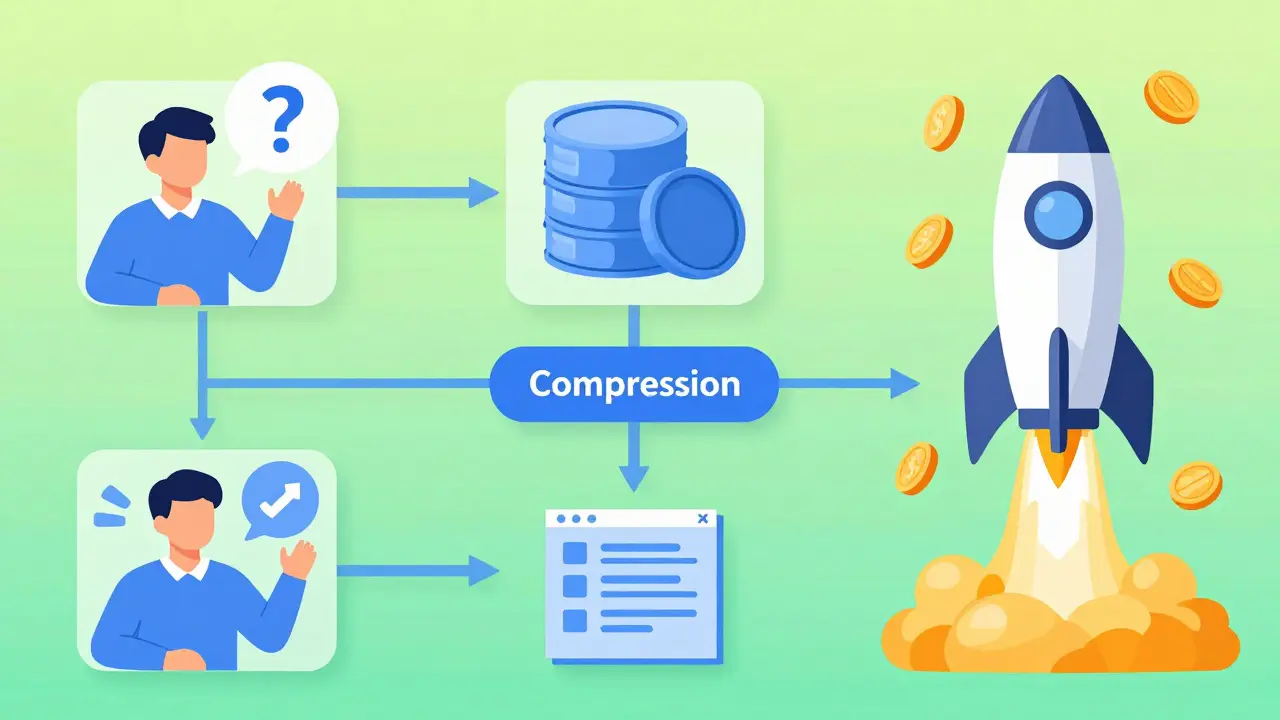
Without compression, you send all 5,000 tokens to your LLM. With compression-aware prompting, you add a layer between the retriever and the generator. Here is how the flow changes:
- Step 1: User asks a question.
- Step 2: Vector DB retrieves top-k documents (e.g., 10 chunks).
- Step 3: A compression module (like LJMLingua or a custom BERT-based filter) analyzes these 10 chunks against the specific question.
- Step 4: Irrelevant sentences are stripped. Redundant facts are merged.
- Step 5: The compressed, high-density prompt is sent to the LLM.
This setup dramatically improves grounding. Studies show that controlling compression granularity can improve downstream performance by up to 23 percentage points. It also preserves entities better-up to 2.7x more entities retained compared to naive truncation. For legal, medical, or technical RAG apps, missing an entity can mean missing a critical drug interaction or a legal clause. Compression ensures those details survive the cut.
Cost Savings and Performance Gains
Let’s talk numbers. Why does this matter for your bottom line?
First, consider inference speed. Smaller LLMs are faster, but they slow down linearly with context length. If you reduce the input tokens by 50%, you roughly halve the time it takes for the model to process the prompt. In a chat application, this means lower latency and happier users. No one likes waiting 10 seconds for a bot to think when it could have answered in 5.
Second, look at API costs. If you are using a cloud provider, you pay per input token. Cutting your average prompt size from 4,000 tokens to 2,000 tokens saves you 50% on input costs. While output tokens usually cost more, the input volume in RAG systems is massive. Over thousands of queries, this adds up to significant monthly savings.
Third, consider hardware constraints. If you are running a local LLM on a laptop or a small server, VRAM is king. Long contexts require more memory to store KV caches. By compressing prompts, you free up VRAM. This allows you to run longer conversations or batch more requests simultaneously without swapping to disk, which kills performance.
Pitfalls to Avoid
Compression is not magic. If you do it wrong, you lose information. Here are common mistakes developers make:
- Over-compressing: Trying to squeeze a 10,000-token report into 100 tokens will result in loss of nuance. Always test the compression ratio against your specific task. Start with a 2x or 3x reduction and see if accuracy holds.
- Ignoring Task Specificity: A compression method that works for summarizing news articles might fail for coding tasks. Code requires exact syntax. Deleting a semicolon or a variable name breaks everything. Use code-aware compressors for programming tasks.
- Latency Trade-offs: Running a compressor takes time. If your compressor takes 2 seconds to run and saves 1 second of LLM inference time, you have made things slower. Ensure your compression step is lightweight. Using a small model like BERT or a distilled transformer is crucial here.
Future Directions: What’s Next?
The field is evolving rapidly. We are seeing a shift towards "soft prompting" combined with sequence-level training. This approach achieves the best trade-off between effectiveness and compression rate. Researchers are also exploring reinforcement learning to train compressors that understand not just what words are important, but how they interact logically.
As small LLMs become more capable, the gap between compressed inputs and raw inputs narrows. However, the economic incentive remains strong. As long as compute is expensive and context windows are finite, compression-aware prompting will be essential. It democratizes access to advanced AI capabilities, allowing startups and individual developers to build sophisticated applications without needing enterprise-grade infrastructure.
Start small. Pick one high-volume query in your application. Add a lightweight filtering step. Measure the drop in token usage and the stability of the answers. You might be surprised at how much cleaner your AI interactions become when you stop feeding it junk.
What is the difference between prompt compression and summarization?
Summarization aims to create a human-readable overview of a text, focusing on narrative flow and key themes. Prompt compression aims to create a machine-readable input that maximizes the LLM's ability to answer a specific query. Compression prioritizes retaining factual entities and logical connections relevant to the task, often resulting in text that looks fragmented or technical to humans but performs better for the model.
Can I use prompt compression with closed-source models like GPT-4?
Yes. Tools like LJMLingua are designed specifically for this. They use a separate, open-source small model to compress the text locally before sending the shortened prompt to the closed-source API. This reduces your API bill and helps avoid rate limits, while keeping the processing logic under your control.
Does compression affect the accuracy of the LLM's response?
When done correctly, compression maintains or even improves accuracy. By removing irrelevant noise, you help the model focus on the signal. However, poor compression strategies that delete critical context will degrade performance. It is essential to validate compression ratios against your specific benchmark tasks to ensure no vital information is lost.
Which compression method is best for RAG systems?
Embedding-based ranking methods, such as those used in TCRA-LLM or TPC, are generally best for RAG. These methods score retrieved chunks based on their semantic similarity to the user's query. This ensures that only the most relevant sentences from the retrieved documents are passed to the LLM, maximizing the utility of the context window.
How much can I expect to save in tokens?
Savings vary by dataset, but studies show reductions ranging from 2x to 20x. Simple filtering might achieve 2-3x reduction, while advanced techniques like LJMLingua can reach up to 20x compression for certain types of natural language text. For structured data or code, compression ratios are typically lower due to the density of information.
Patrick Dorion
June 11, 2026 AT 09:18It is fascinating how we often mistake volume for value in these interactions. The philosophical implication here is that clarity of thought requires the removal of distraction, not just the addition of data. I have found that when running local models on my rig, stripping away the conversational filler before the prompt hits the context window makes a tangible difference in response coherence. It forces you to be more intentional about what information is actually necessary for the task at hand.
Marissa Haque
June 12, 2026 AT 18:13Oh my gosh!!! This is absolutely life-changing!!! I cannot believe I have been wasting so much money on API calls for all this time!! Who knew that simply filtering out the noise could save us so much cash and time??! It is literally mind-blowing!!! I am going to try LJMLingua right now!!! Thank you so much for sharing this incredible insight!!!!
Keith Barker
June 13, 2026 AT 06:13the essence of intelligence is selection rather than accumulation. most people think more context equals better answers but it usually just means more confusion. small models are like focused minds they need only what is relevant to function properly. compression is not just a technical trick it is a cognitive strategy.
Lisa Puster
June 14, 2026 AT 22:28only amateurs rely on raw dumping of text into models. real engineers understand that efficiency is paramount and if you cant compress your prompts you dont deserve to use compute resources. the fact that some of you are still paying for full context windows shows a fundamental lack of understanding regarding system optimization and cost management which is frankly embarrassing for anyone claiming to work in tech
Joe Walters
June 15, 2026 AT 05:14look i tried this stuff last week and honestly it felt like i was cheating the system lol. like why should i do all this work to filter text when i can just throw everything at the model? but then my bill came and i cried. so yeah fine maybe compression is cool but its such a hassle to set up. plus half the time the compressor deletes something important and then the model gives me garbage anyway. its a whole drama every single time i run a query. why cant they just make the models smarter instead of making us play editor?
Robert Barakat
June 15, 2026 AT 20:58there is a quiet dignity in restraint. when we compress our prompts we are acknowledging the limits of both machine and human attention. it is not merely about saving tokens or reducing latency. it is about respecting the architecture of the tool we are using. by forcing ourselves to distill information we engage in a deeper form of thinking. we learn to distinguish signal from noise not because the algorithm demands it but because we choose to honor the process of communication itself.