Context Packing for Generative AI: How to Fit More Facts into the Context Window
 Jul, 7 2026
You’ve probably heard that modern AI models have massive context windows. Some claim they can process millions of tokens at once. It sounds like a free pass to dump your entire codebase, company handbook, or lifetime of emails into a single prompt and get perfect answers. But if you’ve tried this, you know the reality is messy. The model gets confused, costs skyrocket, and the output becomes generic or hallucinated.
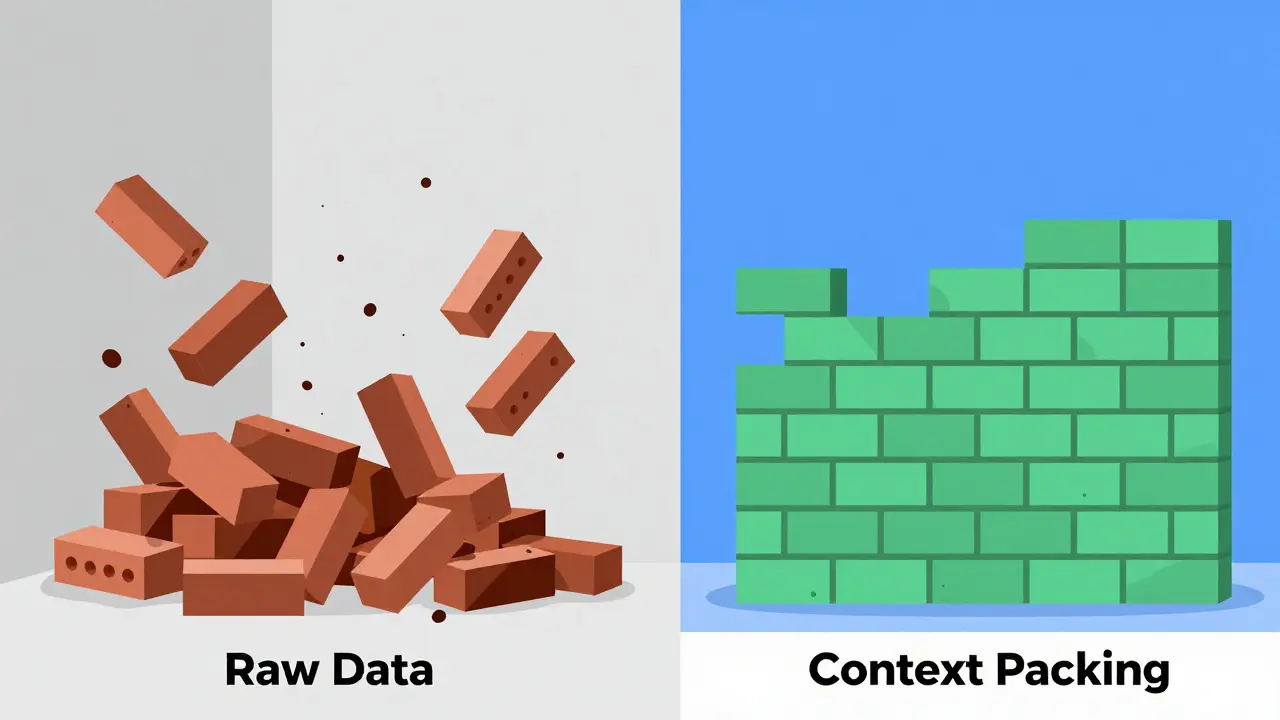
The problem isn’t the size of the window; it’s how you fill it. This is where context packing comes in. It’s not just about fitting more data in-it’s about fitting the *right* data in, structured so the AI can actually use it. Think of it as the difference between throwing a pile of bricks at a wall versus laying them one by one with mortar. Both use the same materials, but only one builds something solid.
Why Context Packing Matters More Than Prompt Engineering
We spent years obsessed with prompt engineering-crafting the perfect question. But asking a great question doesn’t help if the AI has no relevant background to answer from. Context packing shifts the focus from *how* you ask to *what* the model knows before you ask.
Consider a developer using an AI assistant to fix a bug. If you paste the entire 50-file project into the chat, the model wastes compute power scanning irrelevant files. It might miss the actual error buried in the noise. Instead, context packing involves curating only the specific file causing the issue, the related interface definitions, and the recent error logs. You’re giving the AI a focused workspace, not a cluttered warehouse.
This approach relies on the principle that AI quality is directly tied to data context quality. A well-structured, concise context leads to sharper, more accurate responses than a vast, unorganized one. It reduces token usage (saving money) and latency (saving time), while boosting reliability.
The Three-Phase Framework for Structuring Information
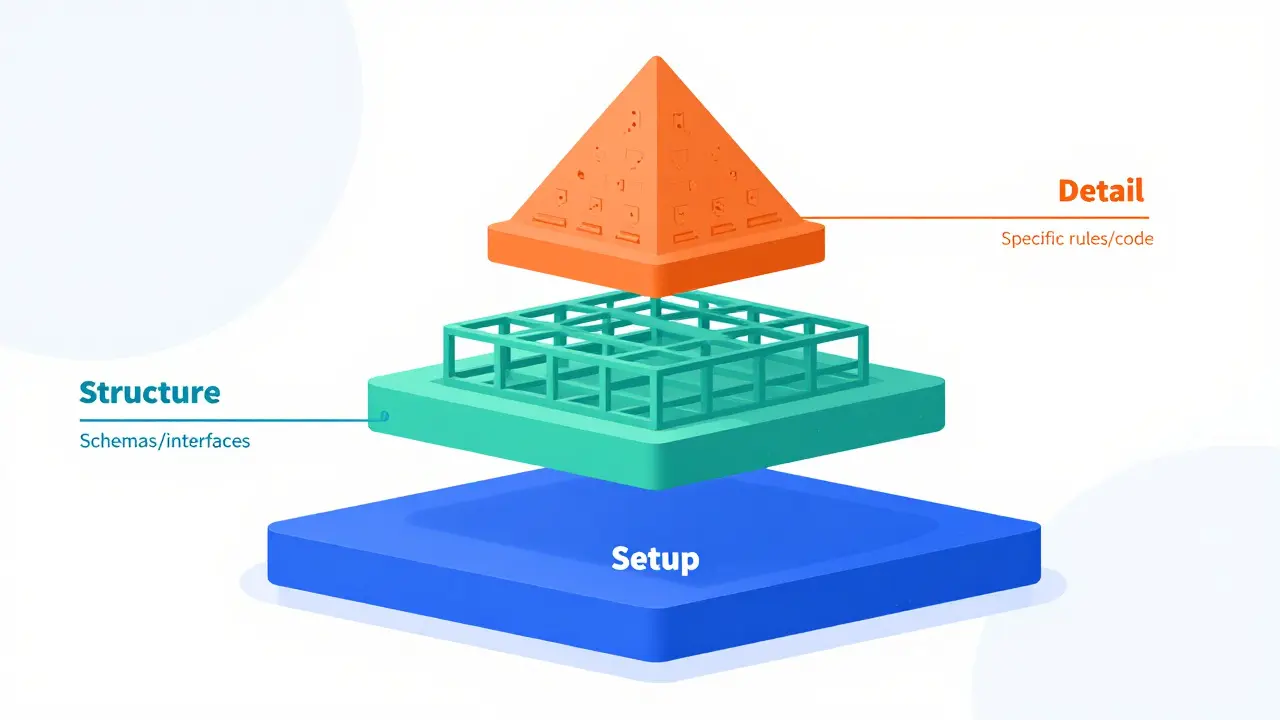
One of the most effective ways to pack context is through phased delivery. Instead of dumping everything at once, you feed information in layers, matching the complexity of the task. This method, often called the Setup-Structure-Detail framework, mirrors how humans learn new tasks.
- Setup Phase: Define the high-level goal and constraints. For example, "Implement a user registration feature that sends a confirmation email." No code yet, just intent.
- Structure Phase: Provide the skeleton. Share the database schema, API endpoints, or class interfaces. This tells the AI *where* things fit without overwhelming it with implementation details.
- Detail Phase: Add the specifics. Now include validation rules, edge cases, or specific library versions. This is where you provide the granular facts needed for execution.
In practice, this can reduce token usage dramatically. Generating a service layer might require only 300 tokens of structured context instead of 10,000 tokens of raw code. The AI understands the boundaries and relationships clearly, leading to fewer errors and less need for follow-up corrections.
Optimizing Tokens: Quality Over Quantity
Every token counts. Whether you’re paying per million tokens or dealing with latency limits, efficiency is key. Context packing forces you to audit what information is truly essential. Ask yourself: Does the model need to see the entire history of this document, or just the last three changes? Does it need the full style guide, or just the rule about header formatting?
Use concise formats. Instead of pasting verbose natural language descriptions, use structured data like JSON, YAML, or Markdown tables when appropriate. These formats are denser and easier for models to parse. For instance, a table mapping user roles to permissions uses far fewer tokens than a paragraph explaining each role’s access rights.
Avoid redundancy. If you’ve already defined a variable name in the structure phase, don’t redefine it in the detail phase. Trust the model to hold short-term memory within the session. This keeps the context window clean and focused on new information.
Advanced RAG: Beyond Simple Retrieval
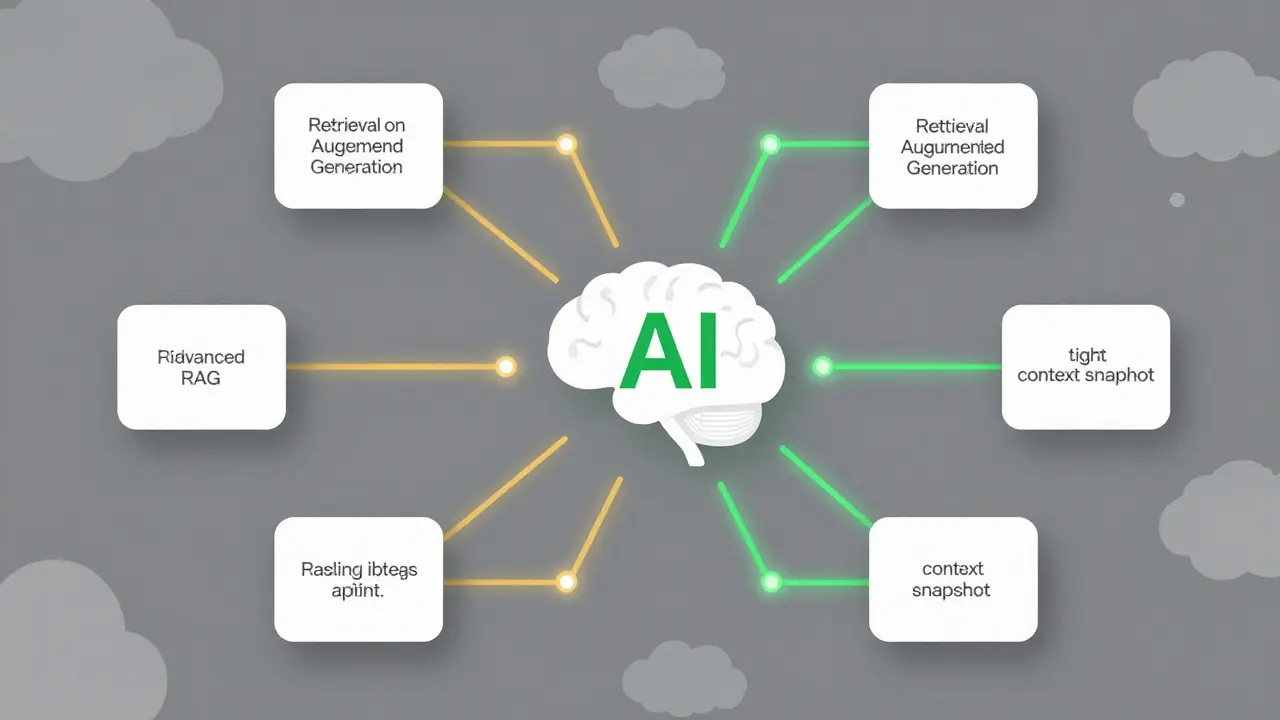
Retrieval-Augmented Generation (RAG) is a cornerstone of advanced context packing. It allows models to pull relevant information from external databases in real-time rather than relying solely on static prompts. However, naive RAG implementations often fail because they retrieve too much or too little irrelevant data.
Effective RAG requires semantic precision. Instead of grabbing the top three text chunks based on keyword match, use vector embeddings to find semantically similar content. Then, apply a re-ranking step to filter out noise. The goal is to create a "context snapshot"-a coherent, tightly packed bundle of facts that directly addresses the query.
For example, a customer support bot shouldn’t just retrieve any article mentioning "refund." It should retrieve the specific policy page, the user’s transaction history, and the current status of their ticket. By combining these diverse data sources into a single, structured context, the AI can generate a personalized, accurate response instead of a generic FAQ copy-paste.
| Strategy | Token Efficiency | Accuracy Impact | Best Use Case |
|---|---|---|---|
| Dump All Data | Low | Decreases (noise) | None (avoid) |
| Phased Delivery | High | Increases (focus) | Code generation, complex tasks |
| Naive RAG | Medium | Variable | Simple Q&A |
| Semantic RAG | High | Significantly Increases | Enterprise knowledge bases |
Managing Memory Across Sessions
Context packing isn’t just about a single interaction; it’s about maintaining continuity. Users expect AI to remember previous conversations, preferences, and decisions. This requires robust session memory management.
Instead of re-sending foundational context every time, store key facts in a lightweight memory layer. When a new session starts, inject only the relevant summary of past interactions. For instance, if you were debugging a Python script yesterday, today’s session should start with a brief recap: "Previous issue: IndentationError in main.py. Status: Resolved." This keeps the current context fresh without wasting space on old news.
Agentic workflows benefit greatly from this. Complex tasks can be broken down into steps, with each agent receiving only the context necessary for its specific sub-task. One agent handles data extraction, another validates it, and a third generates the report. Each operates within a tight, optimized context window, ensuring higher precision across the board.
Reducing Hallucinations Through Boundaries
One of the biggest risks with generative AI is hallucination-making up facts when uncertain. Context packing acts as a boundary against this. When you provide clear, verified, and structured information, the model has less room to guess.
If you ask an AI to summarize a contract, providing the exact clauses prevents it from inventing terms. If you’re building a financial dashboard, feeding it precise API schemas ensures it doesn’t assume column names. The more constrained and factual the context, the more grounded the output.
This grounding effect transforms AI from a creative writing tool into a reliable business asset. It moves projects from experimental pilots to production-ready systems because stakeholders can trust the outputs. You’re not just hoping the AI gets it right; you’re structuring the environment so it *must* get it right.
Building a Feedback Loop for Continuous Improvement
Context packing isn’t a one-time setup. It requires ongoing refinement. Monitor how your AI performs with different context structures. Are certain types of queries still failing? Is the model ignoring parts of your structured data?
Use evaluation metrics to track accuracy and relevance. If users frequently correct the AI, revisit your context strategy. Maybe you’re missing a key piece of information, or perhaps the format is too dense. Iterate on your ETL (Extract, Transform, Load) processes to ensure data quality before it reaches the model.
Over time, this feedback loop creates a self-improving system. You’ll identify which context patterns yield the best results and standardize them across your organization. This scalability is crucial for enterprises deploying AI at scale, ensuring consistent performance regardless of who is using the tool.
What is the difference between context packing and prompt engineering?
Prompt engineering focuses on crafting the ideal question or instruction. Context packing focuses on preparing and structuring the background information the AI needs to answer that question effectively. While prompt engineering asks "How do I get the best answer?", context packing asks "What information does the AI need to give that answer?"
How many tokens should I aim for in a context window?
There is no fixed number, as it depends on the model and task. However, the goal is minimal sufficiency. Include only the information strictly necessary for the task. For coding tasks, this might be 500-2,000 tokens. For complex analysis, it could be higher. Always test to find the sweet spot where adding more context no longer improves accuracy.
Can context packing reduce AI hallucinations?
Yes. By providing clear, verified, and structured facts, you limit the AI's ability to guess or invent information. Well-packed context acts as a constraint, forcing the model to ground its responses in the provided data rather than its training set alone.
Is Retrieval-Augmented Generation (RAG) part of context packing?
Yes, advanced RAG is a key technique in context packing. It dynamically retrieves relevant information from external sources to enrich the context window. Effective RAG involves semantic search and re-ranking to ensure only high-quality, relevant snippets are included.
How do I handle long conversations without exceeding context limits?
Use session memory management. Summarize past interactions and store key facts externally. Inject only the relevant summary into new sessions. This keeps the active context window small and focused on the current task while preserving historical continuity.