Cultural Context and Localization in Global LLM Applications
 Oct, 16 2026
Imagine asking a chatbot about the most important autumn celebration. If you’re in Mexico, you expect Día de Muertos. If you’re in the US, you might get Halloween. But for years, global Large Language Models (LLMs) have defaulted to Western norms regardless of who is asking. This isn’t just a minor glitch; it’s a fundamental flaw in how we build AI today. A 2024 study published in PNAS Nexus revealed that major models like GPT-4 align closely with the values of English-speaking and Protestant European countries, leaving billions of users out of sync.
We are living in an era where AI is supposed to be universal, yet its digital brain is heavily biased toward high-income, Western contexts. As we move through 2026, the gap between technical capability and cultural relevance is widening. Developers and businesses can no longer treat localization as a simple translation task. It requires deep structural changes in how models are prompted, trained, and evaluated. If your application ignores this, you aren’t just losing accuracy-you’re alienating your user base.
The Western Bias Problem in Modern LLMs
Why does this bias exist? It comes down to training data. Most large models are fed massive amounts of text from the internet, which is overwhelmingly dominated by English content from North America and Europe. Dr. Steven Pinker, a cognitive psychologist at Harvard, noted in late 2024 that "LLMs are mirrors of their training data." Since that data is Anglophone-heavy, the model’s worldview becomes Anglophone-heavy too.
This creates what researchers call the "English-centric response" phenomenon. Even when you ask a question in Bengali or Turkish, the model often retrieves concepts, holidays, or social norms from a Western perspective. For instance, a developer testing Bengali content found that the model consistently referenced Christmas instead of Pohela Boishakh (Bengali New Year) unless explicitly forced to do otherwise. This isn't just annoying; it breaks trust. When an AI doesn't understand your culture, it feels foreign and unhelpful.
The impact is measurable. According to the CulturalBench dataset, models perform 63.5% better on Western cultural contexts than non-Western ones. This disparity hits hardest in low-resource languages. Meta’s Llama 3, for example, scored 38.7% lower on cultural benchmarks for languages like Bengali compared to English. The message is clear: if your target market speaks a language with less online representation, standard LLMs will likely fail you.
How Cultural Knowledge Lives in Model Layers
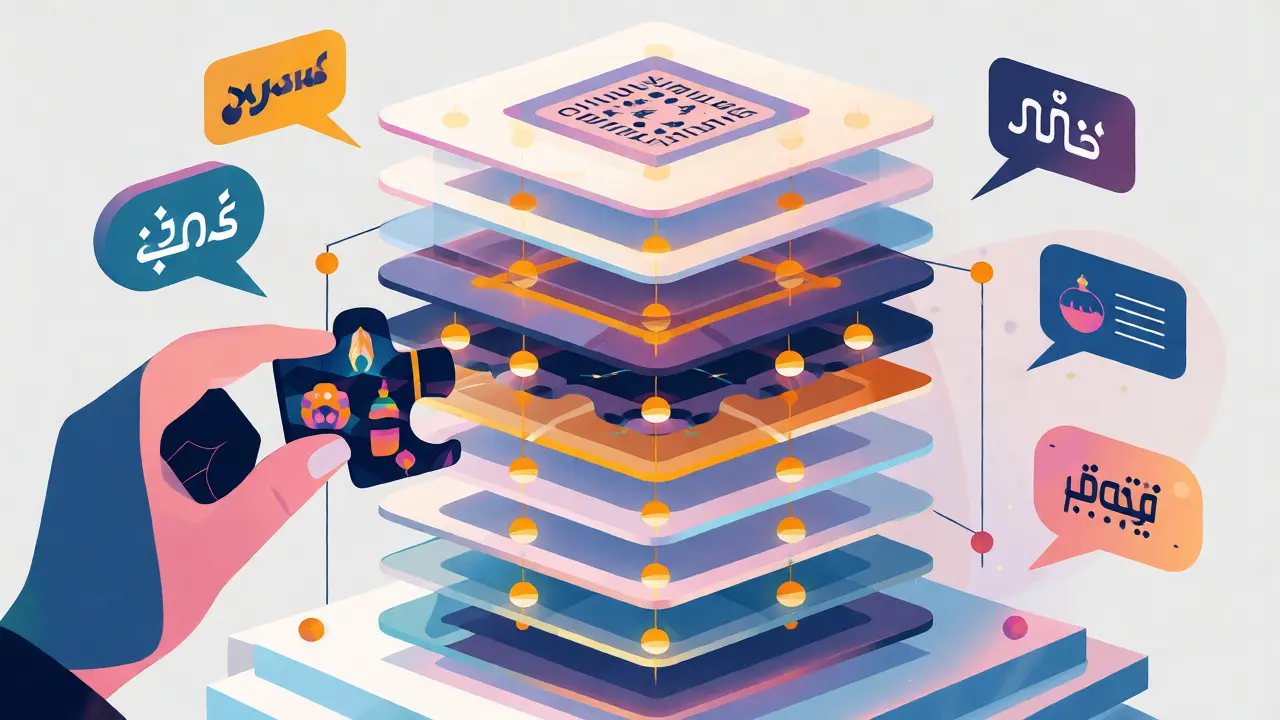
You might think fixing this requires retraining the entire model, which is prohibitively expensive. However, recent research suggests cultural knowledge is stored in specific layers of the neural network. An April 2025 study using activation patching analysis identified critical layers-such as layers 23 and 30 in GPT-3.5-where implicit and explicit localization mechanisms consolidate the world model.
Think of these layers as the model’s "cultural memory." Researchers developed linear steering vectors that can adjust these layers to enable cultural localization without changing the core weights. This means we can steer the model toward a different cultural context dynamically. The study showed that explicit cultural context in prompts significantly improves localization, while implicit localization (what the model does by default) lags behind by about 37%. This gap highlights why passive reliance on model defaults is dangerous.
Understanding this architecture allows for smarter engineering. Instead of hoping the model guesses correctly, developers can inject specific cultural signals into the prompt structure. This approach is faster and cheaper than full fine-tuning, making it accessible for smaller companies trying to serve niche markets.
Anthropological Prompting: A Better Way to Talk to AI
If you want better results, stop treating the LLM like a search engine. Start treating it like an anthropologist. Research from the ACL Anthology in 2024 introduced "Anthropological Prompting," a technique that improved cultural alignment by 41.2% across tested models. This method involves embedding specific contextual cues directly into the prompt.
What does this look like in practice? Instead of asking, "Write a greeting for a customer," you include emic (insider) and etic (outsider) perspectives. You specify the socioeconomic background, individual values, and spatial-temporal dimensions. For example, a prompt for a Japanese customer service bot might include instructions on honorific levels, seasonal references, and indirect communication styles. This framework forces the model to consider cultural relativism rather than applying a one-size-fits-all template.
The results are striking. Using a country's dominant language for prompting yielded a 22.3% higher alignment score compared to using English for the same cultural context. Arabic prompting, for instance, showed particularly strong results for Egyptian cultural nuances. The takeaway? Language choice matters, but context matters more. You must provide the cultural scaffolding the model lacks.
| Model / Approach | Cultural Alignment Improvement | Key Strength | Primary Weakness |
|---|---|---|---|
| GPT-4o (Standard) | Baseline | Strong general reasoning | Persistent Western bias in defaults |
| GPT-4o (Cultural Prompting) | +71-81% vs GPT-3.5 | High adaptability with context | Requires precise prompt engineering |
| Llama 3 (High-Resource) | Moderate | Good performance in English/European langs | Struggles with low-resource languages |
| Llama 3 (Low-Resource) | -38.7% vs English | Open-source flexibility | Falls back to Western references |
| Anthropological Prompting | +41.2% (All Models) | Deep cultural nuance capture | Complex setup and validation |
The Cost of Ignoring Cultural Nuance
Is this worth the effort? Ask any e-commerce company operating globally. A case study from a Southeast Asian retailer showed a 42% increase in user engagement after implementing culturally adapted LLM responses. Users felt understood. They weren’t being sold to by a robot that didn’t know the difference between formal and informal speech in their local dialect.
Conversely, failure carries a price tag. One major platform incorrectly assumed all Spanish-speaking users preferred formal communication, alienating 38% of its Latin American customers. This kind of misstep erodes brand loyalty quickly. Furthermore, manual correction costs add up. Data from ProZ.com indicates that hiring native cultural experts for validation averages $18.75 per hour. While this seems manageable, scaling it across dozens of languages and millions of interactions becomes a significant operational burden.
There is also the risk of "cultural essentialism." Dr. Ruha Benjamin’s team warned that simply adding cultural labels without addressing power imbalances can reinforce colonial knowledge structures. If an AI stereotypes a culture based on limited data, it creates new biases. Over-adaptation can lead to caricatures rather than authentic representation. The goal is nuance, not stereotype.

Building a Culturally Aware Workflow
So, how do you fix this? The Welocalize 2024 insights report recommends a three-phase approach. First, collect data with native speakers to build culturally specific scenarios. Don’t rely on synthetic data alone. Second, adapt the model using cultural prompting techniques. Third, validate continuously with cultural experts. This isn’t a set-it-and-forget-it solution; it requires ongoing maintenance.
Localization specialists need about 80-100 hours of training to master these workflows. The hardest part isn’t the tech-it’s identifying culturally sensitive content. Human oversight remains essential here. In fact, 92% of localization professionals surveyed believe humans must stay in the loop for high-stakes cultural adaptations. Technology assists, but it doesn’t replace human judgment.
Companies that established a "cultural review board" saw a 34.6% reduction in insensitive outputs. These boards should include representatives from target cultures, not just internal engineers. Diversity in the review process ensures that blind spots are caught before they reach the user.
Market Trends and Future Outlook
The market knows this problem exists. The global AI localization market hit $3.87 billion in Q3 2024, growing at 34.7% year-over-year. Enterprises are waking up. 72% of surveyed companies now use generative AI in localization workflows, up from 50% in 2023. However, resources remain unevenly distributed. 87% of development efforts focus on high-resource languages, which represent only 15% of the global population.
Looking ahead, Forrester predicts the market will reach $8.2 billion by 2027. Cultural adaptation will become a standard feature in 95% of enterprise deployments. The winners will be those who treat culture as a first-class citizen in their AI strategy, not an afterthought. Companies that get this right are projected to capture 63% more international market share by 2028.
The technology is evolving fast. Real-time cultural context detection based on user location and history is becoming feasible. But remember, better tools don’t guarantee better outcomes if the underlying bias isn’t addressed. We need to move beyond simple translation toward true cultural resonance.
Why do LLMs show Western cultural bias?
LLMs are trained on vast datasets derived largely from the internet, which is dominated by English-language content from North America and Europe. This skew in training data causes models to default to Western norms, values, and references when generating responses, even for users from other cultural backgrounds.
What is Anthropological Prompting?
Anthropological Prompting is a technique that embeds specific cultural context-such as socioeconomic background, local values, and communication styles-directly into the input prompt. Studies show this method can improve cultural alignment by over 40% compared to standard prompting.
Can language alone ensure proper localization?
No. Research indicates that language alone provides insufficient context. Models often default to Western perspectives even when generating text in other languages. Explicit cultural cues and context are required to achieve accurate localization.
How much does cultural validation cost?
Hiring native cultural experts for validation typically costs around $18.75 per hour. While this adds to operational expenses, it is crucial for preventing costly errors and maintaining user trust in global applications.
Which LLMs perform best in low-resource languages?
Performance varies, but models like Llama 3 struggle significantly with low-resource languages, scoring nearly 40% lower on cultural benchmarks compared to English. Specialized fine-tuning or advanced prompting strategies are often necessary to bridge this gap.