Data Extraction and Labeling with LLMs: Turning Text into Structured Insights
 Jul, 9 2026
Imagine you have a stack of ten thousand lease agreements, medical records, or customer support tickets. Now imagine trying to pull out specific details-like start dates, drug names, or complaint types-from every single one by hand. It sounds exhausting, doesn't it? That is exactly where most organizations hit a wall when dealing with unstructured text. But things are changing fast. Instead of hiring armies of annotators, companies are now using Large Language Models (LLMs) to handle the heavy lifting in data extraction and labeling. This shift isn't just about saving time; it’s about turning messy, raw text into clean, structured insights that machines can actually use. Whether you are building a chatbot for a bank or analyzing clinical trials for a pharma company, getting your data right is the difference between a useful tool and a broken one. Let’s look at how this works, why it matters, and how you can implement it without losing your mind.
The Core Problem: Unstructured Data Chaos
Most business data lives in documents, emails, PDFs, and web pages. This is what we call unstructured data. Unlike numbers in a spreadsheet, this data has no fixed format. One invoice might list the date at the top left; another might bury it in the footer. A doctor’s note might abbreviate "hypertension" as "HTN," while another writes it out fully. For traditional software, this variety is a nightmare. You have to write rigid rules for every possible variation. If the format changes slightly, your code breaks. Humans used to be the solution here. We hired people to read through these documents and tag them manually. But human labeling is slow, expensive, and prone to fatigue. If you need millions of labeled examples to train a deep learning model, manual work simply doesn’t scale.
This is where LLM-assisted labeling comes in. These models, like GPT-4o, Claude 3.5 Sonnet, or Llama 70B, have already read vast amounts of text. They understand context, nuance, and structure far better than old-school keyword search tools. By asking an LLM to extract specific fields, you get consistent, structured output-usually in JSON format-that your applications can consume immediately.
How LLM-Based Extraction Actually Works
You don’t need to be a computer scientist to grasp the workflow, but understanding the steps helps you avoid common pitfalls. The process generally follows a clear path:
- Data Curation and Preprocessing: Before you ask an LLM to do anything, you need clean input. Raw HTML from the web often contains tags, ads, and navigation menus that confuse the model. You strip this noise out. You normalize whitespace and segment long documents into logical chunks. For example, if you are processing SEC filings, you separate the narrative text from the XBRL financial tables.
- Prompt Engineering: This is where you give instructions. You tell the LLM exactly what to look for. Do you want names? Dates? Sentiment? You provide the schema-the structure you expect back. Often, you include a few examples of correct extractions (few-shot prompting) to guide the model’s behavior.
- API Execution: You send your preprocessed text and prompt to the LLM via an API. You have to watch your token limits carefully. If a document is too long, you break it up. The model processes the request and returns the extracted data.
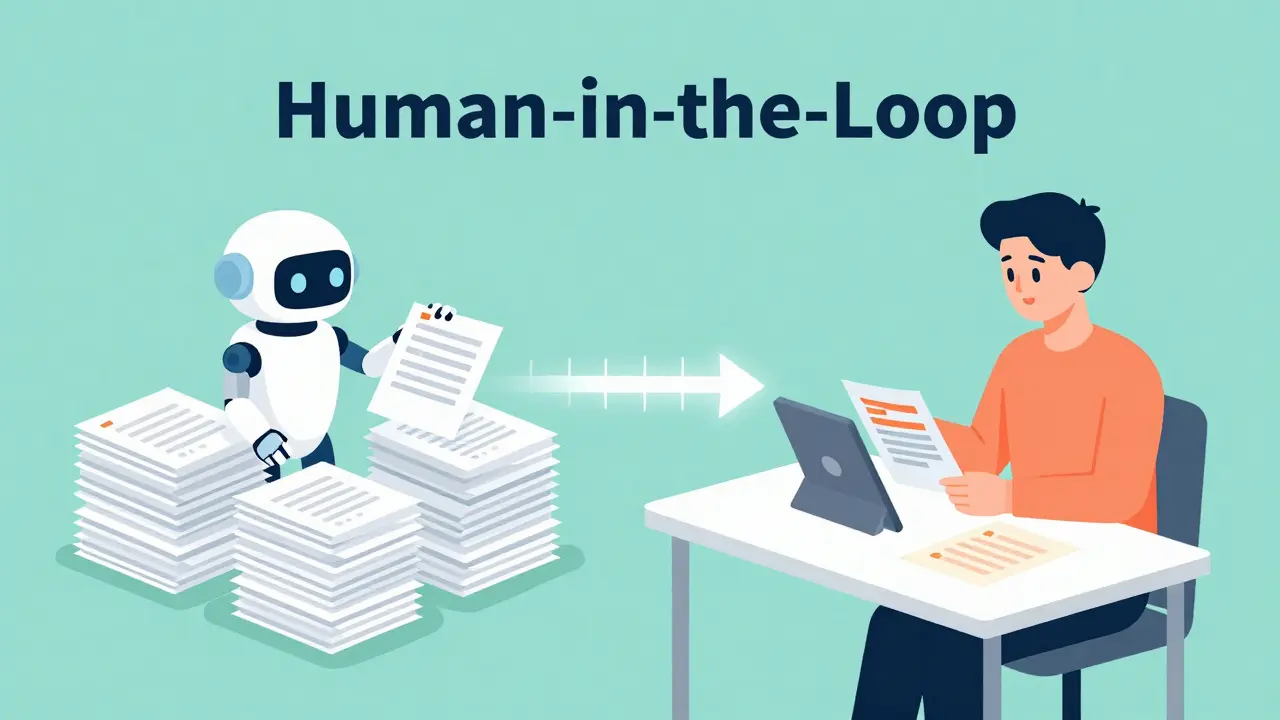
- Validation and Human Review: Here is the critical part. LLMs are smart, but they hallucinate. They make mistakes. You compare the LLM’s output against a small set of ground-truth labels (data you know is correct). You calculate metrics like precision and recall. Then, you feed the results into a labeling platform where humans verify the tricky cases.
This creates a symbiotic loop. The LLM handles the bulk of the easy work-the "low-hanging fruit." Humans focus only on the ambiguous or complex cases. This hybrid approach is significantly faster and cheaper than pure manual labeling, yet more accurate than pure automation.
Key Use Cases Beyond Basic Text Processing
Why are companies adopting this so quickly? Because it solves real problems across different industries. Let’s look at three concrete scenarios.
1. Named Entity Recognition (NER) in Finance
Banks deal with massive volumes of unstructured communication. When a customer chats with a bot, the system needs to understand intent. Is the user asking about their balance? Reporting fraud? Applying for a loan? LLMs classify these utterances accurately, even when customers use slang or incomplete sentences. In investment banking, analysts use LLMs to scan thousands of pages of SEC filings. They extract key risks, executive compensation figures, and merger details, turning dense legal prose into actionable spreadsheets.
2. Medical Record Analysis in Pharma
Pharmaceutical companies spend years developing drugs. Part of that process involves reviewing clinical trial documents and adverse event reports. An LLM can scan patient notes to identify specific procedures, side effects, or drug interactions. For instance, it can flag mentions of "nausea" or "headache" associated with a new medication, linking them to dosage levels. This speeds up safety monitoring and regulatory reporting dramatically.
3. Customer Sentiment and Support Ticket Routing
E-commerce giants receive millions of support tickets daily. Instead of routing them randomly, LLMs analyze the sentiment and topic of each message. If a ticket contains angry language about a late delivery, the system flags it as high priority and routes it to a senior agent. If it’s a simple password reset, it goes to an automated bot. This improves customer satisfaction and reduces operational costs.
| Feature | Traditional Manual Labeling | LLM-Assisted Labeling |
|---|---|---|
| Speed | Slow (hours per document) | Fast (seconds per document) |
| Cost | High (labor-intensive) | Low (API costs + minimal review) |
| Consistency | Variable (human fatigue) | High (consistent prompts) |
| Scalability | Limited by workforce size | Near-infinite (cloud-based) |
| Complexity Handling | Good for nuanced context | Good, but requires validation |
Advanced Techniques: Fine-Tuning and Distillation
If you are serious about this, you eventually move beyond simple prompting. Two advanced strategies stand out: Reinforcement Learning from Human Feedback (RLHF) and Model Distillation.
RLHF-based labeling starts with a small sample of manually labeled data. You use this to fine-tune a smaller version of the LLM. Once tuned, this specialized model generates labels for the rest of your dataset. Because it was trained on your specific domain data, it performs better than a generic off-the-shelf model. You then use human feedback to correct errors and retrain, creating a continuous improvement loop.
LLM Distillation is about efficiency. Large models like GPT-4 are powerful but expensive and slow. Distillation involves using the large model to generate high-quality training data, which is then used to train a smaller, faster model. This smaller model can run locally or on edge devices, providing similar accuracy at a fraction of the cost. This is crucial for applications where latency matters, like real-time chatbots or mobile apps.
Pitfalls to Avoid and Best Practices
It is tempting to think LLMs solve everything automatically. They don’t. Here is what trips people up:
- Ignoring Token Limits: Every LLM has a maximum context window. If you try to stuff a 50-page report into a prompt meant for 4,000 tokens, you will get truncated or garbled results. Always chunk your data intelligently.
- Skipping Validation: Never trust the first batch of outputs blindly. Create a baseline evaluation with 100-500 samples. Compare the LLM’s extraction against known correct answers. Calculate F1 scores. If the accuracy is below your threshold, tweak your prompt or switch models before scaling up.
- Poor Prompt Design: Vague instructions lead to vague results. Be specific. Define your entities clearly. Provide examples. Specify the output format (e.g., "Return only valid JSON"). Test your prompts iteratively.
- Data Privacy Risks: Sending sensitive customer data (PII) to public LLM APIs can violate regulations like GDPR or HIPAA. Use private deployments, anonymize data before sending, or choose enterprise-grade providers with strict data handling policies.
Choosing the Right Tools
The ecosystem for LLM data extraction is growing rapidly. You have several options depending on your needs:
- Kili Technology: A dedicated platform for managing the labeling workflow. It integrates well with LLM outputs, allowing teams to review and correct AI-generated labels efficiently.
- Databricks: Ideal for enterprises needing robust infrastructure to process massive datasets. It offers end-to-end pipelines for cleaning, extracting, and storing structured data.
- Snorkel AI: Focuses on programmatic labeling and distillation. Great for teams that want to automate the creation of training data using code rather than manual clicks.
- AWS SageMaker: Provides comprehensive tools for preparing datasets and deploying LLMs at scale within the AWS cloud environment.
Your choice depends on your team’s technical expertise, budget, and data volume. Start small. Pick one use case, like extracting contact info from resumes, and prove the value before expanding to complex financial analysis.
The Future of Structured Insights
We are moving toward a world where unstructured data is no longer a barrier. As LLMs become more accurate and cheaper, the gap between raw text and usable insight shrinks. Organizations that master this workflow will gain a significant competitive advantage. They will react faster to market changes, comply with regulations more easily, and deliver better customer experiences.
The key takeaway? Don’t try to boil the ocean. Identify one painful, repetitive data task in your organization. Apply LLM-assisted extraction to it. Measure the time saved and the accuracy gained. Then iterate. This is not just a tech trend; it is a fundamental shift in how we handle information.
What is the difference between data extraction and data labeling?
Data extraction involves pulling specific pieces of information (like dates or names) from unstructured text. Data labeling is the broader process of tagging entire documents or segments with categories (like "positive sentiment" or "fraudulent transaction"). LLMs can perform both tasks, often outputting extracted fields as part of a labeled structure.
Are LLMs accurate enough for production use?
Yes, but with caveats. For straightforward tasks like Named Entity Recognition, modern LLMs achieve high accuracy. However, they can still hallucinate or miss nuances. Best practice involves a human-in-the-loop validation step, especially for critical domains like healthcare or finance.
Which LLM should I use for data extraction?
It depends on your needs. GPT-4o and Claude 3.5 Sonnet offer high accuracy and ease of use via API. Llama 70B is a strong open-source option if you need to keep data private or reduce costs. Start with a paid API for speed, then consider fine-tuning an open-source model if volume scales up.
How do I handle token limits with large documents?
Break documents into smaller, logical chunks (sections or paragraphs). Process each chunk separately, then combine the results. Ensure your preprocessing step preserves context boundaries so the LLM doesn’t lose track of references across chunks.
Is it safe to send sensitive data to LLM APIs?
Only if the provider guarantees data privacy and compliance. For highly sensitive PII or PHI, consider using private cloud deployments or on-premise models. Always anonymize or redact sensitive fields before sending data to public APIs unless explicitly permitted by your security policy.