Data Residency for Global LLM Deployments: A Practical Guide
 Jun, 4 2026
You have built a brilliant large language model application. It answers customer questions instantly and drafts reports in seconds. But then legal sends you an email with one sentence: "Where is the data going?" If your answer involves servers in three different continents, you might be looking at a massive fine or a forced shutdown. This is the reality of data residency for global AI deployments.
Data residency means keeping specific data within defined geographical borders. For Large Language Models (LLMs), this is not just about where the database lives. It is about where the prompts go, where the embeddings are stored, and even where the model weights reside. With regulations like the EU's General Data Protection Regulation (GDPR) and China's Personal Information Protection Law (PIPL) tightening their grip, ignoring these boundaries is no longer an option for serious enterprises.
Why Data Residency Matters for AI Now
In the early days of cloud computing, data flowed freely across borders to optimize performance. That era is ending for sensitive information. The core issue is that LLMs are probabilistic engines. They do not just store data; they learn patterns from it. Recent research from the University of Cambridge's Centre for AI Safety in June 2025 showed that LLMs can memorize between 0.1% and 10% of their training data. This means personal information can potentially be retrieved through targeted queries, challenging the old argument that "mathematical representations" are safe.
Regulators are catching up. The European Commission's AI Office released draft guidelines in June 2025 explicitly requiring technical measures to keep training data and outputs within specified boundaries for high-risk systems. Under GDPR, non-compliance can cost up to 4% of your global annual turnover. In China, the PIPL mandates security assessments for any cross-border transfer involving Chinese citizens' data, effectively forcing local infrastructure for operations there. You cannot rely on encryption alone. As Dr. Kenji Tanaka, Chief Privacy Officer at InCountry, noted, physical location matters because laws are territorial, not cryptographic.
Choosing Your Architecture: Cloud, Hybrid, or Local?
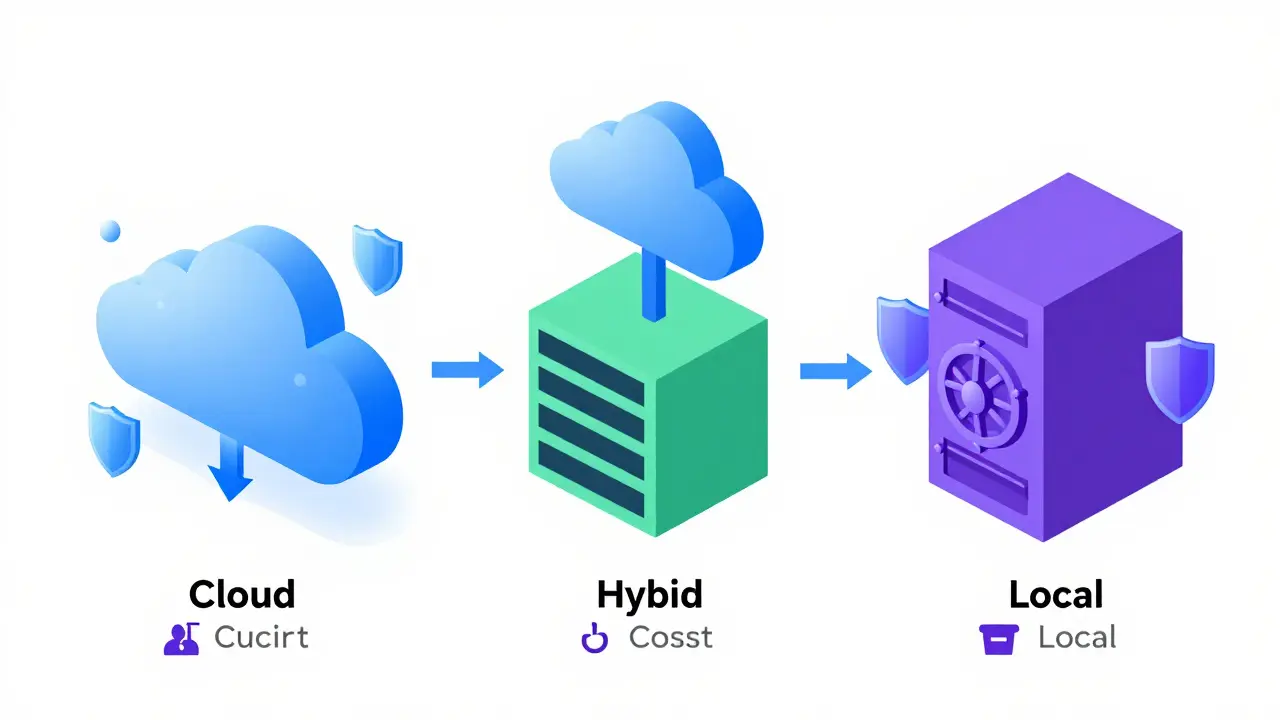
There is no single solution that fits every company. Your choice depends on your risk tolerance, budget, and technical expertise. Here are the three main paths organizations take in 2026.
| Architecture Type | Compliance Level | Performance/Latency | Estimated Monthly Cost | Best For |
|---|---|---|---|---|
| Cloud-Hosted LLMs | Low (2.3/5) | High (4.7/5) | $1,000 - $5,000 | Internal tools, non-sensitive data |
| Hybrid (AWS Outposts/Azure Stack) | High (4.2/5) | Medium (3.1/5) | $15,000+ | Enterprise, regulated industries |
| Fully Local SLMs | Very High (5/5) | Variable | $3,500+ | Strict isolation, lower compute needs |
Cloud-Hosted LLMs like Azure OpenAI Service offer the best performance and ease of use. However, they score poorly on data residency compliance because data often traverses multiple regions before processing. This is risky if you handle health records or financial data.
Hybrid Deployments using services like AWS Outposts or Local Zones allow you to run Amazon Bedrock Agents with on-premises data. The model runs locally, but you still get access to managed services. Gartner's August 2025 Magic Quadrant rates hybrid solutions highly for compliance (4.2/5) but notes they are harder to deploy (3.1/5). Expect a minimum monthly commitment of around $15,000 for robust setups.
Fully Local Small Language Models (SLMs) are gaining traction. Models like Microsoft's Phi-3-mini (3.8 billion parameters) require only 8GB of RAM compared to 140GB for Meta's Llama 3 (70B parameters). While they may achieve only 78% of GPT-4's accuracy on complex tasks, they ensure 100% data residency. This approach costs roughly $3,500 monthly for equivalent throughput but requires skilled ML engineers to maintain.
Building a Compliant Retrieval-Augmented Generation (RAG) System
Most enterprise LLM applications use Retrieval-Augmented Generation (RAG) to ground responses in proprietary data. To keep this process compliant, every step must stay within your designated region. AWS documented a seven-step workflow for this in March 2024, which remains the industry standard for hybrid setups.
- Document Ingestion: Upload files to a local storage system like Amazon S3 on Outposts.
- Vector Conversion: Use a local embedding model to convert text into numerical vectors. Do not send raw text to external APIs.
- Vector Storage: Store these vectors in a local vector database (e.g., Amazon OpenSearch or Pinecone configured for local zones).
- User Prompting: The user submits a query via your frontend application.
- Prompt Forwarding: Send the prompt to your local LLM inference server (e.g., G4dn instances with NVIDIA T4 GPUs).
- Similarity Search: The system searches the local vector database for relevant context.
- Response Generation: The local LLM generates the final answer using the retrieved context.
This architecture achieves latency of 200-300 milliseconds within the same environment, which is faster than many cloud-only deployments (500-700 milliseconds) because data doesn't travel over the public internet. However, setting this up takes time. AWS estimates 8-12 weeks for full deployment, including integration testing.
Security Beyond Geography: Access Control and Memorization
Keeping data in a specific country is necessary, but it is not sufficient. You must also control who sees what. Context-Based Access Control (CBAC) is becoming a critical component. Recommended by Lasso Security in April 2025, CBAC dynamically filters retrieved content based on the user's role, time of day, and content sensitivity. Pilot implementations at European financial institutions showed a 92% reduction in unauthorized data access incidents.
Another hidden risk is model memorization. Even if you delete the source documents, the LLM might still "remember" them. Google Research published a paper in April 2025 detailing selective parameter freezing techniques. This method reduces the memorization of personal data by 73% while maintaining 95% of the model's performance. If you are retraining models on sensitive data, implementing such techniques is a smart defensive move.
The Human Factor: Skills and Operational Challenges
Technology is only half the battle. Implementing data-resident AI requires specialized skills. You need engineers certified in cloud machine learning (like AWS Machine Learning Specialty) who also understand vector database administration and regulatory compliance.
Real-world feedback highlights the difficulty. A senior data engineer at a German bank reported on Reddit in June 2025 that deploying Llama 2 70B on-premises took 14 months and required three dedicated ML engineers. While it reduced their regulatory risk from "high" to "medium," the resource drain was significant. Conversely, Atlassian's case study from July 2025 showed that migrating to a hybrid RAG architecture increased implementation complexity by 40% but achieved full compliance with Australia's Privacy Act.
Maintaining consistency across regions is another headache. Forrester's June 2025 survey found that 63% of enterprises struggle with keeping models consistent across different jurisdictions. Tools like DataRobot's GeoSync, launched in April 2025, help by using containerized model distribution with cryptographic verification to reduce version drift incidents by 88%.
Future Outlook: Fragmentation and Costs
The trend is clear: AI infrastructure is fragmenting. IDC predicts that by 2027, the global market will split into more than 15 sovereign cloud environments, each with distinct rules. Gartner analyst Chetan Joshi expects 65% of global enterprises to deploy hybrid AI architectures with region-specific model instances by 2027, up from 28% in 2025.
This fragmentation comes with a price tag. MIT's Center for Information Systems Research estimates that fully compliant data-resident AI infrastructures could increase operational costs by 220-350% compared to centralized cloud deployments. For mid-sized companies, this might mean opting for smaller, less capable models or delaying AI adoption entirely. Currently, 87% of European healthcare and financial institutions report delaying AI projects due to GDPR concerns, compared to only 32% in less regulated sectors.
However, the market for compliant solutions is growing fast. The global market for data-resident AI infrastructure reached $4.7 billion in Q2 2025, up 187% year-over-year. As vendors like InCountry and IBM compete with hyperscalers like AWS and Azure, prices may eventually stabilize. Until then, planning for data residency must start at the design phase, not as an afterthought.
What is the difference between data sovereignty and data residency?
Data residency refers to the physical location where data is stored and processed. Data sovereignty goes further, referring to the legal jurisdiction that applies to that data. For example, data stored in Germany has German residency, but if it is accessible by US authorities under certain laws, its sovereignty might be contested. For LLM deployments, you need to satisfy both: keep the data physically local (residency) and ensure no foreign laws override local protections (sovereignty).
Can I use cloud-based LLMs like ChatGPT for internal employee data?
It depends on your local regulations and the sensitivity of the data. Under GDPR, sending personal employee data to a third-party cloud provider outside the EU requires strict safeguards. Many companies now avoid this by using private instances or hybrid models. Always consult your legal team, but generally, public cloud LLMs are considered high-risk for sensitive internal data unless specific contractual guarantees and technical isolations are in place.
How much does a hybrid LLM deployment cost?
Costs vary significantly based on scale. A basic hybrid setup using AWS Outposts or similar services typically starts at around $15,000 per month for enterprise-grade reliability and compliance. Fully local deployments using Small Language Models (SLMs) can be cheaper, around $3,500 per month, but require more engineering effort to maintain. These figures exclude the initial setup costs and personnel salaries.
Do Small Language Models (SLMs) perform well enough for business use?
For specific tasks, yes. CloverDX benchmarks show that models like Phi-3-mini achieve 78% of GPT-4's accuracy on financial compliance tasks. They are excellent for structured data analysis, summarization, and classification. However, they fall short on creative writing or complex reasoning, scoring only 62% accuracy in those areas. Choose SLMs if your primary goal is compliance and structured output rather than open-ended creativity.
How long does it take to implement a data-resident RAG system?
Expect 8 to 12 weeks for a full implementation. This includes 3 weeks for knowledge base creation, 2 weeks for embedding model configuration, and 3-7 weeks for integration testing. Complex environments with legacy systems or strict security audits may take longer, as seen in cases where deployments stretched to 14 months.