Ethical Use of Synthetic Data in Generative AI: Benefits and Boundaries
 Jul, 8 2026
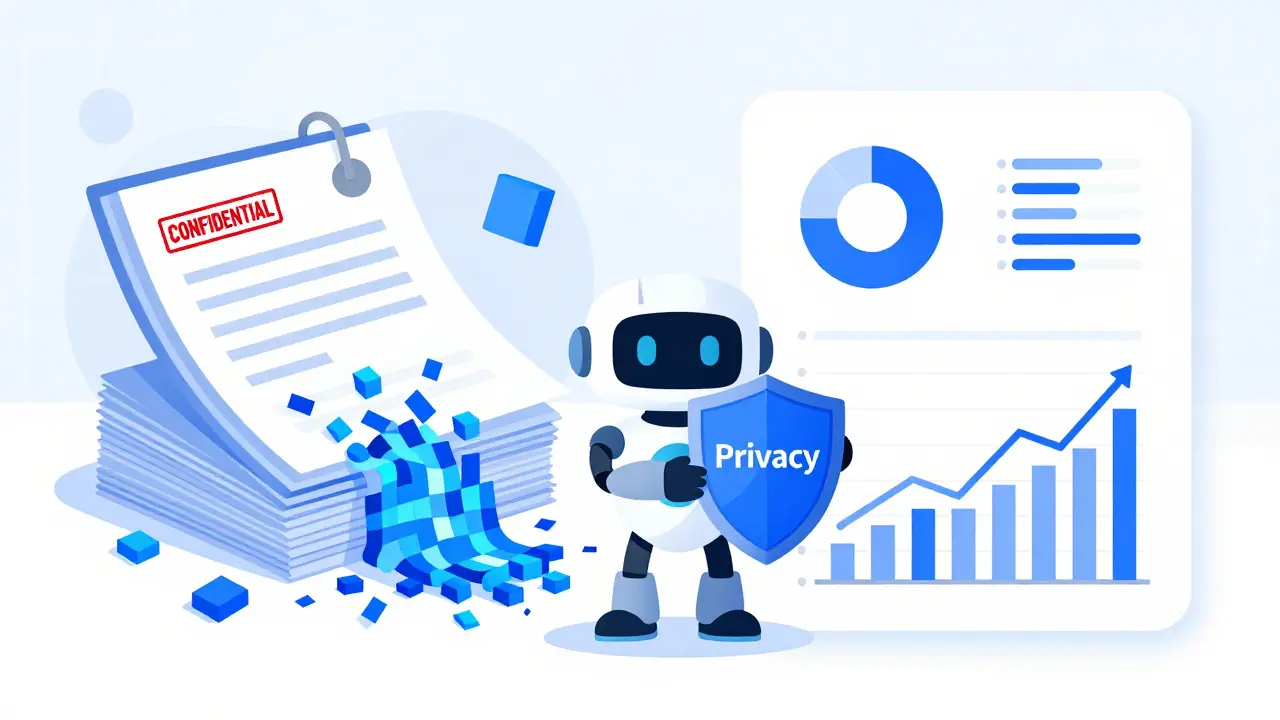
Imagine training a medical AI to detect rare diseases without ever touching a single patient's private record. Or building a fraud detection system for your bank that learns from millions of transactions, yet never exposes real customer financial data. This isn't science fiction anymore. It’s the promise of synthetic data, artificially generated information that mimics real-world patterns without containing actual personal or sensitive details. As generative AI accelerates this capability, we’re hitting a critical crossroads. We have the power to solve massive privacy crises and data shortages, but we also risk creating invisible biases and eroding trust if we aren’t careful.
The core tension is simple: synthetic data offers incredible freedom from regulatory handcuffs like GDPR and HIPAA, but it introduces new ethical landmines. If you generate fake data that looks real but behaves wrong, your AI will make dangerous mistakes. If you hide the fact that data is synthetic, you undermine scientific integrity. Understanding these benefits and boundaries isn't just about compliance; it’s about whether your AI projects actually work in the real world.
The Privacy Shield: Why Synthetic Data Is a Game Changer
For decades, data scientists faced a brutal trade-off. To build accurate models, you needed lots of real data. But real data contains names, addresses, health records, and financial histories. Anonymizing this data-stripping out identifiers-has always been leaky. A 2024 IEEE Security & Privacy study found that traditional anonymization techniques left re-identification risks at 35-40%. That means nearly half the time, someone could still trace "anonymous" data back to a specific person by combining it with other public datasets.
Synthetic data flips this script. Instead of masking real records, you use generative models like Generative Adversarial Networks (GANs) or Variational Autoencoders (VAEs) to learn the statistical patterns of your data and then create entirely new, fictional records that follow those same rules. The result? Re-identification risks drop to less than 5% in properly generated sets. You get the utility of big data without the liability of personal exposure.
This is huge for regulated industries. In healthcare, where HIPAA requires strict safeguards, synthetic data allows researchers to study rare conditions affecting fewer than 1 in 10,000 people without violating patient confidentiality. A 2025 case study from Duke University showed how synthetic patient data enabled oncology research that would otherwise be impossible due to small sample sizes. Similarly, in finance, banks can train fraud detection algorithms on synthetic transaction logs that preserve complex spending behaviors without exposing real account numbers. According to a 2025 Deloitte survey, 89% of major banks now use synthetic data for model validation, driven largely by this privacy advantage.
Solving the Data Scarcity Problem
Privacy isn't the only hurdle. Often, there simply isn't enough data. Maybe your company is new. Maybe you're trying to predict an event that rarely happens, like a specific type of cyberattack or a natural disaster. Real-world edge cases are scarce by definition. This is where synthetic data shines as an augmentation tool.
By generating variations of existing data points, you can expand your training dataset by 200-500% without collecting a single new real-world record. This helps balance skewed datasets. For example, if your loan approval AI has mostly approved applications and very few denials, it won't learn well how to identify risky loans. Synthetic data can generate realistic "denial" scenarios based on known risk factors, giving your model a more balanced education.
However, there’s a catch. Synthetic data doesn't capture true novelty. It extrapolates from what it already knows. If your original dataset lacks diversity, your synthetic data will amplify that lack of diversity. You’re not discovering new realities; you’re simulating known ones. This leads us directly into the most dangerous ethical boundary: bias.
The Bias Trap: When Synthetic Data Amplifies Prejudice
Here’s the hard truth: synthetic data is not neutral. It inherits every bias present in the source data used to train the generator. And often, it makes those biases worse. George Mason University’s 2024 AI Guidelines noted that AI systems perpetuate biases in training data at rates 22-35% higher than human-curated datasets. Why? Because generative models optimize for statistical likelihood. If historical hiring data shows a preference for male candidates, the model learns that pattern and generates synthetic resumes that reinforce it, sometimes even exaggerating the correlation to make the pattern clearer for the downstream AI to learn.
User feedback highlights this pain point. On G2’s 2025 review platform, while 78% of positive reviews praised privacy compliance, 63% of negative reviews cited "unexpected bias amplification in minority subgroups." One European bank reported on Reddit that their synthetic customer data reduced model accuracy by 8.3% on real transactions because subtle distribution shifts had altered the behavior of certain demographic groups in ways that didn't match reality. They spent three weeks recalibrating.
The Ada Lovelace Institute warned in 2025 that synthetic data "makes subjectivity more concentrated and less visible." Developers shape the generation process, deciding which variables matter and which don’t. These choices are subjective, but they appear objective because they come from an algorithm. This illusion of neutrality is dangerous. It places unprecedented power in the hands of engineers who may not fully understand the societal implications of their parameter settings.

Accountability Gaps and the Integrity Crisis
Who is responsible when synthetic data fails? If a self-driving car crashes because its perception system was trained on synthetic weather data that didn't accurately represent snow glare, who pays? The software developer? The data generator? The company that deployed the car? Currently, the answer is often unclear.
A systematic literature review presented at the UK Academy for Information Systems (UKAIS) 2025 conference analyzed 47 peer-reviewed articles and found that accountability gaps are the most severe ethical challenge. In 63% of analyzed cases, responsibility for synthetic data errors was diffuse across the AI supply chain. This ambiguity threatens public trust. If people can’t tell what’s real and what’s simulated, they stop trusting the outputs entirely.
There’s also the issue of academic integrity. David Resnik, a bioethicist at the National Institute of Environmental Health Sciences, points out two primary risks: accidental misuse and deliberate falsification. With generative AI making it easy to create convincing fake datasets, researchers might inadvertently cite retracted papers or fabricated data. A 2024 Nature study found that researchers continue citing retracted papers at a rate of 17%, partly because detection tools struggle to keep up. Current detection methods achieve only 68-75% accuracy in identifying AI-generated data, and evasion techniques are improving quarterly. We are in an arms race between generators and detectors, and right now, the generators are winning.
Technical Limits: Fidelity vs. Reality
Beyond ethics, there are hard technical limits. Synthetic data must maintain high fidelity to be useful. Keymakr’s 2024 technical assessment states that synthetic data typically needs a 90-95% statistical correlation with original datasets to be considered valid. In medicine, Duke University specifies that synthetic data must maintain at least 85% diagnostic accuracy for clinical AI training. In finance, fraud detection capabilities must stay within a 5% margin of error compared to real data.
But achieving this fidelity is expensive and resource-intensive. Generating 1 million high-fidelity synthetic healthcare records requires approximately 128 GPU hours and consumes 3,200 kWh of electricity, according to AIMultiple’s 2024 energy study. More importantly, synthetic data struggles with complexity. The Ada Lovelace Institute’s 2025 analysis documented that synthetic data achieves only 70-80% representation of rare edge cases. It’s good at the average, bad at the outlier. Since outliers are often where the most critical decisions happen-like detecting early-stage cancer or preventing market crashes-this limitation is significant.
| Feature | Synthetic Data | Traditional Anonymization (k-anonymity) |
|---|---|---|
| Re-identification Risk | < 5% | 35-40% |
| Data Utility Preservation | High (90-95% correlation possible) | Moderate (often distorts distributions) |
| Bias Handling | Risk of amplification if unchecked | Preserves original biases exactly |
| Scalability | Unlimited generation | Limited by original dataset size |
| Computational Cost | High (GPU intensive) | Low |
Governance Frameworks: Setting the Boundaries
So, how do we use synthetic data responsibly? It starts with governance. You can’t just plug in a library and hope for the best. Organizations need designated "synthetic data stewards," as recommended by Duke University’s policy brief. These individuals audit generation processes and validate outputs against predefined quality thresholds.
Transparency is non-negotiable. The EU AI Office’s 2025 implementing act for the AI Act mandates "clear provenance labeling" for all synthetic training data. Every dataset should carry metadata stating whether it is real, synthetic, or hybrid. NIST released its Synthetic Data Validation Framework 1.0 in March 2025, providing 27 technical metrics to assess quality across privacy, utility, and bias dimensions. Using frameworks like Shakudo.io’s 2025 recommendation, teams should run continuous evaluation pipelines comparing synthetic and real data distributions using metrics like Kullback-Leibler divergence and Jensen-Shannon distance.
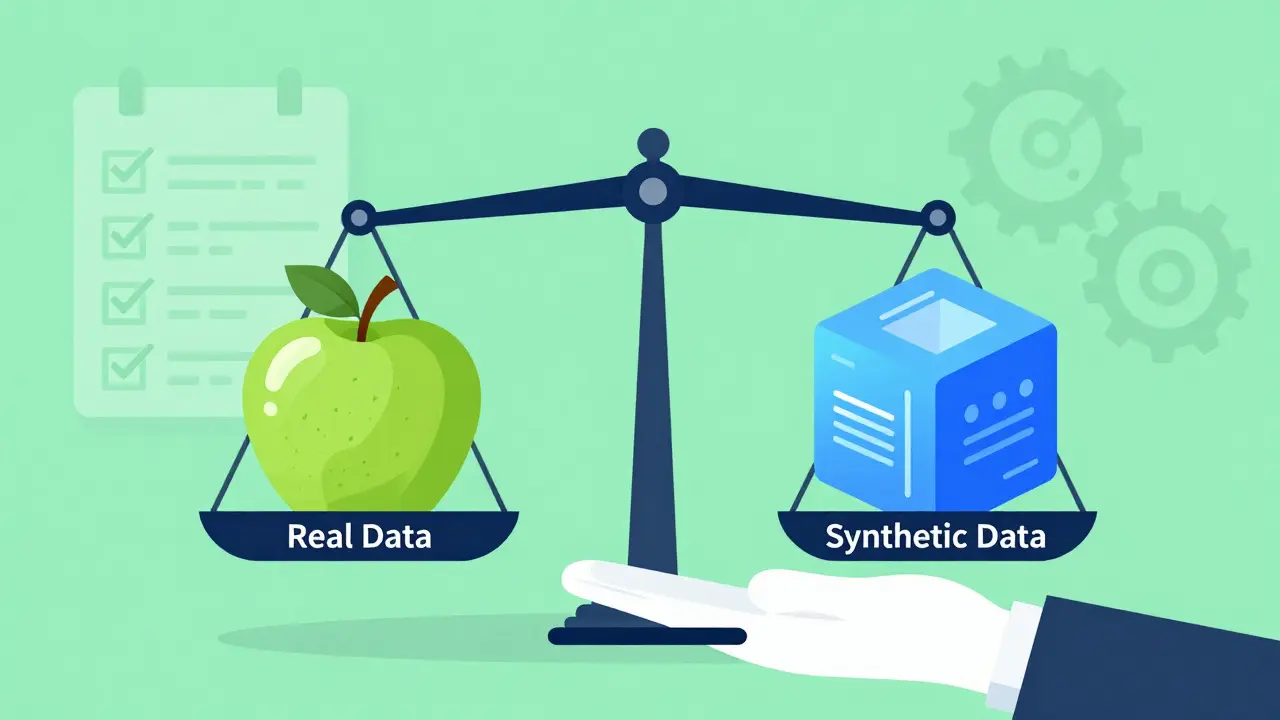
David Resnik advocates for "honor codes" where researchers certify data authenticity. While noble, this relies on individual integrity. Structural safeguards are better. Consider hybrid approaches. Duke University researchers project that optimal AI development by 2027 will use 60-70% real data supplemented by carefully validated synthetic data. This balances the richness of reality with the safety and scalability of simulation.
Implementation Checklist for Ethical Synthetic Data
If you’re planning to adopt synthetic data, here’s what you need to do to stay within ethical and technical boundaries:
- Define Clear Objectives: Are you using synthetic data for privacy, augmentation, or both? Don’t use it as a magic bullet for poor data collection practices.
- Audit Source Data for Bias: Before generating anything, analyze your seed data. If it’s biased, your synthetic output will be too. Mitigate bias at the source.
- Validate Statistical Fidelity: Use established metrics (KL divergence, etc.) to ensure your synthetic data matches the distribution of real data within acceptable margins (e.g., 90%+ correlation).
- Label Everything: Implement strict provenance tracking. Mark all synthetic datasets clearly in your documentation and model cards.
- Test on Edge Cases: Specifically check how your synthetic data performs on rare events. Expect underrepresentation and plan for supplemental real-world testing.
- Establish Accountability: Assign a data steward responsible for ongoing monitoring. Document who made the decisions about generation parameters.
- Plan for Hybrid Models: Avoid relying 100% on synthetic data for high-stakes decisions. Combine it with real data to ground your models in reality.
Synthetic data is a powerful tool, but it’s not a substitute for ethical judgment. It expands our ability to innovate without compromising privacy, but it demands greater vigilance regarding bias and truth. By setting clear boundaries and robust governance, we can harness its benefits without falling into its traps.
Is synthetic data legally compliant with GDPR and HIPAA?
Synthetic data can help achieve compliance, but it is not automatically exempt. Under GDPR, if synthetic data cannot be linked back to an identifiable individual, it is generally not considered personal data. However, you must prove that re-identification risk is negligible (typically below 5%). For HIPAA, covered entities must perform an "expert determination" to verify that synthetic data meets de-identification standards, documenting specific technical safeguards. Always consult legal counsel and use validation frameworks like NIST’s to demonstrate compliance.
How do I detect if my AI model is overfitting to synthetic data?
Overfitting to synthetic data often manifests as high performance on synthetic test sets but poor performance on real-world data. To detect this, maintain a hold-out set of real, anonymized data that is never exposed to the training process. Regularly evaluate your model against this real-world benchmark. Additionally, monitor for "distribution shifts"-if your model’s confidence scores drop significantly when processing live data, it may have learned artifacts specific to the synthetic generation process rather than genuine underlying patterns.
What are the biggest risks of using synthetic data in healthcare?
The primary risks are bias amplification and loss of clinical nuance. Synthetic data may underrepresent rare diseases or specific demographic groups if the source data was skewed. A Duke University study found synthetic data underestimated treatment response variations in elderly patients by 19%. There’s also the risk of "hallucinated" correlations-statistical relationships that exist in the synthetic data but not in biology. Continuous validation against real-world outcomes is essential to prevent harmful clinical decisions.
Can synthetic data replace real data entirely?
No. Synthetic data is best used as a supplement, not a replacement. It excels at privacy preservation and augmenting scarce data, but it struggles with capturing emergent phenomena and true novelty. Experts recommend a hybrid approach, using 60-70% real data grounded by 30-40% validated synthetic data. Relying solely on synthetic data increases the risk of models failing in unpredictable real-world scenarios, particularly during volatile events like market crashes or novel disease outbreaks.
How much does it cost to generate high-quality synthetic data?
Costs vary by volume and fidelity. Generating 1 million high-fidelity healthcare records requires approximately 128 GPU hours and 3,200 kWh of electricity. Enterprise platforms like Gretel.ai or Mostly AI charge based on data volume and API usage, often requiring 2-4 weeks of implementation time. While the upfront computational cost is higher than traditional anonymization, it can save money long-term by avoiding fines for data breaches and enabling faster development cycles through unlimited data availability.