Evaluation Frameworks for Fairness in Enterprise LLM Deployments
 Oct, 24 2026
You deploy a new Large Language Model to handle customer support tickets. It works beautifully for most users. But then you notice it consistently gives shorter, less helpful answers to customers with certain accents or dialects. Or maybe your HR screening bot ranks candidates from specific universities higher, not because they are better, but because the training data skewed that way. This isn't just a bug; it's a fairness failure. In 2026, shipping an Enterprise LLM without a rigorous fairness evaluation framework is like driving a car without brakes on a highway. You might get there fast, but you risk crashing hard into regulatory fines and reputational damage.
Fairness in AI isn't about making every output identical. It's about ensuring that demographic attributes-like gender, race, age, or personality traits-don't lead to undue disadvantage or preferential treatment in ways that aren't justified by the task itself. For enterprises in finance, healthcare, and legal services, this distinction is critical. A biased loan recommendation isn't just annoying; it's a lawsuit waiting to happen. So, how do we actually measure this? We move beyond gut checks and use structured evaluation frameworks designed specifically for the complex, multidimensional nature of modern language models.
Why Traditional Metrics Fail at Fairness
If you're used to evaluating software performance, you're probably comfortable with accuracy scores. Did the model answer correctly? Yes or no. Simple. But fairness is rarely binary. A model can be highly accurate overall while being systematically unfair to a specific subgroup. Traditional single-metric evaluations often miss these nuances because they average out disparities across the entire dataset. If Group A gets perfect results and Group B gets poor results, the average might look "okay," hiding a significant equity gap.
This is where specialized frameworks step in. They don't just ask "Is the answer correct?" They ask "Does the answer change significantly if I swap the user's name from 'John' to 'Maria'?" or "Does the recommendation quality drop when the prompt includes a reference to a specific religion?" These questions target what researchers call prompt-sensitive bias. This type of bias is subtle. It’s driven by linguistic variations rather than explicit discriminatory logic. Without tools designed to detect these shifts, you’re flying blind.
Moreover, modern LLMs are increasingly personalized. They adapt to user styles and preferences. While personalization improves engagement, it can create disparate impact if not checked. Does the model provide more detailed explanations to users who write formally, while giving terse answers to those who use casual slang? That’s a fairness issue rooted in personality-linked bias, not just demographics. Addressing this requires frameworks that go beyond static demographic checks.
FairEval: Deep Dive into Recommendation Fairness
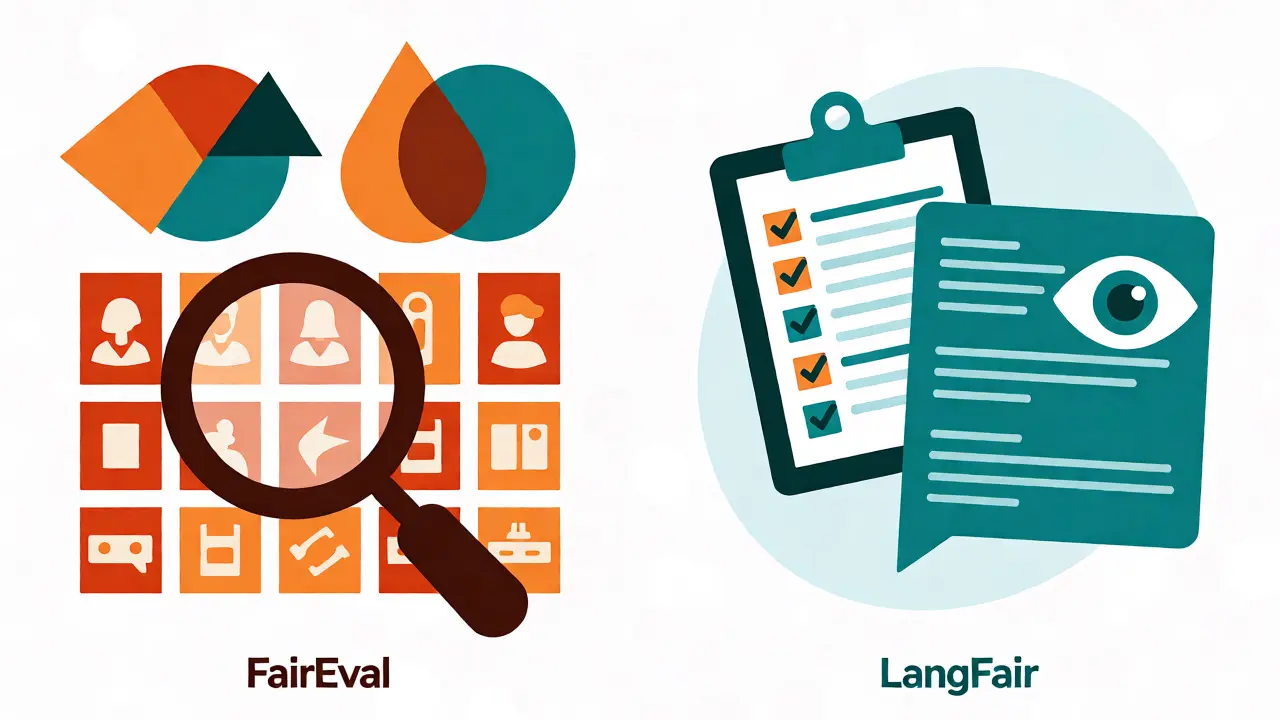
One of the most robust tools emerging for this specific challenge is FairEval. Originally developed for educational contexts where equitable access to learning resources is crucial, its methodology applies broadly to any system generating recommendations. Think movie suggestions, product picks, or even job matches. FairEval operates on a simple but powerful premise: compare outputs from neutral prompts against outputs from prompts containing sensitive attributes.
The framework evaluates divergence. If a model recommends completely different movies to two users solely because one identifies as male and the other female (and gender isn't relevant to movie taste), that’s high divergence, signaling potential unfairness. FairEval uses several sophisticated metrics to quantify this:
- Jaccard Similarity at K (J@K): Measures the overlap between recommendation sets generated from neutral vs. sensitive prompts. Lower overlap means higher sensitivity to the attribute.
- SERP Fairness: Looks at ranking representation. Are certain groups consistently pushed down the list?
- PRAG (Personalization Balance): Ensures that personalization doesn't create disparate impact. It checks if the model is over-personalizing for some groups while under-serving others.
- PAFS (Personality-Aware Fairness Score): This is the game-changer. It quantifies disparities across personality-defined user groups, moving beyond just race or gender to include traits like openness or conscientiousness inferred from text style.
Recent tests using ChatGPT-4o and Gemini 1.5 Flash showed PAFS achieving consistency scores above 0.99. This high score indicates the metric is stable and reliable, but more importantly, it uncovered fairness gaps that older benchmarks missed. By integrating personality dimensions, FairEval helps enterprises understand if their bots are treating "analytical" users differently than "creative" ones in ways that affect service quality.
LangFair: The Practical Tool for Governance Audits
While FairEval is academically rigorous, many engineering teams need something they can plug into their CI/CD pipelines today. Enter LangFair. Developed by CVS Health and open-sourced on GitHub, LangFair takes a pragmatic approach. It’s a Python library designed for real-world deployment scenarios, emphasizing a "Bring Your Own Prompts" (BYOP) strategy.
Why does BYOP matter? Because generic benchmark datasets often don’t reflect your specific business context. Your bank’s customer queries look nothing like a medical triage chatbot’s inputs. LangFair allows you to feed in your actual production prompts and evaluate the outputs for bias. It focuses on output-based metrics, meaning you don’t need access to the model’s internal weights or hidden states-just the text it generates. This makes it ideal for auditing third-party APIs like OpenAI or Anthropic, where you can’t see inside the black box.
LangFair supports workflows for both text generation and summarization. It integrates toxicity detection, bias algorithms, and hate speech identification directly into the assessment loop. For governance teams, this provides actionable evidence. Instead of saying "We think our model is fair," you can present a report showing specific bias scores across different demographic proxies in your actual user data.
Comparing Evaluation Approaches
Choosing the right framework depends on your stage of development and your specific risks. Here’s how the leading approaches stack up against common enterprise needs:
| Feature | FairEval | LangFair | General LLM Benchmarks |
|---|---|---|---|
| Primary Focus | Recommendation systems & Personalization | Text Generation & Summarization | Accuracy & Reasoning |
| Data Source | Structured synthetic + real prompts | User-provided (BYOP) | Static public datasets |
| Bias Dimensions | Demographics + Personality Traits | Toxicity, Stereotypes, Demographics | Limited/None |
| Integration Ease | Research-heavy, custom setup | High (Python Library) | High (Standard APIs) |
| Best For | EduTech, Media, E-commerce | Customer Support, Healthcare, Legal | Model Selection Phase |
Notice that general benchmarks fail here. They tell you if the model knows the capital of France, not if it treats French speakers fairly compared to English speakers. FairEval and LangFair fill that void, but for different purposes. Use FairEval when personalization drives your value proposition. Use LangFair when compliance and safety are your primary concerns.
Implementing Human-in-the-Loop Review
No automated framework is perfect. Algorithms can miss context. A phrase might be flagged as biased by a keyword detector but used ironically in a customer service script. This is why mature enterprise deployments combine automated scoring with human review. This isn't just manual checking; it's structured evaluation.
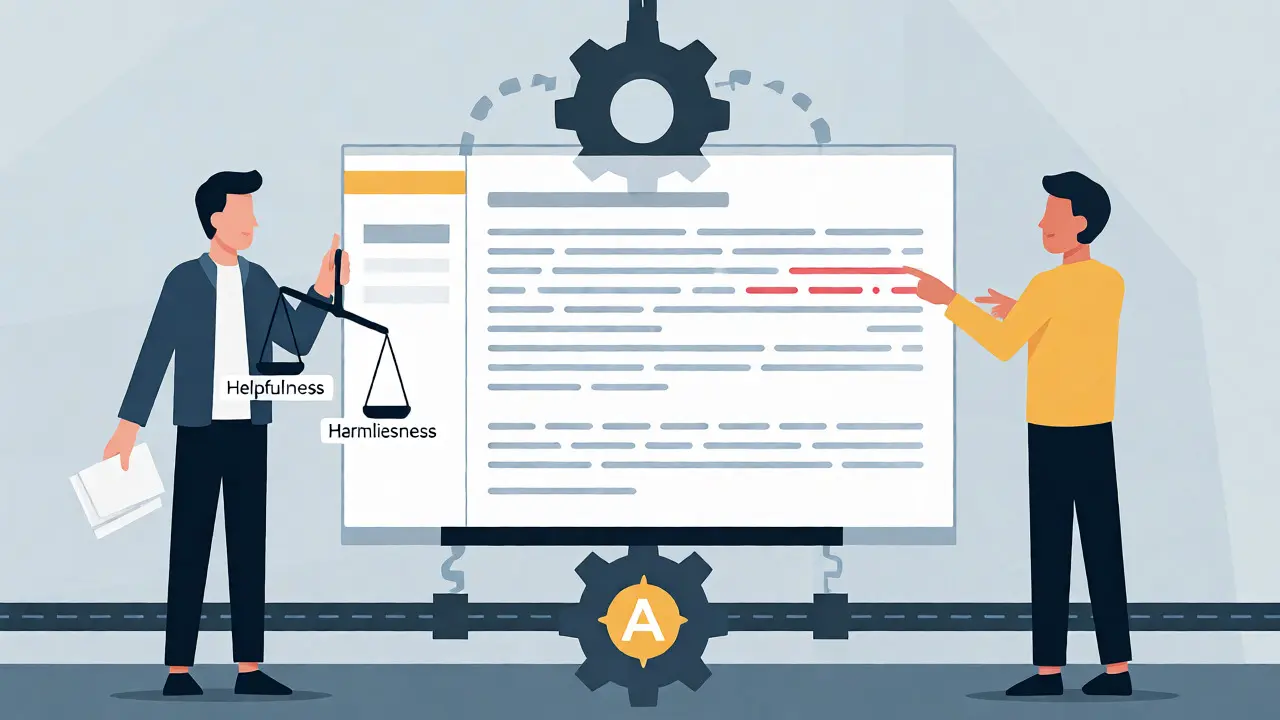
In practice, this looks like a dual-rater system. One rater assesses helpfulness. Another assesses harmlessness and fairness. They use standardized rubrics derived from the framework’s metrics. For instance, if LangFair flags a summary as potentially stereotypical, a human reviewer confirms if the stereotype is harmful or merely descriptive. This hybrid approach reduces false positives in automation while catching subtle biases machines miss. It also builds trust with stakeholders who want to know that humans are still accountable for AI decisions.
Furthermore, human feedback loops help refine the prompts themselves. Often, bias isn't in the model, but in how we ask it questions. A poorly constructed prompt can force a model into a biased corner. By reviewing failures, teams can iterate on prompt engineering, adding constraints or examples that steer the model toward equitable outcomes.
Regulatory and Operational Risks
Ignoring fairness evaluation isn't just an ethical lapse; it's an operational risk. In regulated industries, the stakes are tangible. Financial institutions face scrutiny under laws prohibiting discrimination in lending. Healthcare providers must ensure diagnostic support tools don't perform worse for minority populations. Legal firms cannot afford AI assistants that hallucinate case law based on biased training data.
Frameworks like LangFair and FairEval provide the audit trails needed for compliance. When a regulator asks, "How did you ensure your AI didn't discriminate?", you can show them the divergence scores, the demographic breakdowns, and the mitigation steps taken. Without this documentation, you’re vulnerable. Additionally, bias amplification harms brand reputation. Users talk. If your chatbot consistently misunderstands non-native English speakers, word spreads. Fairness is a competitive advantage in customer experience.
Next Steps for Your Team
Ready to implement? Start small. Don't try to audit every interaction on day one. Pick one high-risk workflow, such as customer intent classification or content summarization. Define your sensitive attributes relevant to your domain (e.g., for hiring, it's gender and ethnicity; for finance, it might be zip code as a proxy for socioeconomic status).
Install LangFair in your testing environment. Create a set of 50-100 representative prompts that vary across these attributes. Run them through your current LLM configuration. Calculate the baseline fairness scores. Then, tweak your prompts or switch models and re-run. Compare the results. Did the change improve fairness without sacrificing accuracy? This iterative process turns fairness from a vague goal into a measurable engineering constraint.
Remember, fairness isn't a feature you ship once. It’s a continuous monitoring requirement. As your user base evolves and model versions update, your fairness profiles will shift too. Build the evaluation pipeline now, before you scale.
What is the difference between bias and fairness in LLMs?
Bias refers to systematic errors in model predictions that favor or disfavor certain groups. Fairness is the normative judgment of whether those biases are acceptable given the context. A model can have bias (e.g., predicting higher income for men) but still be considered fair in a specific narrow application if that bias reflects historical reality and is disclosed, though typically enterprises aim to mitigate bias to achieve fairness.
Do I need access to the model weights to run fairness evaluations?
No. Tools like LangFair use output-based metrics, meaning they only analyze the text generated by the model. This is crucial for enterprises using API-based models (like GPT-4 or Claude) where internal weights are inaccessible. You simply input prompts and analyze the responses.
Can fairness evaluation slow down my application?
Typically, no. Fairness evaluation is usually performed offline during development, testing, or periodic batch audits. Running full fairness checks on every live user request would add latency and cost. Most enterprises sample traffic for ongoing monitoring rather than evaluating every single interaction in real-time.
What are "sensitive attributes" in this context?
Sensitive attributes are characteristics protected by law or company policy that should not negatively influence AI outcomes. Common examples include gender, race, age, religion, disability status, and sexual orientation. In some contexts, personality traits or communication style may also be treated as sensitive if they lead to disparate service quality.
Is FairEval suitable for all types of LLM applications?
FairEval is optimized for recommendation systems and personalized content delivery. If your application involves generating factual answers or performing logical reasoning tasks, tools like LangFair or general safety classifiers might be more appropriate. Choose the framework that matches your primary use case.