Generative AI in Healthcare Administration: Automating Prior Auth and Clinical Summaries
 Oct, 10 2026
You know the feeling. It’s 4:30 PM on a Friday, and you’re staring at yet another prior authorization form that needs to go out before Monday morning. Or maybe you’re a physician trying to write a clinical summary for a specialist referral, but your fingers are tired from charting all day. For years, this administrative grind has been the silent killer of healthcare efficiency, eating up billions of dollars and burning out staff who went into medicine to help people, not fight paperwork.
But something changed recently. Generative AI has moved from a buzzword to a practical tool in healthcare administration, specifically targeting two massive pain points: prior authorization letters and clinical summaries. This isn't just about faster typing; it's about fundamentally changing how data moves between Electronic Health Records (EHRs) and insurance payers. If you're running a clinic or managing hospital operations, understanding how these tools work-and where they fail-is no longer optional. It’s essential for survival in an industry where administrative costs account for nearly 20% of total spending.
The Administrative Burden Is Real (And Expensive)
Let’s look at the numbers, because they don’t lie. According to McKinsey & Company, 78% of healthcare executives see administrative efficiency as the top reason to adopt AI. Why? Because prior authorization processes alone cost the U.S. healthcare system between $23 and $31 billion annually. That’s money spent on fax machines, phone calls, and re-submissions due to missing documentation.
Before generative AI entered the chat, handling a single prior auth request took an average of 15.3 minutes per case. Now, with tools like Nuance DAX Copilot integrated into major EHRs, that time has dropped to roughly 4.7 minutes. A 2024 Blackbaud study confirmed this shift, noting that while speed is great, the real win is accuracy. Automated systems reduce denials caused by incomplete documentation by 37%. When you multiply that by thousands of cases a year, the savings aren't just in hours saved-they're in revenue protected.
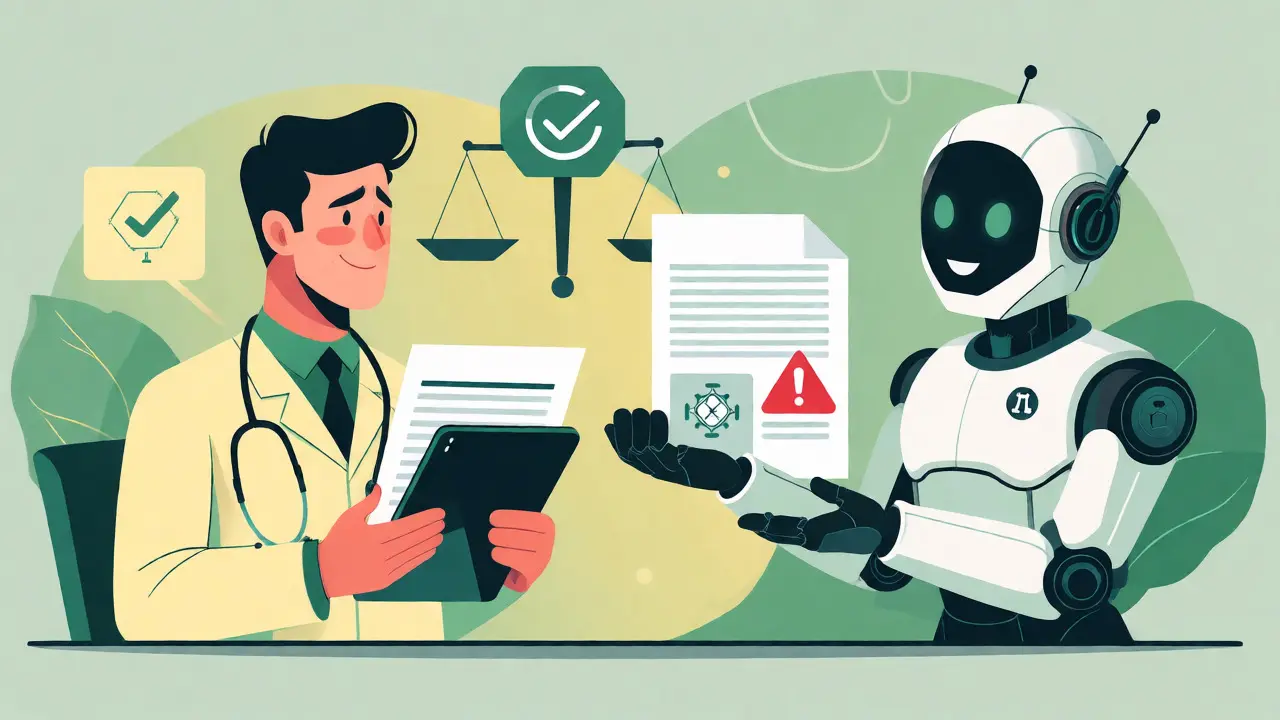
Physicians feel this burden too. Clinicians spend 15-30% of their working hours on administrative tasks. Generative AI doesn't replace the doctor, but it does handle the draft. It pulls relevant patient history, lab results, and diagnosis codes directly from the Electronic Health Record (EHR) to build a coherent narrative. The doctor then reviews and signs off. This "human-in-the-loop" model is critical, as we’ll discuss later, but it frees up mental bandwidth for actual patient care.
How Generative AI Actually Works in This Space
You might think AI just guesses what to write next. In healthcare, guessing is dangerous. Instead, modern solutions use Retrieval-Augmented Generation (RAG). Think of RAG as a librarian who doesn't just memorize books but runs to the shelf to fetch the exact page you need before answering. When an AI generates a prior auth letter, it retrieves specific data points-like ICD-10 codes, recent lab values, and treatment guidelines-from the patient’s record using standards like Fast Healthcare Interoperability Resources (FHIR).
This architecture ensures the AI isn't hallucinating facts. It’s constrained by the actual data in the system. For example, if a patient has a history of kidney disease, the RAG system ensures the AI mentions renal function tests in the clinical summary. Without this retrieval step, a general Large Language Model (LLM) might generate a generic paragraph that sounds good but lacks the specific clinical justification insurers require.
Integration is key here. These tools plug into platforms like Epic or Cerner via HL7 and FHIR APIs. Epic’s 2024 'Samantha' release, for instance, embeds prior auth automation that connects to 92% of major U.S. insurance providers. This connectivity allows the AI to not just write the letter, but also check payer-specific requirements in real-time. If Blue Cross requires a specific imaging report attached, the system flags it before submission, preventing the dreaded denial loop.
Comparing the Major Players
Not all AI tools are created equal. Choosing the right one depends on your existing tech stack and budget. Here’s how the leading options stack up based on 2024 benchmarks:
| Solution | Prior Auth Coverage | Clinical Accuracy | EHR Integration | Best For |
|---|---|---|---|---|
| Nuance DAX Copilot | 92% of Insurers | High (Specialized Medical Coding) | Native Microsoft/Azure & Epic | Large Hospital Systems |
| Google Duet AI | 78% of Insurers | Moderate-High | Strong Google Cloud API | Cloud-Native Practices |
| Amazon Bedrock | Variable | Moderate (Cost-Effective) | AWS Infrastructure | Cost-Sensitive Mid-Sized Groups |
| Abridge / Augmedix | 65% of Workflows | Very High (Documentation Focus) | Multi-EHR Support | Clinician Documentation Efficiency |
Nuance, now part of Microsoft, holds a significant market share (38%) because it was early to market and deeply integrated with Azure. Its strength lies in medical coding accuracy, which is 32% higher than general-purpose models like GPT-4. However, implementation is pricey, averaging $185,000 for a 100-provider system.
On the other hand, specialized players like Abridge focus heavily on the clinician experience. They excel at turning voice notes into structured clinical summaries, reducing documentation time drastically. But they cover only about 65% of prior auth workflows compared to Nuance’s 89%. If your primary headache is physicians leaving at midnight to finish charts, Abridge might be better. If your bottleneck is insurance denials, Nuance or Epic’s native tools are stronger bets.

The Risks: Hallucinations and Bias
We have to talk about the downsides, because ignoring them leads to expensive mistakes. Dr. Eric Topol, a prominent voice in digital health, warns about "hallucination risks." In plain English, this means the AI might confidently state something incorrect. In a creative writing context, a hallucination is interesting. In a prior auth letter, it could mean denying coverage for a necessary procedure because the AI misinterpreted a lab result.
Accuracy rates for structured data (like pulling a date of birth) are high, around 95-99%. But for unstructured clinical notes-where doctors use shorthand and abbreviations-accuracy drops to about 87%. For rare conditions, it can fall to 72%. This is why fully automated decision-making is still risky. The American Medical Association mandates a "human-in-the-loop" requirement. The AI drafts; the human decides.
Bias is another critical issue. A JAMA Internal Medicine study found that some AI systems had a 12.7% higher denial rate for Medicaid patients compared to private insurance patients when not properly calibrated. If the training data reflects historical biases in care delivery, the AI will replicate them. You must audit your outputs regularly to ensure equitable treatment across different patient demographics.
Implementation: What to Expect
Don’t expect plug-and-play magic. Implementing generative AI in healthcare administration typically takes 6-9 months. A July 2024 survey showed that 63% of administrators faced initial challenges, particularly with EHR integration, which averaged 14.2 weeks.
Here’s a realistic roadmap for deployment:
- Data Clean-Up: Ensure your EHR data is structured. AI struggles with messy inputs. If your nurses are entering free-text notes without standardized fields, fix that first.
- Phased Rollout: Start with straightforward prior auth cases (e.g., standard MRIs or physical therapy referrals). Save complex oncology or surgical cases for later phases.
- Staff Training: Administrative staff usually get proficient in 3-4 weeks. Clinicians take longer (6-8 weeks) because they need to learn how to critically edit AI drafts rather than just accepting them.
- Feedback Loops: Set up a committee to review errors weekly. If the AI keeps missing a specific insurer’s requirement, tweak the prompt or template immediately.
University of Pittsburgh Medical Center reported a 52% reduction in processing time and $4.7 million in annual savings after full implementation. Conversely, a Midwest hospital system had to pause its AI tool after 18% of submissions contained critical errors. The difference? Rigorous testing and phased rollout versus a big-bang launch.
The Future: Predictive and Integrated
We are moving beyond simple drafting. The next wave involves predictive analytics. Imagine an AI that flags a potential prior auth requirement *before* the order is placed, suggesting alternative treatments that are pre-approved. This shifts the workflow from reactive to proactive.
Regulatory landscapes are shifting too. California’s 2024 AI in Healthcare Act mandates transparency in AI-assisted decisions. CMS is piloting standardized templates for Medicare Advantage plans. These changes force vendors to make their algorithms more explainable. You won’t just accept a "no" from the AI; you’ll want to know why.
By 2027, 68% of healthcare executives plan to replace standalone prior auth systems with integrated AI solutions. The goal is a unified platform where scheduling, billing, and authorization talk to each other seamlessly. For small practices, this consolidation is promising, as it reduces the number of separate logins and interfaces staff need to manage.
Frequently Asked Questions
Does generative AI replace administrative staff?
No, it transforms their role. While it may reduce the volume of manual data entry, staff move toward oversight roles. They review AI-generated drafts, handle exceptions, and manage complex payer relationships. Estimates suggest a 15-20% reduction in pure data-entry roles by 2028, but demand for skilled coordinators remains high.
How accurate are AI-generated clinical summaries?
For structured data, accuracy is 95-99%. For unstructured clinical notes, it hovers around 87%. Accuracy drops significantly for rare diseases (approx. 72%). Human review is mandatory to catch context errors and ensure clinical nuance is preserved.
What is the biggest barrier to implementing these tools?
EHR integration is the primary hurdle, taking an average of 14.2 weeks. Data silos within existing systems also pose challenges. Additionally, staff resistance due to fear of job displacement or mistrust of AI output requires careful change management and training.
Are these tools HIPAA compliant?
Leading solutions operate on HIPAA-compliant cloud infrastructure (often Azure or AWS) with end-to-end encryption. They include audit trails and de-identification protocols that maintain 99.8% accuracy in removing Protected Health Information (PHI) during processing.
Can AI handle all insurance types equally well?
No. Tools like Nuance cover 92% of major U.S. insurers, but smaller or regional payers may lack standardized APIs. Consistency across payers is a known limitation, with 83% of organizations reporting inconsistent insurance requirements as a challenge.