Global Generative AI Regulation: Where the World Agrees and Disagrees
 Aug, 30 2026
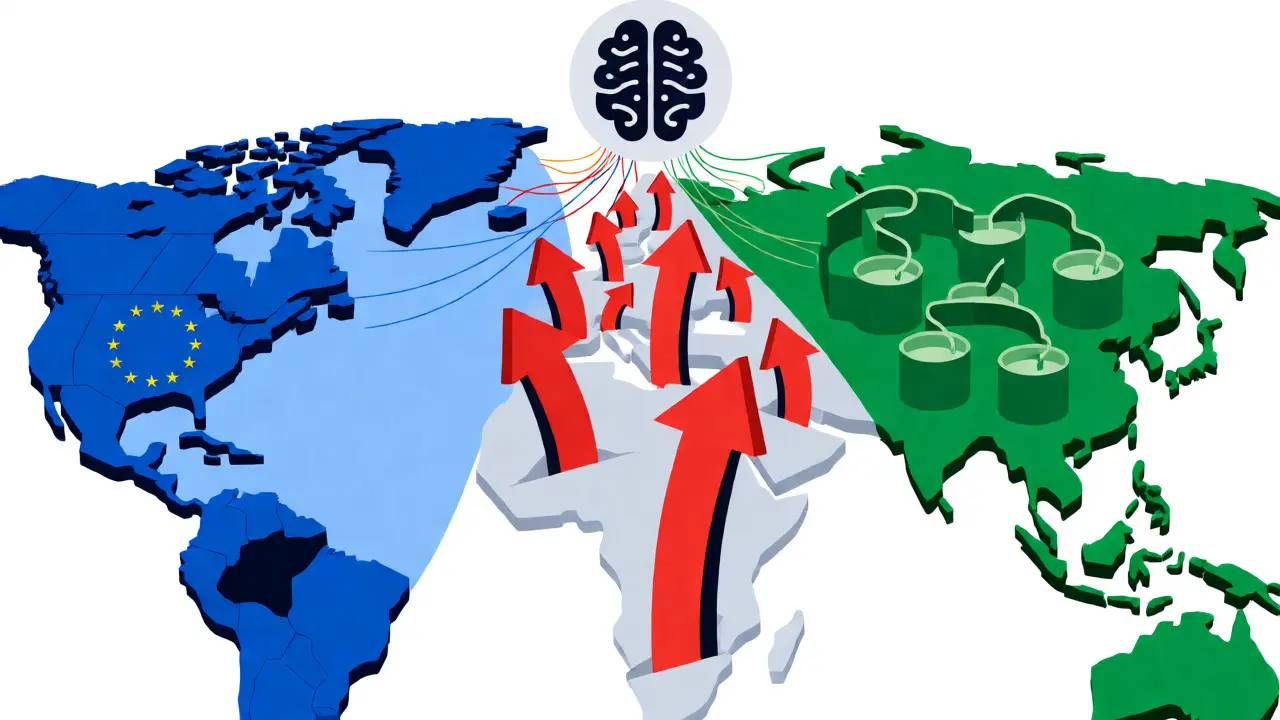
You might think that by now, the world would have figured out a single rulebook for generative AI. But if you are trying to deploy an AI model across borders in late 2026, you know that is far from the truth. The regulatory landscape is less of a unified map and more of a patchwork quilt stitched together with different threads of intent. While there are areas where major economies agree on the need for safety, the methods they use to achieve it diverge sharply. This article breaks down exactly where global policies are converging and where they are pulling apart, helping you navigate the complex web of compliance without getting lost in legal jargon.
The Big Three: How Major Powers Approach AI
When we look at who sets the tone for global tech policy, three names dominate the conversation: the European Union, the United States, and China. Each has taken a distinct path, driven by different cultural values and economic priorities. Understanding these core approaches is the first step to grasping why your compliance strategy can't be one-size-fits-all.
The European Union’s Risk-Based Model stands as the most comprehensive attempt to regulate AI. The EU AI Act, which came into full effect in August 2025, categorizes AI systems based on risk levels. High-risk applications, such as those used in hiring or critical infrastructure, face strict transparency and data governance requirements. The goal here isn't just to ban bad tech, but to ensure that general-purpose models posing systemic risks provide detailed documentation and adhere to copyright standards. It’s a proactive framework designed to protect fundamental rights above all else.
Across the Atlantic, the United States took a sharp turn in January 2025. With Executive Order 14179, the U.S. revoked previous restrictions aimed at "safe" development, pivoting instead to eliminate barriers perceived as hindering American innovation. This shift reflects a belief that speed and market dominance matter more than heavy-handed federal oversight. Instead of a single federal law, the U.S. relies on a mix of executive orders, sector-specific guidelines, and state-level actions. It’s a lighter touch, but don’t mistake light for loose; agencies are still active, just focused differently.
Then there is China, which implemented its Interim Measures for the Management of Generative Artificial Intelligence Services back in August 2023. As the first administrative regulation directly targeting generative AI, it set a precedent for strict content control. Enforced by the Cyberspace Administration of China, these rules mandate that AI-generated content aligns with socialist core values and does not undermine state authority. For providers, this means mandatory labeling of AI content and rigorous checks on training data legality. It’s a prescriptive approach that prioritizes social stability and national security over open-ended experimentation.
Where Nations Agree: The Convergence Points
Despite these stark differences in philosophy, there is surprising agreement on certain technical requirements. If you are building a global product, these are the few constants you can rely on. Regulators everywhere seem to share a common fear: black-box algorithms making decisions we can’t explain or trace.
First, transparency is non-negotiable. Whether you are in Brussels, Washington, or Beijing, the expectation is clear: users must know when they are interacting with AI. The EU requires visible disclosures for deepfakes and chatbots. China mandates watermarks or metadata tags for AI-generated media. Even the U.S., despite its pro-innovation stance, pushes for disclosure through voluntary frameworks and emerging state laws like those in New Jersey urging whistleblower protections for AI employees. The specific format varies, but the principle that opacity equals liability is universal.
Second, risk management has moved from optional to essential. Organizations no longer treat AI risks as hypothetical edge cases. According to McKinsey’s 2025 State of AI survey, companies now manage an average of four distinct AI-related risks, up from two in 2022. These include privacy breaches, lack of explainability, reputational damage, and regulatory fines. Regulators are echoing this concern. The focus has shifted from asking "Is this AI safe?" to "Can you prove how you mitigate harm?" This demand for provenance-knowing where data came and how it was processed-is becoming a global baseline.
Third, copyright and data sourcing are under scrutiny. Every major jurisdiction is tightening rules around how models are trained. The EU insists on respecting intellectual property rights during training phases. China requires legal sourcing of training data. In the U.S., while there is no single federal statute yet, court rulings and industry pressures are forcing clarity on fair use. If your model scrapes copyrighted material without a plan, you are walking into a minefield regardless of where you operate.
Where They Diverge: The Friction Zones
If convergence offers comfort, divergence creates headaches. The biggest friction point for multinational companies lies in conflicting definitions of "acceptable" content and data handling. This is where the rubber meets the road for compliance teams.
Consider data localization versus cross-border flow. China’s sovereign AI concept demands that data, models, and compute resources remain within controlled boundaries. More than 50% of AI leaders cite infrastructure control as a major challenge. In contrast, the U.S. and UK generally favor free data flows to boost efficiency. If you are running a global service, reconciling China’s strict data residency rules with the EU’s GDPR-style portability rights is a logistical nightmare. You might need separate instances of your model for each region, driving up costs and complexity.
Another area of conflict is content moderation standards. What is considered harmful content in one country might be perfectly acceptable in another. China’s requirement to align with "socialist core values" is unique and difficult to automate globally. The EU focuses on fundamental rights and non-discrimination. The U.S. leans heavily on First Amendment principles, resulting in much looser content constraints. A single moderation algorithm rarely satisfies all three. Companies often end up maintaining multiple moderation layers, each tuned to local legal expectations.
Finally, the approach to enforcement differs wildly. The EU has teeth: significant fines for non-compliance with the AI Act. China enforces through administrative penalties and potential service shutdowns. The U.S., post-Executive Order 14179, relies more on soft power, incentives, and litigation rather than upfront regulatory fines. This asymmetry means the cost of failure varies dramatically by geography. A minor infraction in the U.S. might result in a PR headache; the same issue in the EU could hit your bottom line hard.

The Rise of Sovereign AI and Regional Players
Beyond the big three, other regions are carving out their own niches, adding nuance to the global picture. The concept of Sovereign AI has emerged as a critical trend, defined as ensuring that national or organizational data and models remain under local control. This isn't just about privacy; it's about strategic autonomy. Countries want to avoid dependency on foreign tech giants for critical infrastructure.
The United Kingdom positions itself as a pro-innovation regulator. Rather than imposing a rigid new law, the UK established an AI and Digital Hub to offer advice and coordinate existing regulators. It’s a flexible model aimed at attracting investment while maintaining safety nets. Japan follows a similar principles-based approach, relying on voluntary industry standards rather than statutory mandates. This contrasts sharply with the EU’s codified rigidity and China’s top-down control.
For developing nations, the challenge is capacity. The World Bank’s 2025 Digital Progress and Trends Report highlights that low- and middle-income countries struggle to build regulatory frameworks due to resource constraints. Without international coordination, the gap between AI-rich and AI-poor nations threatens to widen inequality. Initiatives like the African Union’s governance frameworks show promise, but implementation lags behind legislative intent. If you operate in emerging markets, expect evolving, sometimes inconsistent, local rules that may not mirror Western standards.
Practical Implications for Businesses
So, what does this mean for your operations? The era of "set it and forget it" compliance is over. Regulatory monitoring is now a continuous, resource-intensive task. Deloitte found that 52% of AI leaders consider regulatory monitoring their biggest sovereign AI challenge. You cannot simply read the law once and assume you are compliant forever.
- Build Modular Compliance: Design your AI systems so that transparency modules, data storage locations, and content filters can be swapped or adjusted per region. Hard-coding Chinese content rules into a global model will break when you try to scale to Europe.
- Invest in Documentation: The EU AI Act requires extensive technical documentation. Start early. Organizations report an average of 6.2 months to establish effective AI governance frameworks. Don't wait until an audit hits.
- Hire Specialized Talent: General counsel isn't enough anymore. 78% of organizations now require dedicated AI compliance officers, up from 32% in 2023. These roles bridge the gap between engineering realities and legal requirements.
- Monitor Local Nuances: Keep an eye on sub-national regulations. In the U.S., states like New Jersey are passing specific resolutions regarding employee protections and AI usage. Global trends don't always predict local pain points.
Tools are emerging to help. Community-driven resources like the GitHub repository 'Global-AI-Regulation-Tracker' document requirements across 47 jurisdictions, offering a crowdsourced view of the shifting landscape. However, technology alone won't solve the problem. Human judgment remains crucial in interpreting ambiguous clauses, especially in rapidly evolving areas like copyright and bias mitigation.

Looking Ahead: Harmonization or Fragmentation?
Experts predict three key trends for the next few years. First, increased harmonization of transparency requirements. As best practices solidify, we may see standard labels for AI content emerge internationally. Second, a move toward application-specific risk assessments rather than horizontal bans. Regulators are learning that a medical AI needs different rules than a marketing chatbot. Third, enforcement mechanisms will tighten. Dr. Yoshua Bengio predicts that by 2027, we will see the first major cross-jurisdictional enforcement actions against systems violating multiple frameworks simultaneously.
The balance between innovation and safety remains delicate. Despite rising regulatory complexity, private investment in generative AI grew 18.7% in 2024. Investors clearly believe that compliance is manageable and worth the cost. Your job is to stay ahead of the curve, treating regulation not as a blocker, but as a design constraint that ultimately builds trust in your products.
Frequently Asked Questions
What is the main difference between the EU AI Act and US regulations?
The EU AI Act uses a comprehensive, risk-based classification system with strict compliance requirements for high-risk applications. In contrast, the U.S. approach, particularly after Executive Order 14179, focuses on removing barriers to innovation, relying more on sector-specific guidance, voluntary frameworks, and litigation rather than a single overarching federal statute.
Why is China's AI regulation considered stricter?
China's Interim Measures impose strict content controls requiring alignment with socialist core values and national security interests. They also mandate rigorous data localization and transparent labeling of AI-generated content, enforced by powerful state agencies like the Cyberspace Administration of China, making compliance highly prescriptive compared to Western models.
Do all countries require AI-generated content to be labeled?
Yes, transparency is a major convergence point. Nearly all major regulatory frameworks, including the EU, China, and emerging U.S. guidelines, require some form of disclosure or labeling for AI-generated content. However, the specific method (watermarks, metadata, text disclaimers) and scope vary significantly by jurisdiction.
What is Sovereign AI?
Sovereign AI refers to the capability of a nation or organization to develop and deploy AI systems using domestic data, models, and compute resources. It emphasizes keeping data and processing within controlled boundaries to ensure security, independence, and compliance with local data residency laws.
How long does it take to implement AI compliance?
According to recent surveys, organizations report an average of 6.2 months to establish effective AI governance frameworks. This includes time for auditing data sources, implementing transparency tools, and training staff on new regulatory requirements.
Quintin Franzese
August 31, 2026 AT 08:55Oh, great. Another article explaining why I need a law degree to use a chatbot in three different countries.
The idea that the US is 'light touch' while simultaneously suing everyone for copyright infringement is just peak American hypocrisy. We claim to love innovation but then choke it with litigation so thick you can't breathe. Meanwhile, China wants your data on their servers and the EU wants your soul on a spreadsheet. It's not a patchwork quilt; it's a bear trap made of paperwork.
Deb Kortyna, MBA
August 31, 2026 AT 18:38This analysis is fundamentally correct, yet it fails to emphasize the sheer administrative burden placed upon small enterprises. The notion that compliance is merely a "design constraint" is an understatement bordering on negligence. When one considers the disparate enforcement mechanisms-ranging from the European Union’s punitive fines to the United States’ reliance on litigation-the asymmetry creates an uneven playing field that disproportionately affects smaller entities. Furthermore, the concept of Sovereign AI is not merely a trend; it is an inevitability driven by geopolitical necessity. If we do not address the resource constraints faced by developing nations, as highlighted by the World Bank report, we risk creating a digital caste system where only the wealthy can afford to innovate compliantly. The current landscape does not foster trust; it fosters anxiety.
alex kobri
September 1, 2026 AT 14:14i think we're missing the bigger picture here
regulation isn't just about rules it's about who gets to define reality
if china controls the narrative through socialist values and the eu controls it through fundamental rights then what happens when those definitions collide in a global model
we are building systems that can't agree on what truth even is
and that scares me more than any fine
Tamara Miller
September 2, 2026 AT 12:14It is absolutely disgraceful that companies are expected to "hire specialized talent" like this is some minor inconvenience!!
Do they realize how much this costs??
And don't get me started on the "voluntary frameworks" in the US... voluntary?! In a world of corporate greed?! That is a joke!!
The EU at least has teeth... but even they are too slow!!
We are drowning in regulations while the tech bros just laugh all the way to the bank!!!
Zach Loescher
September 2, 2026 AT 20:31I appreciate the balanced view here. It seems like the friction between data localization and cross-border flow is going to be the biggest hurdle for actual product deployment. I wonder if modular compliance architectures will become standard engineering practice rather than just a legal requirement. It feels like we are moving toward a future where the backend infrastructure is dictated by geography rather than efficiency.
Savara Gunn
September 3, 2026 AT 01:50Hey, good read! Just wanted to add that for many of us in smaller orgs, the "modular compliance" advice is tough to implement without huge budgets. But keeping documentation early really helps sanity. Don't wait for the audit, seriously. You'll thank yourself later.
Chris Neal
September 4, 2026 AT 05:00Actually, the premise that the US lacks a single federal statute is misleading because Section 230 and various FTC actions effectively create a de facto regulatory environment that is stricter than people admit. Also, the McKinsey survey cited ignores the survivorship bias of large firms that can afford compliance teams. For 90% of startups, "regulatory monitoring" isn't a challenge, it's a death sentence. They aren't hiring AI compliance officers; they are hiring lawyers who also know Python. The distinction matters because it changes the cost structure entirely. And regarding Sovereign AI, it's mostly marketing fluff until there is a standardized API for sovereign compute, which doesn't exist yet. So no, the landscape isn't converging; it's diverging into niche markets that require bespoke solutions, which kills scalability.
Susan Cole
September 5, 2026 AT 03:37I completely agree with the point about documentation being crucial. It’s easy to overlook until you’re scrambling during an audit.