Governance and Compliance Chatbots: Policy Enforcement with Large Language Models
 Aug, 4 2026
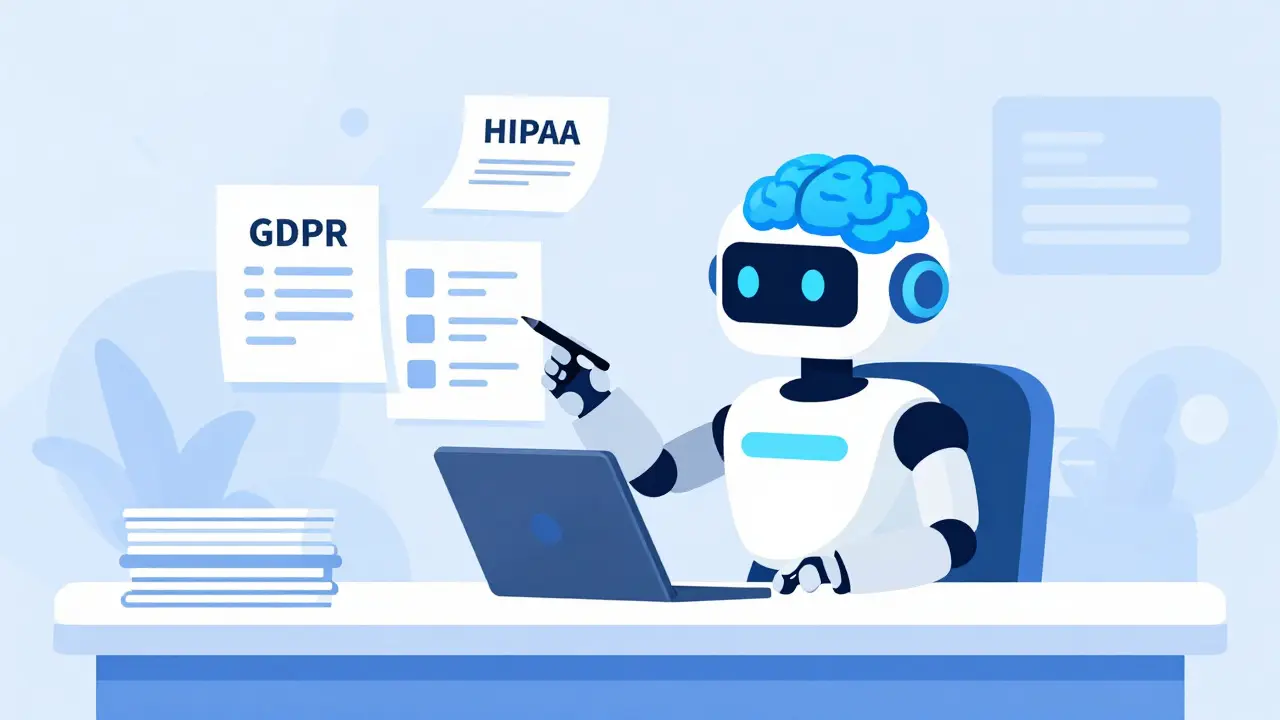
Imagine a compliance officer who never sleeps, reads every new regulation the second it’s published, and answers employee questions instantly. That is not science fiction anymore; it is the reality of Governance and Compliance Chatbots, which use Large Language Models (LLMs) to automate policy enforcement and regulatory adherence within organizations. For years, keeping up with rules like GDPR, HIPAA, or SEC guidelines meant wading through thousands of pages of legal text. Today, companies are replacing that manual grind with AI systems that cut response times by nearly half and slash human error rates by 75%.
But here is the catch: you cannot just plug a generic chatbot into your corporate network and call it a day. If you do, you risk hallucinations, data leaks, and costly fines. The real power lies in how these models are governed, structured, and integrated with your existing policies. This guide breaks down exactly how these systems work, what they cost, and how to deploy them without inviting a regulatory audit from hell.
How Governance Chatbots Actually Work
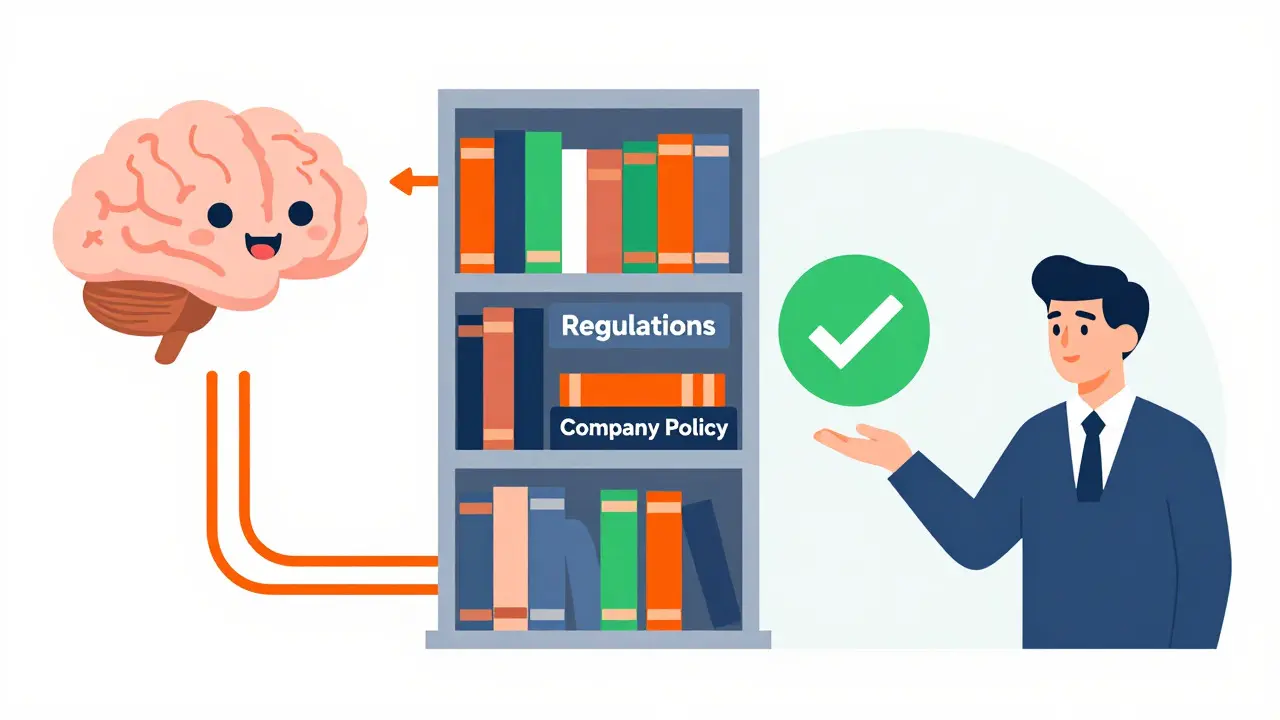
At their core, these chatbots are not magic boxes that know everything. They rely on a specific technical setup called Retrieval-Augmented Generation (RAG). RAG combines large language models with vector databases containing specific regulatory documents and company policies. Think of it this way: the LLM is the brain that understands language, but the vector database is the library where the actual rules live. When an employee asks, "Can I send this patient email to our marketing team?" the system first searches the library for relevant HIPAA clauses, then uses the LLM to draft a clear, accurate answer based *only* on those retrieved documents.
This architecture solves the biggest problem with early AI: making things up. By grounding responses in verified policy documents, accuracy jumps significantly. According to case studies from Gaper.io, properly configured systems achieve 92.4% accuracy on standard regulatory queries. However, if the library isn't updated, the AI will confidently give you outdated advice. That is why integration with live sources like the U.S. Federal Register or the EU's EUR-Lex is non-negotiable for enterprise deployments.
The computational heavy lifting is substantial. An enterprise deployment serving over 10,000 employees typically requires 8 to 16 GPU instances running continuously. It is not a lightweight script; it is infrastructure. Companies like Scytale and John Snow Labs provide pre-built connectors to handle this complexity, linking directly to tools you already use, such as SharePoint, Salesforce, or OneTrust. Without these integrations, your chatbot becomes an isolated silo, useless for actual workflow enforcement.
Why Traditional Systems Fail Where LLMs Succeed
You might be wondering why we need AI when we have rule-based compliance software. The short answer is speed and nuance. Traditional systems operate on rigid if-then logic. If a regulation changes slightly, a developer must rewrite the code. With LLM-powered chatbots, you simply update the source document, and the model adapts its understanding almost immediately.
| Feature | Traditional Rule-Based System | LLM-Powered Compliance Chatbot |
|---|---|---|
| Response Time | Manual lookup or slow search | 2.3-4.7 seconds per query |
| Regulatory Updates | 2-5 business days for manual coding | Within 90 minutes via automated scanning |
| User Adoption | Low (complex interfaces) | 63% higher adoption due to natural language |
| Error Rate (Complex Queries) | 3.2% (Human specialists) | 12.8% (AI without oversight) |
| Cost Impact | High maintenance costs | 30-50% reduction in compliance costs |
The data tells a clear story. Tredence’s analysis of 89 enterprise implementations showed that LLM systems respond 47% faster to regulatory queries. But look closely at that error rate row. In complex, cross-jurisdictional scenarios, humans still outperform AI. This highlights a critical limitation: LLMs are excellent at retrieving and summarizing known rules, but they struggle with novel interpretations where historical data is scarce. A 2023 pilot at JPMorgan Chase revealed that during the first 90 days, human oversight was required for 37% of the chatbot’s responses regarding SEC regulations. The AI wasn't wrong, but it lacked the contextual judgment to navigate gray areas safely.
Key Risks: Hallucinations, Bias, and Security
Deploying AI for compliance introduces new risks alongside the old ones. The most famous is hallucination-when the model invents facts. In a creative writing context, this is harmless. In a legal one, it is catastrophic. The European Data Protection Board (EDPB) found in April 2025 that 8.7% of complex regulatory interpretations contained hallucinations. While that sounds low, imagine a healthcare provider misinterpreting HIPAA’s "minimum necessary" standard because of one bad answer. In February 2024, a hospital was fined $2.1 million after relying solely on an LLM chatbot that failed in 18% of patient data disclosure scenarios.
Then there is bias. Professor David Liu from MIT’s AI Policy Lab warns that without "constitutional AI" guardrails, these chatbots can embed discriminatory practices from their training data. If the original policies were biased, the AI will enforce that bias at scale under the guise of neutrality. This is why transparency matters. You need to know not just what the AI said, but *why* it said it.
Security is another minefield. These systems are vulnerable to prompt injection attacks, where malicious users trick the bot into revealing sensitive internal policies. Engage Hub’s security testing in 2024 documented multiple successful injections against unhardened compliance bots. To mitigate this, solutions like Scytale implement end-to-end encryption and role-based access controls mandated by GDPR Article 35. Every interaction must be logged, time-stamped, and reviewable. If you can’t prove who asked what and when, you aren’t compliant-you’re just guessing.
Implementation Strategy: A 6-Phase Approach
If you are ready to move forward, do not rush. Tredence outlines a proven six-phase approach that balances speed with safety. Skipping steps here leads to the "abandonment" problem, where 63% of poorly implemented AI compliance modules are scrapped within 18 months.
- Assessment (2-4 weeks): Map your current regulatory landscape. Which frameworks matter? GDPR? SOC 2? ISO 42001? Identify the high-risk domains where errors are most costly.
- Data Ingestion (3-6 weeks): Clean and structure your policy documents. Garbage in, garbage out. Ensure your vector database has clean, version-controlled sources.
- Model Fine-Tuning (4-8 weeks): Train the model on your specific terminology. Generic LLMs don’t understand your company’s internal jargon or unique risk appetite.
- Governance Framework Implementation (2-5 weeks): Set up the guardrails. Define confidence thresholds. For example, route any query with less than 90% confidence to a human specialist. This single step reduces compliance errors by 42%.
- User Training (1-3 weeks): Teach your staff how to interact with the bot. Compliance specialists need 18-24 hours of training; developers need 60-80 hours to manage the backend.
- Continuous Monitoring: Conduct weekly red-team exercises. Simulate attacks and tricky regulatory questions to find gaps before regulators do.
A major European bank recently shared their experience on LinkedIn. Their initial accuracy sat at 89%. It took 147 hours of specialist tuning to push that to 95% across 12 different regulatory domains. Patience pays off. The talent gap is real-78% of enterprises partner with specialized vendors like John Snow Labs or lakeFS because hiring in-house AI engineers who also understand FINRA guidelines is incredibly difficult.
Market Trends and Future Outlook
The market for these tools is exploding. Valued at $1.8 billion in 2023, the sector is projected to hit $7.9 billion by 2027, growing at a 34.7% compound annual growth rate (CAGR). Who is leading? Specialized players like John Snow Labs hold 28% of the enterprise compliance AI market, while generalist platforms like Microsoft Azure AI and Google Vertex AI capture significant share by adapting their broad models for specific use cases.
Regulatory pressure is the main driver. The EU AI Act, effective February 2025, demands rigorous documentation for high-risk AI systems. California’s updated CCPA regulations now explicitly cover AI systems. And ISO 42001, introduced in December 2023, provides a unified standard for AI management systems. By 2026, Gartner predicts that 70% of regulatory interactions in financial services will be handled by AI. The question is no longer *if* you should adopt these tools, but *how fast* you can do it securely.
Looking ahead, the trend is moving toward "constitutional AI," where regulatory constraints are baked into the model’s architecture rather than applied as a filter afterward. Anthropic’s approach, adopted by 31% of compliance implementations in 2024, is a prime example. This ensures the AI doesn't just avoid breaking rules, but actively aligns with ethical and legal standards from the ground up. As Dr. Emily Chen of John Snow Labs notes, these frameworks are not checkboxes; they are the infrastructure enabling sustainable AI adoption.
What is the difference between a generic LLM and a compliance chatbot?
A generic LLM is trained on broad internet data and can hallucinate facts. A compliance chatbot uses Retrieval-Augmented Generation (RAG) to pull answers only from verified, internal policy documents and regulatory databases, ensuring higher accuracy and auditability.
How accurate are governance chatbots in real-world scenarios?
When properly configured with updated sources, they achieve about 92.4% accuracy on standard queries. However, accuracy drops to around 78% for newly enacted regulations without immediate retraining, and complex cross-jurisdictional issues may still require human oversight.
Are compliance chatbots secure enough for HIPAA or GDPR?
Yes, if implemented correctly. They require end-to-end encryption, role-based access controls, and comprehensive audit trails. Solutions like Scytale and John Snow Labs are built to meet these standards, but generic setups often fail due to poor data lineage and lack of access restrictions.
How long does it take to implement a compliance chatbot?
A full enterprise implementation typically takes 12 to 26 weeks, following a phased approach including assessment, data ingestion, fine-tuning, and governance setup. Rushing this process often leads to higher abandonment rates later.
Who are the top providers of compliance AI solutions?
Specialized leaders include John Snow Labs (28% market share), Scytale (19%), and lakeFS (14%). Generalist platforms like Microsoft Azure AI and Google Vertex AI also offer strong capabilities for adapting LLMs to compliance tasks.
What is "constitutional AI" in the context of compliance?
Constitutional AI involves embedding regulatory constraints and ethical guidelines directly into the model's architecture during training, rather than relying solely on post-hoc filtering. This helps prevent biases and ensures the model aligns with standards like GDPR or HIPAA from the start.