Governance ROI for Generative AI: Cutting Incidents and Passing Audits
 Oct, 23 2026
You spent millions on generative AI pilots. You bought the GPUs, hired the prompt engineers, and integrated the APIs. But when you look at your P&L, where is the return? For most enterprises, the answer is frustratingly close to zero. MIT’s State of AI in Business 2025 report highlights a brutal statistic: 95% of generative AI pilots fail. And it’s not because the technology didn’t work. It failed because the governance infrastructure couldn’t keep up.
This isn’t just about avoiding fines. It’s about realizing that Governance ROI is the missing link between expensive experiments and scalable value. When you treat governance as a speed bump, you lose money. When you treat it as an accelerator, you cut incidents, pass audits without panic, and actually get returns. Let’s break down how shifting from "compliance overhead" to "governance value" changes the math.
The Paradox of High Spend and Low Return
Why do so many projects stall? Deloitte surveyed 1,854 executives in 2025, and the pattern was clear: spending goes up, but returns stay flat. The problem is structural. Traditional machine learning governance doesn’t work for generative AI. LLMs produce open-ended content, not fixed predictions. You can’t just check if the output matches a label; you have to evaluate relevance, safety, and factual grounding in real-time.
Without proper governance, every deployment becomes a gamble. If a chatbot hallucinates a legal clause or leaks customer data, the remediation cost dwarfs the initial development budget. This is why incident reduction is the first pillar of governance ROI. Companies with strong guardrails see 27% higher revenue performance compared to those flying blind, according to research from Berkeley’s Center for Marketing Research. That’s not a coincidence; it’s the result of stopping bad outputs before they hit production.
Policy-as-Code: Automating the Boring Stuff
Manual reviews are dead. You cannot review every prompt and response manually at enterprise scale. The solution is policy-as-code, which translates business rules into automated tests. Think of it like unit testing for ethics and security. Instead of asking a lawyer to review every new feature, you encode their requirements into scripts that run automatically in your CI/CD pipeline.
- Automated Guardrails: These systems filter unsafe inputs and outputs instantly. If a user tries to inject sensitive data, the system blocks it before the model even sees it.
- Hallucination Testing: Structured frameworks test factual accuracy against trusted sources. If the model deviates beyond a set threshold, the deployment halts.
- Red-Team Integration: Adversarial validation runs continuously, not just once. This stresses the system to find vulnerabilities before attackers do.
This automation eliminates subjective decision-making. It also speeds up approvals. When the code proves compliance, you don’t need a three-week committee meeting to greenlight a release. You just push the button.

Audit Readiness: From Panic to Perpetual State
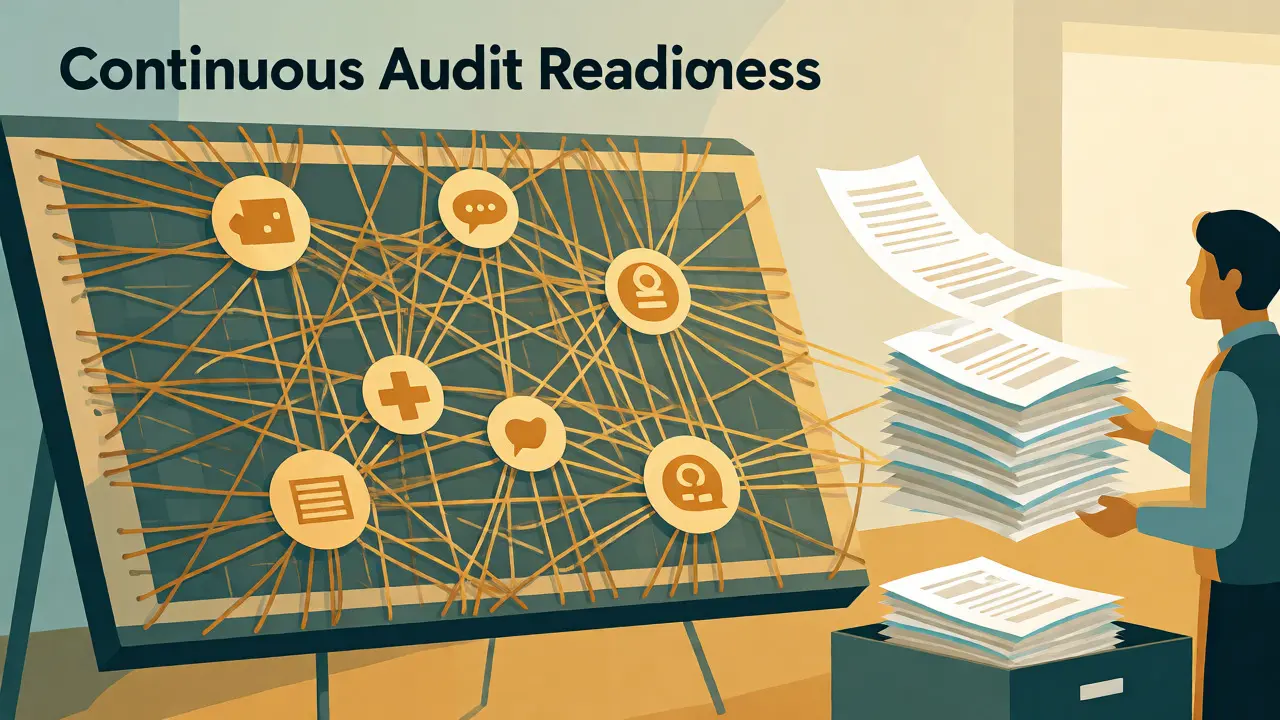
Remember the last time an auditor asked for evidence of how your AI made a specific decision six months ago? Did your team scramble through Slack logs and email threads? That’s the traditional approach, and it’s expensive. Evidence automation shifts this dynamic entirely. It captures logs, approvals, and control validations in real-time as they happen.
This creates a state of continuous audit readiness. You are always ready to prove compliance. Platforms like OneTrust emphasize this "always-on" control approach. Instead of quarterly scrambles, you have a living document of your AI’s behavior. This reduces the total cost of ownership significantly because you stop paying for emergency remediation and manual documentation efforts.
| Feature | Traditional Governance | Automated Governance (ROI Model) |
|---|---|---|
| Audit Preparation | Quarterly crisis mode; manual log reconstruction | Perpetual state; auto-generated evidence |
| Risk Detection | Post-incident analysis | Real-time flagging of deviations |
| Approval Speed | Weeks (manual reviews) | Hours/Days (automated checks) |
| Scalability | Limited by human reviewer capacity | Scales with compute resources |
Risk Stratification: Not All Use Cases Are Equal
One size does not fit all. Using generative AI to brainstorm project names requires different oversight than using it to generate medical device code. Spyrosoft’s case studies show that successful organizations start by risk-stratifying use cases. They assign governance intensity based on potential impact.
Low-risk activities get streamlined approvals to encourage adoption. High-risk activities get strict controls. This proportional approach prevents governance from becoming a bottleneck. It also helps align teams. When legal and compliance teams are involved from day one, they become co-designers rather than blockers. This collaboration ensures that safeguards are practical, not just theoretical.
Breaking Down the Barriers
If governance is so valuable, why aren’t more companies doing it well? Only 47% of organizations have formal risk management frameworks for AI. Most leave it to IT, ignoring the fact that accountability lies with the departments deploying the tech. FullStack Labs identifies seven success factors, but two stand out for ROI:
- Data Discipline: Continuous monitoring and regular cleaning directly improve model ROI. Garbage in, garbage out still applies.
- Executive Sponsorship: Without clear priorities and funding from the top, governance initiatives die in pilot purgatory.
Another major barrier is the misconception that governance slows things down. In reality, mature teams use shared tools and reusable templates to create repeatable practices. Domino.ai notes that unified systems of record make reproduction and auditing straightforward. When everyone uses the same dashboard for logs and approvals, trust builds between engineering and control functions.
Implementing Governance for Measurable Returns
So, how do you start? Don’t try to draft perfect policies in a vacuum. Run controlled pilots. Iterate. Treat governance as part of the delivery pipeline, not a separate phase after deployment.
- Integrate Early: Embed governance tasks directly into CI/CD pipelines.
- Centralize Evidence: Ensure all logs and approvals live in one place.
- Educate Teams: Shared understanding of responsibilities prevents siloed knowledge.
The goal is to reduce rework. Every hour saved fixing a post-deployment issue is an hour gained in innovation. As regulatory frameworks tighten globally, having established governance infrastructure becomes a competitive advantage. You won’t need expensive retrofits when new laws drop. You’ll just tweak a policy script and move on.
What is Governance ROI in the context of Generative AI?
It is the measurable financial and operational benefit derived from implementing structured governance frameworks. This includes reduced costs from fewer security incidents, faster audit cycles, lower rework rates, and accelerated approval processes, rather than viewing governance solely as a compliance cost.
Why do most generative AI pilots fail?
According to MIT's State of AI in Business 2025, approximately 95% of pilots fail due to inadequate governance infrastructure, not technical limitations. Lack of clear policies, risk management, and integration into existing workflows prevents these projects from scaling to production.
How does policy-as-code improve AI deployment speed?
Policy-as-code automates compliance checks within the CI/CD pipeline. By encoding rules into executable scripts, it eliminates manual review bottlenecks, allowing developers to deploy changes rapidly while ensuring continuous adherence to security and ethical standards.
What is continuous audit readiness?
Continuous audit readiness is a state where compliance evidence-such as logs, approvals, and control validations-is captured automatically in real-time. This eliminates the need for manual reconstruction of histories during audits, reducing preparation time and associated costs.
Does stronger AI governance lead to higher revenue?
Yes. Research from Berkeley's Center for Marketing Research indicates that companies implementing generative AI with appropriate guardrails and governance frameworks demonstrate 27% higher revenue performance compared to peers lacking such structures.