How Generative AI Is Rewriting Automotive Design, Diagnostics, and In-Car Experiences
 Jun, 25 2026
Imagine sitting in your car, asking the dashboard to plan a route that avoids traffic, suggests a coffee shop you like, and adjusts the cabin temperature before you even arrive. Now imagine that same system helping an engineer design the bumper three years ago, or a mechanic diagnose a strange noise under the hood in seconds instead of hours. This isn’t science fiction anymore. It’s happening right now through generative AI.
The automotive industry is undergoing its biggest shift since the assembly line. For decades, cars were built on hardware cycles that took five to seven years. Today, they are becoming software-defined devices that update over the air. Generative artificial intelligence-the technology behind large language models and image generators-is accelerating this change. It’s not just about chatbots; it’s about reshaping how vehicles are designed, maintained, and experienced by drivers.
Redefining Vehicle Design with Virtual Prototypes
Traditionally, designing a new car model was a slow, expensive process. Engineers would sketch concepts, build physical clay models, and create a handful of prototypes to test aerodynamics and safety. If something didn’t work, they started over. This cycle could take months for a single component.
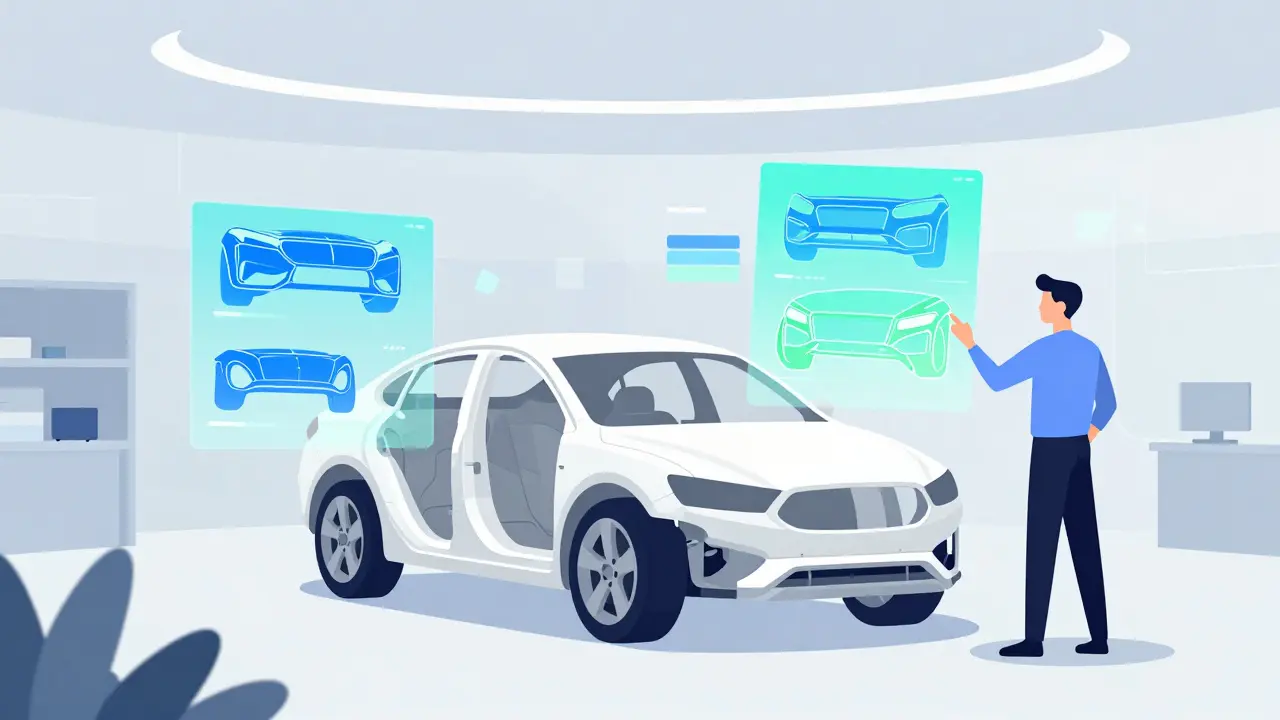
Generative AI changes the math entirely. Companies like L&T Technology Services (LTTS) report that engineers can now use text prompts combined with CAD constraints to generate hundreds of design variants virtually. Instead of evaluating ten physical prototypes, teams can simulate dozens or even hundreds of digital designs. These models check against crash performance metrics, aerodynamic coefficients, and manufacturing limits automatically.
| Feature | Traditional Process | Generative AI Approach |
|---|---|---|
| Design Variants | 10-20 physical prototypes | 100+ virtual simulations |
| Iteration Speed | Weeks per cycle | Hours to days |
| Cost Factor | High material and labor costs | Compute-heavy but lower material waste |
| Validation | Manual engineering review | Automated CAE simulation checks |
Text-conditioned diffusion models translate simple descriptions-like “a bumper with specific geometric and safety constraints”-into detailed 3D representations. These aren’t just pretty pictures; they are functional engineering files compatible with legacy Product Lifecycle Management (PLM) systems. The result? Design cycles that used to take 36 to 60 months are being compressed significantly, allowing automakers to respond faster to market trends.
Faster, Smarter Diagnostics for Mechanics and OEMs
Have you ever taken your car to a shop, only to wait days while technicians guess what’s wrong? Diagnostic trouble codes help, but they don’t always tell the whole story. Enter generative AI in maintenance.
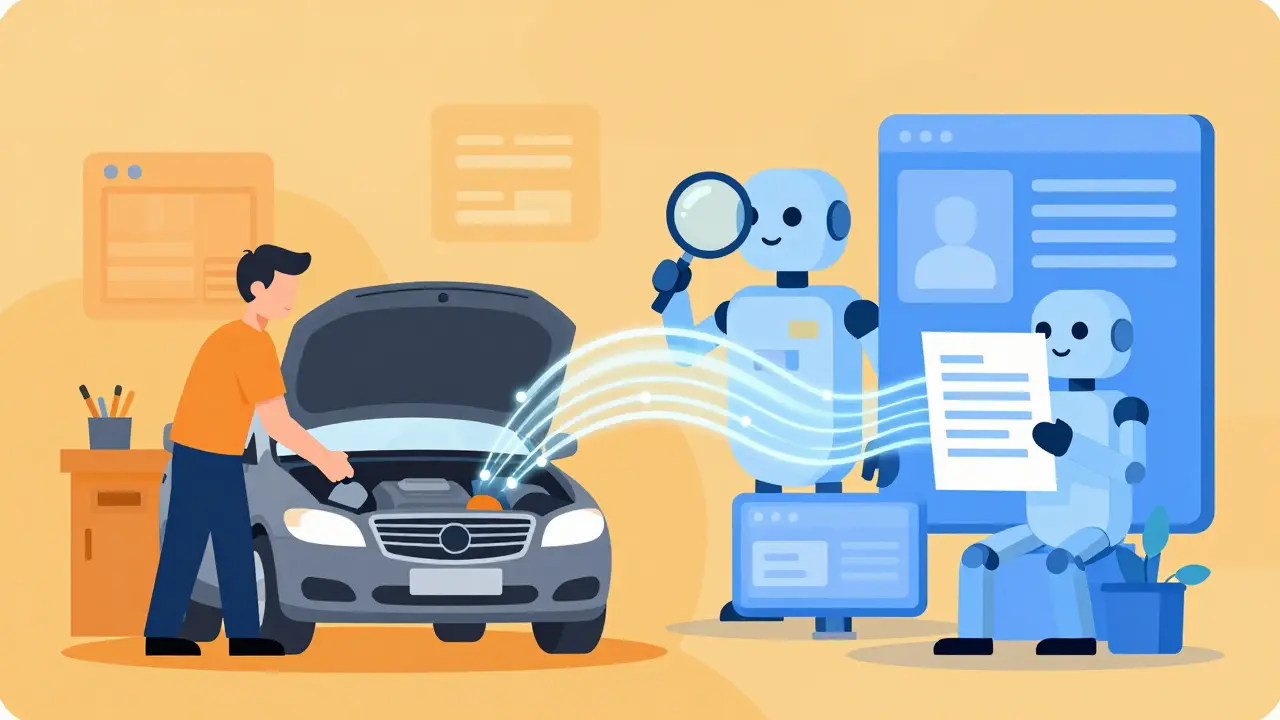
While traditional machine learning has been used for fault detection for years, generative AI adds a layer of reasoning and explanation. NVIDIA describes a workflow where multiple AI agents collaborate. One agent uses computer vision to spot visible issues like leaks or damage. Another, acting as a diagnostic assistant, scans thousands of pages of technical documentation and past service records using Retrieval-Augmented Generation (RAG). A third agent ensures the recommended fix complies with safety protocols.
This setup reduces diagnosis time from hours to minutes. For dealerships and independent shops, this means higher throughput and happier customers. But there’s a catch: hallucinations. Generative models can sometimes invent plausible-sounding but incorrect fixes. That’s why current implementations treat AI recommendations as suggestions, requiring human verification. IBM emphasizes that these copilots must operate within strict governance frameworks to ensure safety-critical decisions remain accountable.
Beyond immediate repairs, generative AI helps create synthetic fault data. Since rare failures don’t happen often enough to train robust models, AI generates realistic scenarios to improve predictive maintenance algorithms across entire fleets.
The Rise of the Connected In-Car Companion
If you’ve used voice assistants in your phone, you know how frustrating they can be when they misunderstand context. Early car voice systems were worse-they relied on rigid command structures. Say “turn up the heat,” and if the syntax wasn’t exact, nothing happened.
Cerence, a major player in automotive voice tech, launched CaLLM, a generative AI-based in-car assistant. Unlike older intent-based systems, CaLLM understands natural conversation. It remembers your preferences, plans trips proactively, and controls vehicle functions via speech without needing precise keywords. This runs on embedded System-on-Chips (SoCs) in the car, connecting to cloud models when needed for heavier processing.
This shift turns the car into a true companion. Imagine an assistant that notices you’re tired based on driving patterns and suggests a rest stop, or one that integrates with your smart home to pre-heat the house while you drive. AWS and IBM highlight how these experiences extend beyond the cabin to mobile apps and dealer portals, creating a seamless ecosystem.
However, safety remains paramount. Drivers interact with these systems while operating heavy machinery. Cerence notes that guardrails and domain adaptation are critical. The AI must never distract the driver or provide ambiguous instructions. Latency matters too-responses need to be near-instantaneous to maintain trust and flow.
Accelerating Software Development and Code Generation
A modern vehicle contains tens of millions of lines of code. Managing this complexity is a nightmare for engineering teams. Legacy Electronic Control Units (ECUs) are consolidating into domain controllers, requiring massive refactoring efforts.
Generative AI steps in here as a coding partner. KPIT explains how large language models can take natural language requirements-such as “create a diagnostic handler for battery temperature”-and produce C or AUTOSAR-compliant code snippets. Engineers then review and integrate this code into their existing V-model development processes.
But it’s not just about writing code. These tools also generate unit tests and scenario-based test cases. Covering hundreds of requirements per ECU manually takes weeks. AI can draft these tests rapidly, increasing coverage and reducing manual effort. Still, compliance with standards like ISO 26262 (functional safety) and ASPICE (software process assessment) requires rigorous validation. Human-in-the-loop review is non-negotiable.
This acceleration doesn’t replace engineers; it frees them from repetitive tasks so they can focus on innovation and complex problem-solving. For companies managing multi-year platform cycles, saving even a few hours per feature adds up to significant cost reductions.

Challenges: Data, Safety, and Trust
Despite the hype, implementing generative AI in automotive isn’t plug-and-play. Several hurdles remain:
- Data Quality and Availability: Training effective models requires vast amounts of high-quality, labeled data. Many OEMs struggle with siloed data across departments and suppliers.
- Computational Cost: Running large foundation models demands significant GPU power. While cloud providers like AWS offer scalable solutions, edge deployment in vehicles requires efficient optimization.
- Safety and Reliability: As mentioned, hallucinations pose risks. In safety-critical contexts, false positives or negatives can have severe consequences. Robust verification mechanisms are essential.
- Regulatory Compliance: Automotive regulations vary globally. Ensuring AI-generated designs or diagnostics meet local standards adds complexity.
- Skill Gaps: Engineering teams need to blend domain expertise with AI literacy. Upskilling workers to work alongside AI tools is an ongoing challenge.
IBM stresses the importance of governed data foundations. Without strict controls over training data and access, companies risk regulatory fines and reputational damage. Transparency and auditability are key. You need to know why an AI made a certain recommendation, especially when lives are on the line.
What’s Next for Automotive AI?
We’re only at the beginning. Over the next few years, expect to see more multimodal models that combine text, images, 3D geometry, and sensor data. These unified systems could propose a design change, simulate its impact, and explain the rationale-all in one pipeline.
Agentic architectures will become more common, where specialized AI agents collaborate under strict orchestration. Think of a team of experts working together: one handles design, another manages supply chain logistics, and a third monitors real-time vehicle health. They communicate seamlessly, optimizing the entire lifecycle from concept to end-of-life recycling.
For consumers, this means cars that learn and adapt over time. Your vehicle will understand your habits better than you do, offering personalized experiences that enhance comfort and safety. For manufacturers, it means staying competitive in a race defined by software speed and innovation.
The question isn’t whether generative AI will transform the automotive industry-it already is. The real question is how quickly you’ll adopt it to stay ahead.
Is generative AI safe for critical vehicle functions?
Currently, generative AI is used primarily for support roles like design assistance, diagnostics suggestions, and in-car entertainment. It is not yet trusted for fully autonomous safety-critical decisions due to risks like hallucinations. All outputs require human verification and must comply with strict safety standards like ISO 26262.
How does generative AI reduce car design time?
By generating hundreds of virtual design variants instantly, engineers can test aerodynamics, safety, and manufacturability digitally without building physical prototypes. This shifts iterations from weeks to hours, compressing overall development cycles significantly.
What is CaLLM by Cerence?
CaLLM is a generative AI-powered in-car assistant that uses large language models to enable natural, context-aware conversations. It allows drivers to control vehicle functions, plan trips, and access services using everyday speech rather than rigid commands.
Can generative AI write code for cars?
Yes, it can generate code snippets in languages like C or AUTOSAR based on natural language requirements. However, this code must be rigorously tested and validated by human engineers to ensure it meets safety and performance standards before deployment.
Which companies are leading in automotive generative AI?
Key players include NVIDIA (compute platforms), IBM (enterprise governance), AWS (cloud infrastructure), Cerence (in-car voice assistants), and engineering firms like KPIT and LTTS (integration and implementation).