How LLMs Cite Sources: Building Trust with Evidence Linking and RAG
 Jul, 14 2026
You ask an AI model for medical advice or a complex business strategy, and it hands you back a polished answer. But then you spot a link at the bottom. You click it, only to find that the article doesn't actually support the claim the AI just made. This isn't just annoying; it's dangerous. As large language models (LLMs) move from casual chatbots to critical decision-making tools in healthcare and finance, the gap between what they say and what they can prove is widening.
The core problem isn't that AI is lying on purpose. It's that traditional LLMs are probabilistic engines-they predict the next likely word, not the truth. To build real trust, we need source citation systems that don't just slap links onto text but verify that those links actually back up every specific claim. This shift from "generating text" to "linking evidence" is the new frontier of AI reliability.
The Anatomy of an AI Citation
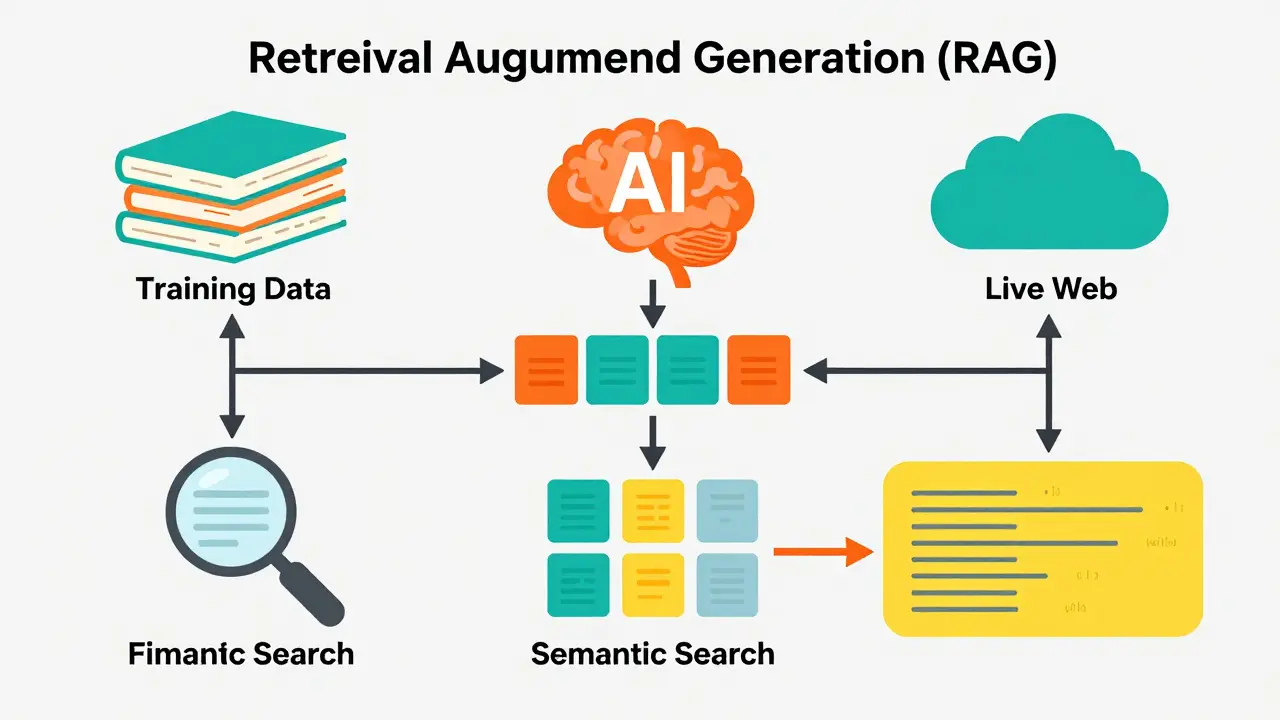
When an LLM provides a source, it’s usually doing one of two things: pulling from its training data (parametric memory) or searching the live web (non-parametric retrieval). The most robust systems today use a hybrid approach. Imagine a researcher who has read thousands of books but also has access to a library where they can pull fresh journals in real-time. That’s the goal of modern evidence linking.
In technical terms, this often involves Retrieval-Augmented Generation (RAG), which is a framework that combines external knowledge retrieval with language model generation to improve accuracy and reduce hallucinations. Here is how the process typically flows behind the scenes:
- Document Chunking: Source documents are split into smaller, searchable pieces. If you try to feed a whole textbook into an AI at once, it gets confused. Chunks keep the context tight.
- Semantic Search: Instead of matching keywords, the system looks for meaning. It converts your question and the document chunks into vectors (numbers representing concepts) and finds the closest matches.
- Passage Ranking: The system scores these chunks based on relevance to your specific query intent.
- Generation with Constraints: The LLM writes the answer, but it’s forced by its instructions to cite only the ranked passages provided in step three.
This pipeline ensures that the AI isn't making things up from thin air. However, simply having a RAG system isn't enough. The quality of the citation depends heavily on how well the system understands structured data.
Why Structured Data Matters More Than Ever
If you think SEO died when search engines became smarter, think again. In fact, structured data is now more critical than ever for AI visibility. When an LLM scans a webpage, it doesn't just read plain text. It looks for signals that tell it exactly what entities are being discussed and how they relate to each other.
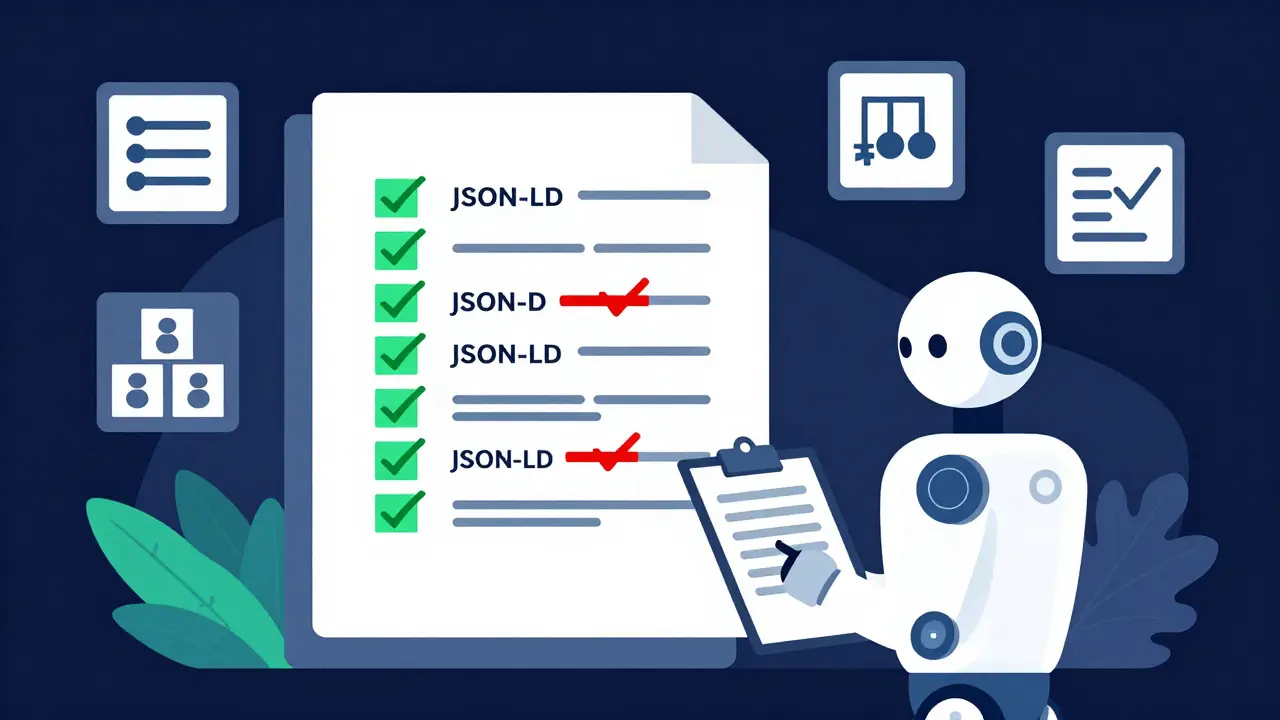
Formats like JSON-LD, RDFa, and Microdata act as explicit roadmaps for the AI. They provide clear references to entities, relationships, and document structures. For example, if a medical study uses Schema.org markup to define a "Drug" entity and its "SideEffect" relationship, an LLM can extract that connection with high confidence. Without this markup, the AI has to guess the relationships, which increases the risk of error.
| Data Type | Evidential Value | Processing Speed | Error Risk |
|---|---|---|---|
| Plain Text | Low | Slow (requires full parsing) | High (ambiguity) |
| HTML Headers | Medium | Medium | Medium |
| JSON-LD / Schema.org | High | Fast (direct extraction) | Low (explicit definitions) |
| RDF Triples | Very High | Fast | Very Low (logical consistency) |
This explains why "authority development" is replacing old-school link building. Getting cited by an LLM isn't about having the most backlinks; it's about having the clearest, most structurally sound evidence. Sites that implement comprehensive schema markup are effectively speaking the native language of these AI retrievers, leading to higher inclusion rates in generated responses.
Pre-Hoc vs. Post-Hoc: Two Ways to Cite
Not all citation strategies are created equal. Developers generally choose between two methodologies, or a mix of both, to ensure accuracy.
Pre-hoc methods identify potential citations *before* the content is fully generated. The system retrieves sources first, then asks the LLM to write the answer using only those sources. This is safer because it constrains the AI from the start. It’s like giving a student a closed-book exam with a reference sheet-they can only use what’s on the sheet.
Post-hoc methods let the LLM generate the answer first, then evaluate and refine citations afterward. This can be faster but risks the AI generating unsupported claims that are hard to fix retroactively. It’s like grading an essay after it’s written and trying to add footnotes to justify sentences that might not have any justification.
The current best practice is a mixed approach. Use pre-hoc retrieval to gather a candidate pool of high-quality, structured sources. Then, use post-hoc evaluation to check if the final generated text actually aligns with those sources. This dual-layer check significantly reduces "hallucinated citations," where the AI invents a URL or misattributes a quote.
Measuring Trust: The SourceCheckup Framework
How do we know if these systems actually work? We can’t just trust the AI to grade itself. That’s where independent evaluation frameworks come in. One notable example is SourceCheckup, which is an automated agent-based pipeline designed to evaluate the relevance and supportiveness of sources in LLM responses.
Researchers used SourceCheckup to test major models in the medical domain-a field where errors can be life-threatening. They annotated 400 statement-source pairings with licensed US medical doctors. The results were telling: the automated verification model achieved an 88.7% agreement rate with human experts. For context, the average agreement between different doctors themselves was only 86.1%. This suggests that well-designed AI evaluators can match or even exceed human consistency in verifying facts.
The key metric here is "precision." Precision measures the percentage of cited sources that actually support the statements made. A low precision score means the AI is dumping generic lists of links at the end of paragraphs without connecting them to specific claims. High precision means every footnote is earned. This distinction is vital for users who need to audit the reliability of the information.
Fixing the Errors: Cleanup Agents
Even with the best systems, mistakes happen. Sometimes an AI will partially deviate from a source, twisting a nuance or missing a caveat. This is where correction agents like SourceCleanup, which is an LLM agent that takes a statement and its source to return a modified, fully supported version of the statement. come into play.
These agents act as a final quality control layer. If the primary generator produces a sentence that isn't fully backed by the retrieved source, the cleanup agent rewrites that specific sentence to align perfectly with the evidence. It doesn't change the meaning; it tightens the alignment. This is crucial for maintaining intellectual property rights and ethical standards, ensuring the AI isn't inadvertently plagiarizing or misrepresenting proprietary research.
The Future of Authority: Beyond Keywords
We are witnessing a fundamental shift in how information authority is established. In the age of traditional search engines, you optimized for keywords and backlinks. In the age of generative AI, you optimize for evidence weight. This means creating pillar pages that serve as comprehensive hubs of truth, supported by cluster pages that dive deep into specifics, all enriched with structured data.
For businesses and creators, this means your content strategy must evolve. It’s no longer enough to write good copy. You must structure your data so that AI systems can easily parse, verify, and cite it. This includes using standard identifiers (like Q-IDs from Wikidata) to link your entities to global knowledge graphs. When an LLM sees that your website’s entity ID matches a trusted global ID, it boosts the evidential value of your content.
As we move further into 2026, the ability to provide verifiable, linked evidence will separate trustworthy AI applications from unreliable ones. Users are becoming savvy; they demand transparency. By implementing robust citation pipelines, leveraging structured data, and utilizing verification frameworks, developers can build systems that don't just answer questions-they prove their answers.
What is the difference between parametric and non-parametric knowledge in LLMs?
Parametric knowledge is information stored within the model's weights during training (its internal memory). Non-parametric knowledge comes from external sources retrieved in real-time, such as via RAG. Combining both allows for deeper context and up-to-date accuracy.
How does structured data like JSON-LD improve AI citations?
Structured data provides explicit definitions of entities and relationships, reducing ambiguity. AI systems can extract this data directly without guessing, leading to higher evidential value and more accurate source attribution in generated responses.
What is Retrieval-Augmented Generation (RAG)?
RAG is a technique that enhances LLMs by retrieving relevant external documents before generating a response. This grounds the AI's output in factual, up-to-date sources rather than relying solely on its training data, significantly reducing hallucinations.
Why is "precision" important in evaluating AI citations?
Precision measures whether the cited sources actually support the specific statements made. High precision ensures that every reference is relevant and justified, preventing the AI from providing generic or misleading link lists.
Can AI verify its own citations accurately?
Yes, specialized evaluation frameworks like SourceCheckup have shown that AI agents can verify citations with accuracy comparable to human experts, particularly when trained on specific domains like medicine. However, human oversight remains essential for critical applications.