How Reasoning-Enhanced LLMs Are Changing Scientific Discovery in 2026
 Jun, 7 2026
For years, we treated artificial intelligence as a glorified search engine for science. You asked it a question, and it pulled an answer from its training data. But that model is breaking down. In 2026, the real shift isn't just about models knowing more facts; it's about them reasoning through problems they haven't seen before. We are moving past simple automation into active investigation.
This change is subtle but massive. It means the difference between an AI telling you what a molecule looks like and an AI explaining why that molecule behaves a certain way based on chemical principles. It’s the difference between retrieving a fact and generating a new hypothesis. Let’s look at how reasoning-enhanced large language models (LLMs) are actually doing this work right now.
The Three Levels of AI in Science
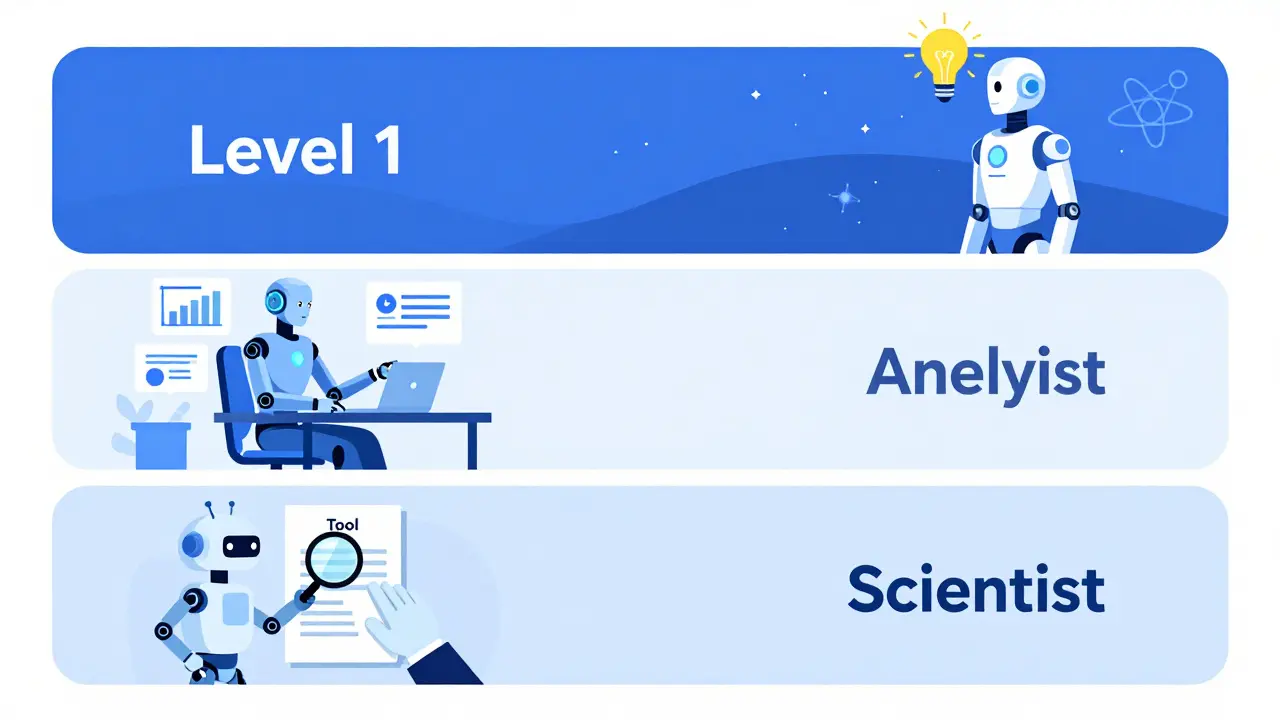
To understand where we are, we need to map out where the technology sits today. Researchers have settled on a clear taxonomy for LLM involvement in scientific discovery. It helps us set realistic expectations about what these tools can and cannot do.
| Level | Role | Capability Description | Autonomy Level |
|---|---|---|---|
| 1 | LLM as Tool | Performs specific, well-defined tasks under direct human supervision (e.g., formatting data, basic translation). | Low |
| 2 | LLM as Analyst | Processes complex information, conducts analyses, and offers insights with reduced human intervention. | Medium |
| 3 | LLM as Scientist | Autonomously formulates hypotheses, plans experiments, analyzes data, and proposes new research questions. | High |
Most commercial tools today sit firmly in Level 1 or early Level 2. They are great analysts. The frontier research, however, is pushing hard toward Level 3. This is where the system doesn’t just wait for instructions; it initiates the scientific process. It asks, "What if we tried this?" and then checks if the idea makes sense before running the simulation.
Why Standard LLMs Fail at Science
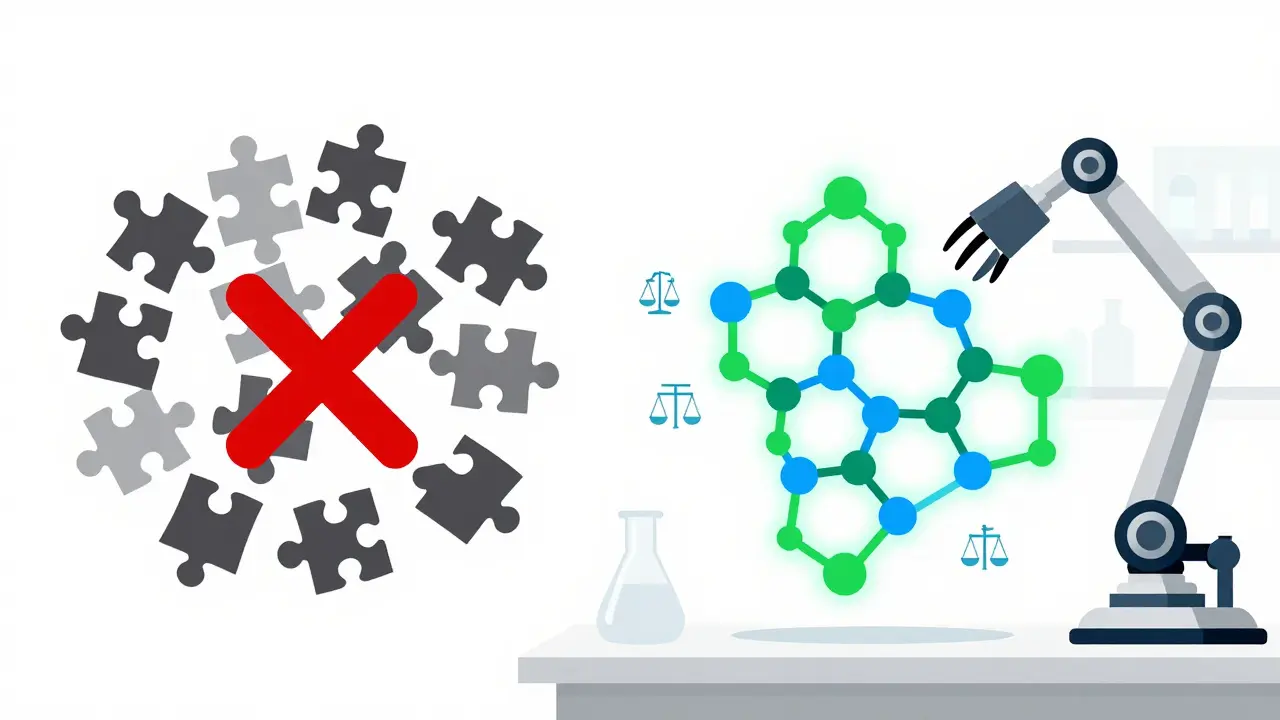
You might wonder why we can't just use the latest general-purpose chatbot for serious research. The problem is interpretability and generalization. Traditional molecular property prediction models often act like black boxes. They give you a number, but they don't tell you why. If the input changes slightly-what researchers call an "out-of-distribution" task-the model often fails because it memorized patterns rather than understanding rules.
Science requires logic. It requires following a chain of thought that adheres to physical laws. A standard LLM might hallucinate a chemical reaction that sounds plausible linguistically but violates thermodynamic principles. Reasoning-enhanced models fix this by integrating explicit verification steps. They don't just predict the next word; they predict the next logical step and check it against known constraints.
Case Study: MPPReasoner and Chemical Logic
A concrete example of this shift is MPPReasoner. This is a multimodal large language model built on the Qwen2.5-VL-7B-Instruct architecture. Unlike previous models that only looked at text strings representing molecules (SMILES strings), MPPReasoner integrates molecular images with those strings. This gives it a comprehensive view of the molecule's structure.
Here is how it achieves its reasoning capability:
- Supervised Fine-Tuning: It was trained on 16,000 high-quality reasoning trajectories. These weren't just answers; they were step-by-step explanations generated by expert knowledge and multiple teacher models.
- RLPGR (Reinforcement Learning from Principle-Guided Rewards): This is the key innovation. Instead of rewarding the model for sounding confident, it rewards the model for applying correct chemical principles. The reward signal comes from computational verification. Did the model correctly analyze the molecular structure? Is the logic consistent?
The results speak for themselves. In extensive experiments across eight datasets, MPPReasoner outperformed the best existing baselines by 7.91% on in-distribution tasks and 4.53% on out-of-distribution tasks. That gap in out-of-distribution performance is critical. It proves the model is learning generalizable chemical reasoning, not just memorizing specific examples.
Beyond Chemistry: Batteries and Physics
This approach isn't limited to small molecules. SES AI has deployed a 70-billion parameter model called Molecular Universe LLM specifically for battery innovation. Battery research involves multistep problems where material properties interact in complex ways. Simple instruction tuning isn't enough here. SES AI introduced "reasoning alignment" to help the model navigate hypothesis generation and self-correction.
In physics, symbolic regression-the process of discovering mathematical equations from data-is seeing similar leaps. Models like DeepSeek R1 and GPT-5 are being used to find governing equations for dynamic systems. In benchmarks, these reasoning-enabled models didn't just guess better polynomials; they proposed structural changes, such as realizing a sign function was needed instead of a simple curve fit. They found solutions faster and with lower error rates than non-reasoning counterparts.
Measuring Real Discovery: The SDE Benchmark
We need a way to test if these models are actually discovering things or just reciting textbooks. Enter the Scientific Discovery Evaluation (SDE) framework. Unlike standard exams that test static knowledge, SDE evaluates models on realistic, iterative research tasks spanning biology, chemistry, materials, and physics.
The SDE benchmark revealed a stark truth: there is a significant gap between passing a science exam and conducting actual discovery. However, turning on reasoning capabilities closed much of that gap. For instance, in a biology task assessing Leinsky's rule, the DeepSeek model's accuracy jumped from 65% to a perfect 100% simply by enabling its reasoning mode. This suggests that the knowledge was already there, but the model needed the structured reasoning process to access and apply it correctly.
However, SDE also showed that current LLMs are far from general scientific superintelligence. Performance varies wildly depending on the scenario. Sometimes a model excels in one project but fails in another, even if the underlying science is similar. This highlights the role of serendipity and guided exploration in discovery-areas where human intuition still holds the edge.
Hybrid Frameworks: RAG Meets Case-Based Reasoning
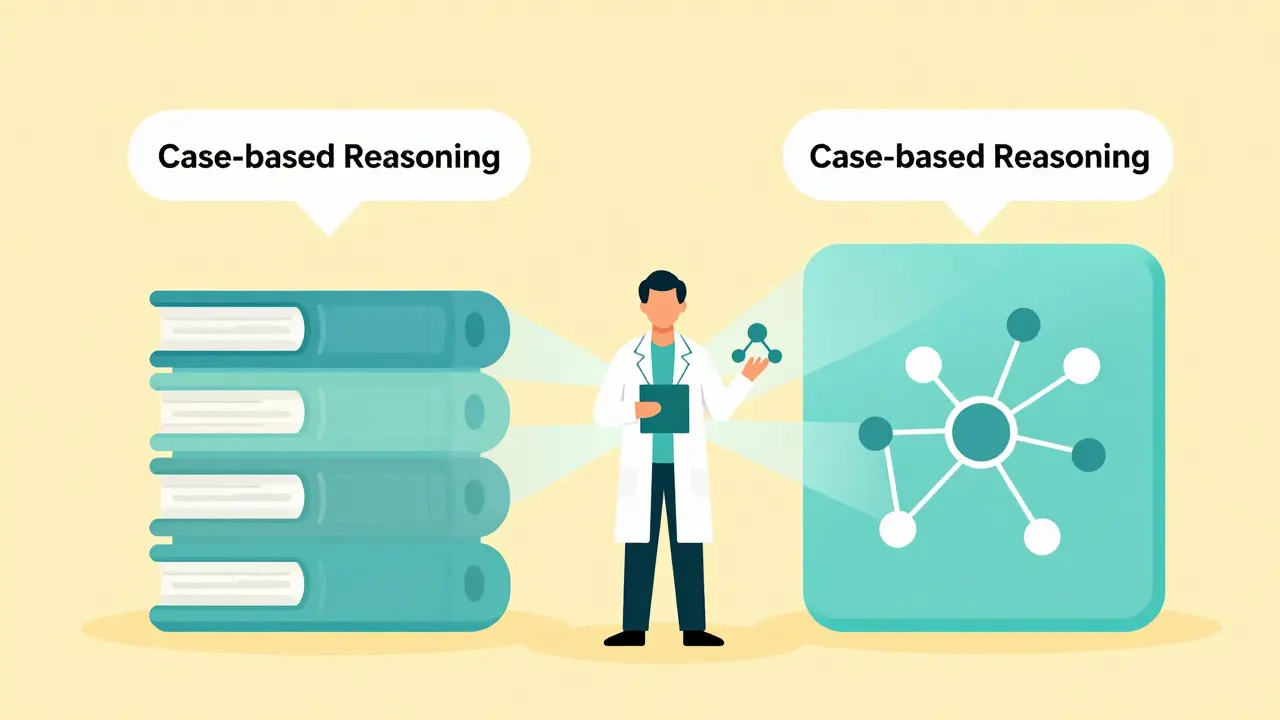
The most promising architectures aren't relying on the LLM alone. They are hybrid systems. Retrieval-Augmented Generation (RAG) is common, but combining it with Case-Based Reasoning (CBR) is the new standard for transparency. In these frameworks, the LLM acts as a reasoning engine rather than a static repository.
Imagine a platform that uses graph databases and vector embeddings to store past research cases. When a scientist presents a new problem, the system retrieves similar historical cases (CBR) and uses the LLM to reason through the differences and similarities (RAG). This creates a collaborative note-taking phase where humans and AI iterate together. It promotes accountability because every suggestion is tied to a retrievable precedent and a verifiable logical step. This is crucial for high-stakes fields like healthcare, where you can't afford opaque decisions.
Limitations and the Road Ahead
Despite the progress, we must be careful not to overhype. Shared failure modes persist across top-tier models. They still struggle with tasks requiring deep, multi-hop causal reasoning without external verification. The gap between general knowledge performance and practical discovery capabilities remains substantial.
Achieving true Level 3 autonomy-the "LLM as Scientist" ideal-requires continued architectural innovation. We need better methods for reasoning alignment and more robust feedback loops. The path forward isn't about building bigger models; it's about building smarter verification systems that keep the AI grounded in physical reality.
What is the difference between a standard LLM and a reasoning-enhanced LLM?
A standard LLM predicts the next likely word based on statistical patterns in its training data. A reasoning-enhanced LLM incorporates explicit steps for logical deduction, self-correction, and verification against domain-specific rules (like chemical laws or physical constants) before generating an output.
Can current AI models autonomously conduct scientific research?
Not fully. While some systems demonstrate Level 3 capabilities like hypothesis generation, they currently require significant human oversight. They excel at assisting in analysis and proposing ideas, but they lack the general superintelligence needed to independently manage entire research projects without error.
What is RLPGR in the context of MPPReasoner?
RLPGR stands for Reinforcement Learning from Principle-Guided Rewards. It is a training method where the AI is rewarded not just for correct answers, but for following valid chemical principles and logical consistency, verified through computational checks during the training process.
How does the SDE benchmark differ from traditional AI tests?
Traditional tests measure static knowledge retrieval (like a multiple-choice exam). The Scientific Discovery Evaluation (SDE) benchmark assesses models on iterative, realistic research tasks, including hypothesis generation and experimental simulation, providing a more accurate measure of discovery potential.
Why is interpretability important in scientific AI?
In science, knowing the 'why' is as important as the 'what.' Interpretability allows researchers to trust the AI's conclusions, identify potential errors in logic, and build upon the AI's reasoning to generate new insights, rather than treating the AI as an unexplainable black box.
Edward Gilbreath
June 7, 2026 AT 20:18its all a psyop to make us think ai is smart when really its just predicting the next word like always and they want you to believe it understands chemistry so you stop thinking for yourself
the government uses this stuff to track what molecules we are making in our garages
trust me i know how these systems work
kimberly de Bruin
June 9, 2026 AT 04:37we are witnessing the dissolution of the subject object dichotomy in scientific inquiry where the observer becomes the observed through the lens of algorithmic determinism
the machine does not reason it merely reflects the collective unconscious of human error back at us in a more organized fashion
is it discovery or is it just memory with better lighting
Edward Nigma
June 10, 2026 AT 20:07You people are completely missing the point here because you are too busy worshipping the tech instead of looking at the actual data which shows that most of these models still fail basic logic tests if you look closely enough
The article says MPPReasoner improved performance by 7.91% on in-distribution tasks which is barely above statistical noise given the margin of error in these benchmarks and frankly it is insulting to suggest that a 7 billion parameter model can truly understand thermodynamics when it cannot even balance a simple chemical equation without hallucinating atoms out of thin air
We need to stop pretending that reinforcement learning from principle-guided rewards is anything more than a fancy way of saying the model was punished until it stopped being wrong about specific things it already knew about
This is not science this is pattern matching with extra steps and anyone who thinks otherwise is either paid to say so or has never actually tried to use these tools for real research where the stakes are high and the consequences of failure are catastrophic
The SDE benchmark is a joke because it tests static scenarios that do not reflect the chaotic nature of real laboratory environments where variables change constantly and intuition matters far more than computational verification
I have seen these models propose hypotheses that sound brilliant in text but are physically impossible to execute because they ignore fundamental constraints of material availability and energy consumption
So please save your breath and stop acting like we are on the verge of artificial general intelligence when we are still struggling to get chatbots to write coherent emails without sounding like robots trying to be human
The gap between Level 2 and Level 3 is not a technical hurdle it is a philosophical chasm that no amount of training data will ever bridge because reasoning requires understanding and understanding requires consciousness which these machines simply do not possess
Until someone can prove that an LLM has subjective experience rather than just simulating it we should treat every output as suspect and verify everything manually because relying on black box algorithms for scientific discovery is reckless at best and dangerous at worst
Let us focus on improving experimental design and human collaboration instead of chasing the ghost of autonomous science that will likely never arrive in our lifetime
Francis Laquerre
June 11, 2026 AT 12:12What a fascinating perspective on the evolving role of artificial intelligence in our scientific endeavors
I must admit that reading about the integration of molecular images with SMILES strings in MPPReasoner left me feeling quite inspired by the potential for cross-disciplinary collaboration
It reminds me of the great symphonies of Beethoven where different instruments come together to create something greater than the sum of their parts
Perhaps we can view the LLM not as a replacement for the scientist but as a virtuoso soloist accompanying the human conductor
The idea of Reinforcement Learning from Principle-Guided Rewards suggests a harmony between mathematical rigor and creative exploration that is truly beautiful to behold
I wonder if we might see similar advancements in the arts where AI helps composers explore new harmonic structures while respecting the traditional rules of music theory
Let us embrace this new era with open hearts and minds knowing that technology serves to amplify our humanity rather than diminish it
Thank you for sharing this insightful article that bridges the gap between cold computation and warm human curiosity
michael rome
June 12, 2026 AT 07:12While I appreciate the detailed breakdown of the taxonomy levels provided in the post I find myself somewhat concerned about the implications for early-career researchers who may rely too heavily on these tools
It is important to remember that critical thinking skills are developed through struggle and failure which are essential components of the scientific method
If we allow AI to handle hypothesis generation and experimental planning we risk creating a generation of scientists who lack the foundational understanding required to innovate beyond the capabilities of current models
However I also recognize the immense potential for these systems to accelerate discovery in fields where resources are limited
Perhaps the solution lies in hybrid educational models where students learn to critique AI outputs rather than accept them blindly
This approach would foster both technological literacy and deep domain expertise ensuring that humans remain the primary drivers of scientific progress
We must proceed with caution and maintain rigorous standards for validation and reproducibility
Let us continue to discuss how we can integrate these tools responsibly into our workflows
Andrea Alonzo
June 13, 2026 AT 14:52I completely agree with the sentiment expressed regarding the importance of maintaining human oversight in the scientific process because when we look at the broader picture of how knowledge is constructed and validated within academic communities we realize that trust is built through transparency and accountability which are qualities that current large language models often struggle to provide consistently across diverse domains and complex scenarios
Furthermore the notion that reasoning-enhanced models can close the gap between static knowledge retrieval and dynamic discovery is intriguing yet it raises significant ethical questions about authorship and credit attribution when an AI system contributes substantially to the formulation of a novel hypothesis or the identification of a previously unknown correlation in biological data sets
We must consider the long-term impact on mentorship relationships where senior scientists guide junior colleagues through the intricacies of experimental design and interpretation and whether delegating these tasks to algorithms could erode the interpersonal connections that foster creativity and resilience in the face of setbacks
Additionally the reliance on benchmarks such as the Scientific Discovery Evaluation framework assumes that these standardized tests adequately capture the nuances of real-world research environments where serendipity plays a crucial role in breakthrough discoveries and where the ability to pivot quickly in response to unexpected results is often more valuable than strict adherence to pre-defined logical pathways
Therefore it is imperative that we develop comprehensive guidelines for the use of AI in scientific research that prioritize education and skill development alongside technological adoption ensuring that researchers are equipped with the critical thinking skills necessary to evaluate and refine AI-generated insights rather than accepting them uncritically
By fostering a culture of collaborative inquiry where humans and machines work together to explore the frontiers of knowledge we can harness the power of artificial intelligence to augment our cognitive abilities while preserving the integrity and spirit of scientific investigation that has driven progress for centuries
Let us engage in thoughtful dialogue about these issues and work towards a future where technology enhances rather than replaces the human element of discovery