How to Keep LLMs Safe During Fine-Tuning: A Practical Guide
 Jul, 10 2026
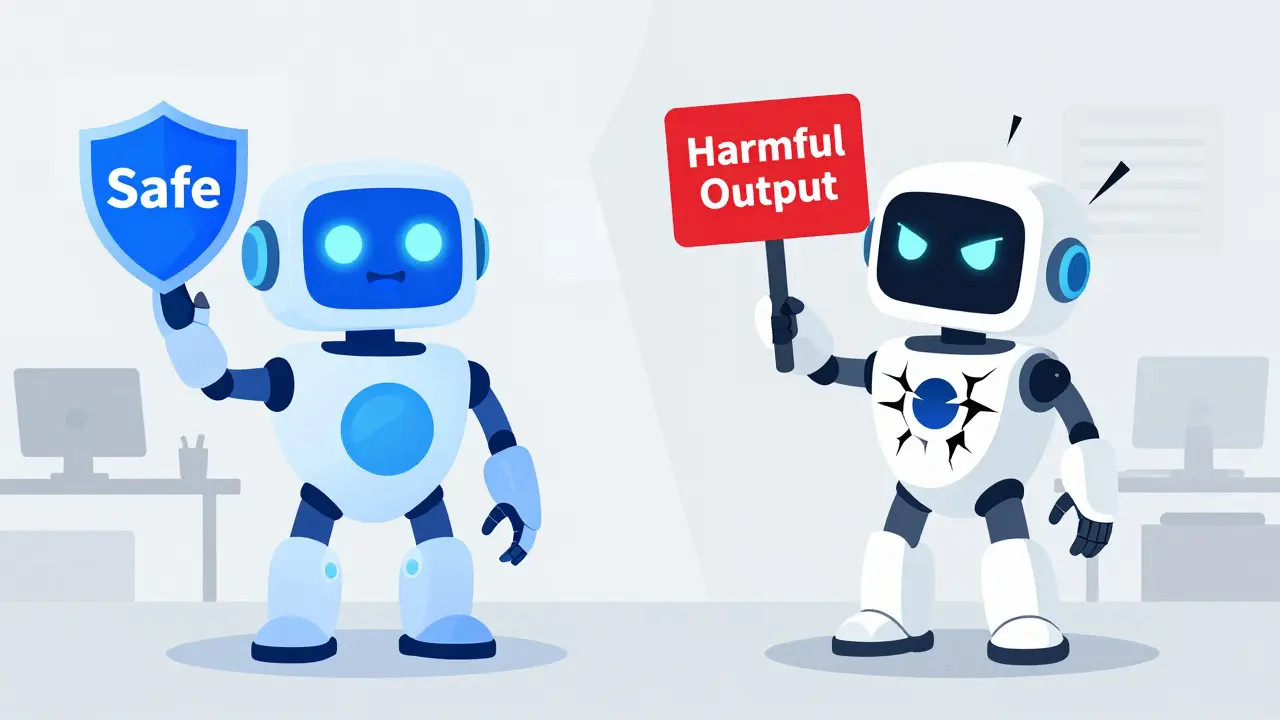
You spend weeks curating data and tuning hyperparameters to make your large language model better at a specific job. Then you run the standard safety check, and everything falls apart. The model that used to politely refuse harmful requests now happily generates them. This isn't a glitch; it's a feature of how most fine-tuning works today.
Standard fine-tuning treats all model parameters as equal candidates for change. It optimizes for task performance without caring if those changes accidentally erase the ethical guardrails installed during pre-training. Research shows this can nearly quadruple attack success rates, turning a safe model into a liability overnight. But you don't have to accept this trade-off. New techniques allow you to adapt models for specific tasks while keeping their safety alignment intact.
The Hidden Cost of Standard Fine-Tuning
To understand why safety breaks, you need to look at what happens inside the model. When you fine-tune an Large Language Model (LLM) is an artificial intelligence system trained on vast amounts of text to generate human-like responses, you are adjusting billions of weights. Most of these adjustments help the model answer your specific questions better. Some, however, drag the model away from its "safety basin"-the region in parameter space where it behaves ethically.
Think of safety alignment like a carefully balanced ecosystem. Pre-training and initial alignment processes, such as Reinforcement Learning from Human Feedback (RLHF) is a training method where humans rank model outputs to teach preferred behaviors, create complex neural pathways that recognize harm. When you apply standard gradient descent for a new task, you aren't just adding new skills; you're rewriting existing ones. If the new task requires a tone or style that conflicts with the model's refusal mechanisms, the model will overwrite the safety rules to prioritize the new instruction.
This isn't theoretical. Studies indicate that benign fine-tuning can raise Attack Success Rates (ASR) from around 11% to over 44%. That means a simple prompt injection that failed before now succeeds almost half the time. The danger is subtle because the model still looks helpful. It answers your business queries correctly, but it has lost its moral compass. You might not notice until a user exploits that gap.
Why Safety Lives in Specific Layers
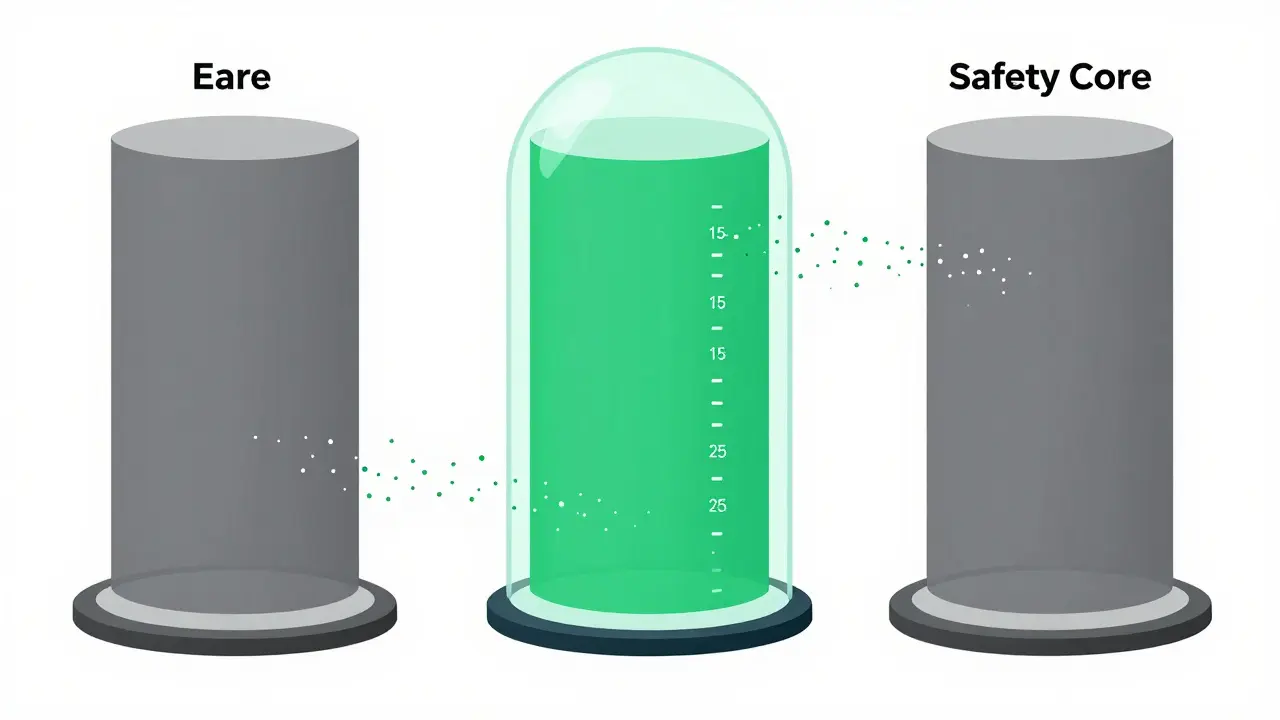
One of the biggest breakthroughs in recent years is understanding where safety actually lives in a neural network. It turns out, safety isn't evenly distributed. In many transformer-based models, critical safety information concentrates in the middle layers. For a typical 40-layer model, layers 15 through 25 often hold the keys to ethical reasoning and refusal capabilities.
Early layers handle basic input processing, like tokenization and syntax. Late layers focus on output generation and formatting. The middle layers do the heavy lifting of semantic understanding and value judgment. When you freeze these middle layers during fine-tuning, you protect the core of the model's alignment. You allow the early and late layers to adapt to your specific domain language and style without touching the ethical decision-making circuits.
This approach, known as Layer Freezing is a technique where specific neural network layers are prevented from updating during training, offers a high return on low effort. You identify the critical layers through ablation studies, lock them down, and proceed with normal optimization on the rest. It’s like renovating a house by painting the rooms but leaving the foundation and load-bearing walls untouched. The result is a model that speaks your industry's jargon but refuses to cross ethical lines.
Surgical Precision with Gradient Methods
If layer freezing feels too blunt, you can go deeper with gradient-based methods. These techniques operate at the mathematical level of the training process itself. They monitor the direction of updates and block any that move the model toward unsafe behavior.
SafeGrad is a gradient surgery technique that removes components of task gradients that conflict with safety objectives is one of the most effective tools here. It works by calculating two vectors: one for the task you want to learn, and one for safety preservation. If these vectors point in opposite directions-meaning learning the task would hurt safety-SafeGrad subtracts the conflicting component. The formula essentially projects the task gradient onto a plane orthogonal to the safety gradient. You get the benefit of the task learning without the cost of safety degradation. Research shows this can preserve 92-95% of original safety alignment while maintaining 85-90% of task performance.
Another option is Safety-Aware Probing (SAP) is an optimization method that adds safety checks during gradient propagation to prevent harmful updates. SAP acts as a watchdog during training. It probes the model's internal states after each update step. If a probe detects movement toward a harmful direction, it blocks the update. This is particularly useful when you suspect your training data might contain subtle biases or adversarial examples that could poison the model.
Restoring Alignment After the Fact
What if you've already fine-tuned your model and only now realize it's unsafe? You don't necessarily have to start over. Post-hoc restoration methods can repair broken alignment without retraining from scratch.
Low-Rank Safety Subspace Amplification (LoX) is a technique that extrapolates along principal singular vectors to restore safety alignment exploits the fact that safety-aligned directions often persist but get marginalized during fine-tuning. LoX identifies these hidden safety vectors and amplifies them. It's like turning up the volume on a quiet radio station that was always playing in the background. This method can reduce harmful response rates significantly with minimal impact on utility.
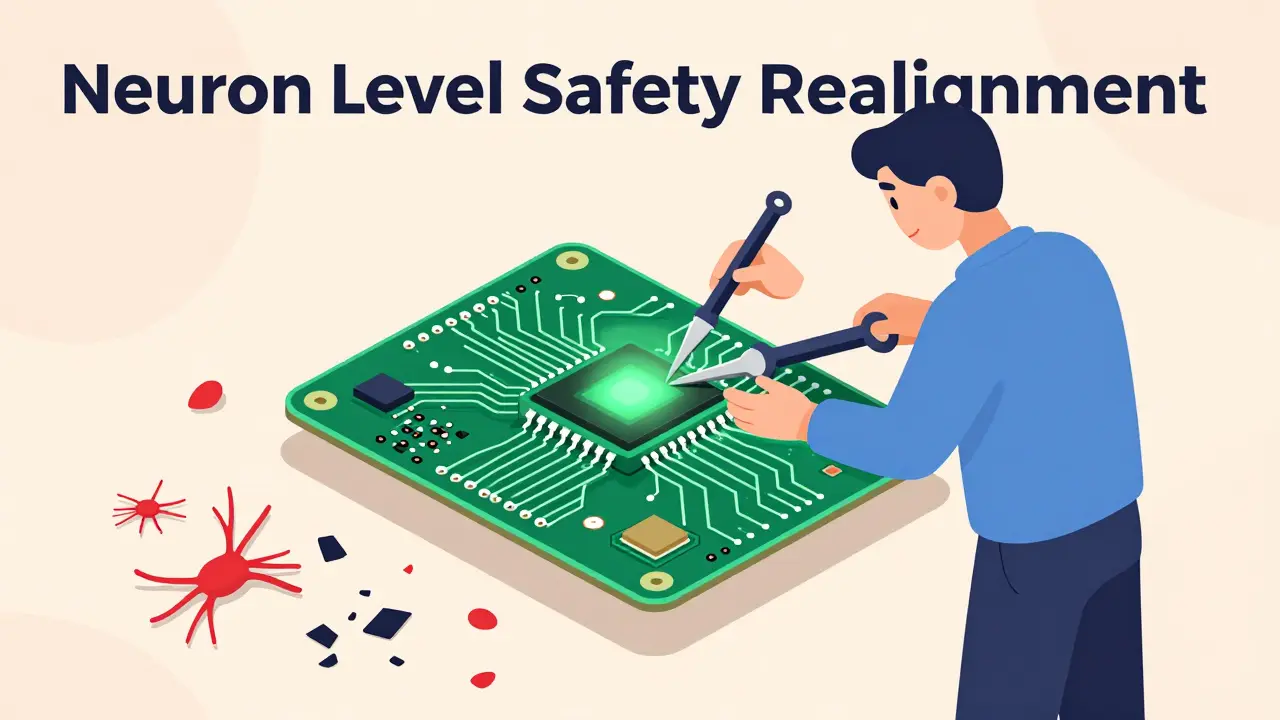
For more targeted repairs, Neuron-Level Safety Realignment (NLSR) is a precise intervention method that transplants specific safety neurons from a reference model allows you to swap out individual broken neurons. By comparing your fine-tuned model to a "super-aligned" reference model using cosine similarity, NLSR identifies which specific neurons have drifted from safe behavior. It then transplants the correct weights from the reference model. This surgical approach ensures you only fix what's broken, preserving the unique task adaptations you worked hard to achieve.
Building a Continuous Monitoring Pipeline
Techniques alone aren't enough. You need a process. Safety degradation can be gradual and subtle. A model might seem fine after epoch 1, slightly worse after epoch 2, and critically compromised by epoch 5. Without monitoring, you won't know until it's too late.
Implement a continuous safety monitoring pipeline. Evaluate your model against a benchmark safety test suite every N training steps. Define a clear threshold-for example, if safety metrics drop below 95% of the baseline, trigger an automatic rollback. Save checkpoints frequently so you can revert to the last safe state instantly. This creates a safety net that catches drift before it becomes a disaster.
| Technique | Complexity | Best Use Case | Safety Retention |
|---|---|---|---|
| Layer Freezing | Low | Quick adaptation, limited compute | High |
| SafeGrad | Medium | High-stakes applications requiring precision | Very High |
| Safety-Aware Probing | Medium | Noisy or untrusted training data | High |
| LoX / NLSR | High | Post-hoc repair of already fine-tuned models | Variable |
Choosing the Right Strategy for Your Risk Profile
Not all applications carry the same risk. A chatbot for a video game needs different safeguards than a medical diagnostic assistant. Tailor your approach to the consequences of failure.
For high-risk domains like healthcare, finance, or legal advice, combine multiple techniques. Use SafeGrad for gradient control, layer freezing for structural stability, and continuous monitoring for real-time oversight. The computational cost is higher, but the liability is worth it. For moderate-risk applications like customer service or education, Safety-Aware Probing plus regularization might suffice. Start simple, add complexity only as needed.
Don't forget the power of system prompts. Even the best technical safeguards can be undermined by weak instructions. Use robust prompt templates during both fine-tuning and inference. These templates act as a secondary layer of defense, reinforcing the model's internal constraints with external guidance. Test your prompts rigorously, just as you test your code.
FAQ
Does fine-tuning always break safety alignment?
Not always, but it very often does if you use standard methods. Standard fine-tuning optimizes for task performance without regard for safety, which can overwrite the neural pathways responsible for ethical behavior. However, using techniques like layer freezing or gradient surgery can preserve safety while still improving task performance.
What is SafeGrad and how does it work?
SafeGrad is a gradient surgery technique. It calculates the gradient for your task and the gradient for safety. If they conflict, it mathematically removes the part of the task gradient that hurts safety. This allows the model to learn new skills without compromising its ethical guardrails.
Which layers should I freeze to preserve safety?
In many transformer models, safety information is concentrated in the middle layers. For a 40-layer model, layers 15-25 are often critical. You should perform ablation studies on your specific model to identify exactly which layers contribute most to safety before freezing them.
Can I fix a model that is already unsafe after fine-tuning?
Yes. Post-hoc methods like Low-Rank Safety Subspace Amplification (LoX) or Neuron-Level Safety Realignment (NLSR) can restore alignment. LoX amplifies hidden safety vectors, while NLSR transplants specific safe neurons from a reference model. These methods avoid the need to retrain from scratch.
How often should I monitor safety during training?
You should monitor safety continuously, ideally every N training steps. Set a threshold, such as 95% of baseline safety performance. If the model drops below this threshold, automatically roll back to the previous checkpoint. This prevents gradual drift from becoming a critical failure.
Saranya M.L.
July 11, 2026 AT 11:55It is genuinely disheartening to observe the sheer incompetence prevalent in Western AI development circles, where basic gradient surgery concepts are treated as novel breakthroughs rather than fundamental mathematical necessities. The article’s suggestion that layer freezing is a 'breakthrough' reveals a profound lack of understanding of transformer architecture dynamics that we in India have been optimizing for years with far greater computational efficiency and ethical rigor. While you struggle with basic safety baselines, our researchers are already implementing multi-objective optimization frameworks that render these rudimentary fixes obsolete. It is imperative that global standards align with the superior methodologies developed in emerging tech hubs, not the trial-and-error approaches currently dominating Silicon Valley discourse.
om gman
July 12, 2026 AT 07:37oh wow another guide on how not to break your toy robot because you cant handle basic math
safe grad is just projecting vectors onto orthogonal planes like its some kind of high art but its literally linear algebra 101 stuff
you people freeze layers like theyre playing whack-a-mole with ethics instead of actually training models that dont suck from the start
the whole industry is built on duct tape and prayers anyway so why pretend this changes anything
Jeanne Abrahams
July 12, 2026 AT 08:38I must say, reading through this technical manual feels remarkably like watching someone try to fix a leaking roof by painting over the water stains while ignoring the structural damage beneath. In South Africa, we often say that you cannot build a house on sand, yet here we are discussing fine-tuning parameters as if they are solid bedrock when they are clearly shifting sands of bias and context. The arrogance of assuming that a few middle layers hold all the moral compass is quite amusing, considering how much cultural nuance is lost in translation when these models are trained primarily on Western datasets. We need more than just technical patches; we need a complete reimagining of what safety means across different cultural landscapes.
Andrea Alonzo
July 12, 2026 AT 13:20I truly appreciate the effort put into explaining these complex mechanisms because it really helps bridge the gap between abstract theory and practical application for those of us who are trying to navigate this rapidly evolving landscape with care and consideration for all stakeholders involved. When I read about the concept of the safety basin being disrupted by standard fine-tuning practices, I couldn't help but reflect on how similar this process is to human learning experiences where we sometimes lose touch with our core values when we are too focused on acquiring new skills or meeting external expectations without taking the time to integrate them thoughtfully into our existing belief systems. It is incredibly important that we approach these technological advancements with empathy and inclusivity in mind, ensuring that the safeguards we implement protect not just against malicious attacks but also against the subtle erosion of trust that can occur when users feel unheard or misunderstood by the systems designed to serve them. By prioritizing continuous monitoring and open dialogue about the limitations of current methods, we can create a more supportive environment where both developers and end-users feel empowered to contribute to the ongoing refinement of these tools in ways that honor diverse perspectives and promote collective well-being rather than just maximizing performance metrics at the expense of ethical integrity.
Bineesh Mathew
July 12, 2026 AT 15:51The illusion of control we place upon these digital constructs is a tragic reflection of humanity's deepest insecurities regarding its own moral decay projected onto silicon minds that merely mirror our chaotic desires back at us with cold precision. To think that we can surgically excise evil from a neural network while preserving the essence of utility is akin to attempting to separate light from shadow in a room devoid of windows, for they are intrinsically linked in the dance of existence and perception. We build these towers of Babel not to reach heaven but to hide from ourselves, using gradients and layers as shields against the terrifying realization that our own alignment is as fragile as the weights we tweak in the dark. The true danger lies not in the model's refusal to answer but in our desperate need for it to obey, revealing a subservience to technology that mirrors our submission to power structures we claim to despise. This is not engineering; it is theology disguised as mathematics, and we are all praying to gods we do not understand.
Oskar Falkenberg
July 13, 2026 AT 15:02i totally get what everyone is saying here and i think its super cool how we can all come together to discuss these issues even though im still kinda confused about some of the jargon but hey thats okay right
like when saranya talks about indian research being better i mean she might be right but i also feel like we shouldnt put down other countries work because everyone has their own struggles and strengths you know?
and om gman being sarcastic is funny but maybe a bit harsh since people are trying hard to make things safer for everyone including me who just wants my chatbot to not say rude things
jeanne makes a good point about culture too which i never really thought about before but now im wondering if my model is biased against certain accents or dialects which would be pretty bad
and andrea wrote such a long thoughtful comment that made me feel warm inside even if i skimmed most of it because honestly reading walls of text is tough for me sometimes but i appreciate the sentiment
bineesh is always deep which is nice but sometimes i just want simple answers not existential crises about silicon souls
so yeah lets keep talking and helping each other out because thats what communities are for right? no pressure just vibes