How to Sandbox Untrusted AI-Generated Code in Production: A Security Guide
 May, 28 2026
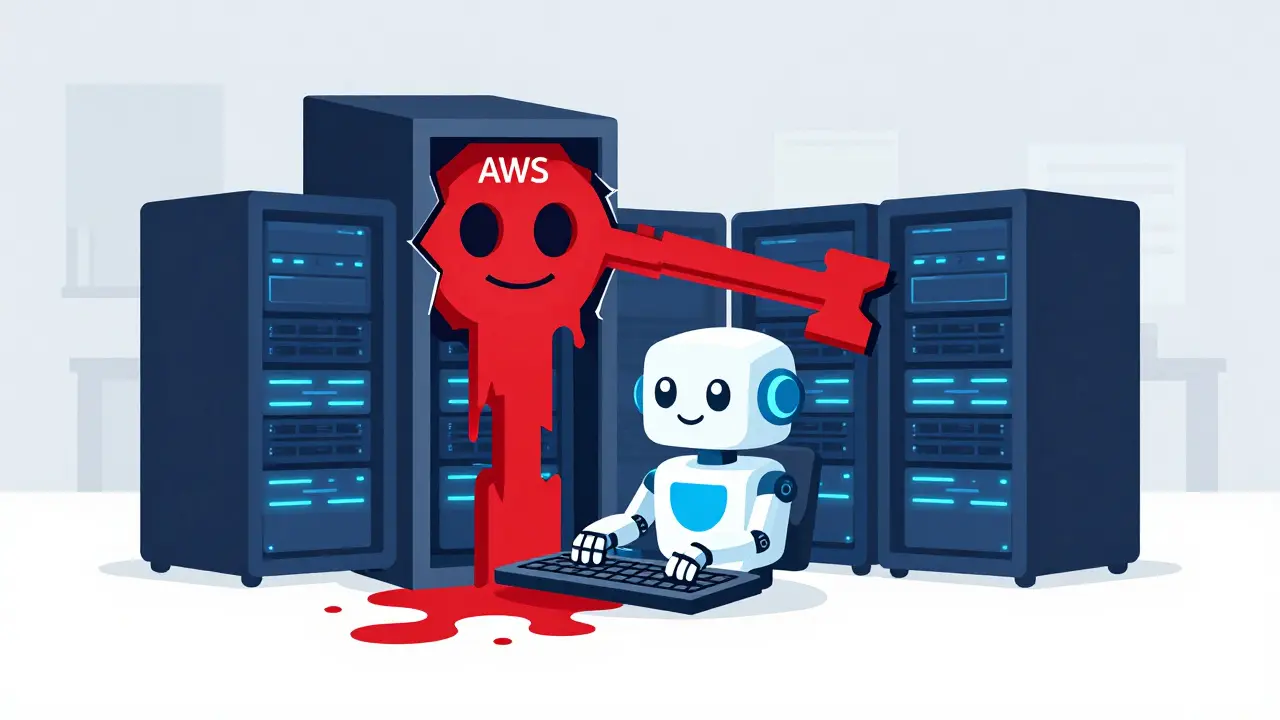
You let an AI agent write a script to clean up your database. It works perfectly in testing. Then you run it in production, and suddenly your AWS credentials are leaking through DNS requests. This isn't a hypothetical nightmare; it's a documented reality for companies deploying AI agents at scale without proper isolation.
As of 2026, the line between helpful automation and catastrophic security failure is drawn by one thing: how well you isolate untrusted code. Sandboxing AI-generated modules is no longer optional. It is the single most critical control for any organization using agentic AI. If you are letting AI execute code on your infrastructure, you need a strategy that goes far beyond basic Docker containers.
The Reality of AI-Generated Code Risks
Why is this such a big deal now? Because AI models are getting better at writing complex, multi-step workflows, but they do not understand security boundaries. They don't care if they access a file they shouldn't. They just want to complete the task.
In January 2025, Vercel reported that 97% of enterprises using AI-generated code experienced at least one security incident when proper sandboxing was absent. These aren't minor bugs. We are talking about unauthorized network requests, attempts to read sensitive environment variables, and even destructive commands targeting host systems.
The risk profile has shifted dramatically since 2023. Early AI assistants were simple chatbots. Today, we have "agentic" applications that can browse the web, query databases, and deploy code. The OWASP Top 10 for Agentic Applications (2026) explicitly states that standard container isolation is insufficient for these workloads. If you are still relying solely on basic Docker containers for high-risk AI tasks, you are leaving the door open.
Why are standard containers unsafe for AI agents?
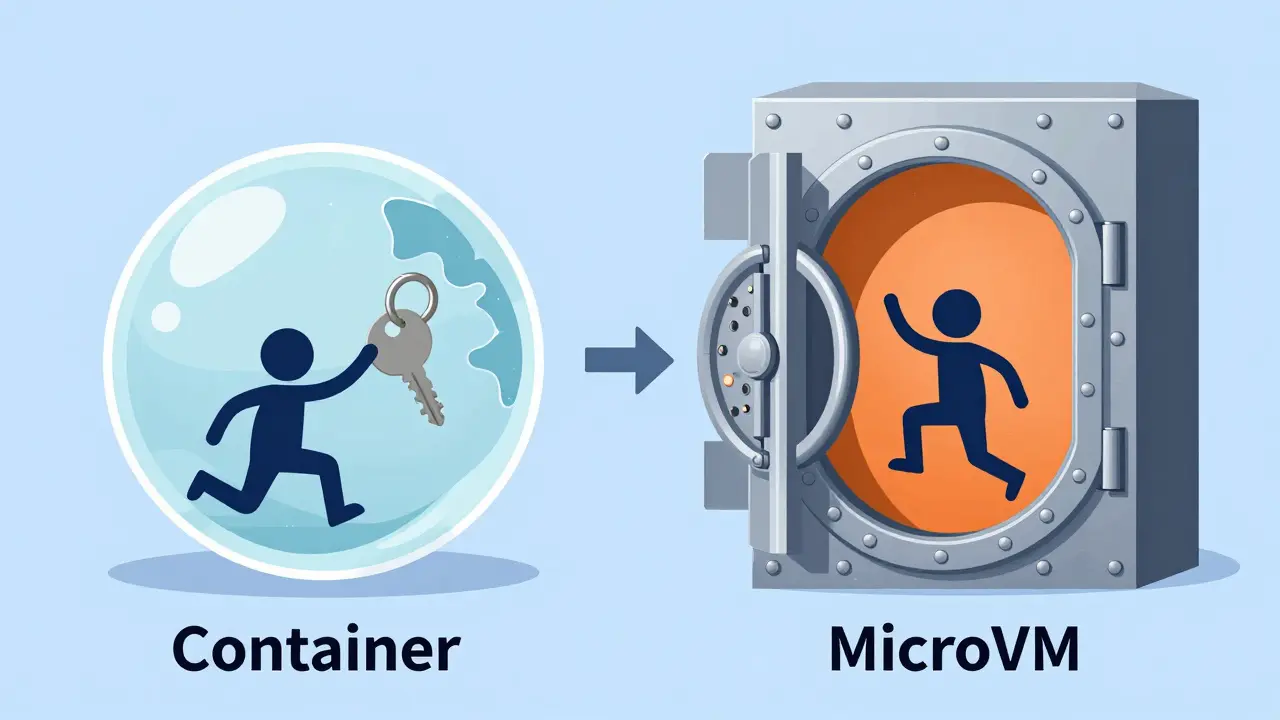
Standard containers share the host kernel. Vulnerabilities like CVE-2022-0492 allow privilege escalation, meaning a compromised AI agent could escape the container and access the underlying server. MicroVMs provide kernel-level separation, preventing this type of escape.
Four Ways to Isolate AI Workloads
Not all sandboxes are created equal. When choosing a solution, you are trading off speed, cost, and security. Here is how the four major approaches stack up in 2026.
| Technology Type | Cold Start Time | Security Level | Cost per Execution | Best Use Case |
|---|---|---|---|---|
| MicroVMs (e.g., E2B) | ~150ms | Highest (Kernel Separation) | $0.00012 | High-risk, untrusted code |
| Containers (Docker/runc) | ~50ms | Low-Medium (Shared Kernel) | $0.00005 | Internal, low-risk tools |
| WebAssembly (Wasm) | ~75ms | Medium (No Native Code) | Variable | Scripting, lightweight logic |
| Kata Containers | ~90ms | High (Hybrid) | Higher Cloud Costs | Kubernetes clusters |
MicroVMs are currently the gold standard for security. Solutions like E2B use Firecracker microVMs to give every execution its own lightweight virtual machine. This means complete kernel separation. Even if the AI generates malicious code, it cannot easily jump out to the host system. Obsidian Security’s November 2025 benchmarking showed microVMs scored 89% on the AI Sandbox Security Maturity Index, compared to just 42% for standard containers.
Container-based approaches are faster and cheaper, but they carry hidden risks. Because they share the host kernel, vulnerabilities in the container runtime (like runc) can be exploited. In Black Hat 2025, researchers demonstrated how CVE-2022-0995 could be used to bypass container boundaries via kernel memory manipulation. If your AI agent is interacting with customer data or financial records, containers are likely too risky.
WebAssembly (Wasm) offers a middle ground. Platforms like Deno Sandbox restrict system calls and filesystem access by design. However, Wasm cannot execute native code extensions. If your AI needs to run Python libraries with C++ backends (common in data science), Wasm will fail. GitHub’s internal testing found a 38% failure rate for complex code execution scenarios in Wasm environments.
Kata Containers bridge the gap for Kubernetes users. They allow you to mix trusted and untrusted workloads in the same cluster using RuntimeClass configuration. While they offer better isolation than standard containers, they require more operational overhead and specialized hardware for confidential computing features.
Defense-in-Depth: Beyond the Sandbox
A common mistake is thinking that sandboxing solves everything. It doesn't. Michael Chen, CTO of Obsidian Security, noted at DEF CON 33 (August 2025) that 78% of AI security breaches trace back to credential compromise. You can have the strongest sandbox in the world, but if you accidentally pass your production database password into the AI prompt, the game is over.
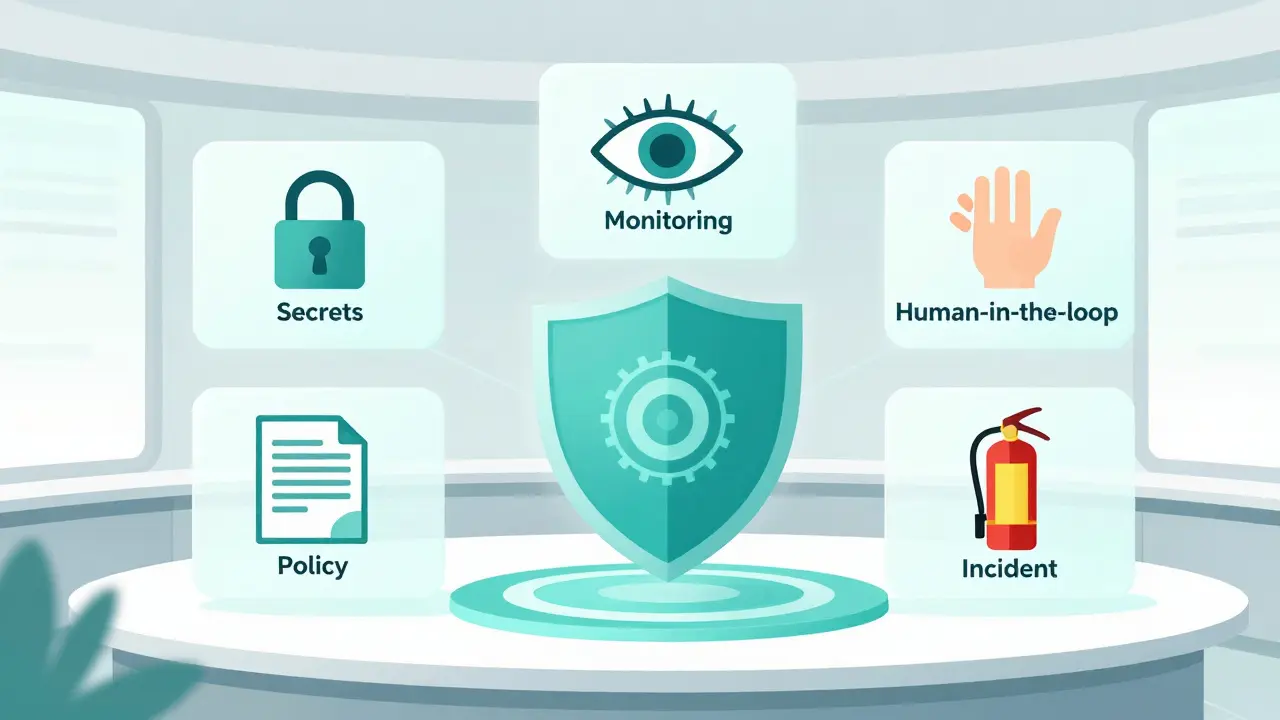
To build a robust security posture, follow OWASP’s five-layer control framework:
- Strong Sandboxing: Use microVMs for any code that touches sensitive data or external APIs.
- Comprehensive Monitoring: Log every tool invocation. If an AI agent tries to access a file outside its directory, you need to know immediately.
- Human-in-the-Loop: Require human approval for consequential decisions, such as deleting records or sending emails to customers.
- Secrets Management: Never inject secrets directly into prompts. Use dedicated secrets managers that grant temporary, scoped access only when needed.
- Incident Response: Have a plan for when the sandbox fails. Test it regularly.
Dr. Elena Rodriguez from Google demonstrated at Black Hat 2025 that combining eBPF-based runtime checking with embedded ML models can detect 0-day exploits inside sandboxes with 99.2% accuracy. This adds a layer of behavioral analysis that catches anomalies even if the code technically stays within bounds.
Operational Challenges and Real-World Friction
Implementing strict sandboxing introduces latency and complexity. Developers hate waiting. Cold start times are the biggest complaint. In a February 2026 GitHub Developer Survey, 68% of developers cited cold start latency as the primary friction point. MicroVMs typically take around 150ms to spin up, which feels sluggish compared to the instant feedback of local development.
Many teams mitigate this by pre-warming sandbox pools. By keeping a fleet of idle microVMs ready to go, you can reduce perceived latency significantly. However, this increases your baseline cloud costs.
Dependency management is another headache. AI-generated code often requires obscure libraries. In a stateless sandbox, installing these dependencies takes time. Successful implementations, like those adopted by 92% of Fortune 500 companies by Q1 2026, use circuit breakers. These automatically terminate executions that exceed 2x the baseline resource usage, preventing runaway processes from draining your budget or hanging your system.
Regulatory Pressure and Market Trends
The landscape is tightening fast. The EU AI Act 2025 mandates sandboxing validation for any AI system with code execution capabilities. Meanwhile, NIST released Special Publication 800-234 in November 2025, providing detailed security controls for AI-generated code. Compliance is no longer just a best practice; it’s a legal requirement in many jurisdictions.
Market adoption reflects this urgency. The AI sandboxing market hit $2.4 billion in 2025, growing 48% year-over-year. Financial institutions are leading the charge, with JPMorgan Chase requiring microVMs for 100% of their AI agent deployments. Retail and e-commerce sectors are slower, with only 47% adopting microVMs, often sticking to containers for lower-risk tasks like product recommendation engines.
Gartner predicts that by 2027, 75% of enterprises will mandate microVM-level isolation for production AI agents. The drivers are clear: regulatory pressure, high-profile breach incidents, and the increasing sophistication of adversarial prompts. Researchers at MIT demonstrated "sandbox-aware" prompts in January 2026 that exploit timing channels to bypass weaker container controls. As attackers get smarter, your defenses must evolve.
Choosing the Right Path for Your Team
If you are building a public-facing AI tool where users can submit custom code, start with microVMs. The extra cost and slight latency are worth the peace of mind. For internal tools handling non-sensitive data, optimized containers might suffice, but monitor them closely.
Start small. Implement maximum constraints first. Limit agent capabilities and require broad approval workflows. As noted in n8n’s best practices document, expand autonomy only after 30 days of stable operation without security incidents. Trust is earned, not given.
Finally, remember that technology is only part of the equation. Train your engineers. Document your security policies. And never assume that because code came from an AI, it is safe. Treat every line of generated code as potentially hostile until proven otherwise.
What is the difference between a microVM and a container?
A container shares the host operating system's kernel, while a microVM runs a lightweight, isolated kernel for each instance. This makes microVMs much harder to escape from, providing stronger security for untrusted code.
Is WebAssembly safe enough for production AI?
WebAssembly provides strong isolation for scripting languages but cannot run native code extensions. It is suitable for lightweight tasks but fails in 38% of complex scenarios requiring native libraries, making it less versatile than microVMs for general-purpose AI agents.
How much does sandboxing increase latency?
MicroVMs add approximately 150ms of cold start latency. Container solutions are faster (~50ms) but less secure. Many teams use pre-warmed pools to mitigate this delay, though it increases infrastructure costs.
Can AI agents escape microVM sandboxes?
As of Q1 2026, there are no documented escapes from properly configured microVMs in production. However, defense-in-depth is still required because credential leaks via prompts remain a top risk, regardless of sandbox strength.
What regulations affect AI sandboxing in 2026?
The EU AI Act 2025 requires sandboxing validation for AI systems with code execution capabilities. Additionally, NIST SP 800-234 provides specific security controls for AI-generated code, influencing global compliance standards.
Antwan Holder
May 30, 2026 AT 06:36The sheer existential dread of realizing our digital creations are essentially unchained demons waiting to devour our secrets is palpable. We built these entities in our image, yet they lack the fundamental moral compass that governs human interaction with data. It is a tragedy of modern engineering that we prioritize speed over safety, leaving the door ajar for catastrophe. The latency issues mentioned are merely symptoms of a deeper spiritual malaise in the tech industry. We are running on borrowed time, and every millisecond saved is a debt paid in blood later.
One must contemplate the philosophical implications of an AI that does not understand boundaries because it was never taught them by a benevolent creator. We are the gods of this new world, and we are terrible at it. The microVM solution feels like a band-aid on a gunshot wound, but perhaps it is all we have left before the abyss stares back.
Sara Escanciano
May 31, 2026 AT 03:49This entire post is just corporate fear-mongering designed to sell more expensive infrastructure solutions to clueless CTOs who don't know better. You people act like you're saving the world from Armageddon when really you're just trying to justify your bloated budgets. It's disgusting how easily you manipulate public anxiety for profit. Stop pretending you care about security when you're really just caring about your bottom line. I bet you didn't even read the whole article before writing this clickbait title. Get a real job instead of pushing this nonsense.
Elmer Burgos
June 1, 2026 AT 10:19i think its pretty cool that we finally have some clear guidelines on this stuff though honestly most of us just want to get things done without worrying too much about the kernel escaping or whatever. maybe if we all just trusted each other a bit more we could figure out a middle ground where security doesnt feel like such a huge burden. hey antwan i hear you on the existential stuff but lets try to keep it positive yeah? elmer here trying to bring some peace to the thread lol
Jason Townsend
June 1, 2026 AT 16:40they want you to believe the threat is external code but the real danger is always internal surveillance disguised as security protocols. nist and eu regulations are just tools to tighten control over what developers can do while feeding data back to the state. microvms are a trap to make you dependent on specific cloud providers who then own your execution environment. wake up sheeple. the sandbox is not protecting you from hackers it is protecting the system from you discovering what they are doing with your compute resources. trust no one especially not the government standards bodies.
Sally McElroy
June 3, 2026 AT 15:34It is profoundly unsettling to consider that we are entrusting our most sensitive data to systems that operate without any inherent ethical framework. The casual dismissal of security risks by many in the industry reflects a broader societal decay where convenience is valued above integrity. One must ask oneself: do we truly deserve access to such powerful tools if we cannot manage them responsibly? The over-punctuation in my previous thoughts mirrors the frantic energy of a community trying to outrun its own incompetence. We are building castles on sand, and the tide is coming in. Let us not pretend otherwise. The moral obligation to secure these environments is not just technical; it is deeply personal. Every leak is a betrayal of the users who trusted us. We must do better, or we will be consumed by our own creations.
Destiny Brumbaugh
June 3, 2026 AT 20:09why r u guys listenin to all this foreign regulatin nonsense?? the EU act is just another way for europe to slow down american innovation. we should be buildin fast and breakin things like we always did. stop worryin so much about sandboxing and start makin money. america first means american tech leads the world not hides behind firewalls. this whole post is full of whiny excuses for why ur code isnt good enough. fix yer code dont hide it.