Legal Document Analysis with LLMs: Summaries, Clauses, and Risk Signals
 Aug, 3 2026
Imagine staring at a 150-page merger agreement. Your eyes glaze over the dense legalese, and you worry about missing a single critical clause that could cost your company millions. This is the daily reality for many legal professionals and business owners. But what if you had a tireless assistant who could read every word in seconds, summarize the key points, extract specific clauses, and flag hidden risks? That is exactly what Legal Document Analysis using Large Language Models (LLMs) offers today.
We are no longer talking about simple keyword searches. Modern LLMs understand context, nuance, and the complex logic embedded in legal texts. They act as junior associates, handling the heavy lifting of document review so human experts can focus on strategy and negotiation. In this guide, we break down how these systems work, how to use them effectively for summaries and clause extraction, and how they detect risk signals before they become liabilities.
How LLMs Process Legal Text
To understand why LLMs are effective here, you need to look at how they handle information. Traditional software looked for exact matches. If you searched for "termination," it found the word. It didn't care if the termination was mutual, unilateral, or conditional. An LLM, however, reads the surrounding text. It understands that a "termination for convenience" clause carries different weight than a "termination for cause" clause.
The core technology relies on advanced natural language processing. The model breaks down sentences into tokens-small units of meaning-and analyzes their relationships. When applied to legal documents, this allows the system to map out obligations, rights, and conditions. For example, it can identify that Party A must pay Party B within 30 days *only if* deliverables are accepted. This conditional logic is where basic search tools fail and LLMs succeed.
However, there is a catch. Most LLMs have token limits. They can only process a certain amount of text at once. A 200-page contract often exceeds this limit. To solve this, developers use techniques like hierarchical chunking. The document is split into logical sections-like recitals, definitions, and indemnity clauses. The LLM processes each section separately, then synthesizes the results. This ensures no part of the contract is ignored while keeping the context intact.
Generating Accurate Summaries
One of the most common uses for LLMs in law is summarization. You don't always need to read every line. You need the gist. A good summary tells you who the parties are, what the deal is, what the main obligations are, and when it expires.
Research shows that LLM-generated summaries can match the accuracy of human-created ones. Studies using metrics like ROUGE and BERTScore compare AI outputs against expert references. The results indicate high semantic likeness. In plain English, this means the AI captures the same meaning as a lawyer would, just much faster.
But not all summaries are created equal. There are two main approaches:
- Extractive Summarization: The AI pulls actual sentences from the document and stitches them together. This is safe because it doesn't invent new facts. It’s great for preserving precise legal wording.
- Abstractive Summarization: The AI rewrites the content in its own words. This produces smoother, more readable text but carries a higher risk of hallucination-inventing details that aren’t there.
For legal work, a hybrid approach works best. The system extracts key clauses verbatim for accuracy but uses abstractive methods to explain the broader context. This gives you the precision of a legal brief with the readability of a blog post.
Clause Extraction and Standardization
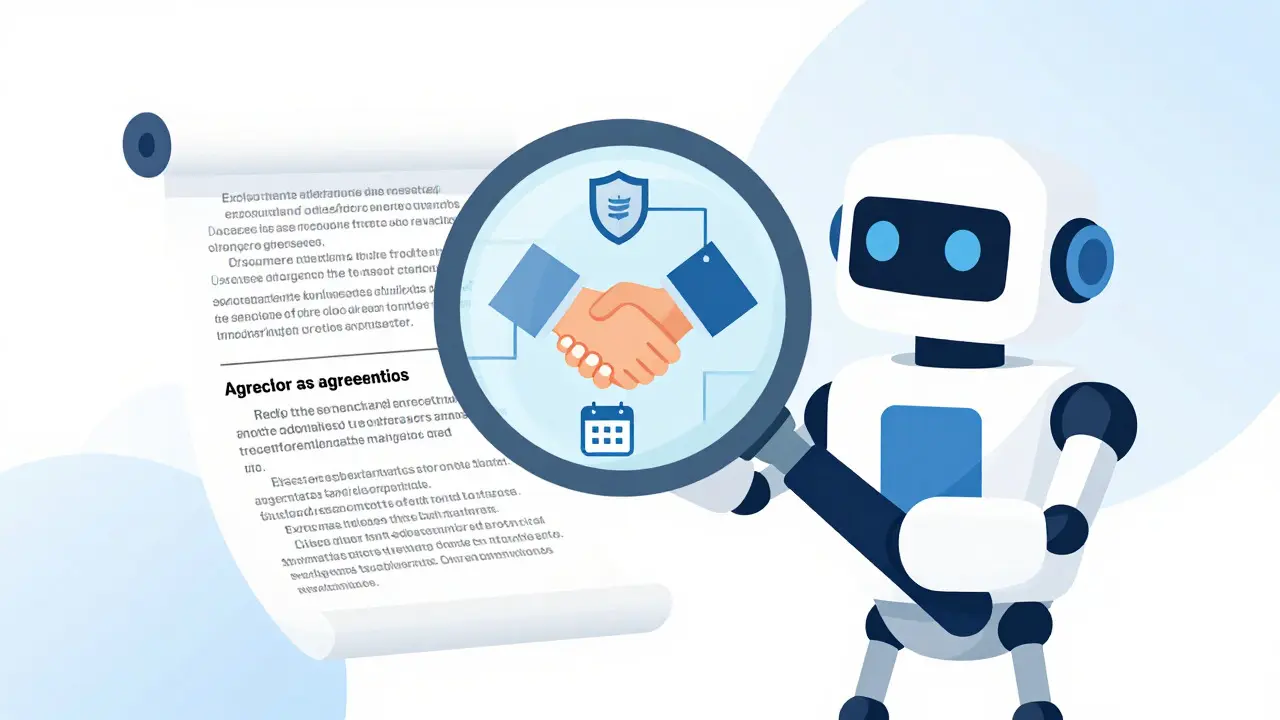
Summaries give you the overview. Clause extraction gives you the specifics. In contract management, you often need to pull out specific data points: payment terms, confidentiality periods, jurisdiction clauses, and limitation of liability caps.
LLMs excel at this by matching patterns rather than just keywords. Let’s say you want to find all non-compete clauses. A standard search might miss variations like "restrictive covenants" or "non-solicitation." An LLM recognizes these as functionally similar concepts. It scans the document, identifies the relevant sections, and extracts the text into a structured format.
This becomes even more powerful when combined with clause libraries. Many organizations maintain standard templates for common contracts. You can train an LLM on these templates. When reviewing a new contract, the AI checks if the incoming clauses match your standard library. If a clause deviates significantly, the system flags it. It also checks for missing clauses. If your standard template requires a data privacy addendum and the new contract lacks one, the LLM alerts you immediately.
This dual verification process-checking for presence and checking for compliance-reduces errors. It turns a chaotic pile of PDFs into organized, comparable data.
Detecting Risk Signals
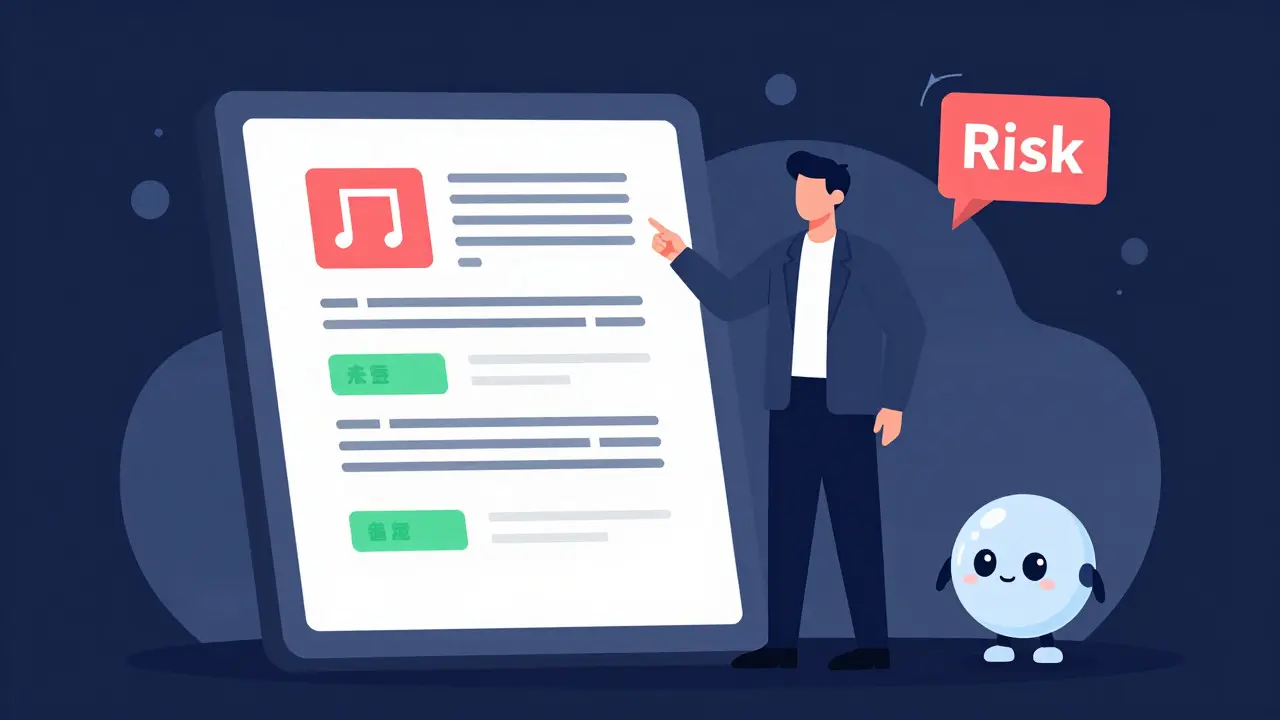
Finding clauses is useful. Finding dangerous clauses is vital. Risk detection is where LLMs provide the highest return on investment. These systems scan for red flags that could expose your organization to financial loss or legal trouble.
What does a risk signal look like? It might be an uncapped liability provision. If a vendor agrees to indemnify you for damages but doesn’t set a maximum limit, you’re exposed to unlimited risk. The LLM spots the absence of a cap and highlights it. Or it might find a broad indemnification obligation that forces you to cover costs even when you weren’t at fault.
Benchmarks like ContractEval measure how well models perform this task. They test for correctness (did it find the right clause?), effectiveness (is the output clear?), and laziness (did it incorrectly say "no related clause"?). Proprietary models generally outperform open-source ones in these tests, especially in complex commercial contracts. However, the gap is closing as open-source models improve.
Effective risk detection isn't just about spotting bad words. It's about understanding context. A penalty clause might be standard in one industry but unusual in another. Matter-aware AI systems connect the document analysis to the broader transaction context. They know that a startup accepting venture capital has different risk tolerances than a public corporation merging with a competitor.
| Capability | Traditional Search Tools | LLM-Based Systems |
|---|---|---|
| Context Understanding | Low (Keyword based) | High (Semantic analysis) |
| Handling Long Docs | Poor (Limited memory) | Good (Chunking & synthesis) |
| Risk Detection | None | Advanced (Pattern recognition) |
| Clause Matching | Exact match only | Semantic similarity |
| Error Rate | Low (but misses nuances) | Moderate (requires human check) |
Overcoming Technical Challenges
Despite their power, LLMs aren't perfect. You need to know their weaknesses to use them safely. The biggest issue is hallucination. An LLM might confidently state a fact that isn't in the document. In a casual conversation, this is annoying. In a legal contract, it’s catastrophic.
To mitigate this, use chain-of-thought prompting. This technique asks the model to show its reasoning step-by-step before giving a final answer. Instead of just saying "There is a risk," it explains, "I found a clause on page 42 that removes the statute of limitations, which creates long-term exposure." This transparency lets you verify the claim.
Another challenge is domain specificity. General-purpose LLMs are trained on vast amounts of internet text, including forums and blogs. They might not grasp the subtle differences between "shall" and "will" in older contracts. Fine-tuning the model on legal datasets helps. Even better, combining the LLM with a knowledge base of legal standards creates a hybrid system. The LLM handles the language, while the knowledge base provides the rules.
Data privacy is also a concern. Uploading sensitive client contracts to a public API feels risky. Many firms now use local deployment or private cloud instances. This keeps the data within your firewall while still leveraging the power of the model.
Best Practices for Implementation
If you’re ready to bring LLMs into your legal workflow, start small. Don’t try to automate everything overnight. Begin with routine tasks like summarizing NDAs or extracting dates from leases. Build trust in the system before moving to complex M&A agreements.
Always keep a human in the loop. Treat the LLM as a junior associate, not a partner. Its job is to draft, highlight, and suggest. Your job is to review, judge, and decide. This oversight catches errors and ensures the final output aligns with your strategic goals.
Invest in prompt engineering. The quality of the output depends heavily on how you ask questions. Vague prompts get vague answers. Specific prompts get specific results. Instead of asking "Summarize this," try "Extract all termination clauses and list the notice periods required for each party." Clear instructions lead to reliable outcomes.
Finally, monitor performance. Track how often the AI misses a risk or misinterprets a clause. Use these errors to refine your prompts or update your clause libraries. Continuous improvement turns a good tool into an indispensable asset.
Are LLM summaries legally binding?
No. An LLM summary is an interpretation, not a legal document itself. It serves as a tool for human review. Always refer back to the original contract text for any binding decisions or negotiations.
Can LLMs replace paralegals?
Not entirely. LLMs automate repetitive tasks like initial review and clause extraction, freeing up paralegals to focus on higher-value work like research and case preparation. Think of it as augmentation, not replacement.
How do I prevent data leaks with LLMs?
Use enterprise-grade platforms that offer data isolation. Ensure the provider does not use your uploaded documents to train their public models. For highly sensitive data, consider deploying open-source models on your own secure servers.
What is the accuracy rate of LLMs in legal tasks?
Accuracy varies by task and model. For clause extraction, top models achieve over 90% accuracy. For complex risk assessment, human oversight is still required due to the nuance involved. Benchmarks like ContractEval provide detailed performance metrics for specific models.
Do I need coding skills to use these tools?
Not necessarily. Many legal tech platforms offer user-friendly interfaces where you simply upload a document and select options. However, custom integrations and advanced prompt engineering may require some technical support or collaboration with IT teams.