LLMOps for Generative AI: A Practical Guide to Pipelines, Observability, and Drift Management
 Jul, 2 2026
You built the prototype. It works in Jupyter Notebook. You prompt it, it answers, everyone is impressed. Then you push it to production, and chaos ensues. Costs spike because users are sending massive context windows. The model starts hallucinating medical advice. Latency jumps from 200 milliseconds to five seconds. This is where traditional machine learning operations (MLOps) fail you, and LLMOps is the specialized discipline focused on managing large language models in production environments.
LLMOps isn't just a buzzword; it's the survival kit for generative AI in the real world. As of mid-2026, enterprise deployments without dedicated LLMOps practices are failing at alarming rates. The gap between a demo and a reliable product is vast. This guide breaks down how to build robust pipelines, implement effective observability, and manage drift so your AI stays accurate, safe, and cost-efficient.
Why Traditional MLOps Fails Generative AI
If you've worked with traditional machine learning, you know the drill: train a model, evaluate accuracy, deploy via API, monitor input distribution. If the data changes, retrain. Simple enough. But Large Language Models (LLMs) break this pattern completely.
Traditional models output discrete values or probabilities. LLMs generate text. Measuring "accuracy" is subjective. Is the answer correct? Yes. Is it helpful? Maybe. Is it safe? That’s another question entirely. According to Stanford HAI research from 2024, automated metrics correlate with human judgment only 65-75% of the time. You can’t rely on a simple loss function.
Furthermore, the scale is different. We’re talking about models with billions or trillions of parameters. The computational intensity is staggering. NVIDIA’s 2024 infrastructure report noted that operational costs for LLMs can be 300-500% higher than traditional ML models. Without LLMOps, you aren't just risking bad outputs; you're burning cash.
Building Robust LLMOps Pipelines
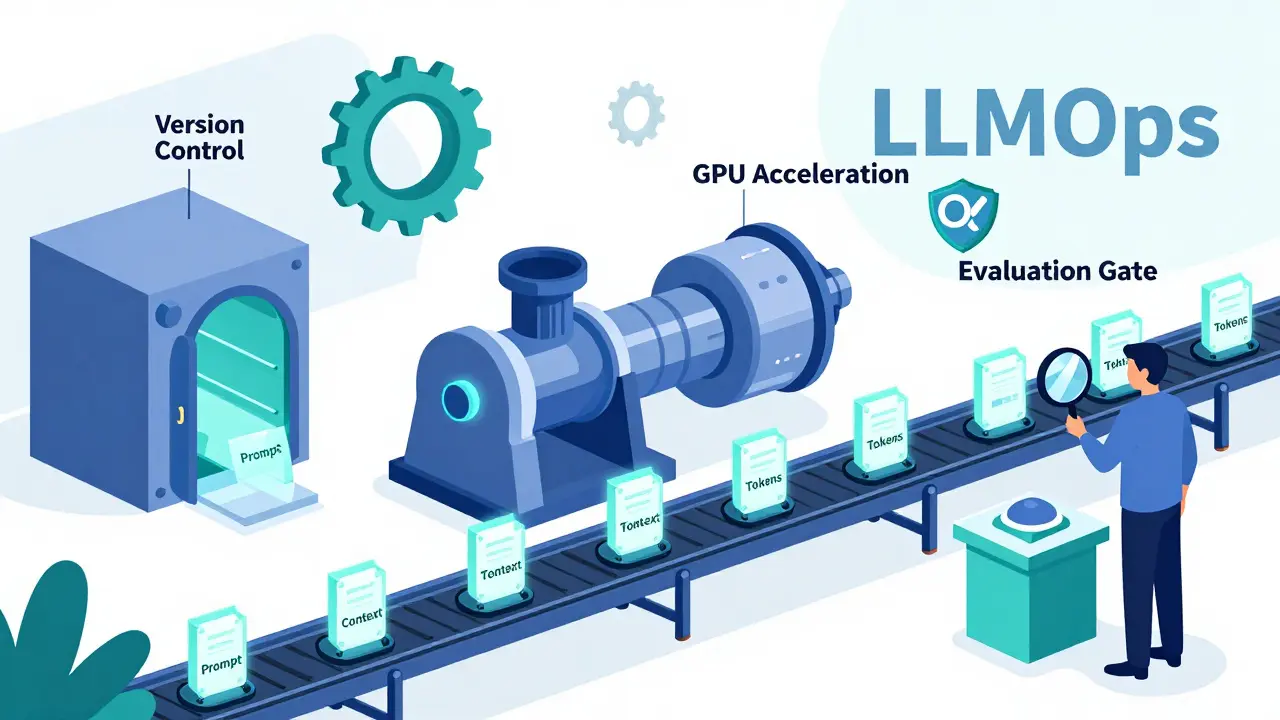
A pipeline in LLMOps isn't just about moving code. It's about orchestrating complex chains of logic, external tool calls, and model interactions. Frameworks like LangChain is a framework that facilitates building applications powered by large language models through chaining components and LlamaIndex is a data framework for connecting custom data sources to large language models have become standard tools here.
Your pipeline needs to handle three critical stages:
- Prompt Management: Prompts are code. Version them. Use a system like Git for prompts. A single word change in a system prompt can drastically alter output quality. IBM notes that efficient library management lowers operational costs significantly.
- Inference Serving: You need GPU acceleration and smart routing. Tools like NVIDIA TensorRT or ONNX Runtime help optimize inference speed. Red Hat’s 2024 technical guide suggests targeting under 500ms latency for enterprise responses. If you exceed this, users leave.
- Evaluation Gates: Before any new model version or prompt update goes live, it must pass an evaluation suite. This isn't just unit tests. It's checking against a golden dataset of known good/bad pairs.
Databricks’ 2024 glossary emphasizes using CI/CD tools to automate these pre-production steps. Don't manually test every prompt tweak. Automate the regression tests.
Observability: Seeing What Your Model Actually Does
Oracle’s documentation states clearly: "Half of LLMOps is observation, and the other half is action." If you can't see what's happening inside your black box, you can't fix it.
Traditional logging isn't enough. You need specialized observability platforms. Open-source tools like Langfuse offer great visibility but can hit scaling limits quickly. One Hacker News user reported hitting walls at just 50 concurrent users with open-source solutions, forcing a switch to commercial tools costing $12,000/month to handle 5,000 users.
What should you track?
- Token Usage: Monitor input and output tokens per request. This directly correlates to cost. Unexpected spikes often indicate inefficient prompts or adversarial inputs.
- Latency Percentiles: Average latency lies. Look at P95 and P99. If 99% of requests take under 500ms, but the top 1% take 10 seconds, your UX is broken.
- Safety Guardrail Hits: How often does your content filter block a response? High block rates might mean your prompt is too loose or your model is drifting into unsafe territory.
- User Feedback Loops: Integrate thumbs up/down buttons. Qualitative feedback is crucial when quantitative metrics fail.
Without this data, you are flying blind. You won't know if a degradation is due to model drift, bad data, or a changed prompt until customers complain.
Managing Drift in Generative AI
Data drift is old news in ML. Concept drift is trickier. In LLMs, we face "prompt drift" and "output quality drift." The underlying model weights might not change, but the way users interact with it does.
For example, if your customer support bot was trained on formal tickets, but users start sending slang-heavy chat messages, the model's performance will degrade. Perplexity scores might increase by more than 15%, as recommended by Wandb’s 2024 benchmarks as a warning sign.
Drift management requires a continuous loop:
- Detect: Set alerts for sudden changes in token usage, latency, or negative user feedback rates.
- Analyze: Use sampling to review recent failed interactions. Was it a specific domain? A specific type of query?
- Remediate: This might mean updating the system prompt, adding few-shot examples to the context, or even fine-tuning the model with new data.
A healthcare startup documented in a 2025 Medium case study learned this the hard way. They achieved 40% cost savings through optimized inference but suffered a 3-week outage because their drift detection failed to catch gradual degradation in medical advice quality. The lesson? Automated detection is necessary, but human-in-the-loop validation is non-negotiable for high-stakes applications.
LLMOps vs. MLOps: Key Differences
Understanding the distinction helps you allocate resources correctly. Here is a comparison of the core focuses:
| Feature | Traditional MLOps | LLMOps |
|---|---|---|
| Primary Output | Discrete predictions (numbers/classes) | Unstructured text/code |
| Evaluation Metric | Accuracy, Precision, Recall | Human judgment, Relevance, Safety |
| Cost Driver | Training compute | Inference tokens & latency |
| Key Risk | Data drift | Hallucinations & Prompt injection |
| Iteration Speed | Weeks/Months (retraining) | Hours/Days (prompt tuning) |
The table highlights why LLMOps requires faster iteration cycles. You don't retrain a 70B parameter model every day. You tweak prompts, adjust retrieval augmented generation (RAG) contexts, and swap model versions dynamically.
Implementation Strategy for 2026
Gartner predicted that by 2026, 70% of enterprises would implement specialized LLMOps practices. If you are starting now, follow this path:
- Start Small: Pick one use case. Build the pipeline with basic logging. Don't over-engineer initially.
- Integrate Evaluation Early: Create a "golden dataset" of 100-200 ideal Q&A pairs. Run all experiments against this set.
- Choose Your Stack: Decide between open-source (Langfuse, MLflow) and commercial (Weights & Biases, Arize). Consider your scale. Startups often outgrow open-source monitoring quickly.
- Establish Governance: Define who approves prompt changes. Implement safety guardrails. Compliance with regulations like the EU AI Act (fully enforced in 2025) requires comprehensive documentation of model behavior.
Remember Andrew Ng’s warning from early 2024: don't bolt LLMOps on later. Integrate it into your core development lifecycle from day one. Fragile implementations fail under production load.
Future Trends and Risks
The field is moving fast. Chip Huyen, CEO of Clay, noted in 2024 that the half-life of an LLM deployment strategy is less than six months. By 2026, we are seeing shifts toward automated prompt optimization and real-time drift compensation systems announced by major cloud providers like AWS and Google Cloud.
However, risks remain. Vendor lock-in is a significant concern as Gartner warned in their July 2024 Hype Cycle report. Standardized evaluation frameworks are still lacking. Ensure your LLMOps layer is abstracted enough to swap underlying models (e.g., from Llama 3 to Mistral) without rewriting your entire application logic.
LLMOps is not a temporary trend. As IBM’s Raghu Murthy stated, it is the foundation for enterprise-grade generative AI. Treat it with the same seriousness as DevOps was treated in the cloud computing era.
What is the difference between MLOps and LLMOps?
MLOps focuses on traditional machine learning models that output discrete values, relying on metrics like accuracy and precision. LLMOps manages Large Language Models that generate unstructured text, requiring evaluation based on relevance, safety, and human judgment, alongside managing unique challenges like prompt engineering and token-based costs.
How do I detect drift in a generative AI model?
Detect drift by monitoring changes in input distributions, tracking increases in perplexity scores (often >15% indicates issues), analyzing latency spikes, and reviewing qualitative user feedback. Unlike traditional ML, you must also watch for "prompt drift" where user interaction patterns change significantly.
Which tools are best for LLMOps observability?
Popular options include open-source tools like Langfuse and MLflow for smaller teams, and commercial platforms like Weights & Biases, Arize, or PromptLayer for enterprise-scale needs. The choice depends on your concurrency requirements and budget, with commercial tools often better suited for high-volume production environments.
Why is prompt management important in LLMOps?
Prompts act as code in generative AI. Small changes can drastically alter output quality, safety, and cost. Versioning prompts allows you to track which instructions yield the best results, roll back ineffective changes, and collaborate effectively across teams, similar to how software code is managed.
How much does implementing LLMOps cost?
Costs vary widely. Enterprise implementations can require minimum investments of $250,000 in infrastructure according to Gartner, plus monthly operational costs that can exceed $100,000 for heavy usage. However, proper LLMOps reduces long-term costs by optimizing inference efficiency and preventing expensive errors or outages.