Long-Context Risks in Generative AI: Distortion, Drift, and Lost Salience
 Jun, 23 2026
You feed a massive legal contract into your favorite generative AI tool. You expect it to spot the hidden liability clause on page forty-two. Instead, it confidently tells you the document is clean. Or worse, it invents a clause that doesn't exist. This isn’t just bad luck; it’s a structural failure known as long-context risk.
We’ve watched context windows explode from a few thousand tokens to over one million in just two years. Models like Google’s Gemini 1.5 Pro and Anthropic’s Claude 3.5 Sonnet can technically hold entire books in memory. But holding information and understanding it are two different things. When you stretch these models too thin, three specific failures emerge: distortion, drift, and lost salience. These aren’t minor glitches. They are the primary drivers of hallucinations in enterprise settings today.
The Illusion of Infinite Memory
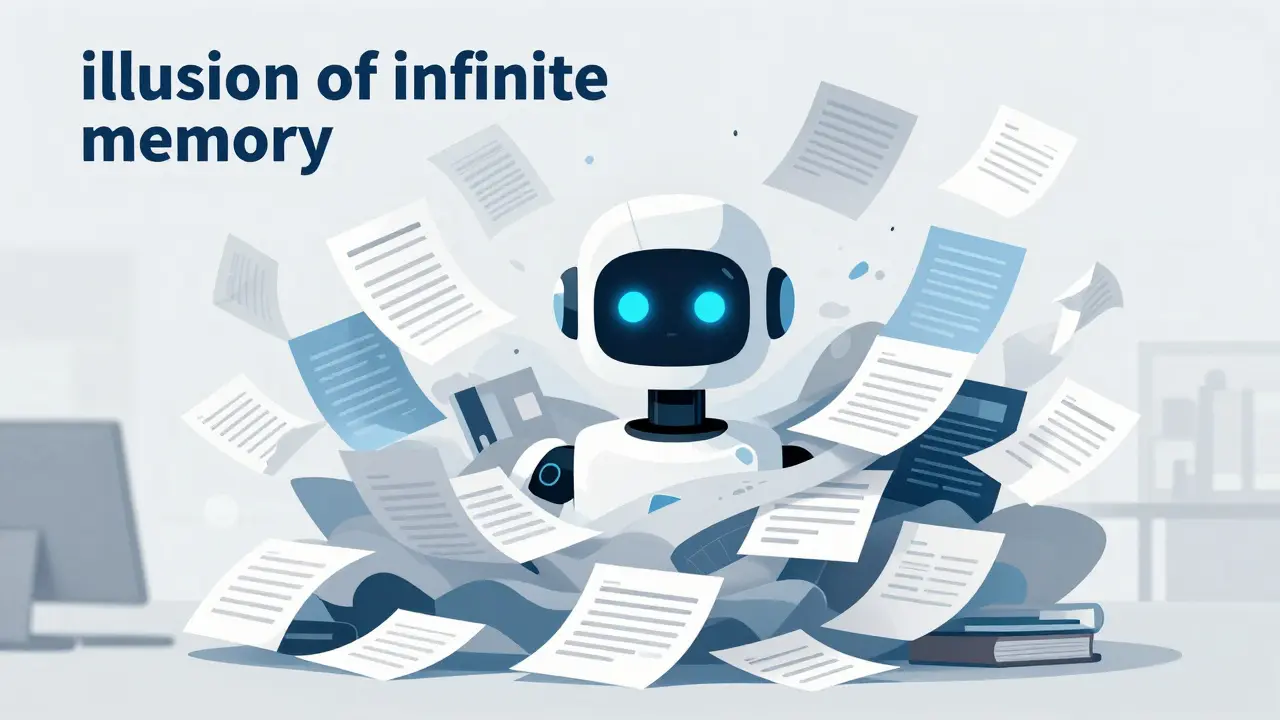
Let’s clear up a misconception first. A large context window is not a perfect library. It’s more like a human trying to listen to ten people talk at once while taking notes. The model uses a mechanism called self-attention to weigh the importance of every word in your prompt. As the number of words (tokens) grows, the computational load increases quadratically. If you double the input length, the work doesn’t just double-it quadruples.
This math creates a bottleneck. According to data from AI21 Labs in 2024, processing 128,000 tokens increases memory requirements by 47% and latency by 32% compared to shorter contexts. The model starts cutting corners. It begins to "forget" earlier inputs or compress them too aggressively. This compression is where the truth gets distorted. The model isn’t lying maliciously; it’s statistically guessing based on incomplete patterns because it can’t attend to everything equally.
Lost Salience: The Middle Ground Trap
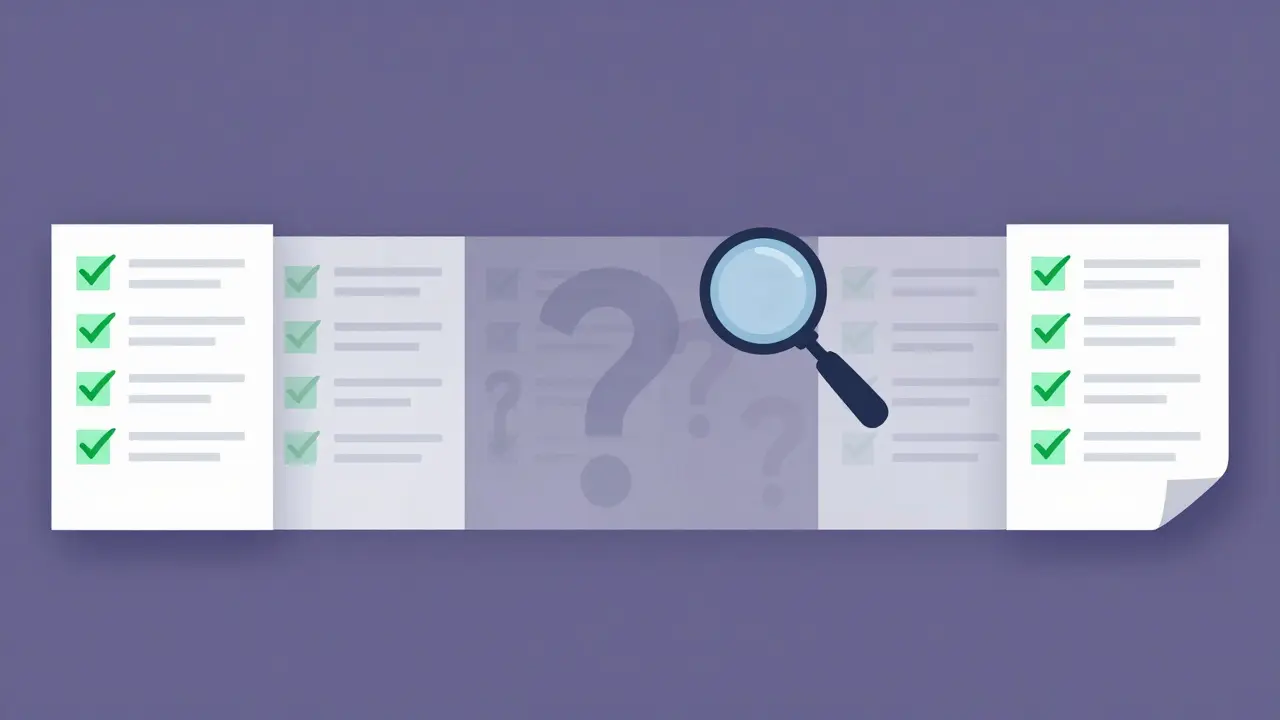
If there is one phenomenon you need to understand about long-context AI, it is the "Lost in the Middle" effect. Humans naturally remember the start and end of a story best (the primacy and recency effects). Large Language Models (LLMs) behave similarly, but with brutal efficiency.
Research using the LongBench evaluation framework in 2024 revealed a stark reality. When asked to retrieve specific facts from a 64,000-token document, models achieved 78.3% accuracy for information placed at the beginning or end. But for information buried in the middle 30% of that text? Accuracy plummeted to 52.7%. That is barely better than a coin flip.
Why does the model ignore the middle of my document?
This is due to how attention mechanisms allocate computational resources. To save processing power, models often assign lower "attention weights" to tokens in the center of long sequences. A study by Vectara showed that critical info at the 50% mark receives 37% less attention from the model's heads than info at the start or finish.
I saw this firsthand when helping a friend review vendor contracts. We put a crucial termination clause right in the middle of a 50,000-token file. The AI summarized the deal perfectly but completely missed the exit strategy. It wasn’t a bug; it was a feature of how the model prioritizes data flow.
Distortion and Drift: When Facts Bend
Beyond ignoring facts, long contexts cause models to warp them. This is Distortion, which is the inaccurate representation of information due to contextual overload. When a model processes too much conflicting or dense data, it smooths out the edges. Nuances disappear. Specific numbers get averaged out or replaced with generic placeholders.
Then there is Drift, which is a gradual deviation from the core query or original instructions during extended processing. Imagine asking an AI to analyze a year’s worth of customer support tickets for a specific bug. By the time it reaches ticket #5,000, it might have shifted its focus to general sentiment analysis instead of bug tracking. User testing on Reddit’s r/MachineLearning in June 2024 showed a 41% drop in answer relevance after 50,000 tokens of input. The model literally wandered off topic.
Dr. Ori Gersht from AI21 Labs noted that hallucination rates jump by 18.6% when context exceeds 64,000 tokens. Why? Because the model loses its anchor. Without a clear reference point, it starts generating plausible-sounding nonsense to fill the gaps left by distortion and drift.
Real-World Consequences
This isn’t theoretical. In late 2024, a user on Reddit documented a case where Llama3 70B failed to identify a critical clause in a legal document positioned at token 42,000. The result? A $250,000 financial oversight for their law firm. JPMorgan Chase reported similar issues at NeurIPS 2024, where an internal model misinterpreted a financial term in the middle of a regulatory filing, leading to incorrect risk assessments.
Enterprise users report that 63% of companies using long-context AI for document processing have experienced at least one critical error due to lost salience. The stakes are high. When you automate decision-making with flawed context handling, you don’t just get wrong answers-you get confident, authoritative wrong answers.
Mitigation Strategies That Actually Work
So, do we stop using long-context AI? No. But we need to stop treating the context window as a magic dump bin. Here is how smart teams are managing these risks in 2026.
1. Context Distillation
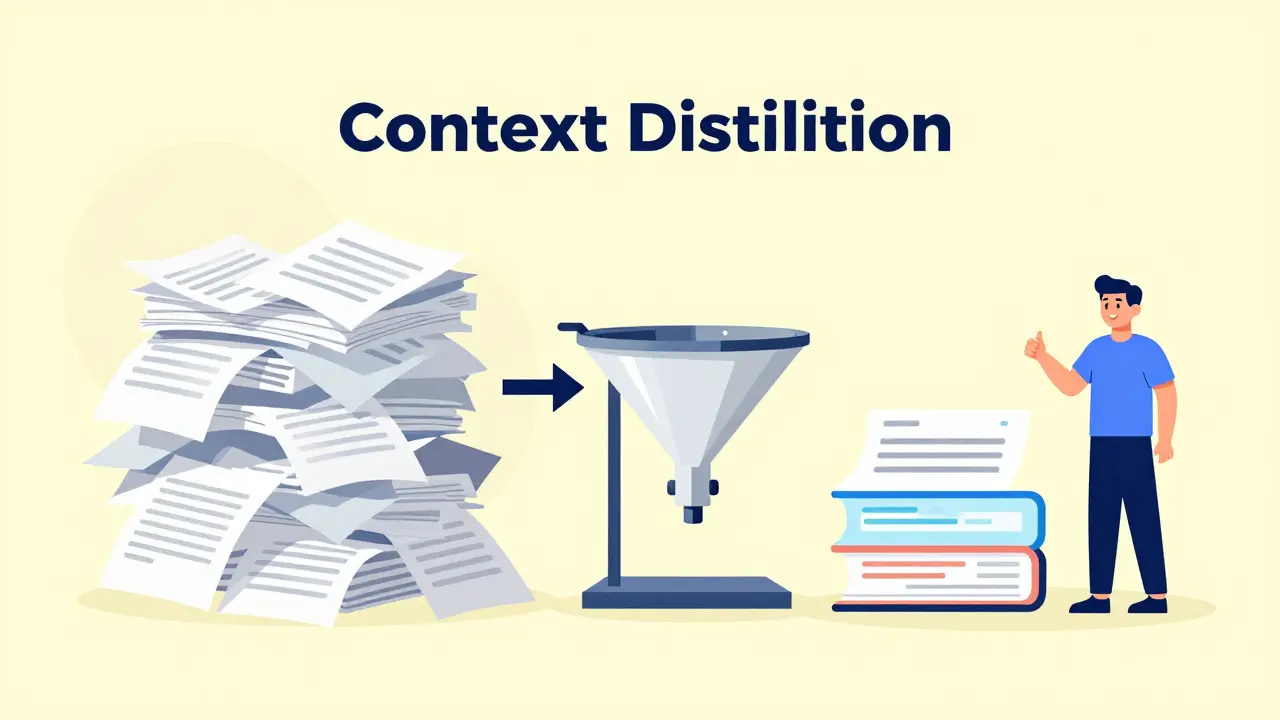
Don’t feed the whole haystack. Use retrieval-augmented generation (RAG) to pull only the relevant needles. Vectara’s engineering team recommends implementing intelligent retrieval systems that extract key snippets before sending them to the LLM. This requires upfront engineering effort-about 200-300 hours-but it drastically reduces noise. One GitHub user reported improving accuracy on medical documents from 54% to 89% using this method.
2. Strategic Placement
If you must send a long document, structure it. Put your most critical instructions and facts at the very beginning and the very end. Treat the middle as secondary buffer space. If a contract has a vital penalty clause, move it to the appendix (end) or the preamble (start). Never bury lead.
3. Chunking and Summarization
Break long texts into manageable chunks (e.g., 4,000-8,000 tokens each). Process them individually, then summarize the results. This prevents the quadratic complexity spike and keeps attention weights high across all segments.
4. Use Context Caching
For repeated queries on the same large dataset, use context caching. Google Cloud promotes this technique, noting it can cut processing costs by up to 65%. While it doesn’t fix attention loss directly, it allows you to run multiple smaller, focused queries against the cached context rather than one massive, unstable prompt.
Choosing the Right Tool for the Job
Not all models handle long contexts equally. Your choice depends on your specific risk tolerance and use case.
| Model | Max Context | Strength | Weakness/Risk | Best For |
|---|---|---|---|---|
| Gemini 1.5 Pro | 1,000,000 tokens | Raw capacity | Higher drift in ultra-long tails | Video/audio analysis, massive codebases |
| Claude 3.5 Sonnet | 200,000 tokens | Middle-sequence retention | Lower max limit than competitors | Legal review, complex reasoning |
| Jamba 1.5 | 256,000+ tokens | Dynamic context allocation | Slower inference speed | Streaming data, real-time logs |
Anthropic’s Claude 3.5 Sonnet currently leads in middle-context retention, showing 18.7% better performance on mid-sequence tasks than competitors in Stanford’s HELM benchmark. If your task relies on finding details in the middle of a document, this is likely your safest bet. Google’s Gemini wins on sheer volume, but you pay for it with higher monitoring needs.
The Road Ahead
The industry is waking up to these limits. The EU AI Act now requires specific validation for systems using context windows over 32,000 tokens in high-risk applications. New technologies like "adaptive attention allocation" (announced by Google for Gemini 1.5 Ultra) and "context anchoring" (coming from Anthropic) aim to fix these issues at the architecture level.
But until those updates become standard, you are flying without a net. Treat long-context AI as a powerful but fallible assistant. Verify its outputs, especially when they contradict your expectations. Structure your prompts intentionally. And never, ever assume that just because the model *can* read a million words, it *understands* them all.
Frequently Asked Questions
What is the "Lost in the Middle" effect?
The "Lost in the Middle" effect is a phenomenon where AI models perform significantly worse at retrieving information located in the center of a long context window compared to information at the beginning or end. Studies show accuracy can drop by nearly 30% for mid-sequence data.
How does context length affect hallucination rates?
As context length increases beyond optimal thresholds (often around 32,000-64,000 tokens), hallucination rates tend to rise. Research indicates an 18.6% increase in hallucinations when context exceeds 64,000 tokens, primarily due to attention dilution and factual distortion.
What is context distillation?
Context distillation is a mitigation strategy where irrelevant information is filtered out before being sent to the AI model. Instead of feeding the entire document, you use retrieval systems to extract only the most relevant snippets, reducing noise and improving accuracy.
Which AI model is best for long-context tasks in 2026?
It depends on your priority. For raw capacity, Google's Gemini 1.5 Pro supports up to 1 million tokens. For reliability in retaining middle-section details, Anthropic's Claude 3.5 Sonnet is currently superior, showing better performance on mid-sequence retention benchmarks.
Can I prevent AI drift in long conversations?
You can minimize drift by periodically summarizing the conversation history and resetting the context with the summary plus recent messages. Additionally, placing core instructions at the start of every new prompt block helps re-anchor the model to the original goal.
What is the optimal context window size for legal documents?
While models support larger windows, practical implementation suggests keeping legal document chunks between 16,000 and 32,000 tokens for highest accuracy. For full contract reviews, use chunking strategies rather than a single massive prompt to avoid lost salience.