Memory Safety in LLM-Generated Native Code: Choosing Safer Languages
 Oct, 12 2026
Here is a hard truth that might sting if you are shipping AI-generated C or C++ code to production: Large Language Models are fantastic at writing syntax, but they are notoriously bad at managing memory. If you let an LLM write native code in C or C++, you are essentially asking it to juggle chainsaws while blindfolded. The result? Buffer overflows, use-after-free errors, and double-frees that turn your shiny new feature into a security vulnerability.
The problem isn't just that LLMs make mistakes; it's that unsafe languages allow those mistakes to become catastrophic failures. A single misplaced pointer can leak data or let an attacker execute arbitrary code. This is why the industry, including heavyweights like Microsoft and government agencies like the NSA, is pushing hard for a shift toward memory-safe languages. But which ones should you pick when your AI assistant is doing the typing? And does switching languages actually solve the problem, or does it just move the burden elsewhere?
Why LLMs Struggle with Unsafe Memory Management
To understand why language choice matters so much here, you have to look at how LLMs work. They predict the next token based on patterns seen in training data. In Rust, the compiler screams at you if you violate ownership rules. In C, the compiler shrugs and lets you compile code that crashes at runtime. When an LLM generates C code, it doesn't "know" that line 42 frees a pointer that line 50 tries to read. It just knows that this pattern looks like valid C.
This lack of semantic understanding creates a dangerous gap. Research from Microsoft’s RustAssistant project highlights that even when developers use LLMs to fix compilation errors in safe languages, the model needs constant feedback from the compiler to get it right. Without that strict feedback loop, as provided by unsafe languages, the LLM can confidently produce code that is syntactically perfect but semantically broken. The NSA and CISA guidance released in 2022 and updated in 2023 explicitly recommends moving away from C and C++ for new development because these classes of bugs account for roughly 70% of critical vulnerabilities in major software ecosystems.
Rust: The Safe Bet with a Steep Learning Curve
If you want the best balance of performance and safety, Rust is currently the top contender. It is designed specifically to prevent memory safety issues through its ownership system and borrow checker. When you prompt an LLM to write Rust, the resulting code often fails to compile initially. Why? Because the LLM hasn't fully internalized the strict lifetime rules. However, this is actually a feature, not a bug.
Tools like Microsoft’s RustAssistant leverage this. Instead of trusting the LLM blindly, the tool feeds compiler error messages back into the model. The LLM then suggests patches-specific diffs to fix the borrowing errors-and the compiler validates them. This iterative loop ensures that only code that passes the rigorous static analysis makes it into your build. The downside? You need developers who understand Rust well enough to review the final output. An LLM can fix a borrow error, but it might do so in a way that hurts performance or readability, requiring human oversight.
| Language | Memory Safety Model | LLM Friendliness | Performance | Ecosystem Maturity |
|---|---|---|---|---|
| Rust | Ownership & Borrowing (Compile-time) | Medium (Requires compiler feedback loops) | High (Zero-cost abstractions) | High (Crates.io, strong tooling) |
| Go | Garbage Collection (Runtime) | High (Simple syntax, fewer edge cases) | Medium-High (GC pauses possible) | High (Standard library, cloud-native) |
| Ada | Strict Typing & Runtime Checks | Low-Medium (Verbose, niche training data) | High (Deterministic execution) | Niche (Safety-critical industries) |
| C/C++ | Manual Management (Unsafe) | High (Vast training data) | Very High | Legacy Standard |
Go: Simplicity Over Strictness
If Rust feels too heavy for your team, Go offers a pragmatic alternative. Go uses garbage collection to manage memory, which eliminates manual `malloc` and `free` calls entirely. For an LLM, this is a massive win. There are no lifetimes to track, no borrows to check, and no dangling pointers to worry about. The language is simple, explicit, and has a huge amount of training data available.
However, Go isn't magic. While it prevents use-after-free errors, it doesn't protect against logic errors related to concurrency or resource leaks (like forgetting to close a file handle). But in terms of pure memory safety-preventing buffer overflows and segmentation faults-Go is significantly safer than C++. For web services and backend systems where raw microsecond latency isn't the primary constraint, Go allows LLMs to generate robust code with less friction than Rust.

Ada: The Hidden Gem for Legacy Translation
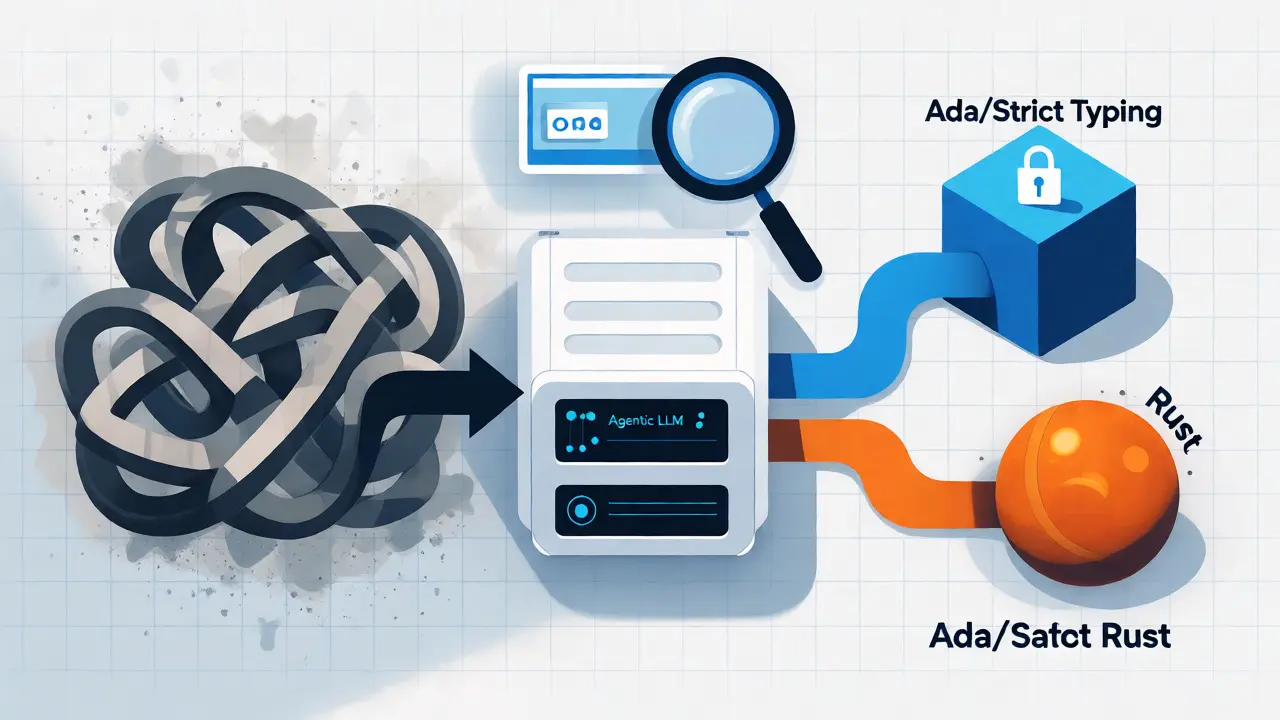
You might think Ada is a relic, but it is experiencing a renaissance thanks to AI-assisted translation. Ada was designed decades ago for safety-critical systems like avionics and defense. It features strong typing, range checking, and exception handling that catch many errors at compile time or runtime. Recent workflows involve using an "agentic LLM" to take a buggy C module, translate it to Ada, run existing tests, and iterate until the tests pass.
This approach works because Ada’s strictness forces the LLM to be precise. If the LLM misses a type constraint, the compiler rejects it. Unlike C, where silent corruption can occur, Ada fails loudly. This makes it an excellent target for refactoring legacy C codebases where stability is paramount. The challenge here is the ecosystem. Finding libraries and developers familiar with modern Ada is harder than finding them for Rust or Go. But for embedded systems or high-integrity applications, the trade-off is worth it.
Vale: The Future of Safe Native Code?
Emerging languages like Vale are trying to solve the remaining gaps in memory-safe native programming. Vale claims to offer complete memory safety without a garbage collector, using mechanisms like "generational references" to prevent use-after-free bugs. It also introduces a "fearless FFI" (Foreign Function Interface) to safely interact with unsafe C libraries.
For LLMs, Vale represents a potential future where the language itself guides the model toward correctness. Since Vale is newer, there is less training data, meaning LLMs might hallucinate more frequently. However, its design principles align perfectly with the goal of eliminating entire classes of bugs by construction. If you are experimenting with cutting-edge tech stacks, keeping an eye on Vale could pay off, though it’s not yet ready for widespread enterprise adoption.
The Verification Gap: Why You Can't Trust the Output Blindly
No matter which language you choose, one rule remains absolute: Never merge LLM-generated code without verification. The SEI (Software Engineering Institute) research on pointer ownership models warns that relying solely on an LLM to generate safety annotations or code can lead to subtle inconsistencies. The LLM might generate a pointer ownership model that looks correct but fails under specific edge cases.
Therefore, your pipeline must include mechanical validation. Use compilers, static analyzers, fuzzers, and comprehensive test suites as the ultimate gatekeepers. For example, in the Rust workflow, the compiler is the judge. In the Ada workflow, the test suite is the judge. If you skip this step, you are just automating the introduction of bugs. Human code review is still essential, particularly for complex logic that automated tools might miss.
Practical Steps for Implementing Safer LLM Workflows
So, how do you actually implement this? Start small. Don’t rewrite your entire monolith overnight. Pick a component that already needs a refactor-maybe a utility library or a new API endpoint. Choose a memory-safe language like Rust or Go for that specific task. Ensure you have good test coverage before you start prompting the LLM.
- Select a Scope: Identify a C/C++ module with known defects or high complexity.
- Prompt Strategically: Ask the LLM to translate or write code in the target safe language, providing context about constraints.
- Integrate and Test: Plug the generated code into your build system and run existing tests.
- Iterate: Feed failure logs back to the LLM. Let it refine the code until tests pass.
- Review: Have a senior engineer review the diff for logical soundness and performance implications.
This iterative process turns the LLM into a powerful assistant rather than an autonomous coder. It reduces the cognitive load on developers while maintaining the safety guarantees of the chosen language.
Frequently Asked Questions
Why are LLMs worse at generating C code than Rust code?
LLMs predict text based on probability, not semantic understanding. C allows many invalid memory operations to compile successfully, so the LLM doesn't receive immediate feedback that it made a mistake. Rust, however, has a strict compiler that rejects invalid memory usage, forcing the LLM (or the developer using it) to correct errors during the generation or compilation phase.
Is Rust really necessary for memory safety, or can I stick with C++?
While modern C++ has improved with smart pointers and RAII, it is not inherently memory-safe. Developers can still misuse raw pointers or create circular references that leak memory. Rust enforces memory safety at compile time, preventing these errors by design. If your team lacks deep C++ expertise, Rust offers a stronger guarantee against common vulnerabilities.
How does the NSA/CISA guidance affect my choice of language for LLM projects?
The NSA and CISA recommend shifting to memory-safe languages for new development to reduce the attack surface. For LLM projects, this means prioritizing languages like Rust, Go, or Swift over C or C++. Following this guidance helps align your technology stack with current cybersecurity best practices and reduces the likelihood of introducing memory-related vulnerabilities.
Can LLMs help migrate legacy C code to Rust or Ada?
Yes, recent studies show that agentic LLMs can effectively translate C modules to Rust or Ada. The process involves prompting the LLM for translation, running tests, and iteratively fixing errors based on compiler or test feedback. This approach leverages the LLM's ability to handle boilerplate and syntax conversion while relying on the target language's safety features to catch logical errors.
What is the role of WebAssembly in memory safety for LLM-generated code?
WebAssembly provides a sandboxed environment for executing native code. Even if you use unsafe languages like C++, compiling to WebAssembly can isolate potential memory violations within the sandbox, preventing them from crashing the host application. It acts as a defense-in-depth layer, complementing language-level safety measures.