Model Distillation for Generative AI: Getting Big Power in Small Models
 Apr, 18 2026
Imagine having the brainpower of a world-class expert but the physical footprint of a pocket calculator. In the world of Generative AI, that's exactly what model distillation is a machine learning process that transfers knowledge from a massive, complex 'teacher' model to a smaller, faster 'student' model. Also known as knowledge distillation, this technique allows developers to strip away the bulk of a giant AI without losing the essence of its intelligence.
For a long time, the rule in AI was simple: bigger is better. If you wanted a model to reason better, you added more parameters. But there's a catch. Huge models are expensive to run, slow to respond, and nearly impossible to put on a phone or a local device. That's where distillation changes the game. Instead of starting from scratch, a small model learns by watching how a big model thinks, effectively taking a shortcut to high performance.
How the Teacher-Student Dynamic Works
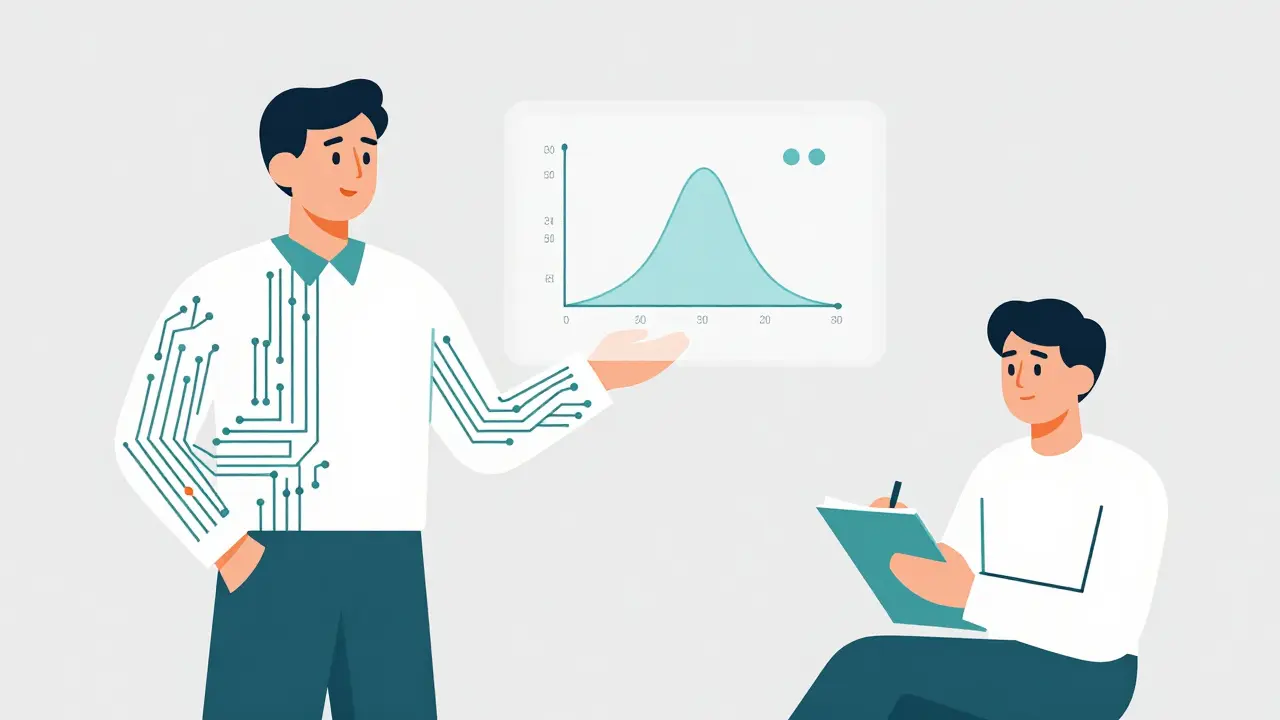
At its core, distillation uses a teacher-student paradigm. Think of it like a professor (the teacher) and a student. The professor doesn't just give the student the final answer; they explain the logic and show the probability of different outcomes. In technical terms, the teacher model is a large, pre-trained network like GPT-4 or Llama 3 that provides high-quality labels and probability distributions .
While a standard model might only tell you that a picture is a "cat" (a hard target), a teacher model provides "soft targets." It might say there's an 85% chance it's a cat, a 10% chance it's a dog, and a 5% chance it's a tiger. These probabilities are gold for the student. They reveal the teacher's decision-making patterns and the nuances between different categories. The student model is a smaller architecture, such as a distilled BERT variant or Mistral 7B, designed for efficiency , which then tries to mimic these distributions using a mathematical process called KL divergence minimization.
One of the coolest breakthroughs here is "distilling step-by-step." Developed by Google and Snorkel AI, this method requires the teacher to provide not just the answer, but the rationale behind it. By learning the "why" alongside the "what," student models can reach high accuracy with 87.5% less training data than if they were just fine-tuned the old-fashioned way.
The Real-World Payoff: Speed and Cost
Why go through all this trouble? Because the numbers are staggering. When you distill a model, you aren't just saving a few cents; you're fundamentally changing the economics of your AI. According to data from AWS, distilled models can maintain 90-95% of the teacher's performance while slashing inference costs by 30-80%.
| Metric | Teacher Model (Large) | Student Model (Distilled) | Improvement |
|---|---|---|---|
| Inference Latency | ~500ms | ~70ms | Up to 7x faster |
| Cost (per 1k tokens) | $0.002 | $0.0007 | ~65% reduction |
| Accuracy Retention | 100% (Baseline) | 89% - 93% | High parity |
| Training Data Needs | Massive labeled sets | Synthetic teacher labels | 8-10x less labeled data |
Take ChatGPT-3.5 Turbo as a prime example. OpenAI distilled this model from a larger ancestor, resulting in a version that processes queries 3.2x faster while keeping 94% of the original benchmark scores. For a business running millions of queries a day, that speed isn't just a luxury-it's the difference between a snappy app and a frustrating one.
Distillation vs. Quantization: Which One to Use?
If you're looking to shrink a model, you've probably heard of quantization is the process of reducing the precision of a model's weights, such as moving from 16-bit to 4-bit floats . People often confuse the two, but they work very differently. Quantization is like compressing a high-res photo into a JPEG-you're losing a bit of detail to save space. Distillation is more like a student summarizing a massive textbook; the core knowledge is preserved, but the fluff is gone.
Quantization is much faster to implement and requires almost no new training. However, distillation preserves nuanced reasoning far better. If you need a model that can still "think" logically but needs to run on a smartphone, distillation is the way to go. If you just need a model to fit into a specific amount of VRAM and don't mind a slight drop in quality, quantization is your best bet.
Where Distillation Hits a Wall
It sounds like magic, but there are limits. A student model can almost never exceed the capabilities of its teacher. If the teacher is wrong or biased, the student will be too-and sometimes, the student actually amplifies those biases. Research from the University of Washington showed a 12.3% increase in gender bias propagation in some distilled sentiment analysis models. This means you can't just "set it and forget it"; you still need rigorous testing.
There's also a capacity limit. While a distilled model might be 93% as accurate on a general test like GLUE, it often struggles with highly specialized, deep-reasoning tasks. For example, IBM found that while distilled models handled customer service bots perfectly, they dropped from 89% to 72% accuracy when tasked with complex legal document analysis. If your AI needs to be a world-leading expert in a niche field, you might actually need that giant, expensive teacher model after all.

Getting Started with Implementation
If you're an engineer looking to implement this, you don't necessarily have to build the pipeline from scratch. Tools like Amazon Bedrock is a fully managed service that provides a foundation for building and scaling generative AI applications, including automated distillation tools can now automate the generation of prompt-response pairs. What used to take a month of manual labeling can now be done in 3 to 5 days.
To get the best results, keep these rules of thumb in mind:
- The 1/10th Rule: Try to keep your student model at least 1/10th the size of the teacher. If the gap is too wide, the student won't have enough "brain cells" to capture the teacher's logic.
- Temperature Tuning: When generating soft targets, set your teacher's temperature between 0.6 and 0.8. This ensures the output isn't too predictable but isn't completely random.
- Verification: Don't trust synthetic data blindly. Expect to manually verify 15-20% of the teacher's outputs to catch hallucinations before the student learns them.
The learning curve for engineers familiar with fine-tuning is usually about 2-3 weeks. You'll need a solid grasp of PyTorch or TensorFlow and an understanding of how KL divergence works to properly tune the loss functions.
The Road Ahead: Self-Distillation and Beyond
We are moving toward a future where models might not even need a separate teacher. Meta AI has been exploring "self-distillation," where a model improves itself by recursively transferring knowledge from its own larger iterations. This has already shown nearly 9% accuracy gains on complex reasoning tasks.
Industry analysts project that by 2027, distillation will be the standard for 80% of all production AI. We're moving away from the "one size fits all" era of giant models and toward a world of specialized, lean, and incredibly fast AI that lives everywhere-from your watch to your car's dashboard.
Can a distilled model be smarter than the original teacher model?
Generally, no. A distilled model is designed to mimic the teacher. While it can be more efficient and sometimes more focused on a specific task through additional fine-tuning, it cannot inherently possess knowledge or reasoning capabilities that the teacher did not have. It's a compression of knowledge, not an expansion.
How much data do I need for model distillation?
One of the biggest perks of distillation is that it requires significantly less labeled data-often 8 to 10 times less than traditional fine-tuning. This is because the teacher model generates "synthetic labels" (soft targets) for unlabeled data, providing a much richer training signal for the student.
Is distillation better than pruning or quantization?
It depends on your goal. Pruning and quantization are faster and easier to implement as they don't require a full training cycle. However, distillation is superior for preserving complex reasoning and nuances. Most high-end production environments actually use a combination of all three to get the smallest, fastest model possible.
Does distillation increase AI bias?
Yes, it can. Because the student model is trained to mimic the teacher, any biases present in the teacher's outputs are transferred. In some cases, this can actually amplify the bias. It's critical to perform bias audits on the student model independently of the teacher.
What are the best teacher-student pairs for LLMs?
Common effective pairs include using a massive model like GPT-4 or PaLM 2 as the teacher and a smaller model like Mistral 7B, Llama-3-8B, or even a BERT-base variant as the student. The key is ensuring the student has enough capacity (parameters) to actually hold the knowledge being transferred.
ANAND BHUSHAN
April 20, 2026 AT 02:07Makes sense. Smaller models on phones would be way better than waiting for the cloud every time.
Rohit Sen
April 20, 2026 AT 02:40Actually, the obsession with size is just a proxy for real architectural innovation. Most of these "distilled" wins are just better data curation in disguise. We're just rearranging the deck chairs on the Titanic here.
Vimal Kumar
April 21, 2026 AT 02:37I think Rohit has a point about data, but the cost reduction is still a huge win for the little guys. If you're a dev with a tiny budget, distillation is basically the only way to get production-ready AI without going broke. It's a great middle ground for anyone trying to build something useful without needing a million-dollar GPU cluster. Plus, it opens the door for way more local-first apps which is great for privacy.
vidhi patel
April 21, 2026 AT 19:47The lack of attention to grammatical precision in this discourse is appalling. One must maintain a rigorous standard of linguistic integrity when discussing technical architectures. Furthermore, the assertion that distillation merely "strips away bulk" is a gross oversimplification of the mathematical reality of KL divergence. It is an intellectual failure to conflate a loss function with a simple summary. The author should have employed a more precise lexicon to describe the stochastic nature of these processes. Such sloppiness in writing typically mirrors sloppiness in implementation. I find the casual tone of this entire thread to be utterly unacceptable and beneath the dignity of a professional engineering discussion. Precise terminology is not a luxury; it is a requirement for clarity and scientific progress. This entire presentation is an exercise in mediocrity.
Amit Umarani
April 22, 2026 AT 17:40Typical. Someone decided that a table and a few bullet points constitute a full technical breakdown. It's a bit lazy to just cite AWS data without actually diving into the trade-offs of different teacher-student architectures. Also, some of the phrasing here is just clunky.
Noel Dhiraj
April 22, 2026 AT 22:21just keep pushing the boundaries guys this is exactly how we get ai in every single gadget soon it is such a cool time to be an engineer just imagine the possibilities when we can run these things on a watch without lag lets get after it
Indi s
April 23, 2026 AT 06:52It's really interesting how this mimics human learning. I can see how a student would feel overwhelmed if the teacher just gave the answer without the logic. It's kind of a relief to know that we're focusing on the "why" part of the intelligence and not just copying results.