Multilingual NLP Progress: How Large Language Models Handle Many Languages
 Jun, 24 2026
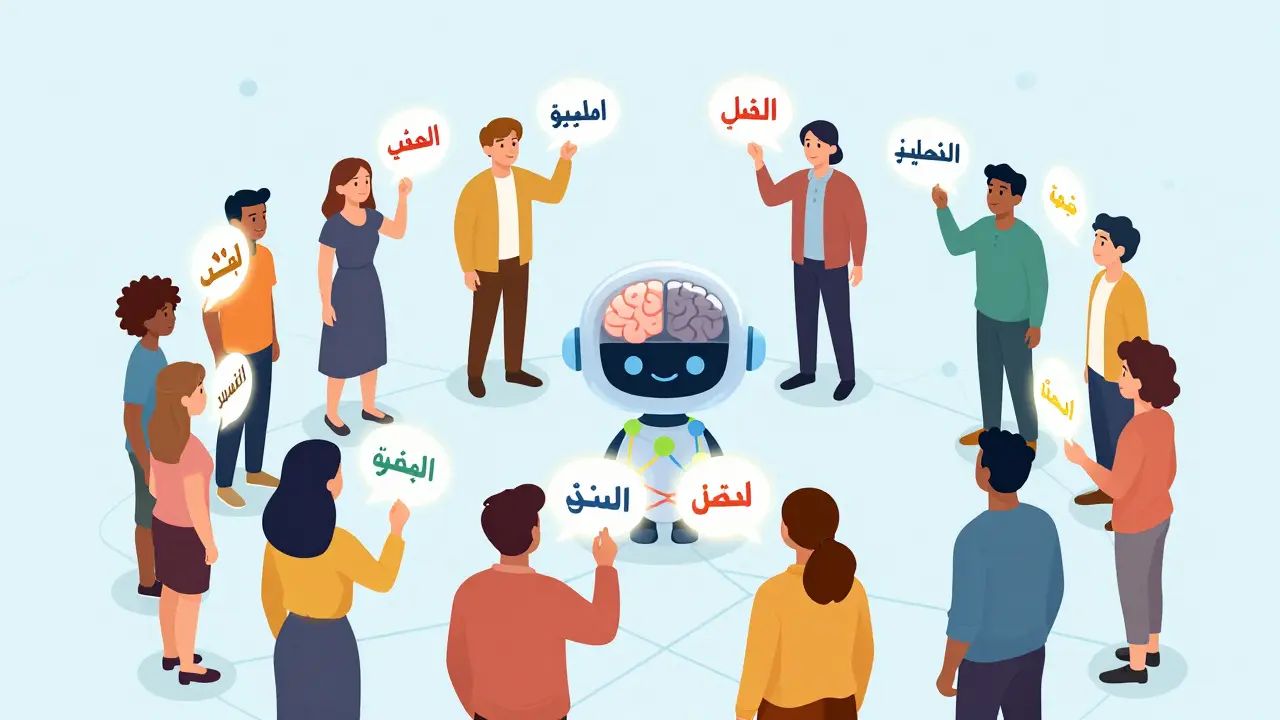
Imagine asking an AI for help in Swahili, getting a nuanced answer back in the same language, without it stumbling over grammar or losing the cultural context. For years, this was a distant dream. Early AI models were essentially English-centric tools with thin translation layers slapped on top. Today, we stand at a different inflection point. Multilingual Large Language Models (MLLMs) are advanced neural networks capable of processing, understanding, and generating text across dozens to hundreds of human languages with high fidelity. These systems have moved beyond simple word-for-word substitution. They now perform complex reasoning, sentiment analysis, and creative writing in languages that previously had little digital presence.
The shift from monolingual giants like early GPT versions to true multilingual architectures represents one of the most significant leaps in natural language processing history. It’s not just about adding more words to a dictionary; it’s about rewiring how machines understand meaning itself. If you’ve noticed your favorite chatbot becoming surprisingly competent in Spanish, Japanese, or even lower-resource languages like Quechua or Yoruba, you’re witnessing the result of massive architectural changes and novel training strategies. But how exactly do these models handle such linguistic diversity without getting confused? And what does this mean for global access to AI?
From Monolingual Silos to Multilingual Bridges
To understand where we are, we need to look at where we started. The first wave of large language models, including BERT and GPT-3, were primarily trained on English data. When developers wanted them to work in other languages, they often relied on machine translation as a crutch-translating input to English, processing it, and translating the output back. This approach introduced latency, lost nuance, and failed completely for languages with no robust translation infrastructure.
The breakthrough came with encoder-only models like mBERT (Multilingual BERT) and XLM-R (Cross-Lingual Language Model). These models were pre-trained on Wikipedia data covering over 100 languages simultaneously. By sharing parameters across languages, mBERT learned that certain concepts map to similar mathematical representations regardless of the language used. This allowed for "zero-shot" transfer learning. You could train a classifier on English legal documents, and it would surprisingly well classify French legal documents, even though it never saw French training labels.
However, these early multilingual models had limits. They were excellent at understanding text (classification, entity recognition) but poor at generating it. The next evolution brought decoder-only models like BLOOM (BigScience Large Open-science Open-access Multilingual Language Model) and later iterations of LLaMA. These models use autoregressive generation, predicting the next token in a sequence. By training on massive, diverse web corpora like CommonCrawl and mC4, they began to master the flow and style of multiple languages natively, rather than just translating through English.
The Architecture of Understanding: Encoder vs. Decoder
Not all multilingual models are built the same way. The architecture dictates what the model can do best. Currently, the field is dominated by three main archetypes, each serving a specific job in the NLP ecosystem.
| Architecture Type | Key Examples | Primary Strength | Training Objective |
|---|---|---|---|
| Encoder-Only | mBERT, XLM-R | Text Understanding, Classification | Masked Language Modeling (MLM) |
| Decoder-Only | BLOOM, LLaMA, PolyLM | Text Generation, Translation, Chat | Causal Language Modeling (CLM) |
| Encoder-Decoder | mT5, NLLB | Translation, Summarization | Sequence-to-Sequence |
Encoder-only models like XLM-R excel at tasks where you need to understand the full context of a sentence before making a decision, such as detecting hate speech or categorizing customer support tickets. They use Masked Language Modeling, where the model predicts missing words based on surrounding context. This forces the network to build deep bidirectional connections between words.
Decoder-only models, which power most modern chatbots, predict text sequentially. They are better suited for open-ended generation. The challenge here is ensuring the model doesn’t lose track of earlier instructions in long conversations, especially when switching languages mid-dialogue. Recent advancements in attention mechanisms have helped mitigate this, allowing models to maintain coherence across thousands of tokens in mixed-language inputs.
How Do They Actually Think? The MWork Hypothesis
One of the most fascinating questions in current AI research is: What happens inside the black box when a multilingual model processes a non-English query? A pivotal 2024 study published at NeurIPS proposed the Multilingual Workflow (MWork) hypothesis, offering a compelling explanation.
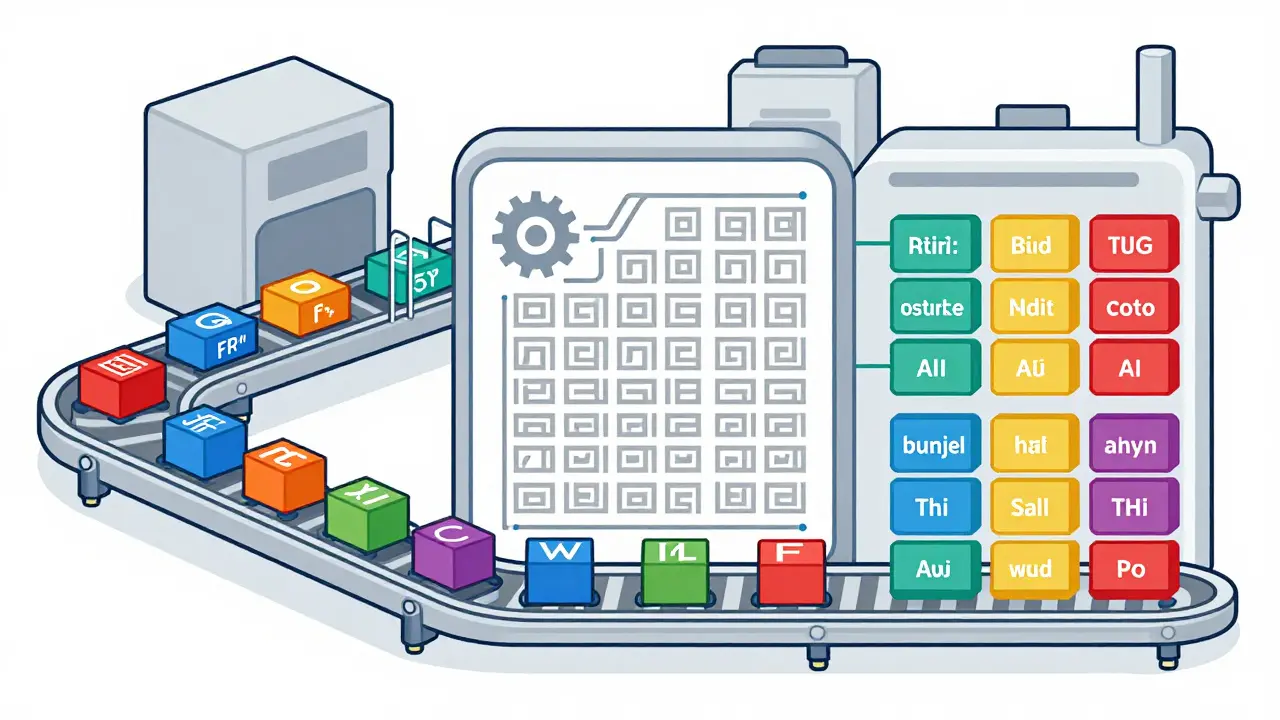
According to MWork, LLMs don’t necessarily reason in the language you speak to them. Instead, they follow a three-step internal process:
- Input Encoding: The initial layers convert the multilingual input into a shared, language-agnostic representation. Think of this as translating the *meaning* into a universal code, not the words themselves.
- Intermediate Reasoning: In the middle layers of the network, the model performs its logical operations. Research suggests these layers heavily rely on English-like structures because English dominates the training data. The model effectively "thinks" in a lingua franca derived from its primary training corpus.
- Output Decoding: The final layers translate the reasoned solution back into the target language specified by the user.
This insight is crucial for developers. It explains why fine-tuning middle layers for specific languages can be inefficient. Instead, researchers found that tweaking the neurons responsible for input encoding and output decoding yields significant improvements in multilingual performance with minimal computational cost. It also highlights a hidden bias: if the "reasoning" layer is overly dependent on English structures, nuances unique to other languages might get flattened during the intermediate step.
Semantic Alignment: Finding Common Ground
For MWork to function, the model needs a way to align meanings across languages. This phenomenon is known as Semantic Alignment. Imagine plotting every word in a high-dimensional space. In a well-aligned multilingual model, the vector for "love" in English should sit very close to "amour" in French and "amor" in Spanish, regardless of their spelling differences.
Researchers measure this using metrics like the Semantic Alignment Development Score (SADS). High SADS scores indicate that the model has successfully mapped semantically similar sentences from different languages into proximate regions of its latent space. This alignment isn’t perfect initially. Early in training, neuron clusters are highly language-specific. As training progresses, particularly in the middle layers, activations become more language-agnostic.
This emergent property allows for powerful capabilities like cross-lingual retrieval. You can search for a document in German using a query in Korean, and the model retrieves the relevant results because it understands the underlying semantic similarity. Techniques like Linear Discriminant Analysis-based latent injection allow engineers to manipulate this alignment, enabling controlled language switching at inference time without degrading the quality of the response.

The Low-Resource Language Challenge
Despite impressive progress, a major gap remains: the disparity between high-resource languages (English, Chinese, Spanish) and low-resource languages (many African, Indigenous, and smaller European languages). Data imbalance is the core issue. If a model sees billions of English sentences but only thousands of sentences in a specific dialect, it will inevitably perform worse in the latter.
Recent strategies aim to level the playing field:
- Curriculum Learning: Training models to start with easier, high-resource tasks and gradually introduce harder, low-resource ones. This helps the model build a strong foundational understanding before tackling sparse data.
- Dynamic Data Sampling: Algorithms like Unimax adjust the sampling rate during training. If the model starts performing too well in English, the system automatically increases the proportion of low-resource language data in the training batch, forcing the model to pay attention to underrepresented languages.
- Language-Adaptive Layers: Instead of retraining the entire massive model, developers add small, specialized modules for specific languages. These layers fine-tune behavior for particular linguistic features without altering the core knowledge base, reducing computational overhead significantly.
Models like NLLB (No Language Left Behind) from Meta have been pioneers here, supporting over 200 languages. While they still lag behind commercial translators like Google Translate in accuracy for some pairs, they provide functionality where none existed before. A 2024 study noted that while GPT-4 beats NLLB in many translation directions, it still struggles with low-resource pairs compared to dedicated supervised systems. However, LLMs offer a unique advantage: they can generate moderate translations for zero-resource languages by leveraging cross-lingual exemplars, something traditional statistical models cannot do.
Real-World Impact and Future Directions
The implications of robust multilingual NLP extend far beyond tech benchmarks. We are seeing tangible benefits in global healthcare, education, and governance. Doctors in rural areas can use voice-enabled AI assistants in local dialects to diagnose common ailments. Students in non-English speaking countries can access high-quality educational content without the barrier of manual translation.
However, challenges remain. Cultural nuance is difficult to capture. An idiom in Arabic might not have a direct equivalent in English, and a literal translation can lead to misunderstandings. Current models are improving at handling these subtleties through instruction tuning with multilingual datasets that include cultural context notes. Additionally, safety alignment is critical. Ensuring that models adhere to ethical guidelines across all languages requires collecting human feedback in those languages, a resource-intensive task that is still in its early stages.
As we move forward, the focus is shifting from simply adding more languages to improving the depth of understanding within each one. The goal is not just functional communication, but culturally aware interaction. With continued investment in diverse data collection and efficient adaptation techniques, the promise of truly inclusive AI is closer than ever.
What is the difference between mBERT and modern Multilingual LLMs?
mBERT is an encoder-only model designed primarily for understanding text, such as classification and entity recognition. Modern Multilingual LLMs like LLaMA or BLOOM are typically decoder-only or encoder-decoder models capable of generating coherent text, holding conversations, and performing complex reasoning tasks across languages, not just analyzing static input.
Do multilingual LLMs think in English?
Research suggests that while they don't "think" in a human sense, the intermediate reasoning layers of many multilingual LLMs rely heavily on representations derived from English due to the dominance of English in training data. This is described by the MWork hypothesis, which posits that input is converted to a shared representation, processed using English-dominant structures, and then decoded back into the target language.
Why do low-resource languages still struggle with LLMs?
The primary issue is data imbalance. High-resource languages like English have billions of high-quality web pages available for training, while low-resource languages may have only thousands. Without sufficient data, the model cannot learn the grammatical rules, vocabulary, and cultural nuances effectively, leading to lower accuracy and higher hallucination rates.
What is Semantic Alignment in NLP?
Semantic alignment refers to the ability of a multilingual model to map words and phrases from different languages to similar positions in its internal mathematical space. For example, the concept of "cat" in English and "gato" in Spanish should activate similar neurons. This alignment enables cross-lingual transfer learning, allowing the model to apply knowledge learned in one language to another.
Can I fine-tune a multilingual LLM for a specific language efficiently?
Yes, using techniques like Language-Adaptive Layers or LoRA (Low-Rank Adaptation). Instead of retraining the entire model, you can train small adapter modules specific to a target language. This approach is computationally cheaper and prevents catastrophic forgetting of other languages, making it ideal for organizations needing specialized performance in a niche language.