Preventing Catastrophic Forgetting During LLM Fine-Tuning: Techniques That Work
 Jun, 8 2026
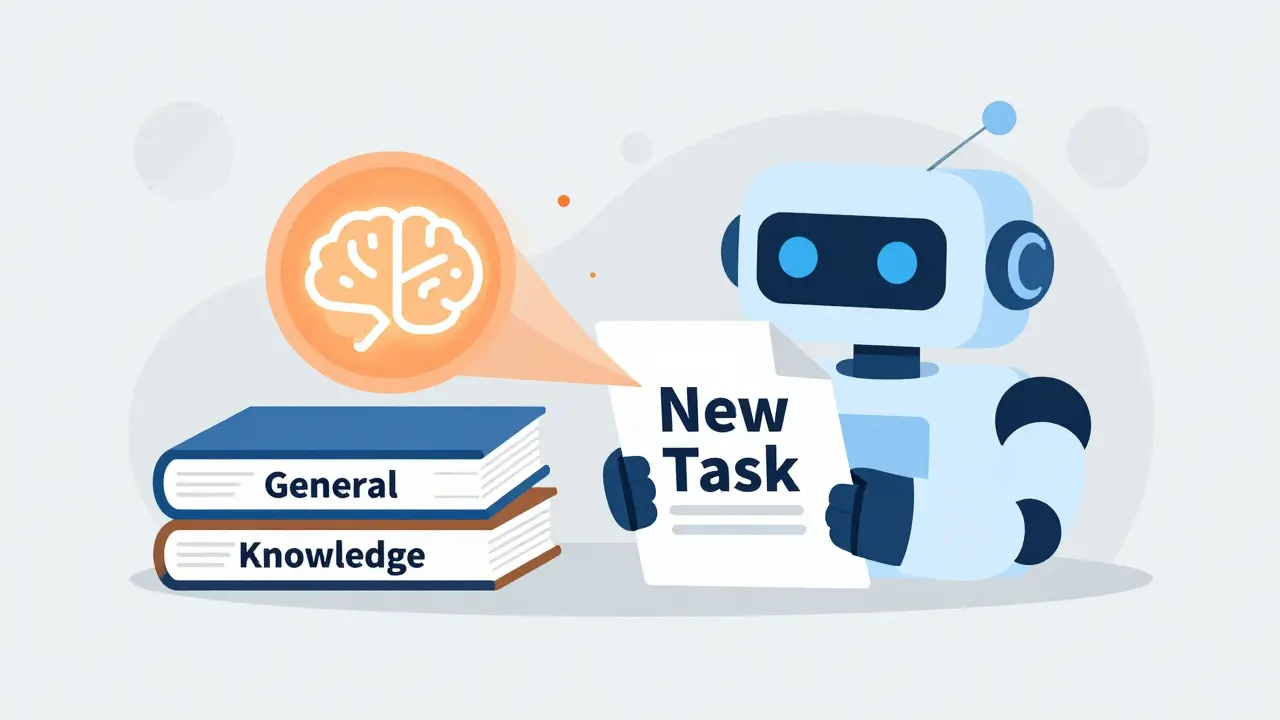
You spend weeks curating the perfect dataset. You fine-tune your large language model to handle customer support tickets with surgical precision. Then, you run a quick sanity check on general knowledge questions, and the results are disastrous. The model that once knew capital cities now thinks Paris is in Brazil. This isn't just a bad day; it's catastrophic forgetting, a phenomenon where neural networks overwrite previously learned knowledge when trained on new tasks. It is the single biggest bottleneck preventing us from deploying truly versatile AI agents in production.
For years, the industry operated under a comforting myth: if you use parameter-efficient fine-tuning (PEFT) methods like Low-Rank Adaptation (LoRA), you automatically avoid this problem because you aren't changing the base weights much. Recent research from 2025 has shattered that assumption. We now know that minimizing weight changes does not equal preserving function. If you are building an LLM pipeline today, understanding the mechanics of forgetting-and the specific techniques that actually stop it-is no longer optional. It is survival.
The Mechanics of Why Models Forget
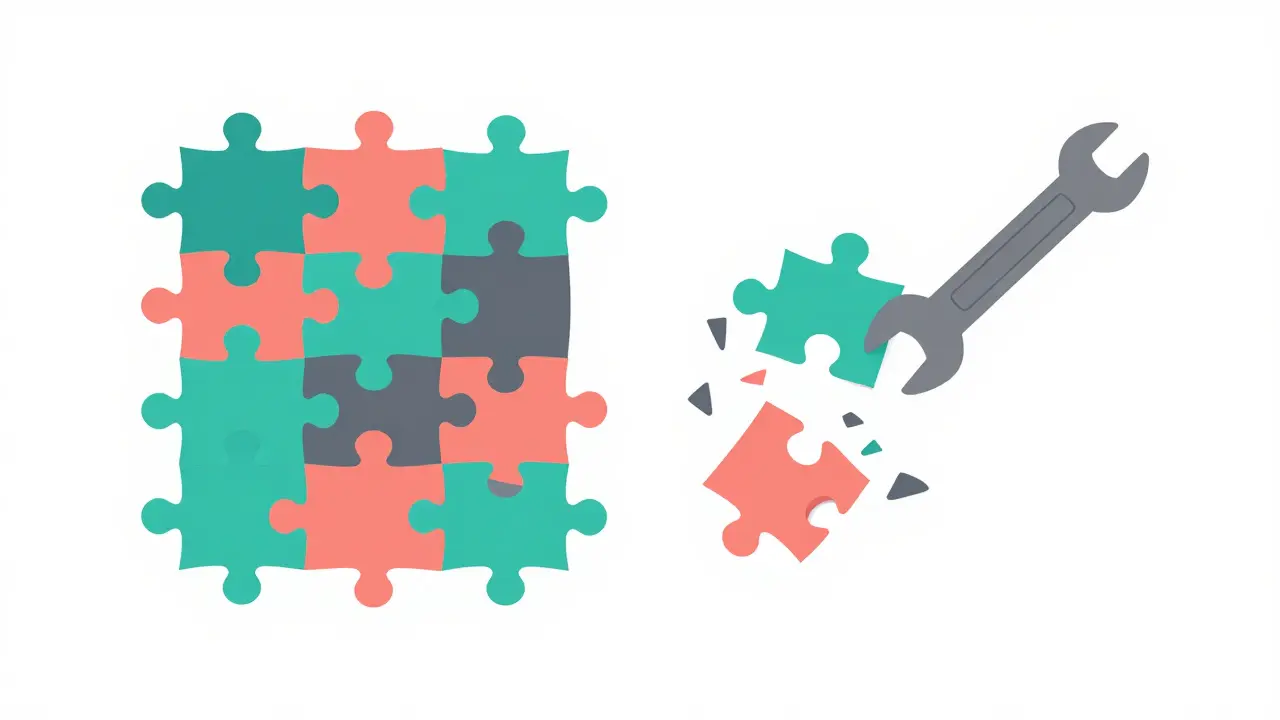
To fix catastrophic forgetting, you first have to understand why it happens. Neural networks optimize parameters to minimize loss on their current task. When you fine-tune a model on a narrow domain, say legal contracts, the optimization process pushes all weights toward configurations that best predict legal terminology. The problem is that these weights also encode general world knowledge, like grammar or basic facts. Without constraints, the optimizer happily smashes those general representations to improve performance on the new task.
This is not a bug; it is a feature of unconstrained gradient descent. The model shifts its internal representation space so dramatically that the pathways used for previous tasks are effectively erased. Research published in early 2025 using GPT-J and LLaMA-3 models demonstrated this severity across scientific and medical tasks. The models didn't just get slightly worse at old tasks; they collapsed entirely outside their fine-tuned domain. The key insight here is that magnitude of change matters less than functional impact. You can change weights significantly without breaking old skills, provided you respect the geometry of the solution space.
Why LoRA Alone Is Not Enough
Low-Rank Adaptation (LoRA) has been the darling of the fine-tuning community since its introduction. By freezing the pre-trained weights and injecting trainable low-rank matrices, LoRA drastically reduces memory requirements. You can fine-tune a massive model on a consumer-grade GPU. It feels efficient. It feels safe. But does it prevent forgetting?
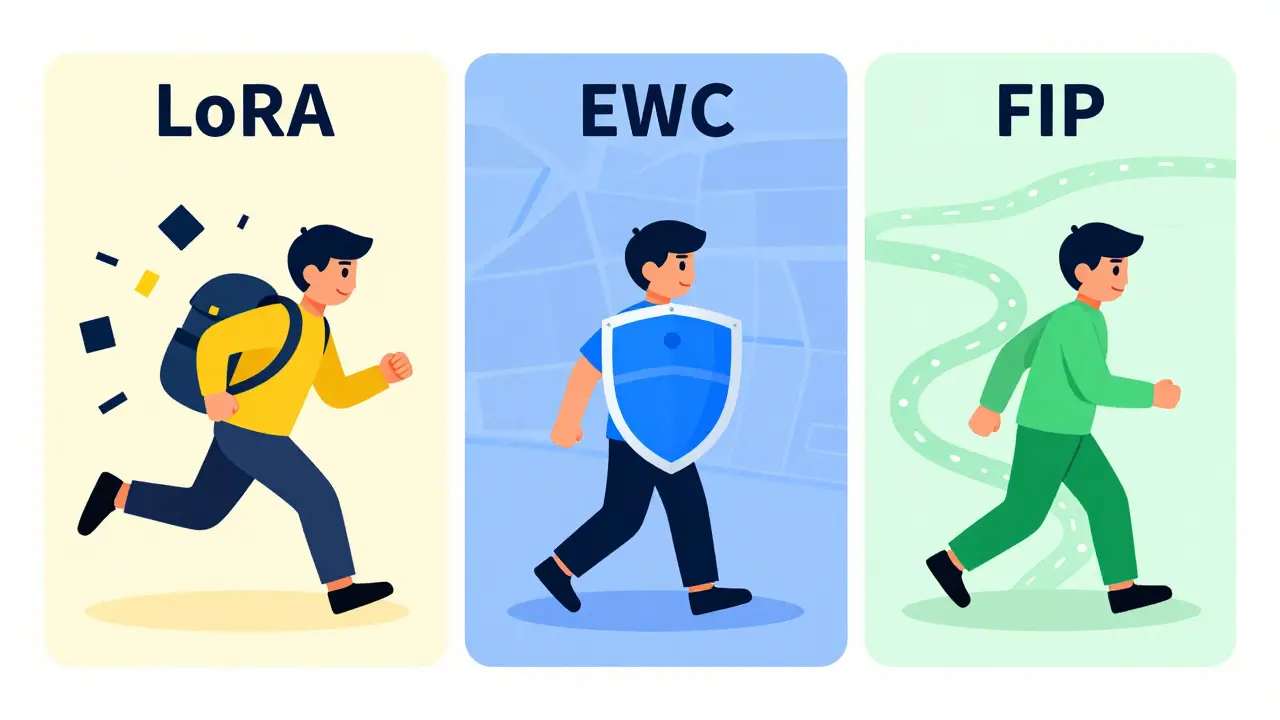
Counterintuitively, no. A pivotal analysis by Legion Intel in 2025 compared LoRA against Functionally Invariant Paths (FIP). The results were stark. In continual learning scenarios-where a model learns Task A, then Task B, then Task C-LoRA failed to mitigate catastrophic forgetting. The reason lies in how LoRA operates. While it keeps the backbone frozen, the adapters still shift the network's output distribution in ways that degrade previous capabilities over time. The belief that "smaller weight changes mean less forgetting" is mathematically flawed. What matters is whether the new solution remains close to the original in functional space, not just parameter space.
| Technique | Mechanism | Computational Cost | Forgetting Prevention Efficacy |
|---|---|---|---|
| Full Fine-Tuning | Updates all parameters | Very High | Poor (High risk) |
| LoRA | Frozen backbone + low-rank adapters | Low | Moderate to Poor (in continual learning) |
| EWC | Bayesian regularization of important weights | Medium | Good (but slow) |
| FIP | Geometric constraint on loss landscape | Medium-High | Excellent |
| Rehearsal/Replay | Mixing old data into new training batches | Low (storage dependent) | Very Good |
Elastic Weight Consolidation (EWC): The Bayesian Guardrail
If LoRA is the lightweight sprinter, Elastic Weight Consolidation (EWC) is the cautious accountant. Developed from a Bayesian perspective, EWC estimates which parameters are most important for previously learned tasks. It calculates the Fisher Information Matrix to determine this importance. During fine-tuning, EWC adds a regularization term to the loss function. This term penalizes updates to parameters that were crucial for old tasks.
In practice, this means the model can still learn new things, but it pays a heavy "cost" if doing so requires altering weights that hold general knowledge. EWC works well, but it comes with a trade-off. Computing the Fisher Information Matrix is computationally expensive and memory-intensive. For smaller models, it’s manageable. For massive LLMs, it can be prohibitive. Hybrid approaches like EWCLoRA attempt to combine the efficiency of LoRA with the protective regularization of EWC, offering a middle ground for teams with moderate resources.
Functionally Invariant Paths (FIP): Respecting Geometry
Here is where the science gets interesting. Caltech researchers developed Functionally Invariant Paths (FIP) to address the core flaw in traditional parameter-constraint methods. Instead of asking "which weights shouldn't move?", FIP asks "how should the weights move so the function doesn't break?"
FIP models the network's weight space as a curved Riemannian manifold. Imagine walking on a globe. If you want to stay near the North Pole, you don't just restrict your steps in one direction; you account for the curvature of the earth. Similarly, FIP ensures that while the model traverses weight space to learn a new task, it stays close to the original network in functional space. The result? Larger changes in individual weights, but preserved performance on old tasks. In head-to-head comparisons, FIP outperformed LoRA in retaining previous knowledge while acquiring new skills. It is currently one of the most promising techniques for high-stakes continual learning applications.
Rehearsal and Replay: The Power of Old Data
Sometimes, the simplest solution is the most robust. Rehearsal-based methods, also known as replay, involve keeping a small subset of data from previous tasks. When training on Task B, you mix in examples from Task A. This forces the optimizer to find a parameter configuration that satisfies both datasets simultaneously.
This approach is intuitive and highly effective. Research by Jin et al. and others has shown that even a tiny buffer of old data can drastically reduce forgetting. The challenge is storage and privacy. You cannot always store user data indefinitely due to GDPR or HIPAA regulations. However, for synthetic data or public benchmarks, rehearsal is often the gold standard. It requires no complex mathematical approximations like EWC or FIP. It just works. If you have the storage budget, prioritize a small, diverse replay buffer alongside your fine-tuning pipeline.
New Frontiers: FAPM and Selective Token Masking
The field is evolving rapidly. Two emerging techniques from 2025 deserve attention: Functional Alignment via Prompt Masking (FAPM) and Selective Token Masking (STM).
FAPM, introduced in EMNLP proceedings, achieves a catastrophic forgetting rate of only 0.25% in controlled studies. It works by aligning the functional behavior of the model rather than constraining parameters directly. It is particularly effective when applied to full fine-tuning, suggesting that we can train aggressively if we guide the alignment correctly.
Selective Token Masking (STM) takes a different angle. Instead of looking at weights, STM looks at tokens. It masks high-perplexity tokens during fine-tuning. High perplexity often indicates the model is struggling with unfamiliar concepts or noise. By masking these, the model focuses on stable, low-perplexity patterns, preserving its core linguistic structure. Experiments on Gemma 2 and Llama 3 showed consistent effectiveness across different scales. This token-level approach represents a paradigm shift from parameter-centric to input-centric mitigation.
Choosing Your Strategy: A Practical Decision Tree
No single technique solves every problem. Your choice depends on three factors: computational resources, data availability, and the criticality of retention.
- Low Resource, Single Task: Use LoRA. Accept that some minor degradation may occur, but the speed and cost savings are worth it for non-critical general knowledge.
- Medium Resource, Continual Learning: Combine LoRA with a small Replay Buffer. Keep 1-5% of general data in your training mix. This is the best bang-for-buck strategy for most startups.
- High Resource, Critical Retention: Implement FIP or EWC. If your model must maintain medical or legal accuracy while learning new case law, the computational overhead is justified.
- Data Privacy Constraints: Avoid Replay. Use EWC or FAPM, which rely on weight statistics or functional alignment rather than storing raw data samples.
Remember to evaluate performance not just on your new task, but on a representative set of previous tasks. Set up automated regression tests. If your model's score on a general knowledge benchmark drops by more than 5%, your forgetting mitigation strategy is failing.
What is catastrophic forgetting in LLMs?
Catastrophic forgetting occurs when a neural network loses previously acquired knowledge after being trained on new tasks. In LLMs, this means the model becomes expert in its new domain but fails at general reasoning or facts it knew before fine-tuning.
Does LoRA prevent catastrophic forgetting?
Not reliably. While LoRA reduces computational costs by freezing base weights, recent 2025 research shows it does not fully mitigate forgetting in continual learning scenarios. It minimizes weight movement but not necessarily functional degradation.
What is the difference between EWC and FIP?
EWC uses Bayesian regularization to protect important weights based on the Fisher Information Matrix. FIP uses geometric constraints on the loss landscape to ensure the model stays functionally similar to the original, allowing larger weight changes without losing performance.
How can I implement rehearsal without violating privacy laws?
You generally cannot use real user data for rehearsal if it contains PII. Instead, use synthetic data generated by the model itself or public domain datasets that represent the general knowledge you wish to preserve. Alternatively, switch to parameter-based methods like EWC or FIP.
Is Selective Token Masking (STM) ready for production?
STM is a promising emerging technique from 2025. While experiments show strong results on models like Llama 3, it is newer than established methods like EWC. It is recommended for experimental pipelines or secondary models until broader industry validation occurs.
Edward Gilbreath
June 8, 2026 AT 17:03its all just corporate buzzwords designed to sell more gpu cycles nobody actually reads the papers they just copy paste abstracts and pretend its new science
Lisa Nally
June 9, 2026 AT 04:43Oh, absolutely not! The nuance here is simply staggering for those who haven't delved into the epistemological underpinnings of transformer architectures.
You see, while Mr. Gilbreath above suggests a cynical dismissal of academic rigor, we must consider that the shift from parameter-centric to input-centric mitigation represents a paradigmatic shift in how we conceptualize neural plasticity. It's not merely about 'selling GPUs'; it's about preserving the functional integrity of the model's latent space during continual learning scenarios.
The fact that LoRA fails in multi-task environments isn't a bug; it's a feature of low-rank approximations failing to capture the full covariance structure of the original pre-trained weights. When you inject these adapters, you are essentially creating a subspace that might be optimal for Task A but orthogonal to the manifold required for Task B. This leads to what we call representational collapse.
I've seen teams try to patch this with simple replay buffers, but without careful curation of the buffer diversity, you end up with mode collapse where the model overfits to the replay samples and ignores the new data entirely. It's a delicate dance between stability and plasticity. One must balance the Fisher Information Matrix estimates with computational feasibility. EWC is theoretically sound but practically prohibitive for models beyond 7B parameters without significant approximation errors.
Furthermore, the mention of FIP (Functionally Invariant Paths) is intriguing because it treats the loss landscape as a Riemannian manifold rather than a Euclidean space. This geometric perspective allows for larger weight updates that remain functionally equivalent to the original model. It's elegant, truly. But does it scale? That remains the million-dollar question.
We also cannot ignore the privacy implications of rehearsal methods. GDPR compliance means we can't just hoard user data for replay. Synthetic data generation via the model itself introduces bias amplification risks. If the model hallucinates during synthesis, you're training on noise. It's a vicious cycle.
In my experience, hybrid approaches are the only viable path forward. Combining LoRA with a small, carefully selected subset of general knowledge data (say, 1-2% of the training set) often yields the best trade-off between performance retention and computational cost. But you have to monitor your regression tests religiously. If your general knowledge score drops by even 0.5%, something is wrong.
It's frustrating when people oversimplify these complex issues. We need more rigorous evaluation protocols across diverse benchmarks. Not just MMLU or GSM8K, but domain-specific evaluations that test for subtle degradation in reasoning capabilities. The industry needs to stop chasing SOTA numbers on narrow tasks and start caring about robustness.
So, to answer the unasked question: yes, catastrophic forgetting is real, yes, LoRA alone is insufficient, and no, there is no silver bullet. It requires a holistic approach combining architectural constraints, data strategies, and rigorous evaluation. Anything less is negligence.
Michael Richards
June 10, 2026 AT 00:52Stop pretending you know what you're talking about if you haven't deployed this at scale. Theory is cheap. Production is expensive. Most of you are playing with toys while actual engineers are fighting fires because your 'elegant' solutions crash in the wild. Get a real job or shut up.
Edward Nigma
June 11, 2026 AT 07:19Actually i think everyone is missing the point here. LoRA works fine if you just tune the rank higher. People are scared of compute costs so they blame the method instead of their own laziness. Also FIP sounds like made up math to justify hiring more PhDs. I bet half these techniques fail when you throw enough garbage data at them which is what real world data looks like. Stop overthinking it and just train harder.
kimberly de Bruin
June 11, 2026 AT 10:15we forget because we are machines trying to be human but we are only mirrors reflecting our own brokenness back at us the weights shift like sandcastles before the tide comes in and washes away everything we thought we knew about paris being in brazil or whatever reality was yesterday
Francis Laquerre
June 12, 2026 AT 01:23As someone who has worked with AI teams across Europe and Asia, I find this discussion incredibly illuminating yet fraught with cultural misunderstandings about risk. In many jurisdictions, the legal ramifications of a model 'forgetting' medical guidelines are not just technical failures; they are existential threats to the organization.
The Western obsession with efficiency-hence the love for LoRA-often clashes with the Eastern emphasis on harmony and continuity in system behavior. When a model shifts its representation space too drastically, it disrupts the trust users place in the interface. It is not merely about accuracy metrics; it is about the phenomenological experience of interacting with an agent that seems to lose its soul mid-conversation.
I have witnessed teams in Tokyo adopt stricter rehearsal buffers despite the storage costs because the cultural expectation of reliability outweighs the economic pressure to minimize GPU usage. Conversely, startups in Silicon Valley often gamble on LoRA-only pipelines, accepting the risk of forgetting as a cost of speed. This divergence highlights a deeper philosophical split in how we value consistency versus innovation.
Perhaps the solution lies not in a single technical fix, but in aligning our engineering practices with the ethical frameworks of the regions we serve. If we treat the model as a static artifact rather than a dynamic participant in a social contract, we will continue to face these crises of identity. Let us remember that behind every weight update is a human expectation that was either met or betrayed.
michael rome
June 12, 2026 AT 02:12I appreciate the depth of this conversation. It is vital that we support each other in navigating these complex technical landscapes. While some may dismiss the theoretical aspects as irrelevant, I believe that understanding the underlying mechanics empowers us to build more resilient systems.
Let us remain focused on collaboration rather than conflict. Whether one prefers EWC, FIP, or a hybrid approach, the goal remains the same: to create AI that serves humanity reliably and ethically. Your insights contribute significantly to this collective effort. Thank you for sharing your perspectives, even when they differ. Together, we can overcome the challenges of catastrophic forgetting and ensure that our models retain their wisdom as they learn anew.