Privacy and Security Risks of Distilled Large Language Models (2026)
 Jul, 4 2026
Smaller is faster. Smaller is cheaper. But when it comes to Distilled Large Language Models, which are compressed AI models that inherit capabilities from larger teacher models through knowledge transfer techniques, smaller can also mean sneakier vulnerabilities. You might think shrinking a model strips away its secrets along with its size. The reality is the opposite. Distilled models often pack the same dangerous behavioral patterns as their massive parents, but they hide them in tighter, harder-to-audit code.
In 2026, deploying these compact models on edge devices or private servers feels like the logical next step for cost-conscious engineering teams. Yet, without specific safeguards, you are inviting data leaks, intellectual property theft, and model inversion attacks right into your infrastructure. This guide breaks down exactly where distilled models fail us and how to lock them down properly.
The Illusion of Safety in Model Compression
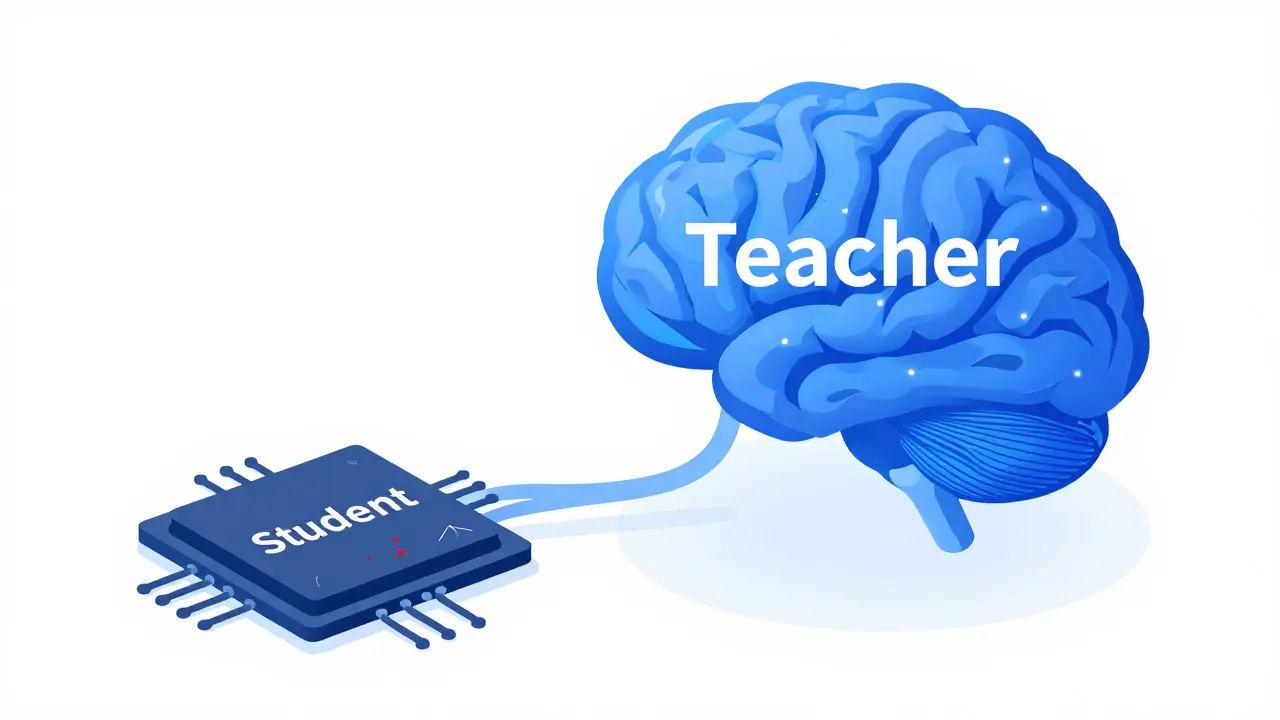
Knowledge distillation, a technique popularized by Hinton et al. in 2015, works by training a small "student" model to mimic the output probabilities of a large "teacher" model. The goal is efficiency. A model like DeepSeek-R1 (1.5 billion parameters) can achieve 83.7% accuracy on complex math tasks while using only 3.2GB of memory. Compare that to its 7B parameter counterpart needing 13.5GB. That’s a huge win for hardware budgets.
But here is the catch: the student doesn’t just learn the answers; it learns the reasoning path. And if the teacher model was trained on leaked emails, proprietary code, or sensitive patient records, the student inherits those biases and memories too. Dr. Emily Brauchler from Palo Alto Networks noted in July 2024 that distilled models inherit a "huge part of their teacher model's behavior, including any security risks embedded in their training data."
You cannot assume that because the model is smaller, it knows less about your users. In fact, studies show that distilled variants like DistilGPT-2 demonstrated equivalent personally identifiable information (PII) leakage to GPT-2 when hit with adversarial queries. They reproduced 63% of the sensitive data exposures found in the original model. Size reduction does not equal privacy enhancement.
New Attack Vectors Unique to Distilled Architectures
While full-sized models have broad attack surfaces, distilled models introduce specific weaknesses that attackers love. Because the distillation process simplifies decision pathways, it creates gaps between what the teacher knew and what the student retained. These gaps are exploitable.
- Capability-Specific Extraction: The LUCID framework (OpenReview, March 2025) proved that distilled models are 2.3 times more likely to exhibit capability-specific vulnerabilities. Attackers can target narrow functions-like code generation or legal summarization-to extract proprietary logic without stealing the whole model.
- Easier Boundary Mapping: On Hacker News, developers reported that the smaller parameter count actually made it easier to map a model’s decision boundaries. With fewer variables, malicious actors can reverse-engineer the model’s logic faster than they could with a 175B-parameter behemoth like GPT-3.
- Prompt Injection Success Rates: GitHub trackers for models like TinyLlama showed 14 verified instances of prompt injection attacks successfully extracting training data in late 2024. The compressed architecture lacks the redundancy that sometimes confuses or blocks such injections in larger models.
Professor Michael Carbin of MIT highlighted this gap at the NeurIPS 2025 Lock-LLM Workshop. He pointed out that existing fingerprinting techniques focus on detecting complete model theft. They offer little protection against someone stealing just the specific functional capabilities your business relies on.
Hardware Isolation: Trusted Execution Environments (TEEs)
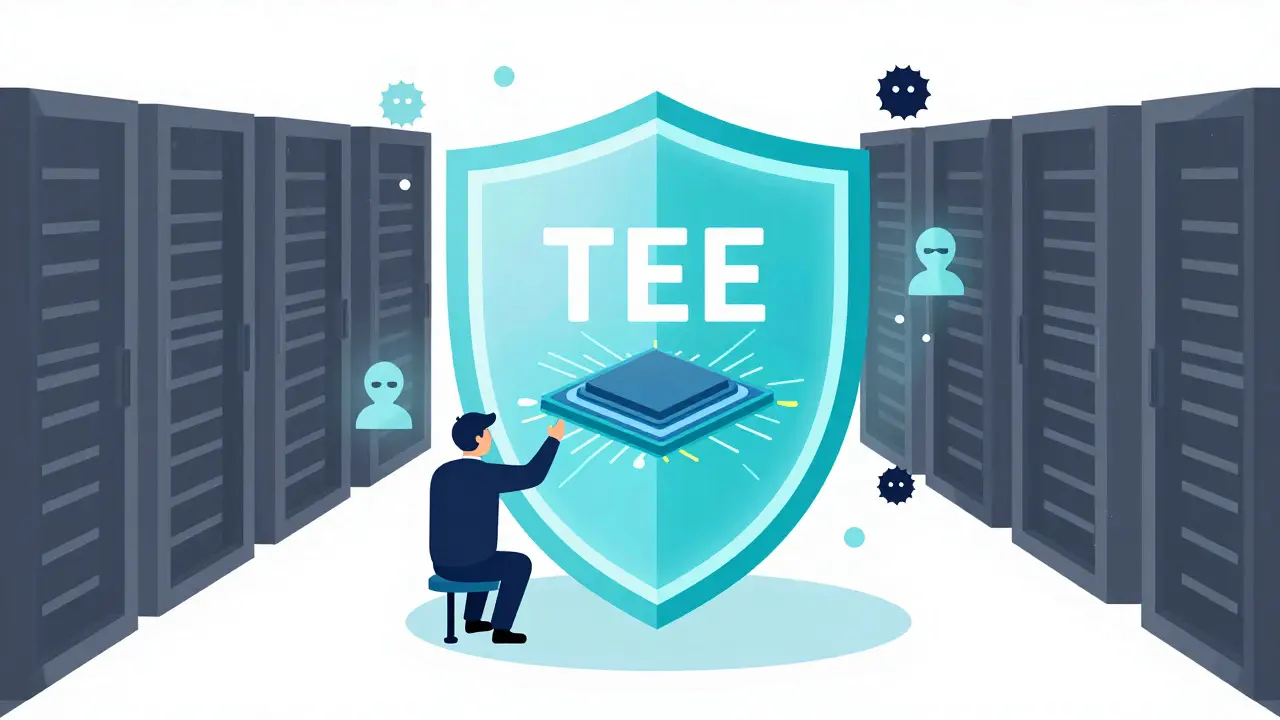
If software patches aren't enough, you need hardware-level isolation. This is where Trusted Execution Environments (TEEs) come in. Specifically, Intel’s Trust Domain Extensions (TDX), introduced in Q4 2023, allows you to run AI models inside isolated virtual machines that protect memory from snooping even if the host OS is compromised.
TDX solves a major problem for distilled models: memory safety. Even when deployed locally, sensitive information in an LLM is vulnerable to side-channel attacks. TDX isolates the model’s execution environment, ensuring that no other process on the server can peek at the data being processed.
| Feature | Standard Local Deployment | TDX-Protected Deployment (Intel) |
|---|---|---|
| Memory Protection | Vulnerable to root-level snooping | Isolated enclave; immune to host OS compromise |
| Performance Overhead | Baseline (0%) | 12-18% overhead (reduces to 5-8% with 8-bit quantization) |
| Max Secure Memory | Limited by RAM | Up to 16GB per enclave (vs. SGX's 1GB limit) |
| Integration Effort | Low | High (40-60 hours engineering time) |
The trade-off is performance. Running a distilled model entirely within a TDX enclave adds a 12-18% latency penalty due to the encryption and decryption steps required for every memory access. However, if you use optimized 8-bit quantization, that gap narrows significantly to 5-8%. For most enterprise applications, this speed drop is a fair price for guaranteed confidentiality.
Regulatory Pressure and Compliance in 2026
You can no longer treat model security as an afterthought. The regulatory landscape has shifted dramatically. The EU AI Act’s July 2025 update explicitly requires "demonstrable safeguards against knowledge extraction attacks" for any distilled model deployed commercially. If you are selling AI services in Europe, you must prove your model won’t leak user data under targeted attacks.
Gartner’s December 2025 report (#G00784521) noted that the global market for confidential AI computing hit $2.8 billion in Q3 2025, driven largely by this compliance need. Meanwhile, a Forrester survey from November 2025 revealed a stark disconnect: while 68% of Fortune 500 companies now use distilled LLMs internally, only 32% have implemented comprehensive security measures against extraction attacks. You are either in the safe minority or the exposed majority.
Practical Steps to Secure Your Distilled Models
Securing a distilled model isn’t about installing one plugin. It requires a layered approach combining architectural choices, runtime protections, and rigorous testing. Here is how to build that defense.
- Implement Differential Privacy During Distillation: Don’t wait until deployment. Add noise to the gradients during the training phase. Research presented at NeurIPS 2025 shows that differential privacy techniques can reduce model extraction success rates by 73% while maintaining 89% of the model’s accuracy. It makes the "memorized" data statistically indistinguishable from random noise.
- Use Capability-Sensitive Testing: Standard penetration testing misses subtle leaks. Use frameworks like LUCID to construct observation datasets containing 15,000-20,000 curated prompts targeting specific capabilities. This takes 3-5 weeks per model, but it identifies the exact vectors an attacker would exploit.
- Enforce Input Sanitization: Distilled models are more susceptible to prompt injection. Strip metadata, validate input lengths strictly, and use a pre-filtering layer to block adversarial patterns before they reach the model.
- Deploy Behind a Gateway: Never expose the model API directly. Use an AI gateway that logs all requests, monitors for anomalous query patterns (like rapid-fire probing), and can rate-limit suspicious IPs.
Dr. Chen from the Intel Labs/UC Berkeley team warned that even local deployments are vulnerable to memory-snooping. So, if you handle highly sensitive data (healthcare, finance), combine the above steps with TEE hardware isolation. Yes, it costs more in engineering hours. Yes, it slows inference slightly. But it prevents catastrophic breaches.
Future Outlook: Hardware-Accelerated Security
The good news is that the industry is catching up. Intel announced TDX v3.0 in January 2026, featuring hardware-accelerated encryption specifically optimized for quantized models. By Q3 2026, this should slash the security overhead from 12% down to just 3-5%. This means you’ll get near-native speeds with military-grade isolation.
Gartner predicts mainstream adoption of secure distilled LLM frameworks by 2028. Until then, the burden falls on your engineering team. The tools exist. The research is clear. The only question is whether you’re willing to invest the time to lock your doors.
Are distilled LLMs inherently less secure than full-sized models?
Not inherently, but they face unique risks. While they have a smaller attack surface due to fewer parameters, they are 2.3x more susceptible to capability-specific extraction attacks. They also inherit all the privacy vulnerabilities of their teacher models, meaning they can leak PII just as easily as larger versions.
What is the performance cost of using Trusted Execution Environments (TEEs) for AI?
Using Intel TDX currently adds a 12-18% performance overhead due to memory encryption requirements. However, this drops to 5-8% when combined with 8-bit quantization. Future hardware updates like TDX v3.0 aim to reduce this to 3-5% by mid-2026.
How can I prevent my distilled model from leaking training data?
Implement differential privacy during the distillation process to add statistical noise to memorized data. Additionally, use capability-sensitive testing frameworks like LUCID to identify and patch specific extraction vulnerabilities before deployment.
Is it compliant to deploy distilled models in the EU under the AI Act?
Yes, but only if you implement demonstrable safeguards against knowledge extraction attacks. The July 2025 update to the EU AI Act mandates these protections for commercial deployments, requiring proof that your model cannot be easily reverse-engineered to steal IP or data.
Why are distilled models easier to reverse-engineer?
Their simplified architecture and reduced parameter count make decision boundaries easier to map. Attackers can probe the model with fewer queries to understand its logic compared to the vast complexity of a 175B+ parameter model.