Product Design with Multimodal Generative AI: Rapid Prototypes and Iterations
 Jul, 5 2026
Imagine telling your computer exactly what you want a chair to look like, how strong it needs to be, and what material it should use-just by speaking. Then, watch as it generates three hundred distinct, manufacturable 3D models in under a minute. This isn't science fiction anymore. It is the new reality of product design powered by multimodal generative AI.
For decades, designers have been stuck in a loop: sketch, model, simulate, fail, repeat. That cycle took weeks. Now, thanks to systems that understand text, images, audio, and engineering specs simultaneously, that same cycle takes minutes. The shift is not just about speed; it is about freedom. You can explore ideas that were previously too expensive or time-consuming to test.
The Six-Stage Engine Behind Smart Design
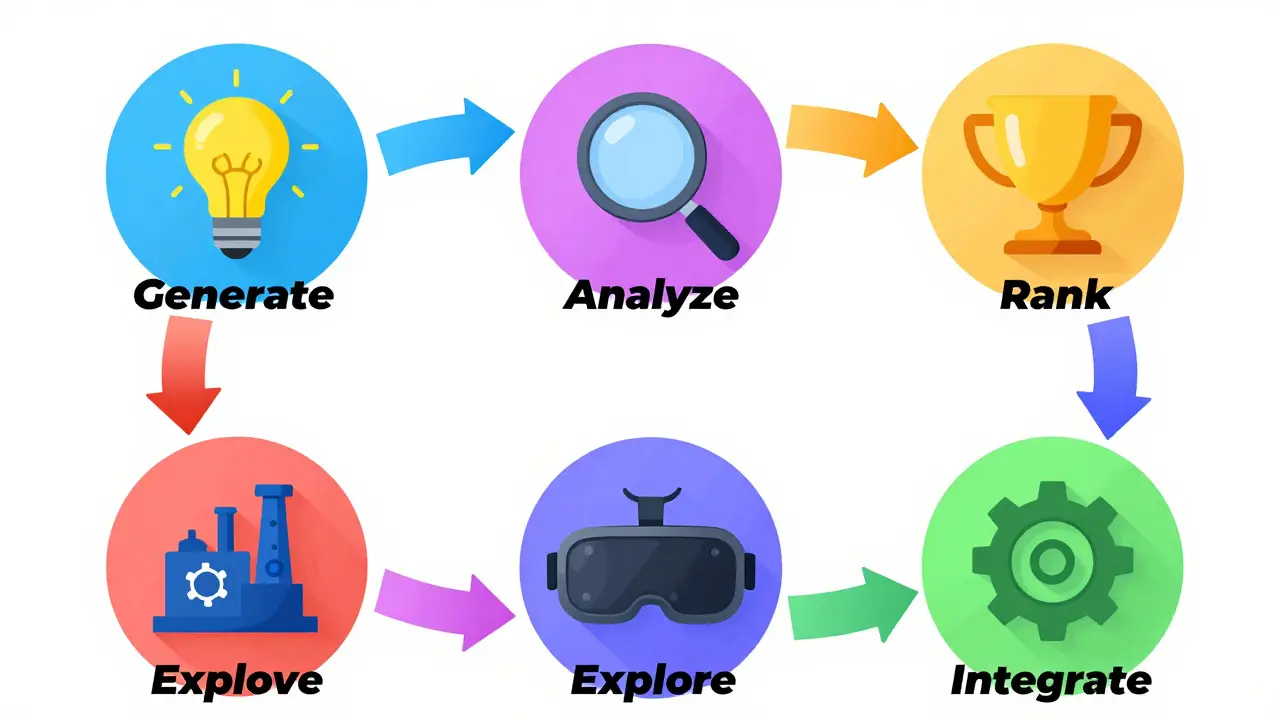
To understand why this technology works so well, we need to look at how it processes information. Researchers at NVIDIA documented a specific six-stage framework that powers these workflows. It moves far beyond simple image generation. It is a complete engineering pipeline.
- Generate: Instead of manually tweaking sliders for every parameter, you describe your goals in natural language. The AI creates initial design options based on constraints like weight limits or aesthetic preferences.
- Analyze: The system runs predictive models. It checks if the design will break under stress or overheat. Crucially, it uses surrogate models-lightweight AI versions of heavy simulations-to predict performance without waiting hours for full computational fluid dynamics (CFD) results.
- Rank: Not all generated designs are equal. The AI scores them against your criteria, such as maximizing strength while minimizing material cost.
- Evolve: You give feedback. "Make the handle thicker" or "Reduce the weight by 10%." The AI refines the top contenders instantly.
- Explore: You visualize the options in 3D or even augmented reality (AR) to see how they fit in real-world contexts.
- Integrate: The final chosen design is exported directly into traditional CAD software for manufacturing preparation.
This structure turns design from a linear path into a dynamic conversation. You are no longer drawing lines; you are guiding an intelligent partner.
From Sketches to Simulations in Minutes
The biggest bottleneck in traditional product development has always been simulation. Testing a car part for aerodynamics or a drone frame for structural integrity used to require supercomputers and days of processing time. Today, deep learning models act as proxies for these heavy calculations.
Consider the automotive industry. Engineers need to ensure that a new bumper design meets safety standards while being lightweight. In the past, running finite element analysis (FEA) on multiple variations was prohibitively slow. With multimodal AI, engineers input the load conditions and material properties. The AI evaluates thousands of geometric variations in real-time. If a design fails a virtual crash test, the system discards it immediately and suggests a stronger alternative. This reduces computation times from days to minutes.
A documented case study highlights this efficiency. A team used generative design to explore thirty different product idea categories. The AI produced over 2,500 concept images. From there, they refined those down to twelve finalized concepts and videos. Without AI, creating even one high-fidelity prototype would have taken a week. Here, they explored hundreds of directions in a fraction of the time.
Beyond Engineering: Fashion and Consumer Electronics
You might think this technology only applies to cars and planes. But consumer electronics and fashion are seeing massive shifts too. These industries rely heavily on aesthetics and user preference, which are hard to quantify but easy for multimodal AI to interpret.
In smartphone design, teams analyze user feedback, social media trends, and existing design sketches simultaneously. The AI identifies patterns-like a preference for curved edges or matte finishes-and generates prototypes that align with current market desires. This allows companies to launch products faster and adapt to changing tastes before competitors do.
Fashion brands are using similar techniques combined with virtual reality. They create digital clothing designs that customers can view and interact with in immersive environments. Shoppers can "try on" jackets or dresses without physical samples. This provides immediate visual feedback and collects precise data on customer preferences. It reduces waste significantly because fewer physical samples are needed during the design phase.
| Feature | Traditional Workflow | Multimodal AI Workflow |
|---|---|---|
| Ideation Speed | Days to weeks per concept | Minutes for hundreds of variants |
| Simulation Cost | High (requires specialized hardware/time) | Low (AI surrogate models predict outcomes) |
| User Feedback Integration | Manual interpretation of surveys/sketches | Real-time analysis of text, image, and sentiment data |
| Iteration Cycle | Linear and rigid | Circular and adaptive |
| Prototyping Phase | Heavy reliance on physical prototypes | Digital-first, minimal physical validation |
Tools That Make It Possible
You do not need to build your own AI models to benefit from this. Several platforms are already democratizing access to these capabilities. Tools like Neural Concept automate design and simulation, allowing teams to evaluate multiple variations quickly. For developers who want more control, low-code platforms like Bolt allow rapid prototyping of mobile AI experiences.
These tools often integrate with existing software ecosystems. If your team uses AutoCAD, SolidWorks, or Blender, modern AI plugins can feed generated geometry directly into these environments. This ensures that the creative exploration phase does not disconnect from the technical execution phase.
Moreover, AI assistants like ChatGPT support the broader process. They help generate interview scripts for user research, analyze competitor data, and even write code for custom design scripts. This holistic support means the designer spends less time on administrative tasks and more time on creative problem-solving.

Pitfalls and Human Oversight
Despite the hype, AI is not a magic wand. It has limitations that every designer must respect. The most critical issue is input quality. Garbage in, garbage out. If you define vague constraints, the AI will generate vague or unusable designs. You must clearly specify load conditions, material properties, and manufacturing limits.
Another major constraint is manufacturability. An AI might generate a beautiful, organic shape that looks great in 3D but cannot be molded, cast, or assembled with current factory equipment. Human engineers must validate every AI-generated suggestion. The AI explores the possibility space; humans filter for reality.
Data quality also matters. Surrogate models that predict simulation results are only as good as the data they were trained on. If the training data lacks edge cases, the AI might miss critical failure points. Always run final validations using traditional, high-fidelity simulations before committing to production.
The Future of Designer Roles
How does this change your job? It shifts you from a drafter to a curator. You are no longer spending hours moving vertices in a 3D model. You are defining problems, setting boundaries, and evaluating solutions. Your value lies in your judgment, not your manual skill.
This evolution enables mass customization. Because generating variations is cheap, you can offer personalized products without skyrocketing costs. Imagine ordering a pair of headphones where the ear cups are perfectly shaped to your head scan, generated and optimized by AI in seconds. This level of personalization was economically impossible ten years ago.
As natural language processing improves, the barrier to entry lowers further. Designers who are not coding experts will be able to command complex generative systems through conversation. This inclusivity will lead to more diverse perspectives in product development, driving innovation across industries.
What is multimodal generative AI in product design?
It is an AI system that processes multiple types of data-such as text prompts, images, audio, and engineering specifications-simultaneously to generate, analyze, and refine product designs. Unlike single-modal AI, it understands context from various sources, enabling more accurate and versatile prototyping.
How does AI reduce simulation time in engineering?
AI uses surrogate models, which are lightweight machine learning algorithms trained on historical simulation data. These models can predict the outcome of complex physics simulations (like CFD or FEA) in seconds, whereas traditional methods might take hours or days. This allows designers to test thousands of variations rapidly.
Can AI replace human designers?
No. AI acts as a powerful assistant that accelerates iteration and exploration. However, human designers are essential for defining goals, ensuring manufacturability, validating ethical considerations, and making final aesthetic judgments. The role shifts from manual creation to strategic curation and oversight.
What industries benefit most from this technology?
Industries with high complexity and strict performance requirements benefit most, including automotive, aerospace, and consumer electronics. Additionally, sectors driven by aesthetics and trend responsiveness, such as fashion and furniture design, leverage AI for rapid visualization and customer feedback integration.
Do I need coding skills to use multimodal AI for design?
Not necessarily. Many modern platforms offer no-code or low-code interfaces where you can input parameters via natural language or graphical menus. However, understanding basic principles of design constraints and materials helps you get better results. Advanced customization may still require some scripting knowledge.
Is AI-generated design ready for manufacturing?
Yes, but with caveats. AI can generate geometry that fits within manufacturing constraints if properly guided. However, human engineers must verify that the design can actually be produced using available machinery and materials. Final validation with traditional CAD and physical prototyping is still recommended before mass production.