Red-Yellow-Green Deploy Gates for Vibe-Coded Changes
 Oct, 20 2026
You just prompted an AI to build a new feature. It spat out 200 lines of Python in ten seconds. You ran it locally, saw the happy path work, and hit deploy. But did you actually check if that code is safe? Or did you just trust the vibes?
This is the reality of vibe coding, a development style where natural language prompts drive code generation, bypassing traditional review processes. While this approach accelerates delivery, it creates a massive governance gap. Traditional CI/CD pipelines rely on static analysis and peer reviews to catch errors. Vibe coders often skip these steps entirely, leading to what security researchers call "dark development"-code that runs in production without visibility or testing.
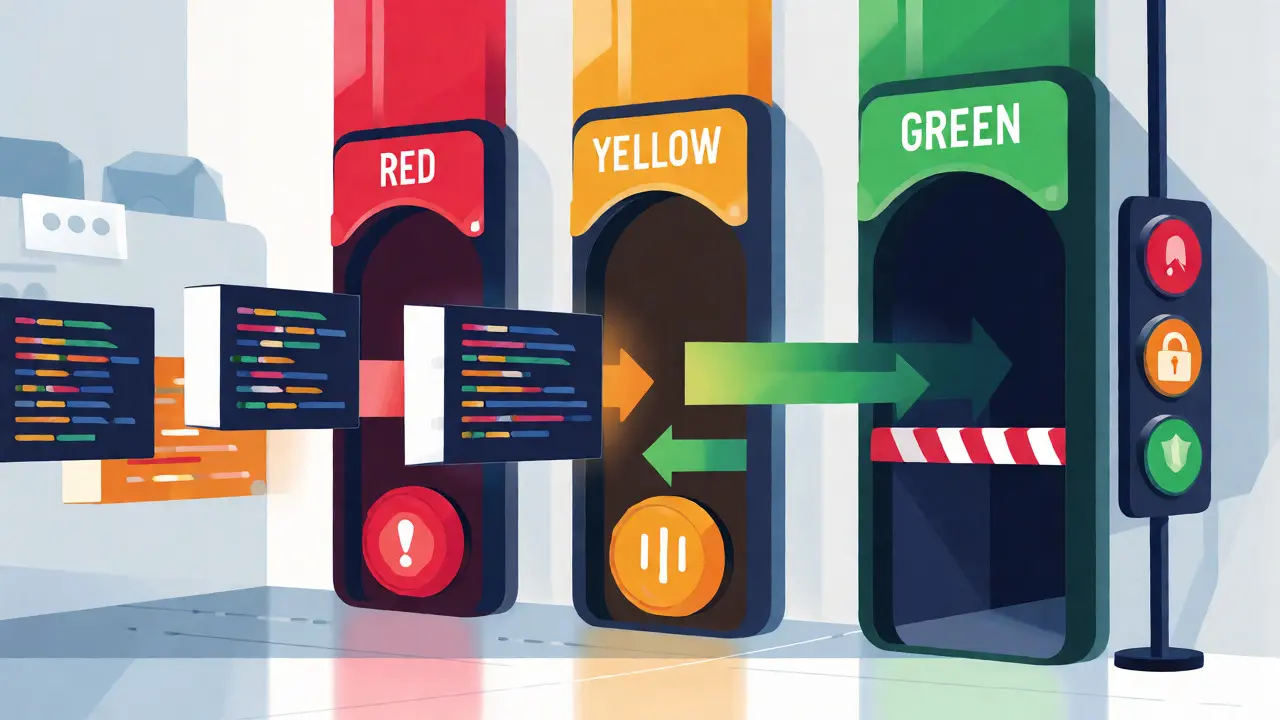
To fix this without killing speed, teams are adopting Red-Yellow-Green Deploy Gates. This isn't about bureaucracy; it's about triage. It’s a simple traffic-light system that tells you exactly when to stop, when to pause, and when to ship vibe-coded changes safely.
The Governance Gap in AI-Generated Code
Traditional DevSecOps follows a strict pipeline: Plan, Code, Build, Test, Release, Deploy, Monitor. Each stage has a checkpoint. Static analysis checks your code. Penetration tests check your app. Change boards approve your release.
Vibe coders flip this script. They go from Idea → Prompt AI → Copy/Paste → Run → Deploy. There is no build step. No dependency scanning. No peer review. By the time IT notices the application exists, it’s already handling customer data.
| Stage | Traditional DevSecOps | Vibe Coding Default |
|---|---|---|
| Planning | Threat modeling & requirements | Natural language prompt |
| Coding | Static analysis (SAST) & linting | AI generation (no checks) |
| Testing | Unit, integration, pen tests | Manual happy-path run |
| Deployment | CI/CD pipeline with approvals | Direct push or manual upload |
| Visibility | Full audit trail | Invisible until failure |
The risk here isn't just bugs. It's technical debt and security holes. If an AI hallucinates a library version or hardcodes an API key, you might not find out until a breach occurs or the service crashes at 3 AM.
Defining the Red-Yellow-Green Gate System
A deploy gate is a decision point before code goes live. In a vibe-coding context, you can’t afford heavy manual reviews for every change. So, we automate the judgment using three statuses:
- Green (Go): The change passes automated safety checks. Deploy immediately.
- Yellow (Caution): The change triggers warnings. Deploy allowed, but requires monitoring or a quick human glance.
- Red (Stop): The change fails critical criteria. Deployment blocked until fixed.
This system shifts governance from "blocking everything" to "enabling safe speed." It respects the velocity of AI-assisted development while protecting production stability.
How to Implement Automated Checks for Vibe Code
You don't need a complex enterprise toolchain. You need lightweight scripts that run against the generated code before deployment. Here is how to map common vibe-coding risks to gate colors.
Green Light Criteria
Code gets a Green light if it meets these baseline standards. These checks should be fast (under 60 seconds) so they don’t slow down the developer.
- Dependency Hygiene: All imported libraries exist in the package manager and have known, stable versions. No random GitHub links.
- No Hardcoded Secrets: A regex scan finds zero instances of strings like "api_key," "password," or long alphanumeric tokens in the source files.
- Basic Syntax Validity: The code compiles or parses without syntax errors.
- Test Coverage: At least one basic unit test exists and passes. For vibe coding, even a simple assertion that the function returns a non-null value is better than nothing.
Yellow Light Criteria
Yellow lights indicate potential issues that aren't catastrophic but need attention. Developers can deploy, but they must acknowledge the warning.
- Unverified Dependencies: The code uses a library that hasn't been scanned recently or has open vulnerabilities rated "Medium."
- Complex Logic: Cyclomatic complexity exceeds a threshold (e.g., >15). AI often generates nested loops that are hard to debug later.
- Missing Error Handling: Functions lack try/catch blocks or error returns for external calls (APIs, databases).
- Large Diff Size: The change touches more than 50 lines of core logic. Large AI-generated diffs are harder to reason about mentally.
Red Light Criteria
Red lights are hard stops. These represent immediate threats to security or stability.
- Hardcoded Credentials: Any detected secret pattern fails the build.
- Critical Vulnerabilities: Dependency scanners flag CVEs with CVSS scores above 7.0.
- Deprecated APIs: The code uses methods marked as deprecated in the current framework version.
- No Tests: Zero test files associated with the changed module.
- License Conflicts: Imported libraries use licenses incompatible with your company’s policy (e.g., GPL in a proprietary SaaS product).
Building the Pipeline: From Prompt to Production
Implementing these gates doesn't require replacing your entire stack. Most modern platforms support pre-deployment hooks. Here’s a practical workflow for a team using tools like Cursor, Copilot, or Replit Agent.
- Prompt & Generate: The developer asks the AI to create a feature. The AI outputs code files.
- Local Lint & Scan: Before pushing, the developer runs a local command (e.g., `npm run security-check`). This script executes the Red/Yellow/Green logic.
- If Red: The script exits with error code 1. Git commit is rejected.
- If Yellow: The script prints warnings. Commit proceeds, but adds a label to the PR.
- If Green: Silent success. Commit proceeds.
- CI Enforcement: On push, the CI pipeline re-runs the checks. This prevents developers from bypassing local checks.
- Deploy Decision:
- Green deploys automatically to staging/production.
- Yellow deploys to staging but pauses production release until a lead engineer approves.
- Red fails the pipeline. The developer must refactor the prompt or manually edit the code.
Pro Tip: Make the feedback loop instant. If the linter takes five minutes, vibe coders will ignore it. Aim for sub-minute feedback.
Writing Policies That AI Can Understand
Traditional security policies are written for humans reading PDFs. Vibe coders interact with AI assistants. Your governance needs to speak their language.
Guidepoint Security suggests publishing policies in plain text files that AI tools can access, such as `.coderules`, `README.md`, or project-specific wikis. Use prescriptive language, not vague principles.
Bad Policy: "Ensure secure handling of sensitive data."
Good Policy: "Never hardcode API keys. Always load secrets from environment variables named `SECRET_*`. Use `os.getenv()` in Python."
When your AI assistant sees this rule in the context window, it is more likely to generate compliant code. This shifts governance left-from catching errors after deployment to preventing them during generation.
Managing Technical Debt in Vibe-Coded Apps
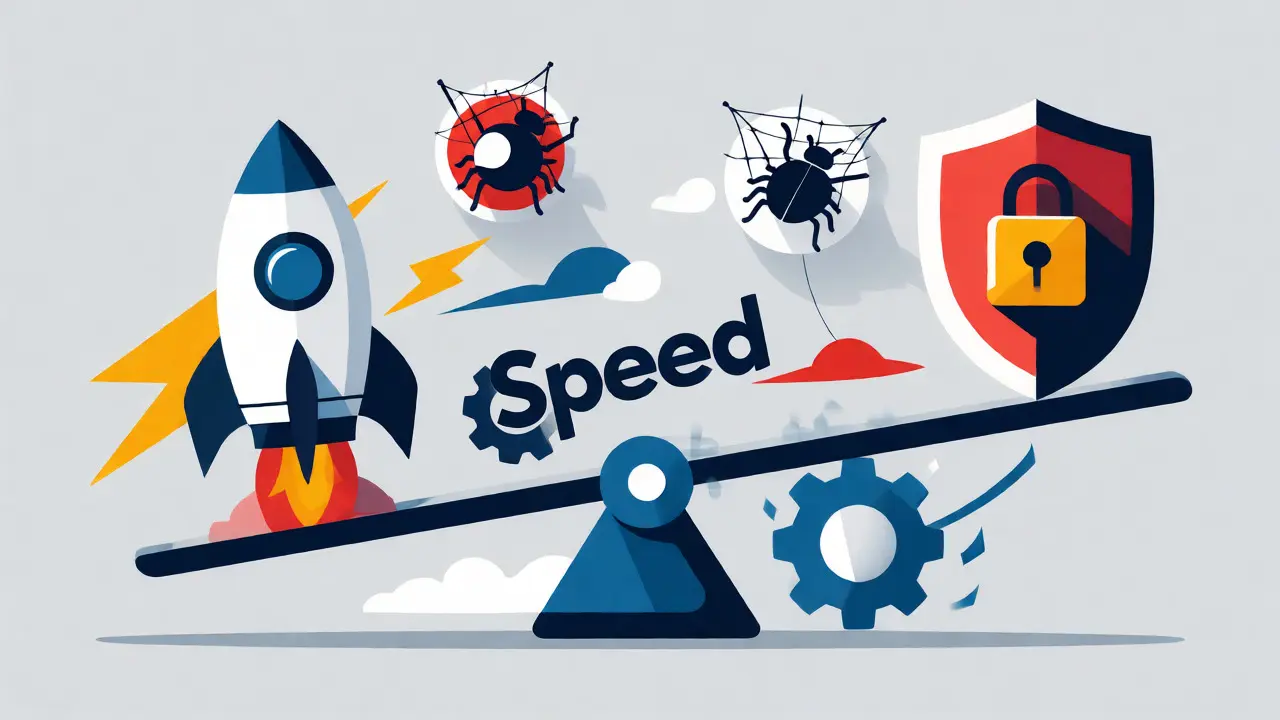
Baytech Consulting notes that vibe coding increases technical debt because AI prioritizes working code over clean code. Without refactoring, your codebase becomes a pile of disjointed snippets.
Use Yellow Gates to trigger debt collection. Every time a change hits Yellow due to "High Complexity" or "Missing Tests," log it in a backlog. Schedule weekly "cleanup sprints" where developers refactor these flagged modules. This keeps the codebase maintainable without stopping feature development.
Common Pitfalls to Avoid
Teams implementing this system often make three mistakes:
- Too Many Reds: If 80% of changes fail the gate, developers will disable the checks. Tune thresholds to allow reasonable friction, not paralysis.
- Ignoring False Positives: If the scanner flags every string variable as a "secret," people lose trust. Whitelist known patterns quickly.
- Lack of Feedback: Don't just say "Failed." Tell the developer *why*. "Failed: Hardcoded AWS Key found in line 42" is actionable. "Security Check Failed" is not.
Key Takeaways
- Speed vs. Safety: Vibe coding breaks traditional review models. Red-Yellow-Green gates restore balance by automating risk assessment.
- Automation is Key: Manual reviews kill vibe coding velocity. Use lightweight scripts for secret scanning, dependency checks, and complexity analysis.
- Policy as Code: Write rules that AI assistants can read. Prescriptive guidelines in repo files improve code quality at the source.
- Triage, Don't Block: Use Yellow status for conditional deployments to keep momentum while managing risk.
What is vibe coding?
Vibe coding is a development approach where programmers use natural language prompts to generate code via AI tools, often bypassing traditional manual coding and deep inspection. Coined by Andrej Karpathy, it emphasizes rapid iteration and trusting the AI's output for functional prototypes and features.
Why do vibe-coded changes need deploy gates?
Vibe coding often skips standard QA steps like static analysis, peer review, and dependency scanning. Deploy gates act as automated safety nets, catching security flaws, hardcoded secrets, and unstable dependencies before they reach production, reducing the risk of "dark development" incidents.
How does the Red-Yellow-Green system work?
It is a traffic-light status system. Green means all automated checks passed, allowing immediate deployment. Yellow indicates warnings (like high complexity or medium vulnerabilities) requiring caution or approval. Red signifies critical failures (like hardcoded secrets or critical CVEs), blocking deployment until resolved.
Can AI tools enforce these gates automatically?
Yes. Modern IDEs and CI/CD platforms support pre-commit hooks and pipeline scripts. You can configure tools like ESLint, SonarQube, or custom Python scripts to run against AI-generated code and assign a Red, Yellow, or Green status based on predefined criteria.
Does vibe coding increase technical debt?
Yes, significantly. AI tends to prioritize functionality over maintainability, often resulting in duplicated code, poor structure, and missing documentation. Implementing Yellow gates for complexity and test coverage helps identify areas needing refactoring, preventing uncontrolled debt accumulation.