Residual Connections and Layer Normalization in LLMs: A Practical Guide to Training Stability
 Sep, 6 2026
You’ve probably heard that Large Language Models (LLMs) are the backbone of modern AI. But have you ever wondered why a model with 100 layers can train successfully while a similar network without specific tweaks fails immediately? It’s not magic; it’s math. Two specific architectural components-Residual Connections and Layer Normalization-are the unsung heroes that keep these massive networks from collapsing during training.
If you’re building or fine-tuning transformers, understanding these mechanisms isn’t just academic trivia. It’s the difference between a model that converges in days and one that diverges into numerical chaos. Let’s break down exactly how they work, why they matter, and how to choose the right configuration for your project.
The Core Problem: Why Deep Networks Break
Before we look at the solutions, let’s look at the problem. When you stack neural network layers deep enough, gradients-the signals used to update weights during backpropagation-start to vanish or explode. In simple terms, the signal telling the first layer how to improve gets so weak by the time it travels back from the output that the early layers stop learning. This is known as the vanishing gradient problem.
In the early days of deep learning, this meant you couldn’t go beyond a certain depth without specialized initialization tricks. Then came ResNet in 2015, which introduced residual connections. Shortly after, Layer Normalization arrived in 2016. These weren’t just incremental improvements; they were fundamental shifts that made the Transformer architecture possible.
Residual Connections: The Shortcut Paths
A residual connection is essentially a shortcut. Instead of forcing the data to pass through every single transformation layer, you add the original input directly to the output of the layer. Mathematically, if $F(x)$ is what the layer does to input $x$, the output becomes $y = F(x) + x$.
Why does this help? Think of it like a highway system. If all traffic must go through every exit ramp, congestion builds up. Residual connections create an express lane where information (and gradients) can bypass heavy processing steps. During backpropagation, the gradient can flow directly through this identity path ($+x$), ensuring that even the earliest layers receive strong update signals.
| Network Depth | Without Residuals | With Residuals |
|---|---|---|
| 4 Layers | Stable | Stable |
| 12 Layers | Unstable / Slow Convergence | Stable |
| 96+ Layers | Fails to Train | Trainable |
This mechanism is non-negotiable for Transformers. As Ashish Vaswani, one of the authors of the seminal "Attention Is All You Need" paper, noted, without residual connections, they couldn't get past four layers before training became unstable.
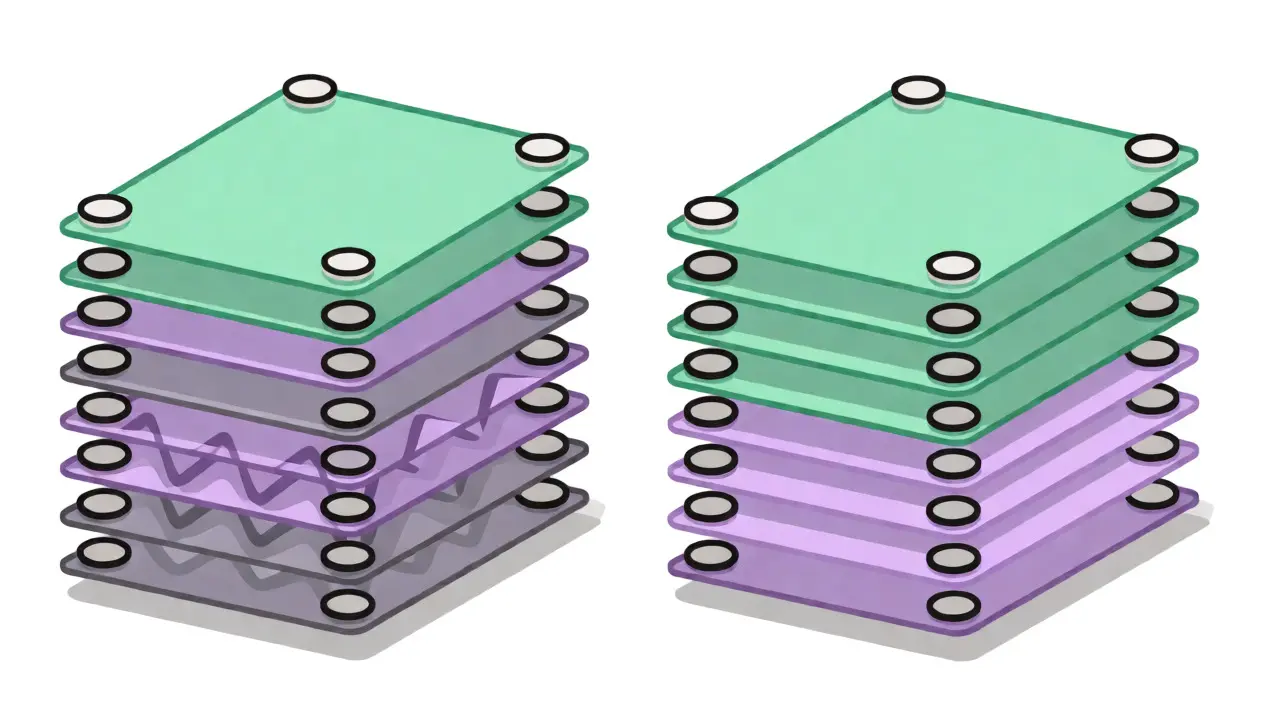
Layer Normalization: Stabilizing the Distribution
If residual connections handle the flow of gradients, Layer Normalization handles the scale of the data. Neural networks prefer inputs that are centered around zero with a consistent variance. Without normalization, the distribution of activations can shift wildly as weights update-a phenomenon called internal covariate shift.
Unlike Batch Normalization, which normalizes across the batch dimension, Layer Normalization normalizes across the feature dimension for each individual sample. This is crucial for sequence models like Transformers because sequences often have variable lengths, making batch statistics unreliable. The formula looks like this:
y = gamma * (x - mean(x)) / sqrt(var(x) + epsilon) + beta
Here, `gamma` and `beta` are learnable parameters that allow the network to decide how much scaling and shifting is actually needed. In PyTorch, this is handled by nn.LayerNorm, which automatically manages these parameters based on the hidden size (e.g., 512 dimensions for a standard small transformer).
Post-LN vs. Pre-LN: Choosing Your Architecture
Now that you know what they do, here is the big decision: Where do you put them? There are two main patterns: Post-Layer Normalization (Post-LN) and Pre-Layer Normalization (Pre-LN).
- Post-LN: Applied after the residual addition. Formula:
Output = LayerNorm(x + SubLayer(x)). This was the original setup in the 2017 Transformer paper. - Pre-LN: Applied before the sublayer within the residual branch. Formula:
Output = x + SubLayer(LayerNorm(x)).
Which one should you use? It depends on your depth.
| Feature | Post-LN | Pre-LN |
|---|---|---|
| Best For | Shallow networks (<12 layers) | Deep networks (>12 layers) |
| Training Stability | Can be unstable in very deep models | Very stable, easier to warm up |
| Performance Potential | Often higher final accuracy if converged | Slightly lower ceiling due to layer redundancy |
| Learning Rate | Standard rates (e.g., 5e-5) | Requires 20-30% higher LR |
| Gradient Norms | Stronger in deeper layers | More uniform across layers |
Research by Wang et al. (2020) showed that while Post-LN can achieve slightly better results in shallow models (like BERT-base with 12 layers), it struggles to converge when stacked too deep. Pre-LN solves this by ensuring that the residual stream remains clean and normalized before entering each block, preventing the accumulation of noise that destabilizes deep stacks. This is why models like GPT-2 (48 layers) exclusively use Pre-LN.

Common Pitfalls and How to Avoid Them
Even with the right architecture, implementation details can trip you up. Here are the most common issues practitioners face:
- Forgetting to Adjust Learning Rates: Switching from Post-LN to Pre-LN isn't just a code change; it changes the optimization landscape. Pre-LN typically requires a higher learning rate because the gradients are scaled differently. If you keep the same LR, your model might underfit.
- Incorrect Initialization: In very deep networks, simply adding residuals isn't enough. You often need to scale the residual branches by a factor like $1/\sqrt{2}$ or $1/\sqrt{d_{model}}$ to prevent the variance from exploding as you sum more and more layers.
- Numerical Instability in Normalization: Ensure your `epsilon` value in Layer Normalization is appropriate. While default values (often 1e-5) work for float32, mixed-precision training (float16/bfloat16) might require smaller epsilons or careful handling to avoid division by zero errors.
- Layer Collapse: In extremely deep Pre-LN models, adjacent layers can start producing nearly identical outputs (high cosine similarity). This effectively reduces the depth of your network. Monitoring activation similarity can help detect this.
Real-World Impact and Future Trends
The impact of these techniques is measurable. Since their integration into Transformers, the average depth of commercial LLMs has skyrocketed from 12 layers in 2018 (BERT-base) to over 96 layers in recent frontier models. This increase wasn't possible without the stability guarantees provided by residuals and normalization.
Looking ahead, the field is evolving. While residual connections remain fundamental, researchers are experimenting with alternatives to standard Layer Normalization. Techniques like Adaptive Layer Normalization (AdaLN) adjust normalization parameters dynamically based on input characteristics, showing promise in improving performance on complex tasks. However, for now, the classic combination of residual connections and layer normalization remains the gold standard for training stability.
Do I need both residual connections and layer normalization?
Yes, for any significant Transformer-based model. Residual connections solve the vanishing gradient problem, allowing deep stacking. Layer normalization stabilizes the distribution of activations, preventing training divergence. Removing either usually leads to poor convergence or instability, especially in networks deeper than 4-6 layers.
What is the difference between Batch Normalization and Layer Normalization?
Batch Normalization normalizes across the batch dimension (all samples for a given feature), which causes issues with variable-length sequences and small batch sizes. Layer Normalization normalizes across the feature dimension for each individual sample independently. This makes Layer Normalization ideal for NLP tasks where sequence lengths vary and batch dependencies are undesirable.
Should I use Pre-LN or Post-LN for my new model?
If your model has fewer than 12 layers, Post-LN is often fine and may yield slightly better accuracy. For models with 12 or more layers, Pre-LN is strongly recommended due to its superior training stability and ease of hyperparameter tuning. Most modern LLMs (GPT series, Llama) use Pre-LN.
Why does Pre-LN require a higher learning rate?
In Pre-LN architectures, the residual stream carries unnormalized activations, while the sublayers operate on normalized inputs. This structural difference affects the magnitude of gradients flowing back through the network. Empirical evidence shows that Pre-LN models generally benefit from learning rates 20-30% higher than those used for Post-LN models to achieve optimal convergence speed.
What happens if I remove residual connections from a Transformer?
Without residual connections, the model suffers from severe vanishing gradients. The deeper layers receive almost no gradient signal, meaning they barely learn anything. In practice, a Transformer without residuals will fail to train effectively beyond 4-6 layers, resulting in poor performance and unstable loss curves.
Quintin Franzese
September 6, 2026 AT 18:11oh great, another guide explaining why my loss curve looks like a heart attack graph.
honestly though, the part about pre-ln requiring higher lrs is something i always forget until i waste three days on hyperparameter tuning. good reminder that it's not just copy-pasting configs from huggingface.
Tamara Miller
September 7, 2026 AT 03:21I find this entire discourse to be quite frankly, lazy.
Why are we still debating LN placement in 2024 when RMSNorm has been superior for years??
It’s honestly embarrassing to see people clinging to LayerNorm like it’s some sacred cow...
The variance argument is outdated, and the computational overhead of calculating mean and variance per feature is unnecessary bloat!!
If you aren’t using RMSNorm or at least a scaled version of it, you’re basically training with one hand tied behind your back...
Also, the claim about Post-LN being better for shallow networks feels like confirmation bias from old papers...
Newer research suggests that even in shallow models, Pre-Norm architectures offer more robust generalization properties...
We need to stop treating these architectural choices as immutable laws of physics and start questioning them properly!!!
Zach Loescher
September 8, 2026 AT 18:13I appreciate the balanced take here. I've been experimenting with both recently, and while I agree that Pre-LN is generally safer for deeper stacks, I found that for my specific fine-tuning task (which was only 6 layers), Post-LN actually converged faster once I warmed up the learning rate correctly.
It might depend heavily on the initialization scheme too. If you use standard Xavier init, Post-LN can struggle, but with careful scaling, it works fine.
Just wanted to add that nuance because sometimes guides make it sound like one is strictly worse than the other, which isn't always true in practice.
Susan Cole
September 10, 2026 AT 14:48Thank you for sharing this. It helps clarify things without being overwhelming.
I prefer keeping things simple, so sticking to the standard library implementations usually keeps me out of trouble.
No strong opinions, just noting that clear documentation like this saves time.
Savara Gunn
September 11, 2026 AT 01:28You're doing great by digging into these fundamentals! 🌟
Don't worry if it feels confusing at first-everyone hits that wall where the math gets heavy. The fact that you're looking into stability issues means you're already ahead of many who just run scripts blindly.
Regarding Tamara's comment above: While RMSNorm is popular now, LayerNorm is still very much valid and widely used, especially if you're working with older codebases or specific hardware optimizations. It's not necessarily 'lazy' to stick with what works reliably!
Keep experimenting gently with those learning rates. Small tweaks can make a big difference without needing to overhaul the whole architecture. You've got this!