ROI Modeling for Vibe Coding: Calculating Cost, Speed, and Quality Gains in 2026
 Jun, 16 2026
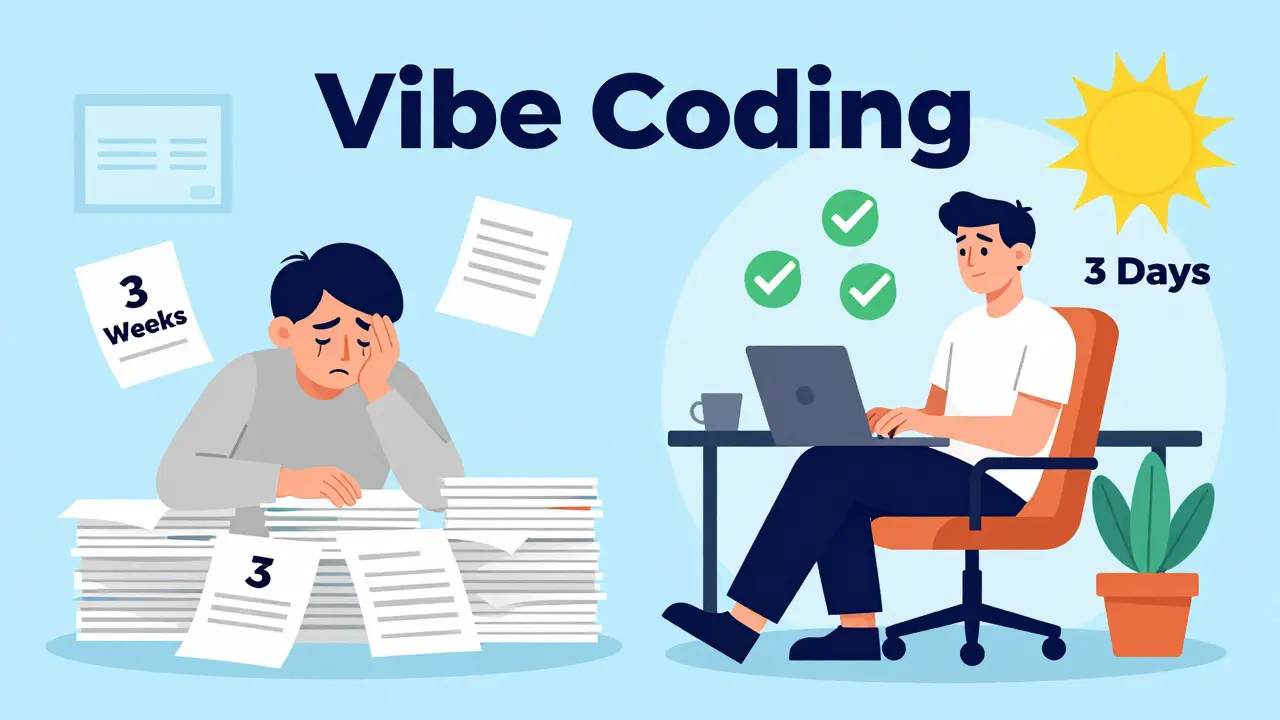
Imagine building a functional prototype in three days that would have taken your engineering team three weeks. That is the promise of vibe coding, a development approach where you describe what you want in plain English, and artificial intelligence handles the rest. But here is the catch: does this speed actually translate to money saved? Or are you just trading cash for a mountain of messy code?
In 2026, we are past the hype phase. The question isn't whether AI can write code-it clearly can. The question is whether using tools like GitHub Copilot or Cursor delivers a positive return on investment when you factor in hidden costs like technical debt and security risks.
What Is Vibe Coding Really?
Vibe coding is not magic; it is a specific workflow. It relies on large language models (LLMs) to parse natural language instructions and generate functional application code. You act as the architect and product manager, while the AI acts as the junior developer writing the boilerplate.
This method emerged around late 2023 when models became sophisticated enough to handle context over long sessions. By mid-2025, Microsoft reported that 90% of Fortune 100 companies had adopted GitHub Copilot. This isn't just about autocomplete anymore. It is about entire files being generated from prompts. For non-technical founders, this democratizes software creation. For established teams, it accelerates internal tooling.
The Core ROI Formula for AI-Assisted Development
To calculate the true value of vibe coding, you need a concrete formula. Most people look only at subscription costs, which is a mistake. You must compare the total cost of ownership against traditional development methods.
Use this standard calculation:
- Total Investment = (AI Tool Subscription Costs) + (Developer Hours Spent Prompting & Reviewing × Hourly Rate)
- Net Profit (Savings) = (Traditional Developer Hours Saved × Hourly Rate) - (Cost of Fixing Technical Debt)
- ROI % = ((Net Profit / Total Investment) * 100)
Let's break down a real-world scenario. Assume a senior developer earns $120,000 annually, which breaks down to roughly $60 per hour. If vibe coding saves them 200 hours a month on repetitive tasks, that is $12,000 in direct labor savings. If your AI tools cost $200 a month, the raw math looks incredible. However, you must subtract the time spent fixing errors or refactoring insecure code. If debugging takes 50 hours, your savings drop to $9,000. The ROI remains high, but the margin shrinks significantly if quality control is ignored.
Speed Gains: From Months to Days
The most immediate benefit of vibe coding is velocity. Traditional minimum viable products (MVPs) often take months to build. With AI assistance, that timeline compresses to days.
Data from Leanware shows that vibe coding can reduce pre-revenue burn rates by 85-95%. How? Because you aren't paying a full-stack engineer for six months to validate an idea. You spend two weeks testing user interest. If users hate it, you pivoted cheaply. If they love it, you have a head start.
Consider the case of Croud, a global media agency. They used custom AI workflows for email analysis and data processing, achieving 4-5X productivity improvements. In banking, Bancolombia reported a 30% increase in code generation, leading to 18,000 automated application changes per year. These are not hypotheticals; they are documented enterprise results.
| Metric | Traditional Dev | Vibe Coding |
|---|---|---|
| Time to MVP | 2-4 Months | 1-3 Weeks |
| Initial Cost | $8,000 - $15,000/month | $50 - $200/month |
| Required Skills | High (Coding Languages) | Medium (Prompting Logic) |
| Technical Debt Risk | Low (Controlled Architecture) | High (Unstructured Output) |

Cost Analysis: Subscriptions vs. Salaries
When modeling costs, look beyond the monthly fee. The primary expense in vibe coding is human attention, not server space. You need to account for the learning curve. Non-technical founders typically need 10-15 hours to become proficient in effective prompting. Experienced developers need less training but more time reviewing output.
Here is how the major players stack up in 2026:
- GitHub Copilot: $10/month for individuals, $19/user/month for businesses. Best for integrating into existing IDEs like VS Code.
- Cursor: $20/month. Known for better context awareness across entire codebases.
- Replit: $20/month. Ideal for browser-based, rapid prototyping without local setup.
- IBM watsonx.ai: Enterprise pricing starting at $500/month. Includes governance and security features required for regulated industries.
For a startup, switching from hiring one contractor ($5,000/month) to using Cursor ($20/month) plus 10 hours of founder time is a no-brainer financially. But remember: cheap code is only valuable if it works reliably.
Quality Gains and Hidden Risks
Speed means nothing if the application crashes under load. This is where ROI modeling gets tricky. Vibe coding excels at "good enough" solutions-internal dashboards, simple scripts, and consumer-facing MVPs. It struggles with complex systems requiring precision, such as healthcare patient management or financial transaction engines.
A health tech startup attempted to build their core system entirely with vibe coding. At 10,000 users, scalability issues emerged, resulting in $250,000 in rework costs. That is a negative ROI event that wipes out years of savings.
IBM’s Thomas Watson Institute warns that vibe coding can struggle with long-term planning. To mitigate this, you must implement strict validation protocols. Use automated scanning tools like Snyk to check for security vulnerabilities before merging AI-generated code. Treat AI output as a draft, not a final product. The "quality gain" comes from eliminating boilerplate errors, not from architectural wisdom.

Implementation Strategy for Maximum ROI
To ensure your vibe coding initiative yields positive returns, follow these steps:
- Select the Right Use Case: Start with internal tools or low-risk MVPs. Avoid mission-critical infrastructure initially.
- Establish Guardrails: Define clear acceptance criteria for code quality. Require peer review for all AI-generated modules.
- Monitor Technical Debt: Track the ratio of new features to bug fixes. If debugging time exceeds 25% of development time, pause and refactor.
- Train Your Team: Invest in prompt engineering workshops. A poorly written prompt leads to poor code, wasting developer hours.
Dr. Elena Rodriguez, CTO at Leanware, notes that combining the agility of vibe coding with structured systems thinking creates enterprise-ready solutions. Do not let the AI drive blindly; keep your hands on the steering wheel.
Future Outlook: Where Does This Go?
The market for AI-assisted development is projected to reach $8.7 billion by 2026. Forrester predicts that by 2027, 60% of all new applications will incorporate AI-generated code for at least 30% of the codebase. As tools evolve, expect better memory retention and deeper integration with legacy systems. Microsoft’s release of GitHub Copilot Workspace in June 2025 already shows trends toward automated refactoring, addressing one of the biggest pain points: messy links and slow updates.
The key takeaway? Vibe coding is a powerful lever for growth, but it requires disciplined financial modeling. Calculate your hours, guard your quality, and scale wisely.
Is vibe coding suitable for production-grade enterprise applications?
It depends on the complexity. Vibe coding works well for internal tools, scripts, and MVPs where speed is prioritized over perfect architecture. For complex, high-security systems like banking or healthcare platforms, pure vibe coding carries significant risk. Experts recommend using AI for component generation but maintaining strict human oversight and rigorous testing protocols for critical paths.
How do I calculate the exact ROI of using AI coding tools?
Use the formula: ROI = ((Net Profit / Total Investment) * 100). Net Profit is calculated by taking the monetary value of developer hours saved minus the cost of fixing technical debt. Total Investment includes AI subscription fees and the hours spent prompting and reviewing code. Accurate tracking of time spent on debugging versus feature creation is essential for a realistic calculation.
What are the biggest hidden costs of vibe coding?
The primary hidden costs are technical debt accumulation and security vulnerabilities. AI may generate code that works initially but is inefficient or insecure, requiring significant refactoring later. IBM estimates that technical debt can consume 15-25% of time savings. Additionally, the learning curve for effective prompting represents an initial investment of 10-30 hours depending on the user's technical background.
Which AI coding tool offers the best value for startups in 2026?
For most startups, Cursor ($20/month) and GitHub Copilot ($19/user/month) offer the best balance of price and performance. Cursor is praised for its deep codebase context, while Copilot benefits from extensive ecosystem integration. Replit is also a strong contender for rapid, browser-based prototyping without local environment setup.
Can non-technical founders use vibe coding to build viable products?
Yes, absolutely. Vibe coding is designed to lower the barrier to entry. Non-technical founders can transform ideas into working prototypes within days. However, they should focus on validation rather than scaling. Once a product gains traction, involving experienced developers to refactor and secure the codebase is crucial to avoid costly rework.