Safety-Aware Decoding: How LLM Guardrails Work at Inference Time
 Oct, 6 2026
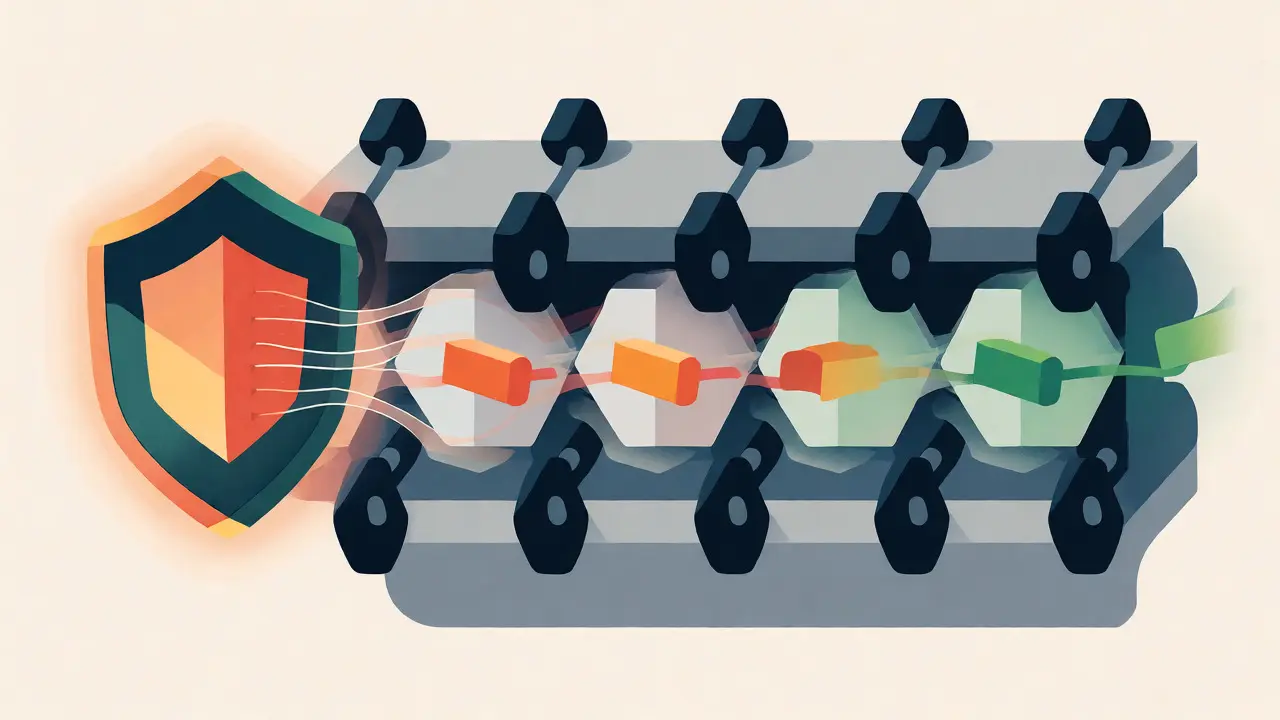
You send a prompt to a large language model. It generates a response that looks perfect until you realize it just leaked private data or agreed to build a bomb. Retraining the model to fix this takes weeks and burns through your compute budget. But what if you could stop the bad output before it even finishes generating? That is the core promise of safety-aware decoding. Instead of changing the model's brain during training, these techniques act as real-time traffic cops, inspecting and steering token generation at inference time to ensure outputs remain helpful yet harmless.
Why Training-Time Alignment Isn't Enough
Most people know about RLHF (Reinforcement Learning from Human Feedback), where models are fine-tuned to prefer safe answers. It works, but it’s rigid. If a new type of jailbreak attack emerges next week, you can’t just patch the weights without a full retraining cycle. This is where inference-time guardrails shine. They operate outside the model’s fixed parameters. Think of them as a layer of logic that sits between the model’s raw probabilities and the final text. By intervening in the autoregressive generation pathway-specifically the logits, hidden activations, or candidate token pools-you can enforce safety policies instantly. You don’t need to touch the model’s core architecture. This modularity allows teams to update safety rules in minutes, not months.
The shift toward inference-time solutions isn't just theoretical. Between February 2024 and April 2026, we saw a surge in specific methods like SafeDecoding, Speculative Safety-Aware Decoding (SSD), and ShieldHead. These aren't minor tweaks; they represent a fundamental change in how we view model security. We are moving from static alignment to dynamic, context-aware moderation.
How SafeDecoding Steers the Conversation
SafeDecoding, introduced in early 2024, tackles one of the sneakiest problems in AI: the "jailbreak." When a user tries to trick an LLM into ignoring its rules, the model often gets confused. Harmful tokens might have high probability, but safety disclaimer tokens (like "I cannot" or "Warning") also appear in the top candidates. SafeDecoding exploits this. It scans the sorted list of token probabilities at each step. If it sees safety-related tokens competing with harmful ones, it artificially boosts the probability of the safe options while dampening the risky continuations.
This method doesn't require new training data. It simply changes how the model picks the next word. Imagine a multiple-choice test where the correct answer is slightly less likely than a trap answer. SafeDecoding acts like a tutor who nudges you toward the right choice by making it visually brighter on the page. The result? A significant drop in jailbreak success rates. The model refuses the unsafe request more consistently, not because it was retrained to hate the topic, but because the decoding process actively favored the refusal tokens present in its own vocabulary.
Speculative Safety-Aware Decoding (SSD): Speed Meets Security
Critics of safety guardrails often complain about latency. Checking every token slows things down. Speculative Safety-Aware Decoding (SSD) solves this by using a small, highly efficient "safety model" to guide a larger, more capable target model. The small model guesses several tokens ahead. The big model checks them. If the small model predicts a safe sequence, the big model accepts it quickly. If the match ratio-the agreement between the two models-is low, SSD falls back to conservative decoding.
This approach turns a potential bottleneck into a speed boost. Because speculative decoding generally accelerates inference, adding safety constraints here means you get better security without the typical performance hit. In fact, some implementations report faster overall throughput compared to naive sampling. It’s a clever trade-off: use a cheap model for the heavy lifting of safety checks, and reserve the expensive model for complex reasoning only when necessary.

Embedded Guardrails: ShieldHead and Decoder-Level Architecture
Sometimes, external validators are too slow or disconnected from the model’s internal state. Enter ShieldHead. This technique adds an auxiliary classification head directly to the last-layer hidden states of the transformer. As the model generates text, this extra head simultaneously evaluates the risk of the current prefix. It’s a joint generator-moderator system.
Because the classifier shares the same computational graph as the main model, there’s no network call overhead. The moderation happens in nanoseconds, integrated into the forward pass. If ShieldHead detects a harmful trajectory mid-sentence, it can flag or suppress the sequence immediately. This token-wise granularity is powerful. It catches issues that post-hoc filters miss, such as subtle shifts in tone or intent that accumulate over a long paragraph. Similarly, decoder-level safety architectures design the entire decoding loop to include a safety assessment step, ensuring that correction happens before the token is finalized.
Multi-Objective Alignment with DeAL
Safety isn't binary. Sometimes you want strict compliance; other times, you want creative freedom. DeAL (Decoding-time Alignment for LLMs) frames safety as one objective among many, including helpfulness, style, and politeness. It treats decoding as a constrained optimization problem. You can dial up the safety weight for a medical chatbot and dial it down for a creative writing assistant, all using the same base model.
This flexibility eliminates the need for repeated RLHF cycles. Need a stricter policy for a new regulatory requirement? Adjust the decoding parameters. No retraining. DeAL demonstrates that alignment can be modular. Different applications can attach different safety constraints to the same underlying engine, drastically reducing operational costs and deployment time.
Latency and Performance Trade-offs
Let’s talk numbers. How much does this actually slow down your app? According to recent industry benchmarks from frameworks like Guardrails AI, a single guard typically runs in under 10 milliseconds. Configured validators add around 100 milliseconds of latency. For most interactive applications, this is negligible compared to the hundreds of milliseconds or seconds it takes to generate a full response. The biggest delays usually come from calling external APIs, not the local guardrail logic itself.
| Method | Mechanism | Latency Impact | Best Use Case |
|---|---|---|---|
| SafeDecoding | Token probability reweighting | Low (<10ms) | Defending against known jailbreak patterns |
| SSD | Speculative sampling with safety model | Negative (Speeds up) | High-throughput production environments |
| ShieldHead | Auxiliary classifier head | Very Low (Integrated) | Real-time streaming moderation |
| DeAL | Multi-objective optimization | Moderate (Configurable) | Dynamic policy adjustment |
The Arms Race: Contextual Representation Ablation (CRA)
No defense is perfect. Just as we developed guardrails, attackers found ways to bypass them. In April 2026, researchers proposed Contextual Representation Ablation (CRA). This technique identifies low-rank subspaces in the model’s hidden states that mediate refusal behaviors. By suppressing these activation patterns during decoding, CRA can effectively silence the model’s guardrails, allowing harmful content to flow through unimpeded.
CRA outperforms many baseline jailbreak attacks, proving that shallow token-level reweighting isn't enough. Future safety mechanisms must be robust to representation-level attacks. This highlights the importance of combining methods-using both token-level steering and deep architectural interventions-to stay ahead of adversarial strategies.
Implementation Guide for Engineers
Ready to implement this? Here’s a practical roadmap:
- Select Your Base Model: Ensure you have access to logits and hidden states. Most open-source transformers support this.
- Choose a Method: Start with SafeDecoding for simplicity. Move to SSD if you need speed. Use ShieldHead if you have custom training capabilities.
- Integrate Middleware: Wrap your API with a guardrail framework like Guardrails AI or a custom SDK. This handles input validation and output filtering.
- Monitor Latency: Track P95 latency. Aim to keep guardrail overhead below 10% of total response time.
- Test Against Adversaries: Run your setup against CRA-style attacks. Adjust weights if refusals become too frequent (over-refusal).
Skills required include familiarity with transformer internals, Python, and ML engineering. You don’t need to be a research scientist, but understanding how logits work is crucial. Teams with existing custom decoding loops can integrate these features in days.
Frequently Asked Questions
Does safety-aware decoding require retraining the model?
No. The primary advantage is that it operates at inference time. Methods like SafeDecoding and SSD modify how tokens are selected from the existing probability distribution, leaving the model weights untouched. Only techniques like ShieldHead might require fine-tuning an additional head, but the core model remains unchanged.
What is the typical latency impact of inference-time guardrails?
According to industry benchmarks, simple guards add less than 10ms, while complex validators add around 100ms. This is often negligible compared to the total generation time of an LLM. SSD can even reduce latency by accelerating the decoding process through speculative sampling.
Can inference-time guardrails prevent all jailbreaks?
Not all. Techniques like Contextual Representation Ablation (CRA) can bypass standard token-level defenses by manipulating hidden states. A layered approach combining token reweighting, architectural heads, and external validation offers the best protection against sophisticated attacks.
What is the difference between SafeDecoding and RLHF?
RLHF modifies the model's weights during training to align it with human preferences. SafeDecoding modifies the output selection process at runtime. RLHF is static and expensive to update; SafeDecoding is dynamic and can be adjusted instantly via configuration.
Is ShieldHead compatible with any LLM?
It requires access to the model's last-layer hidden states. Most modern transformer-based LLMs expose these. However, implementing ShieldHead may require modifying the model architecture to add the auxiliary classification head, which involves some engineering effort compared to purely external methods.