Sales Enablement with Generative AI: Proposal Drafting, CRM Notes, and Personalization
 Aug, 26 2026
Imagine your sales team spending three hours a day writing proposals and updating CRM records. Now imagine that time dropping to fifteen minutes. That is the promise of Generative AI in sales enablement. It is not just about chatting with a bot; it is about automating the heavy lifting of documentation and tailoring every interaction to the specific buyer. For many B2B companies, this shift is moving from experimental to essential. If you are looking to streamline your sales process, understanding how these tools handle proposal drafting, CRM notes, and personalization is the first step.
Key Takeaways
- Proposal drafting speeds up document creation by 60-75%, turning hours of work into minutes.
- CRM notes generated by AI capture up to 95% of conversation details, far exceeding human accuracy rates.
- Personalization powered by AI increases conversion rates by 20-30% by matching content to buyer profiles.
- Successful implementation requires clean data and a dedicated change management strategy.
- The technology reduces administrative overhead, allowing reps to focus on relationship building.
How Generative AI Transforms Proposal Drafting
Creating a compelling sales proposal used to be a manual grind. Sales reps would copy-paste templates, tweak a few bullet points, and hope for the best. This approach was slow and often resulted in generic documents that failed to resonate with the prospect. Today, AI-powered proposal generation changes this dynamic entirely. Tools like Highspot’s AutoDocs can create customized sales documents in 2-5 minutes, compared to the 2-4 hours required manually. The system analyzes past interactions, deal stages, and product catalogs to draft a bespoke deck or one-pager.
This isn’t just about speed; it’s about relevance. When an AI tool drafts a proposal, it pulls from a knowledge base of successful past deals. If a prospect is in the healthcare sector and has previously expressed concern about compliance, the AI highlights relevant case studies and compliance features automatically. This ensures that every document feels hand-crafted, even though it was generated in seconds. For sales teams managing multiple complex deals, this capability frees up significant mental bandwidth for actual selling rather than formatting slides.
Automating CRM Notes for Better Data Hygiene
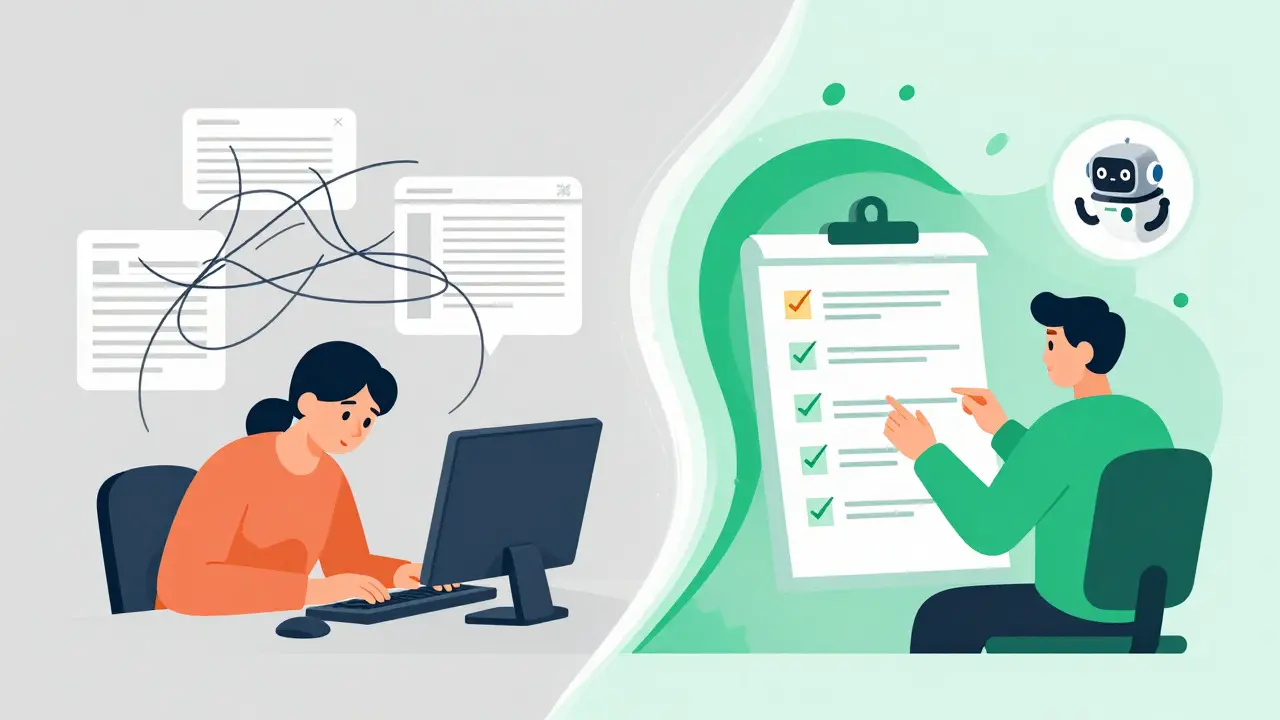
If you have ever asked a sales rep why their CRM entries are sparse, the answer is usually simple: they are too busy selling. Manual note-taking is tedious and often skipped after long calls. This leads to incomplete data, which in turn hurts forecasting and account planning. AI-generated CRM notes solve this problem by listening to conversations and summarizing key points in real-time. According to Gartner, these systems capture 95% of conversation details, whereas human note-taking typically hits only 60-70% accuracy.
The impact on productivity is substantial. AI note-taking systems reduce CRM update time by 75%. Instead of spending 30 minutes post-call typing out what was discussed, a rep spends about 8 minutes reviewing and approving the AI’s summary. This quick review ensures that critical details-like budget constraints, decision-maker names, and next steps-are logged accurately. Clean CRM data is the fuel for better analytics and more accurate AI recommendations down the line. Without it, the entire enablement stack struggles to perform at its peak.
The Power of Hyper-Personalization
Generic marketing materials rarely win big enterprise deals. Buyers today expect content that speaks directly to their pain points. Hyper-personalization uses generative AI to tailor emails, presentations, and follow-ups based on individual buyer profiles. By analyzing engagement history, industry verticals, and deal stages, the AI suggests or creates content that matches the prospect’s current needs. This level of customization increases conversion rates by 20-30%, according to Seismic’s research.
Consider a scenario where a rep is following up with a CIO who recently read a whitepaper on cloud security. A traditional system might send a standard newsletter. An AI-enabled system, however, drafts a personalized email referencing that specific whitepaper and linking it to a new feature release relevant to security. This small touch makes the interaction feel thoughtful and attentive. Over time, these micro-interactions build trust and keep the brand top-of-mind without requiring the rep to manually craft each message from scratch.
Implementation Challenges and Best Practices
While the benefits are clear, rolling out generative AI in sales is not plug-and-play. Implementation typically takes 8-12 weeks for enterprise deployments. One of the biggest hurdles is data quality. If your CRM data is messy or incomplete, the AI will generate inaccurate recommendations. Experts recommend having at least 70% clean CRM data before launching these tools. Organizations with established CRM hygiene see ROI in 4-6 weeks, while those needing data cleanup may wait 8-12 weeks.
Change management is equally critical. Sales reps are protective of their workflows. If they perceive AI as a threat or a distraction, adoption will stall. Successful implementations include dedicated change management resources, such as 1-2 full-time employees per 100 sales reps. Training should focus on prompt engineering and how to interpret AI outputs. Many companies use gamified training and champion programs, where top performers lead the way, to drive adoption. Remember, the goal is to empower reps, not replace them.
| Feature | Traditional Tools | Generative AI Solutions |
|---|---|---|
| Proposal Creation Time | 2-4 hours | 2-5 minutes |
| CRM Note Accuracy | 60-70% | 95% |
| Personalization Level | Static/Templated | Dynamic/Hyper-personalized |
| Implementation Cost | $50k-$200k | $100k-$500k |
| Setup Duration | 4-6 weeks | 8-12 weeks |

Market Trends and Future Outlook
The market for AI-powered sales enablement is growing rapidly. Projected to expand from $525 million in 2023 to $1.8 billion by 2026, this segment reflects a broader shift toward intelligent automation. Adoption is highest in technology (45%), financial services (38%), and healthcare (32%). By 2026, IDC forecasts that 80% of enterprise sales teams will deploy some form of generative AI. This trend is driven by the need for efficiency in increasingly competitive markets.
Looking ahead, we can expect deeper predictive capabilities. Gartner predicts that 70% of sales AI tools will include predictive deal risk scoring by 2025. This means AI won’t just help you write better emails; it will warn you if a deal is likely to slip. Multimodal content generation, combining text, image, and video personalization, is also on the horizon. As these technologies mature, the distinction between "enablement" and "execution" will blur, creating a seamless flow from insight to action.
Frequently Asked Questions
What is the main benefit of using generative AI for sales proposals?
The primary benefit is speed and relevance. AI reduces proposal creation time by 60-75%, allowing sales reps to deliver customized, high-quality documents in minutes rather than hours. This accelerates the sales cycle and improves the customer experience.
How accurate are AI-generated CRM notes compared to human input?
AI-generated CRM notes are significantly more accurate, capturing up to 95% of conversation details. In contrast, human note-taking typically achieves only 60-70% accuracy due to fatigue and multitasking during calls.
What is the typical cost of implementing generative AI sales tools?
Enterprise deployments typically range from $100,000 to $500,000, depending on the scale and complexity of the integration. This is higher than traditional sales enablement platforms, which usually cost between $50,000 and $200,000, but the ROI from increased productivity often justifies the investment.
Do sales reps need special training to use these tools?
Yes, basic training is required. Most reps need 2-3 weeks to become comfortable with the tools. Training should cover prompt engineering, how to review AI outputs, and how to integrate the tools into daily workflows. Change management support is crucial for high adoption rates.
Can generative AI handle industry-specific jargon accurately?
Accuracy varies. For general business language, accuracy is over 95%. However, for highly specialized industry jargon, accuracy drops to 85-90%. To mitigate this, organizations should train the model on company-specific terminology and implement a human-in-the-loop review process for the first few months.