Scaling Laws in NLP: How Bigger Data and Models Created Modern LLMs
 Jul, 12 2026
Imagine trying to build a skyscraper without knowing how much steel or concrete you need. You’d just guess, pour some materials, and hope it stands. For years, that’s exactly how researchers built artificial intelligence models. They threw more data and computing power at the problem, hoping for better results, but they had no clear map of what would happen next. Then came scaling laws. These mathematical rules changed everything. They turned AI development from a guessing game into a predictable engineering discipline.
If you’ve wondered why modern Large Language Models (LLMs) like GPT-4 or Claude are so capable, the answer isn’t just "more code." It’s math. Scaling laws proved that if you increase the size of a model, the amount of data it sees, and the computing power used to train it, its performance improves in a very specific, predictable way. This article breaks down how these laws work, why they matter, and how they shaped the AI we use today.
The Core Formula: Loss, Compute, and Size
To understand scaling laws, you first need to understand what they measure. In natural language processing, the primary metric for success is often cross-entropy loss. Simply put, loss measures how wrong the model is. A lower loss means the model is better at predicting the next word in a sentence. The big question was: how do we get that loss number down?
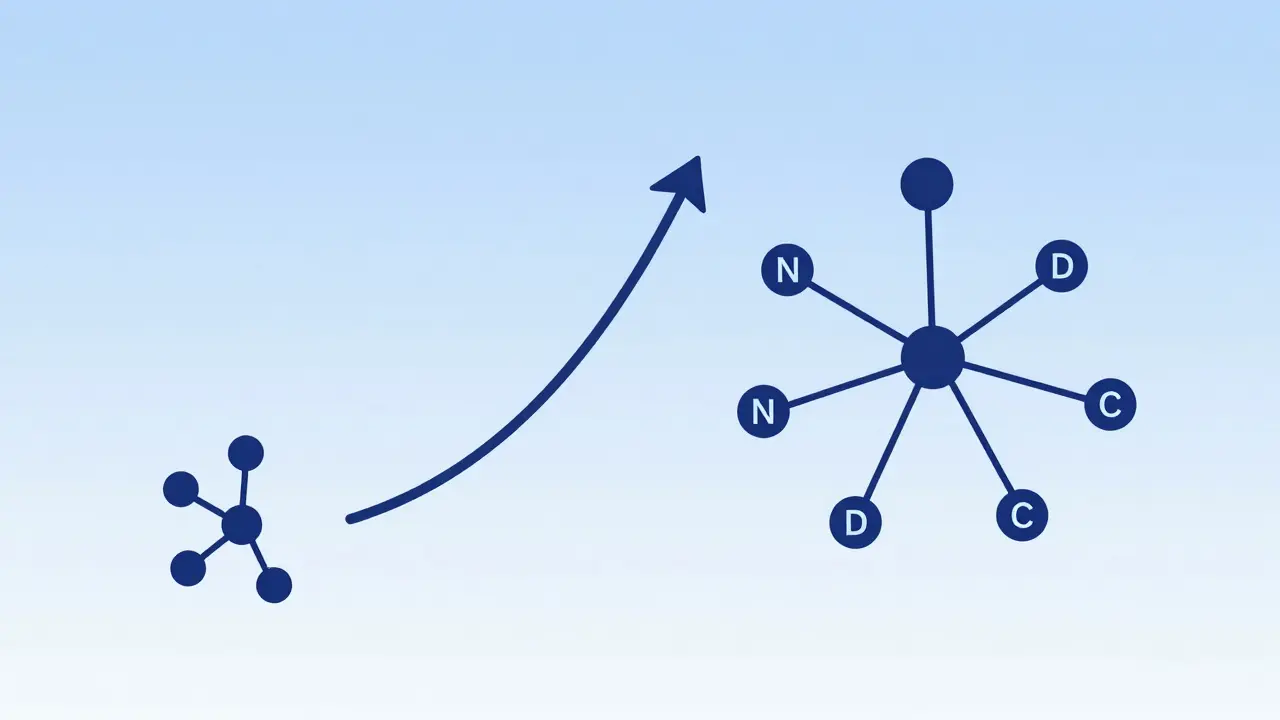
In 2020, researchers published a landmark paper titled "Scaling Laws for Neural Language Models." They discovered a simple relationship. The loss of a model scales as a power law with three key variables:
- Model Size (N): The number of parameters in the neural network. Think of this as the brain’s capacity to store knowledge.
- Dataset Size (D): The number of tokens (words or pieces of words) the model reads during training.
- Compute (C): The total amount of computational effort, usually measured in floating-point operations (FLOPs), used to train the model.
The breakthrough finding was that architectural details-like whether the network was wider or deeper-mattered far less than people thought. What mattered most was simply making things bigger. If you doubled the compute, you could predict exactly how much the loss would drop. This allowed researchers to train small models, fit a curve to their performance, and then accurately predict how a massive model would perform without spending millions of dollars on a failed experiment.
The Chinchilla Revolution: Quality Over Quantity?
For a while, the industry followed a trend: build huge models and train them on relatively small datasets. The assumption was that a smarter brain needed less study time. But in 2022, DeepMind released a model called Chinchilla, which flipped this script entirely.
The Chinchilla scaling law showed that previous models were inefficient. They were too big for the amount of data they were fed. Hoffmann and his colleagues found that to minimize loss for a given compute budget, you should scale the model size and the dataset size equally. Specifically, both the number of parameters (N) and the number of training tokens (D) should grow proportionally to the square root of the compute budget (C^0.5).
| Strategy | Model Size Growth | Data Growth | Efficiency Outcome |
|---|---|---|---|
| Pre-Chinchilla (Traditional) | Rapidly increasing | Slowly increasing | Diminishing returns; wasted compute on over-parameterized models |
| Chinchilla Optimal | Proportional to √Compute | Proportional to √Compute | Minimal loss per dollar spent; balanced resource allocation |
This meant that instead of building one giant model trained on a week’s worth of text, companies should build slightly smaller models trained on months’ worth of high-quality text. The impact was immediate. OpenAI, Anthropic, and others adjusted their strategies. We saw a shift toward models that were not just larger, but better-fed. This explains why recent models feel more coherent-they’ve seen more of the internet, not just because they’re bigger brains, but because they studied longer.

Predicting the Future Without Breaking the Bank
Why are scaling laws so valuable? Because training an LLM is incredibly expensive. A single training run for a state-of-the-art model can cost tens of millions of dollars and take weeks. You can’t afford to guess wrong.
Scaling laws act as a crystal ball. Researchers use a technique called extrapolation. Here’s how it works:
- Train a series of small models with varying sizes and data amounts.
- Measure their loss on a validation set.
- Fit a power-law curve to this data.
- Extrapolate the curve to predict the loss of a model 1,000 times larger.
This method successfully predicted the performance of GPT-4 before it was even fully trained. By using 1,000 to 10,000 times less compute for initial experiments, teams could make confident decisions about billion-dollar investments. It transformed AI research from trial-and-error into a precise science. If the curve says a 100x increase in compute yields a 10x increase in model capability, you know your money is well spent.
The Diminishing Returns Reality Check
There is a myth that AI progress is exponential-that every doubling of compute leads to a doubling of intelligence. Scaling laws tell us this is false. The relationship follows an exponential decay pattern. As models get larger, each additional unit of compute yields smaller and smaller improvements in loss.
Think of it like cleaning a room. The first hour gets rid of most of the clutter. The second hour makes it tidy. The third hour involves dusting baseboards. You’re still getting cleaner, but it takes progressively more effort to achieve the same level of improvement. This is crucial for understanding why AI progress feels fast now but may slow down unless we find new efficiencies. We cannot rely solely on brute force forever.

Beyond Pretraining: The New Frontier of Scaling
As of 2026, the story of scaling laws is evolving. The traditional focus was on pretraining-feeding raw text to a model to teach it language basics. But new research suggests that scaling doesn’t stop there.
In 2024 and 2025, models like OpenAI’s o1 demonstrated the power of inference-time scaling. Instead of just making the pretraining bigger, these models spend significant compute during the actual reasoning process. They think step-by-step, using reinforcement learning to refine their answers. This is a different kind of scaling. It’s not about seeing more data upfront; it’s about thinking harder in the moment.
This shift challenges the old assumption that pretraining is the only bottleneck. Now, engineers are exploring how to allocate compute budgets between pretraining, post-training alignment, and inference-time reasoning. The result is models that don’t just recite facts but solve complex problems by breaking them down logically. This represents a maturation of the field, moving from sheer memorization to genuine reasoning capabilities.
Data Quality: The Missing Variable?
Recent studies have begun questioning whether traditional scaling laws account for everything. A 2025 paper submitted to the Association for Computational Linguistics argued that data quality plays a larger role than previously admitted. Scaling laws assume that all tokens are equal, but in reality, reading a textbook is more valuable than reading spam comments.
If you double the amount of low-quality data, the model might not improve much. But if you curate high-quality data, the same model size achieves lower loss. This suggests that future scaling laws will need to include a "quality" parameter. As the web becomes saturated with AI-generated content, the ability to filter and select high-signal data will become just as important as having massive GPUs. The era of "more data is always better" is ending; the era of "better data is essential" has begun.
What are scaling laws in AI?
Scaling laws are empirical formulas that describe how the performance of a neural network improves as you increase its size, the amount of training data, and the computing power used. They allow researchers to predict model performance before training large systems.
What is the Chinchilla scaling law?
The Chinchilla scaling law states that for optimal efficiency, the size of the model and the amount of training data should scale equally with the available compute budget. Specifically, both should grow proportionally to the square root of the compute.
Do scaling laws apply to all types of AI models?
Scaling laws have been most rigorously proven for autoregressive language models (LLMs). However, similar power-law relationships have been observed in computer vision and other deep learning domains, suggesting they are fundamental properties of neural networks.
Why did the industry shift towards larger datasets after Chinchilla?
Before Chinchilla, models were often too large for the data they were trained on, leading to inefficiency. The Chinchilla findings showed that balancing model size with data volume yields better performance per dollar spent, prompting companies to invest in higher-quality, larger datasets.
How does inference-time scaling differ from pretraining scaling?
Pretraining scaling involves feeding more data to a model during its initial learning phase. Inference-time scaling involves using more compute during the actual generation of responses, allowing the model to reason step-by-step and verify its own outputs before answering.