Scaling Up Large Language Models: From Millions to Hundreds of Billions of Parameters
 Jul, 15 2026
Training a modern large language model costs millions of dollars. You do not want to spend that money on a guess. That is why scaling laws matter so much right now. They are the mathematical maps that tell researchers how big a model needs to be, how much data it needs, and how much compute it will consume before they even start the expensive training run.
We have moved past the era where simply throwing more parameters at a problem guaranteed better results. The industry has shifted from brute-force size increases to sophisticated multi-phase training strategies. Understanding this shift is critical for anyone involved in AI development today.
The Core Mechanics of Scaling Laws
At their simplest, scaling laws are predictive formulas. They allow you to train small, cheap models first and then predict the performance of a massive, expensive target model. This solves the economic bottleneck of LLM development. If you cannot afford to train a 70-billion-parameter model just to see if it works, you use a scaling law to estimate its potential based on smaller siblings.
The functional form of these laws relies on three primary components:
- Model Parameters: The number of adjustable weights in the neural network.
- Training Tokens: The volume of text data used during pretraining.
- Baseline Performance: The inherent capability floor of the specific model architecture family.
Together, these variables help researchers estimate the expected "loss" (error rate) of the final model. A lower predicted loss means better expected output quality. The goal is to allocate your computational budget-measured in FLOPs (floating-point operations)-as efficiently as possible.
What Recent MIT Research Revealed About Accuracy
Between 2024 and 2025, researchers Choshen, Andreas, and Zhang from MIT and the MIT-IBM Watson AI Lab conducted the most comprehensive analysis of scaling laws to date. Their work provides the current gold standard for understanding prediction reliability.
They analyzed data from
Metric
Value
Distinct Model Families
40 (including Pythia, OPT, LLaMA, Bloom)
Unique Pre-trained Models
485
Performance Metrics Analyzed
1.9 million
Scaling Laws Fitted
Over 1,000
The accuracy of these predictions is measured using Absolute Relative Error (ARE). The MIT team found that an ARE of 4 percent represents approximately the best achievable accuracy due to random seed noise inherent in training processes. However, predictions with up to 20 percent ARE remain useful for practical resource allocation decisions.
This gives practitioners a realistic benchmark. You do not need perfect precision to make good business decisions about whether to scale up or optimize elsewhere.
How to Improve Prediction Reliability
Not all data points are created equal when building scaling laws. The MIT research highlighted several critical factors that determine whether your predictions will hold up in reality.
First, include intermediate training checkpoints. Relying solely on the final loss of a model ignores valuable trajectory data. By observing how a model improves over time, you get a clearer picture of its learning dynamics.
Second, discard very early training data. Data collected before a model has processed 10 billion tokens is substantially noisier. Including this early-stage noise reduces the overall accuracy of your scaling law. It is better to start your analysis once the model has stabilized somewhat.
Third, prioritize breadth over depth in your test runs. Instead of concentrating effort on training one or two very large models, train more models across a distributed range of sizes. Selecting five models of different sizes provides a solid empirical starting point for robust predictions.
Cost Optimization Strategies for Budget-Constrained Teams
You do not always need to train full-scale models to get accurate predictions. Several cost-saving strategies emerged from the research that maintain prediction quality while slashing computational expenses.
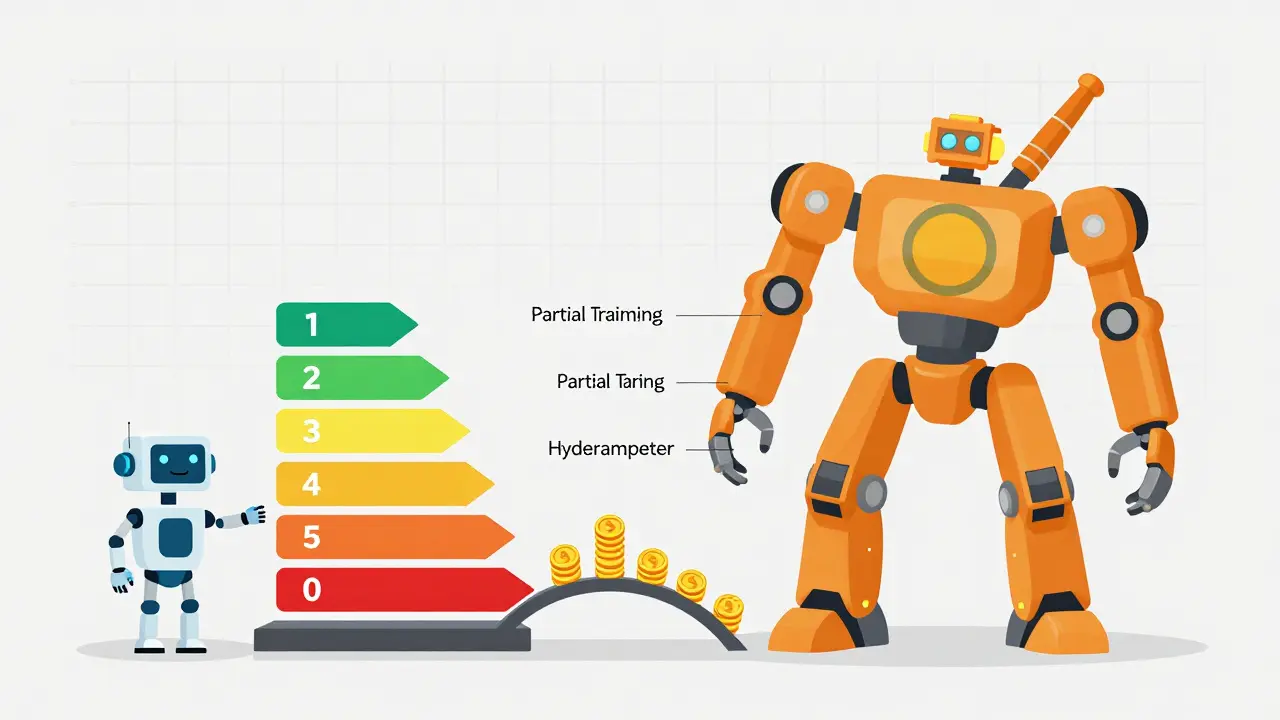
If you have a moderate budget, partially train your target model. Training a model to approximately 30 percent of its complete dataset and using that partial data for extrapolation can substantially reduce costs without sacrificing much accuracy.
If you are severely budget-constrained, consider borrowing scaling law parameters. Train a single smaller model within your target family and borrow hyperparameters from a different model family with a similar architecture. Note that this approach does not work reliably for encoder-decoder architectures, but it is viable for many decoder-only models.
An unexpected finding was the strong correlation between hyperparameters across different families. Just three of five key hyperparameters explained nearly all variation. This suggests greater uniformity across diverse model families than previously theorized, potentially simplifying development across different architectures.
The Shift Beyond Pure Parameter Scaling
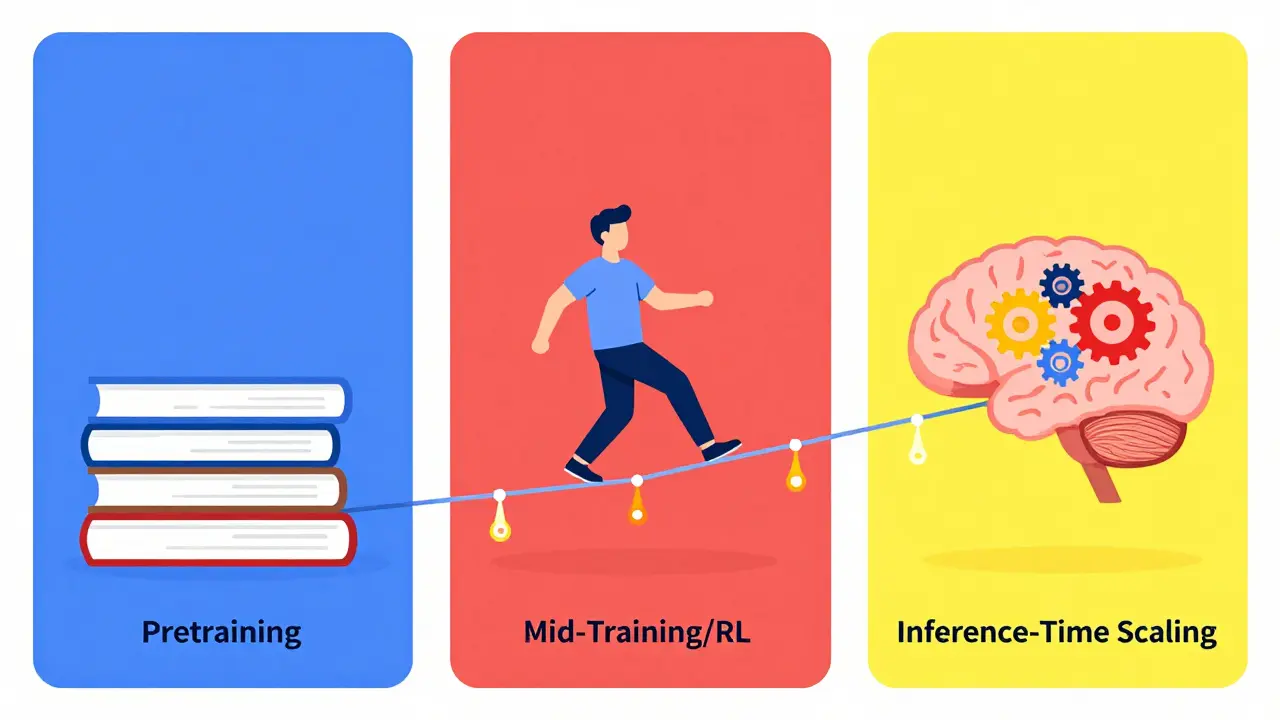
The landscape of LLM development changed significantly in 2025. The first-generation dividend of scaling primarily through ever-larger pretraining has clearly approached its endpoint. Pretraining still determines the upper capability bound, but it is increasingly insufficient for creating meaningful differentiation between competing models.
A second scaling curve has emerged as the true battleground: mid-training and reinforcement learning (RL). These methods convert additional compute into verifiable capability gains beyond what pretraining alone can provide. This represents the most important repositioning of the research paradigm recently.
New techniques like RLVR (Reinforcement Learning via Reward Models) and GRPO (Group Relative Policy Optimization) are becoming standard. Inference-time scaling is also gaining traction, allowing models to "think" longer during generation rather than just knowing more facts from training.
| Approach | Primary Focus | Current Status (2026) |
|---|---|---|
| Pure Pretraining Scaling | Increasing parameters and data volume | Diminishing returns; baseline requirement |
| Mid-Training / RL | Aligning outputs with complex rewards | Key differentiator for top-tier models |
| Inference-Time Scaling | Dynamic computation during generation | Emerging strategy for reasoning tasks |
Infrastructure Requirements for Massive Models
As we push toward hundreds of billions of parameters, infrastructure becomes a limiting factor. GPU and TPU clusters containing thousands of specialized processors are necessary. Distributed training approaches spread the model across multiple nodes to accelerate calculations and reduce memory requirements per individual processor.
Memory optimization technologies like ZeRO (Zero Redundancy Optimizer) and FlashAttention enable efficient processing of large contexts without degrading computational performance. Cloud platforms now offer automatic scaling capabilities to handle large numbers of simultaneous inference requests, making it easier for organizations to deploy these massive models without managing bare-metal hardware.
Frequently Asked Questions
What is the most accurate way to predict LLM performance?
The most accurate method involves fitting scaling laws using data from multiple intermediate checkpoints across a range of model sizes. Discarding early training data (before 10 billion tokens) and aiming for an Absolute Relative Error (ARE) below 20% provides reliable predictions for resource allocation.
Can I use scaling laws from one model family for another?
Yes, but with caution. For budget-constrained scenarios, you can borrow scaling law parameters from a different family with a similar architecture. However, this does not work reliably for encoder-decoder models and requires careful validation against your specific use case.
Is pretraining still the best way to improve LLMs?
Pretraining remains essential for establishing the upper capability bound, but its marginal gains are decreasing. The industry has shifted toward mid-training and reinforcement learning (RL) as the primary drivers of new capabilities and differentiation in 2025-2026.
How many models should I train to establish a reliable scaling law?
Researchers recommend training at least five models across a distributed range of sizes. This breadth provides more robust empirical data than training fewer, larger models, leading to more accurate predictions for your target architecture.
What role does inference-time scaling play in modern LLMs?
Inference-time scaling allows models to allocate more computational resources during the generation phase. This is particularly useful for complex reasoning tasks, enabling the model to "think" step-by-step rather than relying solely on static knowledge acquired during pretraining.